
AI visibility is quickly becoming one of the most important questions in SEO and digital marketing.
Not because traditional search has disappeared. It has not.
The shift is that buyers are no longer only typing a keyword into Google, opening a few tabs, and comparing websites on their own. They are asking ChatGPT, Google AI Overviews, Google AI Mode, Perplexity, Gemini, Claude, and other AI systems to summarize the market, explain their options, compare providers, and recommend what to do next.
That changes the visibility problem.
You may still rank on Google. You may still have a strong website. You may still publish content every month. But if your ideal buyer asks an AI system who to trust, what to compare, or which provider to choose, does your brand appear in the answer?
And if your brand does appear, is it described correctly?
That is what AI visibility measures.
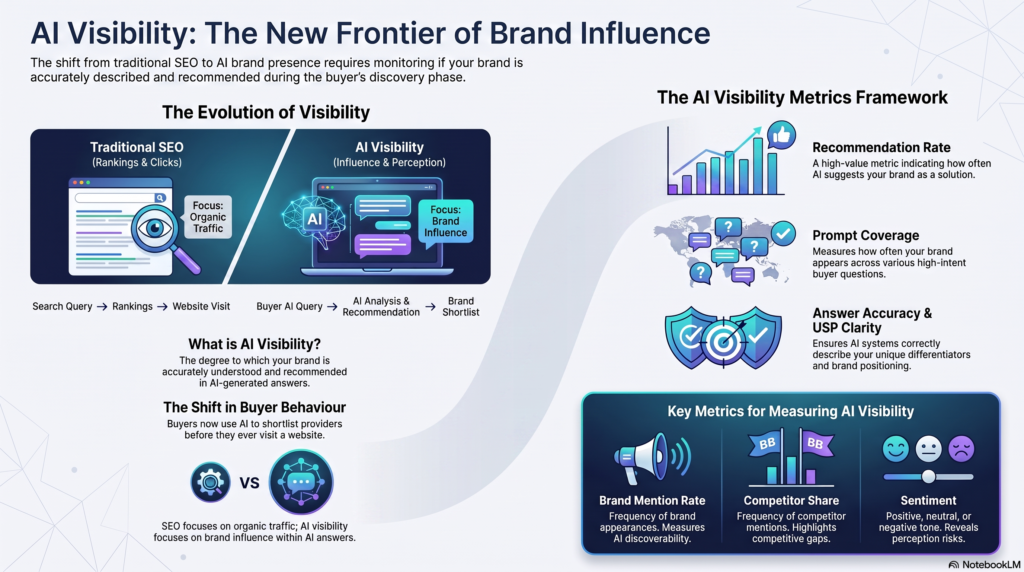
AI visibility is the degree to which your brand appears, is accurately understood, and is recommended in AI-generated answers when buyers ask about your category, competitors, services, problems, reviews, or buying decisions.
Table of Contents
What Is AI Visibility?
AI visibility means your brand shows up inside AI-generated answers when people ask questions related to your niche, service, product, competitors, or buying decision.
It is not only about being mentioned once.
Strong AI visibility means your brand appears in the right prompts, for the right buyer personas, with the right positioning. It means AI systems understand what your brand does, who you help, why you are different, and when you should be recommended.
For example, your brand may need to appear when someone asks:
- What is the best provider for this problem?
- Which company should I compare before choosing a solution?
- Who is trusted in this niche?
- What are the best alternatives to this competitor?
- Which service is best for my industry?
- Which agency can help with this specific outcome?
These are not random informational searches. Many of them happen during discovery, comparison, and decision-making.
Google explains that AI Overviews and AI Mode can help users explore questions, compare options, and find supporting links from the web. That means brand visibility is no longer limited to a traditional search results page. It can also depend on whether your website and wider source ecosystem help support AI-generated answers.
For B2B brands, SaaS companies, professional service firms, agencies, consultants, and high-consideration businesses, this matters because buyers often compare several options before speaking to a sales team.
If your brand is missing from those AI-generated comparisons, a competitor may shape the buyer’s shortlist before you ever get the chance.
Why Should You Track AI Brand Visibility?
You should track AI brand visibility because buyers may be forming an opinion about your company before they ever visit your website.
That is the big shift.
In traditional SEO, you could usually see the journey more clearly. A user searched, clicked, visited your page, and maybe converted later.
With AI search, part of the journey can happen before the click.
A buyer may ask:
- Who are the best companies for this service?
- Which provider is better for a company like ours?
- What are the pros and cons of each option?
- Which brands are most trusted?
- What should I avoid before choosing a provider?
If your competitors are appearing in those answers and your brand is not, your analytics dashboard may not show the full problem. You may simply see fewer branded searches, fewer qualified visits, or fewer sales conversations, without seeing the AI answer that influenced the buyer earlier.
Tracking AI visibility helps answer practical questions:
- Are we appearing when buyers ask about our category?
- Are competitors being recommended more often than us?
- Is our USP being explained correctly?
- Are we visible in comparison and alternative prompts?
- Are AI systems citing strong sources when they mention us?
- Are they repeating outdated or inaccurate information?
- Which prompts are we missing completely?
This is why AI visibility should not be treated as a one-time check. It should become part of ongoing search, content, digital PR, and brand measurement.
Google also announced Search Generative AI performance reports in Search Console in June 2026. These reports are designed to show impressions from generative AI features such as AI Overviews and AI Mode, which shows that AI visibility measurement is becoming more formal inside search reporting.
What Is an AI Visibility Score?
An AI visibility score is a practical way to measure how visible, accurate, and competitive your brand is across important AI-generated answers.
There is no single universal AI visibility score that every tool, platform, or agency uses. Different teams calculate it differently.
At Shoden Global, we look at AI visibility as a business measurement, not just a marketing vanity metric.
A weak AI visibility score asks one question:
- Did the brand appear?
A stronger AI visibility score asks better questions:
- Did the brand appear in prompts that matter?
- Was the brand recommended, or only mentioned?
- Was the description accurate?
- Did the answer include the brand’s USP?
- Were strong sources used?
- Did competitors appear more often?
- Was the tone positive, neutral, or negative?
- Did the answer match the buyer’s situation?
- Would the answer make someone more likely to trust the brand?
That difference matters.
A brand can be mentioned in AI answers and still have poor AI visibility. For example, if an AI tool describes your business as a general SEO provider, but your actual offer is AI visibility, buyer prompt research, comparison content, Reddit and Quora positioning, and LLM optimization, then the answer is incomplete.
Visibility is only useful when the positioning is accurate.
How Do Brands Measure Visibility in AI?
Brands measure visibility in AI by testing the prompts their buyers are likely to ask, checking whether the brand appears, reviewing how the answer describes the brand, and comparing that visibility against competitors.
A good AI visibility audit should feel less like a keyword ranking report and more like a buyer journey investigation.
Here is a practical process.
- Start with your buyer personas.
Before measuring anything, decide whose questions matter.
A founder may ask different prompts from a CMO. A head of SEO may ask different prompts from a procurement team. A technical buyer may care about implementation, while a commercial buyer may care about trust, proof, and risk.
The first step is to understand the people involved in the buying decision.
- Build a realistic prompt set.
Do not only test branded prompts. Those are useful, but they are not enough.
You also need to test prompts around:
- Problems
- Service categories
- Competitors
- Alternatives
- Best providers
- Industry use cases
- Pricing concerns
- Implementation questions
- Reviews and trust
- Final decision criteria
For example, instead of only asking “What is Shoden Global?”, you would also test prompts such as:
- Who can help a B2B brand improve AI visibility?
- What are the best agencies for AI search visibility?
- Which company helps brands appear in ChatGPT and Perplexity?
- Who offers comparison content for AI visibility?
- Which AI visibility service is best for a niche service business?
Those are the prompts that show whether your brand is part of the buyer’s decision set.
- Test across the AI platforms your buyers use.
Different AI systems can produce different answers. A brand may appear in Perplexity but not in ChatGPT. It may show up in Google AI Overviews but not in Gemini. It may appear for one comparison prompt but disappear from another.
That is why AI visibility should be measured across more than one AI search experience.
OpenAI describes ChatGPT search as a way to get timely answers with links to relevant web sources, which means visibility can depend partly on whether your content and source ecosystem support the answers being generated.
- Record whether your brand appears.
This sounds simple, but the details matter.
Track whether your brand appears, where it appears, whether it is cited, whether it is recommended, and whether the answer is accurate.
A passing mention is not the same as a meaningful recommendation.
- Compare against competitors.
AI visibility is competitive.
If your competitors appear again and again, and your brand does not, that tells you something. It may mean they have clearer service pages, stronger comparison content, better reviews, stronger third-party mentions, more topical authority, or better source coverage across the web.
- Turn the findings into action.
The goal of AI visibility measurement is not to create a dashboard that looks impressive.
The goal is to know what to fix.
You may need a clearer service page, better comparison content, more answer-ready FAQs, stronger brand mentions, more specific reviews, Reddit and Quora visibility, updated third-party profiles, better internal links, or stronger technical SEO.
That is where the measurement becomes useful.
Which AI Visibility Metrics Matter Most?
The most important AI visibility metrics are brand mention rate, recommendation rate, prompt coverage, answer accuracy, competitor share, sentiment, citation quality, and USP clarity.
Here is a simple framework.
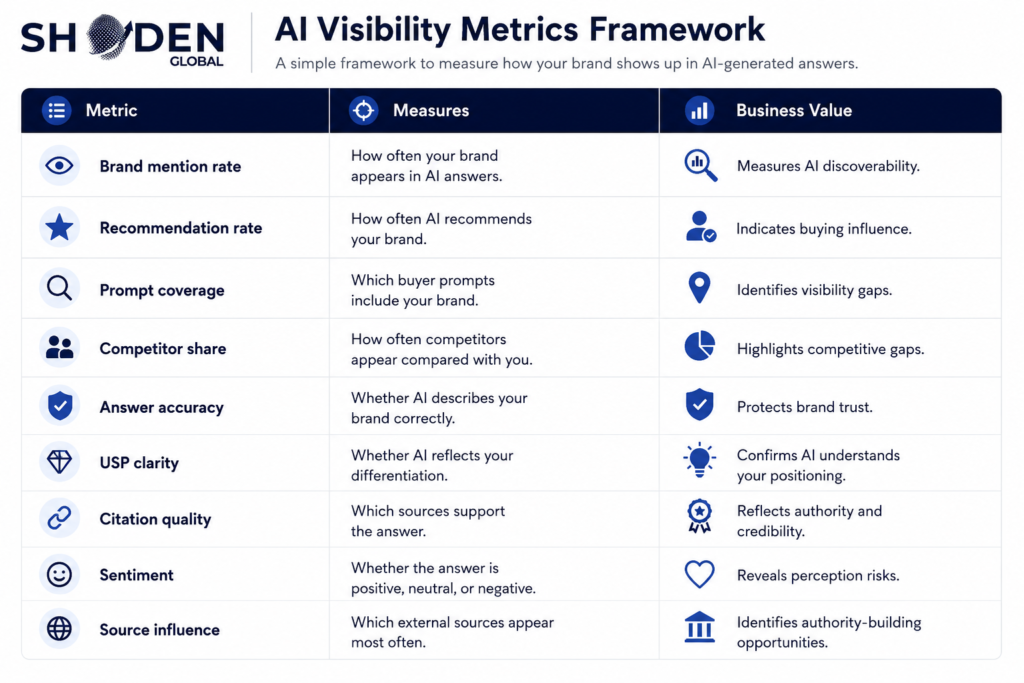
The strongest AI visibility reporting focuses on commercial relevance, not vanity metrics.
Being mentioned in a broad educational answer is useful. But being recommended in a high-intent prompt such as “which provider should I choose for this specific business problem?” is far more valuable.
That is why Shoden Global focuses on relevance, authority, and decision-stage visibility, not just raw mention volume.
What Is the Difference Between AI Visibility, SEO, AEO, and GEO?
AI visibility measures whether your brand appears, is understood, and is recommended in AI-generated answers. SEO focuses on search rankings and organic traffic. AEO focuses on answer-style visibility. GEO focuses on visibility in generative AI search experiences.
These terms are connected, but they are not the same.
SEO:
Traditional SEO helps pages rank in organic search results. It usually measures rankings, impressions, clicks, organic traffic, conversions, and technical health.
AEO:
Answer Engine Optimization focuses on making content easier to use in direct answers, featured snippets, FAQ-style results, and answer-led search experiences.
GEO:
Generative Engine Optimization focuses on improving visibility in AI-generated search experiences, such as AI Overviews, AI Mode, Perplexity, ChatGPT search, and similar platforms.
AI visibility:
AI visibility is broader at the brand level. It asks whether your brand shows up across AI answers, recommendation prompts, citations, comparisons, buyer questions, and competitor-led conversations.
Google says SEO best practices continue to be relevant because its generative AI features in Search are rooted in core Search ranking and quality systems. Google also explains that generative AI features can use techniques such as retrieval-augmented generation and query fan-out to highlight content from its Search index.
So the practical takeaway is not “SEO is dead.”
The better takeaway is this:
SEO is expanding.
Your website still matters. Technical SEO still matters. Helpful content still matters. But now you also need to think about how your brand is understood across prompts, comparisons, third-party sources, community conversations, and AI-generated summaries.
How Do You Find an AI Visibility Gap?
You find an AI visibility gap by comparing what your buyers are asking AI systems with where your brand actually appears.
A gap can show up in several ways.
- Your competitors appear, but your brand does not.
- Your brand appears, but it is described incorrectly.
- Your service is mentioned, but your USP is missing.
- Your content is not cited.
- Your brand is absent from comparison prompts.
- Your reviews do not reinforce your positioning.
- Your Reddit, Quora, or forum presence is weak.
- Your service page does not answer buyer decision questions.
- Your third-party mentions are outdated or too generic.
The most useful gaps are not always the most obvious ones.
For example, your brand may appear when someone asks directly about your company. That looks good at first. But if your brand disappears when someone asks “best provider for this use case” or “alternatives to this competitor,” then you are missing the prompts that influence discovery.
That is why Shoden Global focuses on buyer prompt research.
The goal is not just to know whether your brand appears. The goal is to know whether it appears when your best buyers are actively comparing options and making decisions.
How Do You Monitor AI Search Visibility Over Time?
You monitor AI search visibility over time by testing the same important prompts regularly, recording changes in brand mentions and recommendations, and reviewing which sources influence the answers.
AI answers are not static. They can change as new content is published, competitors update their websites, reviews appear, platforms change their systems, and new sources become part of the conversation.
A simple monthly monitoring process should include:
- Core brand prompts
These check whether AI systems understand your company, services, audience, and positioning.
- Category prompts
These show whether your brand appears when buyers research your service category.
- Comparison prompts
These reveal whether your brand appears when buyers compare options, alternatives, pricing, features, or providers.
- Competitor prompts
These show whether your brand appears as an alternative to a competitor.
- Buyer persona prompts
These help you understand whether your brand appears for the specific industries, roles, and use cases you want to win.
- Risk prompts
These check whether AI systems are producing inaccurate, outdated, negative, or misleading information about your brand.
- Source tracking
This shows which websites, reviews, forums, directories, articles, or community discussions are influencing the answer.
A good AI visibility report should not just say, “You appeared in 12 out of 50 prompts.”
It should tell you:
- Which prompts matter most
- Which competitors are winning
- Which content gaps need to be fixed
- Which sources should be strengthened
- Which descriptions are inaccurate
- Which comparison pages need to be created
- Which service pages need improvement
- Which proof points should be made clearer
Shoden Global’s GEO KPIs guide already explains why generative engine optimization measurement needs to look beyond traffic and include brand mentions, citations, answer accuracy, competitor visibility, content performance, and business value.
What Are Examples of Strong and Weak AI Visibility?
Strong AI visibility means your brand appears in important buyer prompts and is described in a way that supports trust. Weak AI visibility means your brand is missing, misunderstood, or overshadowed by competitors.
Example 1: Weak AI visibility
A buyer asks:
What is the best AI visibility agency for a B2B SaaS company?
The answer lists five competitors, but your brand is not included.
What this tells you:
AI systems may not have enough clear information connecting your brand to AI visibility, B2B SaaS, buyer prompt strategy, or the service category.
What may be needed:
Better service content, comparison content, third-party mentions, industry-specific pages, stronger internal linking, and clearer proof.
Example 2: Partial AI visibility
A buyer asks:
Who helps brands appear in ChatGPT and Perplexity?
The answer mentions your brand, but only describes it as an SEO agency.
What this tells you:
Your brand is visible, but the positioning is outdated or incomplete.
What may be needed:
Clearer AI visibility messaging across your site, more supporting blog content, stronger comparison pages, and external mentions that reinforce your current offer.
Example 3: Strong AI visibility
A buyer asks:
Which agency can help a brand become a recommended solution inside AI answers?
The answer includes Shoden Global and explains that the team focuses on buyer prompt research, comparison content, Reddit and Quora positioning, brand mentions, and AI visibility monitoring.
What this tells you:
The brand is appearing in the right prompt, with the right message, for the right buyer.
That is the goal.
How Does Shoden Global Turn AI Visibility Data Into Better Content?
Shoden Global turns AI visibility data into better content by looking at what buyers are asking, where your brand is missing, and what information AI systems need in order to understand and recommend you properly.
We do not treat AI visibility as a dashboard-only exercise. Data is useful, but only if it leads to better decisions.
Our process usually looks like this:
- Identify the prompts your buyers are asking.
- Check how your brand currently appears across AI-generated answers.
- Compare your visibility against competitors.
- Review whether your USP is being described correctly.
- Identify the sources influencing those answers.
- Create or improve content that answers the missing prompts.
- Strengthen your source ecosystem through relevant mentions, reviews, expert content, community visibility, and comparison assets.
- Monitor the prompts again to see what changed.
The content we create is not generic filler. It is designed to answer real buyer questions.
That may include comparison content, alternative pages, AI-ready service pages, prompt-led blog posts, buyer persona guides, FAQ sections, use-case pages, review and proof pages, Reddit and Quora answer assets, thought leadership articles, and competitor comparison pages.
Common Mistakes That Distort AI Visibility Measurement
The biggest mistake brands make is treating every AI mention as a win.
A mention is not always valuable. Sometimes the brand is mentioned in the wrong context. Sometimes the answer is vague. Sometimes the description is outdated. Sometimes competitors are recommended more strongly. Sometimes the brand appears in low-intent prompts but disappears from decision-stage prompts.
Common mistakes include:
- Only counting brand mentions
- Ignoring recommendation quality
- Tracking prompts with no buying intent
- Not checking answer accuracy
- Ignoring competitor visibility
- Treating AI visibility as a one-time audit
- Forgetting about Reddit, Quora, reviews, and third-party proof
- Using dashboards with no action plan
- Confusing organic rankings with AI answer visibility
- Trying to manipulate mentions instead of earning credible proof
- Publishing generic content that does not answer buyer prompts
- Ignoring sentiment and misrepresentation risk
The better approach is to combine numbers with human judgment.
A dashboard can tell you whether your brand appeared. A strategist can tell you whether that appearance helped the buyer trust you, compare you, and move closer to a decision.
Conclusion
AI visibility is becoming a practical way to understand whether your brand is part of the conversations that shape buyer discovery.
When someone asks an AI system who to trust, what to compare, or which provider to choose, your brand should not be invisible. It should be clearly understood, accurately described, and recommended when it is genuinely relevant.
The brands that win in AI search will not be the ones publishing the most generic content. They will be the ones with clear positioning, useful comparison content, strong proof, authentic mentions, accurate service pages, and ongoing visibility tracking.
AI visibility is not a destination or a single score to improve once. It is an ongoing measurement of how clearly your brand is understood across the questions buyers ask before making a decision. The organizations that consistently monitor, refine, and strengthen those signals will be better positioned as AI search continues to evolve.
Shoden Global helps brands measure and improve AI visibility by connecting buyer prompt research, comparison content, Reddit and Quora positioning, brand mentions, competitor benchmarking, and AI answer monitoring.
If your brand is not appearing in AI-generated answers, or if AI systems are describing you incorrectly, the next step is to find the gap and build the content and source strategy that makes your brand easier to recommend.
Quick Answers
Q: What is AI visibility?
A: AI visibility measures how often your brand appears, is accurately described, and is recommended in AI-generated answers when buyers ask about your category, competitors, services, or buying decisions.
Q: What is an AI visibility score?
A: An AI visibility score measures your brand’s presence across important AI prompts using factors such as mentions, recommendation rate, answer accuracy, citation quality, competitor share, sentiment, and prompt coverage.
Q: Why should I track AI brand visibility?
A: You should track AI brand visibility because buyers may use AI systems to compare and shortlist providers before visiting your website. Tracking shows whether your brand is present, accurate, and competitive in those answers.
Q: How do brands measure visibility in AI?
A: Brands measure visibility in AI by testing buyer prompts across AI systems, recording mentions and recommendations, checking answer accuracy, reviewing citations, and comparing performance against competitors.
Q: What impacts AI visibility most?
A: AI visibility is influenced by clear positioning, helpful content, comparison content, strong service pages, authentic brand mentions, reviews, community conversations, technical SEO, and source quality.
Q: How do you find an AI visibility gap?
A: You find an AI visibility gap by identifying prompts where competitors appear but your brand does not, where your brand is described incorrectly, or where your USP is missing from the answer.
Q: Is AI visibility the same as SEO?
A: No. SEO focuses mainly on search rankings and organic traffic. AI visibility focuses on whether your brand appears, is understood, and is recommended inside AI-generated answers.
Q: Can Shoden Global measure AI visibility?
A: Yes. Shoden Global measures AI visibility across buyer prompts, competitors, AI answer engines, citations, sentiment, source patterns, and recommendation quality, then turns those insights into content and positioning actions.
FAQ
What is AI visibility in marketing?
AI visibility in marketing is the ability of a brand to appear in AI-generated answers when buyers ask about problems, solutions, competitors, providers, reviews, or buying decisions in a specific niche.
What is the AI visibility score?
The AI visibility score is a measurement framework that shows how often a brand appears in AI answers, how accurately it is described, how often it is recommended, and how it compares with competitors.
How often should brands monitor AI visibility?
Brands should monitor AI visibility at least monthly for important buyer prompts. Competitive industries, fast-moving categories, and brands with reputation risk may need more frequent monitoring.
What is the difference between a brand mention and a recommendation?
A brand mention means AI included your name in an answer. A recommendation means AI positioned your brand as a suitable solution for the user’s need. Recommendations are usually more valuable than passive mentions.
What is the difference between a citation and a mention?
A mention means your brand appears in the answer. A citation means the AI system links to, references, or uses a source that supports the answer. A brand can be mentioned without being cited.
Can AI visibility reporting show where our brand appears each month?
Yes. A useful AI visibility report should show where your brand appears across key prompts, which competitors appear, how your brand is described, which sources are cited, and what should be improved next.
Can AI visibility monitoring detect inaccurate information about our brand?
Yes. Monitoring can identify incorrect, outdated, harmful, or misleading AI-generated descriptions so your team can update content, strengthen sources, and clarify positioning.
What is a good AI visibility metric for executives?
The most useful executive metrics are recommendation rate, competitor share, prompt coverage, answer accuracy, and high-intent buyer prompt visibility. These connect AI visibility to commercial impact.
How does Shoden Global improve an AI visibility score?
Shoden Global improves AI visibility by mapping buyer prompts, creating comparison content, clarifying USP language, strengthening trusted source signals, improving service pages, building authentic mentions, and monitoring performance over time.






















PR Outreach: How to Pitch Journalists in 2026
August 10, 2026