
An AI content strategy helps marketing leaders use AI across planning, research, production, optimization, distribution, and measurement without surrendering human judgment. In 2026, the challenge is deciding where AI adds leverage, where evidence is required, and who remains accountable for every claim.
A strong strategy starts with business priorities, audience decisions, editorial standards, and measurable outcomes; not a tool list or a production target.
An AI content strategy is a documented system aligning business goals, audience needs, editorial standards, AI-assisted tasks, human approvals, governance, distribution, and measurement. It defines what AI may do, what people must own, what evidence content needs, and how the organization will improve results.
Table of Contents
What Is an AI Content Strategy?
An AI content strategy is the operating plan for using artificial intelligence responsibly across the content lifecycle. It connects audience research, topic selection, evidence, production, quality assurance, publishing, distribution, and measurement while assigning responsibility to human owners.
It should answer six questions: What outcome are we pursuing? Whom are we helping? What do they need? Where can AI improve the work? Where must people exercise judgment? How will success be measured?
An AI-assisted content strategy is broader than a prompt library. Prompts standardize tasks; strategy establishes purpose, inputs, controls, decision rights, and feedback loops.
How Is AI Content Strategy Different From AI-Generated Content?
AI-generated content describes a production method. AI content strategy describes how an organization decides what to create, why it matters, which inputs are trustworthy, how AI may contribute, and who approves the result.
A company can generate large amounts without a strategy, producing more output but little differentiation. A mature strategy may use AI for research, clustering, drafting, repurposing, checks, and reporting while keeping expert conclusions and final approval human-led.
The goal is not to maximize AI-produced material. It is to improve the quality and performance of the entire content system.
Which Business Goals Should an AI Content Strategy Support?
An AI content strategy should support defined goals such as increasing qualified demand, enabling sales, building category authority, improving customer education, reducing production friction, or expanding visibility across search and AI-assisted discovery.
Assign one primary outcome and supporting indicators to each program. A decision guide may target qualified enquiries; a technical series may reduce objections; thought leadership may focus on authoritative mentions.
Approve a topic only when:
• The audience and decision are clear.
• It supports a strategic offer or position.
• It can add useful evidence or expertise.
• A meaningful next action exists.
• Results can be measured.
• The content can be maintained.
Otherwise, AI only helps produce low-priority content faster.
How Do You Map Audiences, Keywords, and Buyer Prompts?
Map audiences, keywords, and buyer prompts by starting with the decisions people need to make, then connecting them to language used in search, sales conversations, communities, and AI assistants.
Define the role, buying stage, question, required proof, and next action. A chief marketing officer may prioritize governance and return, while an operations manager needs workflow guidance.
Keyword research reveals established demand and topic relationships. Buyer-prompt research adds contextual questions used for comparisons, recommendations, troubleshooting, and risk assessment. Cluster overlapping questions into one useful resource rather than a thin page for every variation. Give each cluster a parent topic, supporting questions, conversion path, and internal-link destination.
How Do You Choose the Right Content Formats?
Choose the format that best helps the audience complete a decision, not the format easiest for AI to generate.
Definitions, FAQs, and explainers support early understanding. Comparisons, buyer guides, and checklists help people evaluate choices. Case studies, original research, and expert commentary reduce risk and build trust. Implementation guides and templates help people act.
Service pages support commercial decisions.
Match format to evidence. A market report needs defensible data, a case study needs approval and attribution, and a comparison needs transparent criteria and balanced limitations. When evidence is limited, publish a focused explanation rather than an unsupported definitive guide.
Where Should Humans Lead and AI Assist?
Humans should lead positioning, expertise, ethical judgment, sensitive decisions, and final approval. AI should assist with bounded tasks such as organizing research, finding patterns, drafting from approved inputs, repurposing material, and checking content against defined rules.
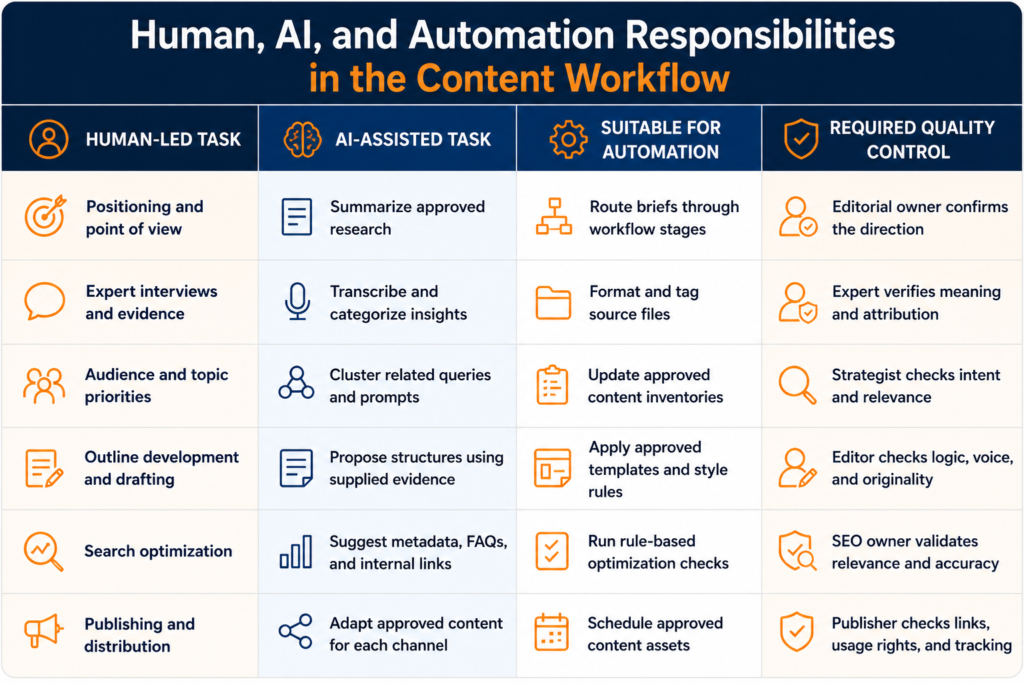
Automation is best for repetitive, rules-based, low-risk, reversible, and auditable work. The more consequential or ambiguous a decision is, the stronger the human role should be.
How Do You Build Original Evidence and Expert Input Into the Process?
Build evidence before drafting. Each important asset should have an evidence brief listing planned claims, supporting sources, validating experts, and unresolved gaps.
Useful inputs include expert interviews, customer questions, anonymized data, experiments, case studies, field observations, proprietary frameworks, and implementation lessons. Even modest first-hand insight can outperform a summary of existing pages.
For high-value or high-risk assets, keep a claim ledger with the claim, source, date, owner, approval status, and review date. Separate facts from interpretation and recommendations. Never treat generated text as evidence. This also reduces rework because reviewers and future updaters can trace every material claim.
Which AI Content Governance Controls Are Essential?
Essential AI content governance controls include approved and prohibited uses, data rules, source requirements, named owners, review thresholds, disclosure guidance, rights checks, version records, and corrections.
Your policy should define:
• Approved systems and account types.
• Data that must never be entered.
• Tasks requiring expert, legal, compliance, or executive review.
• Claims requiring primary or internal evidence.
• Copyright, licensing, quotation, and image-rights checks.
• Disclosure expectations.
• Prompt, source, revision, and approval records.
• Correction and withdrawal procedures.
NIST’s AI Risk Management Framework organizes responsible AI work around Govern, Map, Measure, and Manage. This structure suits content operations because it connects policy, context, evaluation, and ongoing risk treatment.
Governance must appear inside briefs, reviews, and publishing gates. A separate policy alone will not reliably change behavior.
How Should the AI Content Workflow Be Structured?
An effective AI content workflow uses defined inputs, named owners, clear stages, and approval gates. AI may accelerate work, but it must not bypass human accountability.
A reliable sequence is:
- Intake: define audience, purpose, action, risk, and owner.
- Brief: document questions, format, evidence, distribution, and success measures.
- Evidence: gather approved sources, examples, interviews, and data.
- Development: organize research and draft from permitted inputs.
- Editorial review: improve reasoning, usefulness, voice, and originality.
- Fact and risk review: verify claims, citations, permissions, and commitments.
- Optimization: refine headings, answers, links, metadata, and technical details.
- Approval and publishing: obtain sign-off, confirm tracking, and record the final version.
- Distribution: adapt approved material without changing its meaning.
- Measurement and refresh: compare results with the baseline and schedule updates.
AI automation in the content lifecycle creates value by moving approved information through repetitive steps while preserving visible gates for judgment.
How Is Content Optimized for Search and AI Answers?
Content is optimized for search and AI answers by making it useful, accessible, structured, evidence-led, and easy to interpret. LLM content optimization should improve the reader experience, not rewrite pages for a machine.
Start each question-based section with a concise answer, then add context, examples, limitations, and practical steps. Use descriptive headings, precise definitions, comparison tables, visible authorship, relevant internal links, and sources near important claims.
Google’s current guidance says foundational SEO remains relevant to its generative search features and emphasizes unique, non-commodity, people-first content. It also says there is no special AI markup requirement and warns against producing many low-value pages to target query variations or manipulate generative results.
Check that every page:
• Answers the core question clearly.
• Adds expert input, evidence, or a distinctive framework.
• Uses crawlable links and logical internal architecture.
• Is indexable, canonicalized, mobile-friendly, and current.
• Applies relevant structured data accurately.
• Removes unsupported claims, vague superlatives, and duplication.
• Ends with a suitable next step.
Which Metrics Show Whether the Strategy Is Working?
The right metrics show whether the strategy improves operations, visibility, audience outcomes, and commercial performance. Publishing volume alone is not success.
Operational metrics include cycle time, cost per approved asset, approval delays, revision rate, and refresh completion. Audience metrics include qualified organic traffic, non-brand visibility, engagement, conversions, and topic-cluster performance.
AI visibility metrics may include mentions, citations, recommendation frequency, factual accuracy, source inclusion, and share of answer against agreed competitors. Because outputs vary, use a stable prompt set, repeated tests, consistent conditions, and a defined reporting period. Google’s Search Console reporting for generative search performance can complement analytics and conversion data.
Commercial metrics may include qualified enquiries, accepted leads, influenced opportunities, pipeline, revenue, retention, or support-cost reduction. Set a baseline and label evidence as direct, assisted, or directional.
What Should a 90-Day AI Content Strategy Plan Include?
A 90-day plan should move from diagnosis and policy to a controlled pilot, then use evidence to decide what to scale, revise, or stop.
Days 1–30: Establish the Operating Model
- Audit the operation. Review audiences, assets, search performance, buyer questions, bottlenecks, data access, AI use, risks, and content debt.
- Set goals and baselines. Choose one primary outcome, define supporting and commercial indicators, record current performance, and identify pilot assumptions.
- Establish policy. Approve systems and use cases, restrict sensitive data, assign owners, define evidence standards, and set escalation rules.
- Design the workflow. Map intake through refresh, specify where people lead and where AI assists, create templates, define approval gates, and configure tracking.
Days 31–90: Pilot, Publish, and Learn
- Produce a focused pilot. Create three to six assets within one topic cluster using expert input, approved evidence, and at least two formats.
- Review and improve. Measure revision effort, investigate unsupported claims or voice drift, and update briefs, prompts, and controls.
- Publish with quality assurance. Confirm facts, links, metadata, accessibility, permissions, conversion paths, analytics, and final ownership.
- Distribute and repurpose. Adapt approved material for email, social, sales, PR, and partner channels while preserving claims and evidence.
- Measure and decide. Compare results with the baseline, identify bottlenecks, and classify each practice as scale, improve, limit, or stop.
Which Common AI Content Strategy Mistakes Should You Avoid?
The most damaging mistakes come from scaling activity before clarifying purpose, evidence, ownership, and quality controls.
Avoid:
• Starting with software instead of business and audience needs.
• Automating decisions requiring positioning or expertise.
• Treating generated text or citations as verified evidence.
• Publishing at scale before testing a governed workflow.
• Measuring output instead of useful outcomes.
• Creating thin pages for every keyword or prompt variation.
• Removing experts and producing commodity content.
• Entering sensitive information into unapproved systems.
• Failing to record sources, approvals, and versions.
• Publishing without a maintenance or correction plan.
A controlled pilot reduces rework, inconsistent messaging, reputational risk, and content debt.
Quick Answers
What is the first step?
Audit goals, audience needs, content, workflows, evidence, current AI use, and risk before selecting tools or setting production targets.
Who should own the strategy?
A senior marketing or content leader should own it, with input from experts, SEO, analytics, sales, operations, and legal or compliance.
What should be automated first?
Start with low-risk work such as brief routing, transcript formatting, taxonomy tagging, approved-content repurposing, checks, and reporting preparation.
Can AI produce a first draft?
Yes, when the brief, evidence, sources, voice rules, and review requirements are clear. Treat it as working material, not verified content.
How large should a pilot be?
A focused pilot of three to six connected assets can be large enough to reveal workflow problems without overwhelming reviewers.
How often should the strategy be reviewed?
Review operations and strategy at a cadence appropriate to the program, and sooner when products, evidence, regulations, audience behavior, or platform capabilities change.
Conclusion
A practical AI content strategy is not a mandate to generate more. It is a management system for producing useful, defensible, and measurable content with the right balance of human responsibility and AI assistance.
Begin with business goals and buyer decisions. Build evidence before drafting. Put governance inside the workflow. Automate only where rules are clear, and risk is controlled. Then measure operational efficiency, visibility, qualified demand, and commercial outcomes.
For full program management, explore Shoden Global’s Content Marketing Services.
For execution support, explore Shoden Global’s Content Creation Services.
FAQ
What is an AI content workflow?
It is the sequence of stages, owners, inputs, AI-assisted tasks, approvals, and checks used to move an asset from idea to measurement.
What is AI content governance?
It is the decision rights, policies, controls, and records that keep AI-assisted content accurate, secure, lawful, brand-aligned, and accountable.
How does an AI-assisted content strategy improve efficiency?
It reduces repetitive work, organizes research, standardizes briefs and checks, and simplifies repurposing. The greatest savings come from a better system, not fewer experts.
What is LLM content optimization?
It makes useful content clearer, more structured, evidence-led, and easier for AI-assisted systems to interpret and reference. It complements technical SEO and people-first writing.
How can teams reduce AI hallucinations?
Use approved source packs, require evidence for material claims, verify citations, involve qualified experts, and never treat generated text as a source.
Does AI-assisted content rank in search?
AI assistance does not determine rankings. Relevance, originality, technical accessibility, authority, quality, and user value matter. Low-value scaled content creates risk regardless of how it was produced.
Should every AI-assisted article include a disclosure?
Not automatically. Disclosure should follow applicable rules, audience expectations, and the material role automation played. Set a consistent policy.
How long does implementation take?
You can test a usable operating model within 90 days. Mature capability develops through measurement, training, stronger evidence systems, and workflow refinement.















































PR Outreach: How to Pitch Journalists in 2026
August 10, 2026