The best generative engine optimization tools help businesses understand how often their brand appears in AI generated answers, which sources AI engines cite, how competitors are mentioned, and what content needs to be improved.
For most businesses, the strongest GEO stack combines AI visibility tracking, content optimization, technical SEO, digital PR, and a clear measurement process.
Top platforms to compare include Semrush AI Visibility Toolkit, Ahrefs Brand Radar, Profound, Peec AI, Scrunch, OtterlyAI, AthenaHQ, Writesonic, SE Ranking, and Rankscale. Each tool solves a different part of the GEO problem, so the best choice depends on whether your business needs monitoring, content recommendations, competitive intelligence, AI crawler readiness, reporting, or full service execution.
For a broader strategy, start with our generative engine optimization guide.
Table of Contents
What Is Generative Engine Optimization?
Generative Engine Optimization, often shortened to GEO, is the process of improving how your brand, content, products, services, and expertise appear inside AI generated answers.
Traditional SEO focuses on rankings and organic clicks. GEO focuses on being included, cited, summarized, and recommended by AI systems such as ChatGPT, Perplexity, Gemini, Copilot, Google AI Overviews, Claude, and other answer engines.
AI answers are changing the way buyers discover brands. A user may no longer compare ten search results before making a decision. Instead, they may ask an AI tool for the best provider, the most trusted solution, or the right platform for their business.
If your brand is not mentioned, cited, or described accurately in those answers, your business can lose visibility before the buyer even reaches your website.
Why GEO Tools Matter
GEO tools help businesses answer four important questions:
- Are AI engines mentioning our brand?
- Are they citing our website or our competitors?
- Are they describing us accurately?
- What should we improve to become more visible?
These tools are especially useful for businesses in competitive markets where buyers use AI search to compare agencies, software, services, products, consultants, healthcare providers, finance companies, education brands, ecommerce stores, and B2B solutions.
Best Generative Engine Optimization Tools and Platforms Compared
| Tool or Platform | Best For | Main GEO Use Case | Strengths | Watch Outs |
| Semrush AI Visibility Toolkit | SEO teams that already use Semrush | Tracking how brands appear in AI generated answers | Useful for marketers who want AI visibility data alongside traditional SEO workflows. | Best value if your team already uses Semrush data and processes. |
| Ahrefs Brand Radar | Competitive AI visibility research | Researching brand visibility across AI search experiences | Strong for benchmarking brand visibility, competitor mentions, and AI search opportunities. | Teams still need a workflow to turn findings into content and PR actions. |
| Profound | Enterprise brands and larger marketing teams | Monitoring AI answer visibility across many answer engines | Strong for large scale AI visibility monitoring, competitive tracking, and enterprise reporting. | Best suited to teams with enough budget and internal capacity to act on advanced insights. |
| Peec AI | Marketing teams that want prompt level clarity | Prompt tracking, AI rankings, citations, and competitive visibility | Useful for tracking important buyer questions, brand mentions, rankings, and citation sources. | Works best when you already know the commercial questions your buyers ask. |
| Scrunch | Enterprise teams focused on AI crawler experience | AI search visibility plus machine readable content delivery | Helpful for businesses that want to improve how AI agents access and understand their website. | May be more advanced than what smaller teams need at the beginning. |
| OtterlyAI | Prompt monitoring and brand mention tracking | Tracking mentions, citations, and competitor visibility in AI search | Practical for monitoring how brands appear in ChatGPT, Perplexity, Google AI Overviews, and AI Mode. | Best used with a focused prompt set to avoid noisy reporting. |
| AthenaHQ | Teams that want GEO reporting and action planning | AI visibility tracking, content gaps, competitor monitoring, and ROI reporting | Useful for executive dashboards, content gap detection, competitor monitoring, and leadership reporting. | Best for teams ready to operationalize GEO across content, reporting, and strategy. |
| Writesonic GEO | Content teams that want creation and GEO tracking together | Improving brand presence and mentions in AI generated answers | Good fit for teams that want content production and visibility tracking in one workflow. | Best for content led teams that need both writing support and AI visibility insights. |
| SE Ranking AI Visibility Tracker | SEO teams that want AI visibility inside an SEO platform | Tracking brand mentions, links, competitors, and visibility trends | Useful for monitoring brand mentions, competitor visibility, prompt results, and links in AI answers. | Best for teams that want GEO measurement connected to broader SEO activity. |
| Rankscale | Brands that want broad AI engine tracking | Multi engine AI visibility analytics, sentiment, and AI readiness audits | Helpful for tracking visibility across multiple AI engines, sentiment, and AI readiness factors. | Broad coverage is useful, but teams should prioritize the AI engines their buyers actually use. |
Which GEO Tool Is Best?
There is no single best GEO platform for every business. The right tool depends on what your company needs to improve.
For SEO teams already using Semrush, Semrush AI Visibility Toolkit is a natural starting point because it connects AI visibility to familiar SEO workflows.
For competitive research, Ahrefs Brand Radar is useful because it gives a broad view of brand visibility across major AI search surfaces.
For enterprise AI visibility monitoring, Profound, Scrunch, and AthenaHQ are strong options because they are built for larger teams, deeper reporting, and multi platform visibility.
For prompt level tracking, Peec AI and OtterlyAI are practical choices because they focus on the actual questions users ask and the brands that appear in answers.
For content led teams, Writesonic GEO can be useful because it connects visibility with content production.
For SEO teams that want AI tracking inside a broader SEO platform, SE Ranking and Rankscale are worth comparing.
How to Choose the Right GEO Platform
Before buying a GEO tool, define what your business needs to measure. Many teams start with dashboards before they have a strategy, which leads to interesting data but weak execution.
A good GEO platform should help you understand where your brand appears, where competitors are winning, which sources AI engines trust, and what actions can improve visibility.
Key features to compare include:
- AI engine coverage
- Prompt tracking
- Citation tracking
- Brand mention tracking
- Competitor comparison
- Sentiment analysis
- Content recommendations
- Technical insights
- Reporting
- ROI measurement
The best GEO platform should not only tell you that your brand is missing from AI answers. It should help you understand why and what to improve next.
GEO Tools vs SEO Tools
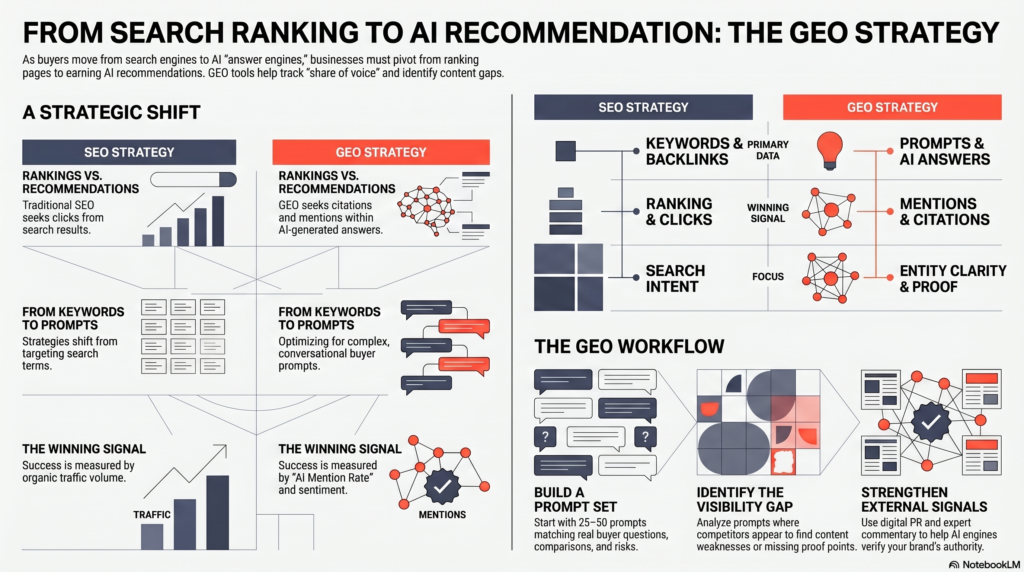
GEO tools and traditional SEO tools overlap, but they are not the same.
| Category | Traditional SEO Tools | GEO Tools |
| Main Goal | Improve rankings and organic traffic from search engines | Improve mentions, citations, and recommendations in AI answers |
| Primary Data | Keywords, backlinks, rankings, technical SEO, traffic | Prompts, AI answers, brand mentions, citations, sentiment, competitors |
| Winning Signal | Your page ranks and earns clicks | Your brand or page appears inside the AI answer |
| Content Focus | Search intent, topical authority, internal links, backlinks | Extractable answers, entity clarity, proof, citations, and trusted sources |
| Measurement | Rankings, impressions, clicks, and conversions | AI visibility share, mention rate, citation rate, answer sentiment, and AI referral quality |
SEO still matters. GEO builds on SEO by making your content easier for AI systems to understand, verify, and reuse.
How to Use GEO Tools in a Real Workflow
A GEO tool is only useful if it changes what your team does. The best results come from combining tool insights with content improvements, technical SEO, digital PR, and measurement.
1. Build a Prompt Set
Start with 25 to 50 prompts that match real buyer questions. These should include definition questions, comparison questions, commercial investigation questions, risk questions, measurement questions, and service related questions.
Examples include:
- What is generative engine optimization?
- Why is generative engine optimization important?
- How does generative engine optimization work?
- How to do generative engine optimization?
- How to optimize content for generative engines?
- Is generative engine optimization the same as traditional SEO?
- Answer engine optimization vs generative engine optimization
- Generative engine optimization vs traditional SEO
- How to measure the success of generative engine optimization campaigns?
- How do I measure the ROI of generative engine optimization?
- Are there risks to using generative engine optimization?
- Does generative engine optimization work for all types of websites?
- Generative engine optimization best practices
- Best AI tools for generative engine optimization
- Best generative engine optimization platforms
- What are generative engine optimization services?
- Generative engine optimization agency
2. Track Mentions and Citations
Run your prompt set through your chosen GEO tool and review the results carefully.
Track whether your brand is mentioned, whether your website is cited, which competitors appear, which pages AI engines use as sources, and whether the answer describes your business accurately.
3. Find the Visibility Gap
For every prompt where competitors appear and your business does not, look for the reason.
Common gaps include unclear content, weak proof, missing comparison pages, thin service pages, poor internal linking, limited external authority, inconsistent brand information, and lack of credible third party mentions.
4. Improve Your Content
Update priority pages with direct answers, clear headings, short definitions, comparison tables, checklists, proof points, case studies, internal links, author credibility, company credibility, and structured data where appropriate.
Your content should make it easy for AI engines to understand who you are, what you do, who you help, why you are credible, and when your business should be recommended.
5. Strengthen External Signals
Many AI answers rely on more than your website. Strong third party signals can help AI systems verify your brand and understand your authority.
Useful external signals include digital PR, expert commentary, guest articles, partner pages, relevant listicle inclusions, industry directories, reviews, consistent business profiles, and high quality mentions from trusted sources.
Shoden Global Communication helps businesses turn GEO data into action. This includes mapping the questions buyers ask, improving website content for AI visibility, strengthening internal linking, building digital PR assets, supporting LLM seeding, and creating a clearer brand footprint across the web.
6. Measure Business Impact
GEO measurement should include both visibility metrics and business outcomes.
Track:
- AI mention rate
- AI citation rate
- Share of voice in AI answers
- Sentiment
- Branded search growth
- Direct traffic changes
- Referral traffic from AI tools
- Assisted conversions
- Lead quality
- Sales influenced by AI discovery
Do not rely on one metric. GEO works best when you connect prompt visibility, content quality, authority signals, and conversion data.
Best Practices for Using GEO Tools
GEO tools can show the gap, but they cannot replace strategy. Use them to guide content, technical SEO, brand positioning, and authority building.
Best practices include:
- Track buyer questions, not random keywords.
- Compare at least three to five competitors.
- Separate brand mentions from website citations.
- Review actual AI answers, not only scores.
- Update pages that are close to being cited.
- Add concise answer blocks to key pages.
- Use tables for comparison queries.
- Keep brand information consistent across your website and trusted third party sources.
- Strengthen third party proof through digital PR and credible mentions.
- Review your prompt set every month.
The goal is not to manipulate AI answers. The goal is to make your business easier to understand, easier to verify, and easier to recommend.
Common GEO Tool Mistakes
Many companies buy a GEO platform and still fail to improve visibility. This usually happens when the tool is used for reporting only, rather than action.
Common mistakes include:
- Tracking too many prompts too soon
- Choosing prompts with no commercial value
- Monitoring only one AI engine
- Treating brand mentions and citations as the same thing
- Publishing thin content
- Ignoring technical crawlability issues
- Ignoring competitor citations
- Failing to build external authority
- Reporting visibility without connecting it to revenue
- Expecting tools to replace strategy, content, and PR
A GEO platform gives you data. Growth comes from what you do with that data.
When Should You Work With a GEO Agency?
A business should consider working with a GEO agency when competitors are appearing in AI answers more often, AI tools are describing the brand inaccurately, internal teams do not know which prompts to track, or the company needs content, SEO, digital PR, and measurement working together.
Shoden Global Communication helps businesses build a practical GEO system that connects strategy, content, technical optimization, AI visibility tracking, digital PR, and citation building.
The aim is simple: make your brand clearer, more credible, and more likely to be included when AI answer engines compare providers in your market.
FAQ
What are the best AI tools for generative engine optimization?
The best AI tools for generative engine optimization include Semrush AI Visibility Toolkit, Ahrefs Brand Radar, Profound, Peec AI, Scrunch, OtterlyAI, AthenaHQ, Writesonic, SE Ranking, and Rankscale. The best choice depends on whether your business needs AI visibility tracking, prompt monitoring, citation analysis, content optimization, technical AI readiness, or enterprise reporting.
What is the best generative engine optimization platform?
The best generative engine optimization platform is the one that matches your workflow. Semrush and SE Ranking are strong for SEO teams. Profound, Scrunch, and AthenaHQ are better suited to larger teams. Peec AI and OtterlyAI are useful for prompt monitoring. Writesonic is practical for content teams. Ahrefs Brand Radar is strong for AI visibility research.
Is generative engine optimization the same as traditional SEO?
No. Traditional SEO focuses on ranking pages in search results and earning organic clicks. GEO focuses on being mentioned, cited, and recommended inside AI generated answers. The two disciplines overlap because strong technical SEO, content quality, internal linking, and authority can all help AI systems understand and trust your content.
How do you optimize content for generative engines?
To optimize content for generative engines, answer the target question clearly, use question based headings, add concise definitions, include comparison tables, show proof, cite credible sources, strengthen internal links, and keep brand information consistent across your website and trusted third party sources.
How do you measure the success of generative engine optimization campaigns?
Measure GEO success with AI mention rate, citation rate, share of voice, sentiment, competitor visibility, branded search growth, AI referral traffic, assisted conversions, and lead quality. Use the same prompt set each month so you can compare progress over time.
How do you measure the ROI of generative engine optimization?
Measure GEO ROI by mapping AI visibility improvements to business signals such as branded search growth, direct traffic, referral traffic from AI tools, demo requests, qualified leads, assisted conversions, and sales influenced by AI discovery.
Are there risks to using generative engine optimization?
Yes. Risks include chasing low quality mentions, publishing thin content, overstating claims, relying only on tool scores, ignoring technical SEO, and trying to manipulate AI systems through spam. A brand safe GEO strategy should focus on accuracy, useful content, credible proof, and trustworthy distribution.
Does generative engine optimization work for all types of websites?
GEO can help many websites, but it works best when buyers ask research, comparison, recommendation, or problem solving questions before converting. B2B services, SaaS, healthcare, finance, education, ecommerce, agencies, local services, and expert led businesses can all benefit when they have clear expertise and credible proof.
Conclusion
The best generative engine optimization tools do more than show rankings. They reveal how AI systems understand your brand, which competitors are being recommended, which sources are being cited, and where your content needs to improve.
Start with a small set of high value prompts. Track brand mentions, citations, competitors, and sentiment. Improve the pages most likely to be used in answers. Reinforce your expertise through internal linking, digital PR, and credible third party signals. Then connect visibility improvements to business outcomes.
A GEO tool can show you where you stand. A strong GEO strategy helps you become the answer.



























PR Outreach: How to Pitch Journalists in 2026
August 10, 2026