
Reciprocal linking is not automatically an SEO problem. Organisations often mention each other because they collaborate, join the same event or serve overlapping audiences. Risk appears when mutual links become ranking assets rather than editorial references. Judge each arrangement by its purpose, relevance, placement, incentive and wider pattern, not by an invented “safe” percentage.
Reciprocal linking happens when two websites link to each other. It can arise naturally between partners, associations, event participants or genuinely complementary resources. It becomes risky when exchanges are scaled, irrelevant, tightly coordinated, or arranged mainly to influence rankings rather than help readers.
Table of Contents
What Is Reciprocal Linking?
Reciprocal linking is a two-way relationship: Website A links to Website B, and Website B links back. The links may appear on different pages, use different wording, and be added at different times.
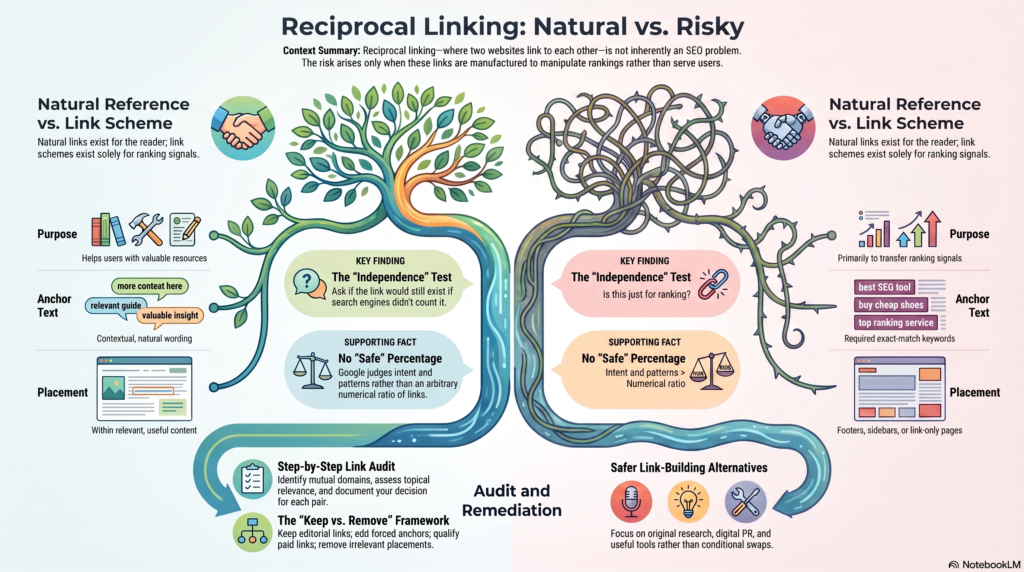
Natural and Manufactured Examples
A natural example is an association linking to a member profile while the member links to its accreditation page. An event may list a participating company, while that company links to the agenda. A software provider and integration partner may link to each other’s setup instructions.
A manufactured reciprocal link exchange may require a backlink before publication, dictate an exact-match anchor, or place links on unrelated resource pages. The critical question is not whether both sites link, but why each link exists.
Does Google Allow Reciprocal Links?
Yes. Google does not prohibit every pair of websites linking to each other. Its spam policies identify excessive link exchanges and partner pages created exclusively for cross-linking as link spam. The distinction is between useful mutual references and links created primarily to manipulate rankings.
Google does not publish a safe reciprocal-link ratio. Even one exchange can be questionable when it is paid, irrelevant, or ranking-led. By contrast, legitimate business relationships may produce mutual references for independent reasons. Google’s published policy focuses on the purpose and pattern of exchanges rather than a numerical threshold.
Google also recommends concise, descriptive, and relevant anchor text, while advising publishers not to force keywords into links. Editors should choose wording that suits the page rather than accept a required exact-match phrase.
When Is a Reciprocal Link Natural and Useful?
A reciprocal link is natural and useful when each website has an independent reason to reference the other, and both links help readers. The arrangement should still make sense if search engines assigned no ranking value to either link.
Acceptable situations may include suppliers, professional memberships, event participation, co-authored research, verified integrations, and complementary resources. For example, a manufacturer may link to an authorised installer directory, while an installer links to technical documentation. Each link serves a different need.
Natural Reciprocal-Link Checklist
• Both links help real users.
• Pages and audiences are genuinely related.
• No exact-match anchor is required.
• There is no large-scale exchange quota.
• No payment, product, or hidden benefit affects an unqualified link.
• The relationship is disclosed where appropriate.
• Links are not sitewide or templated without purpose.
• Each page makes sense without the reciprocal link.
• The arrangement can withstand editorial review.
• The decision is documented.
When Does Reciprocal Linking Become a Link Scheme?
Reciprocal linking becomes a link scheme when its main purpose is to manufacture ranking signals. Risk increases with excessive exchanges, irrelevant placements, compulsory return links, hidden incentives, repeated anchors and coordination across multiple sites.
Google’s link-spam examples include excessive link exchanges, partner pages used only for cross-linking, and links obtained in exchange for money, goods, or services. Three-way exchanges are not automatically safer: routing a return link through another domain does not change a ranking-first purpose.
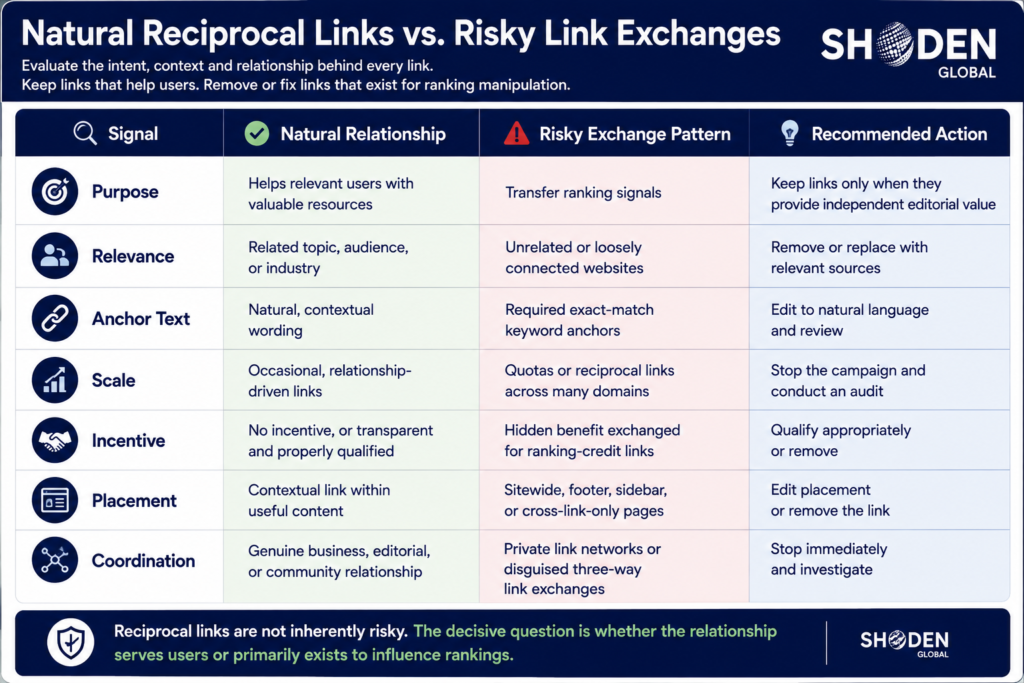
The same reciprocal relationship can be harmless or manipulative depending on how it is structured. The table below highlights the signals that separate a natural reference from a risky exchange.
What Are the SEO and Brand Risks?
The main risks are reduced search visibility, manual-action exposure, poor referral quality, weaker editorial trust, and continuing maintenance. A low-value exchange may also provide no meaningful benefit even without formal action.
Google says automated systems and human review can detect policy violations; affected sites may rank lower or disappear from results. Search Console can also report patterns of unnatural, artificial, deceptive or manipulative links.
Irrelevant partner pages may make visitors question a brand’s judgement. They can also create weak traffic, broken links and old obligations that survive after staff, agencies or partnerships change.
How Do You Audit Reciprocal Links Step by Step?
Audit reciprocal links at domain, page and relationship level. Mutuality alone is not enough to classify a link; review relevance, placement, anchor text, incentive, scale and coordination.
Reciprocal-Link Audit Process
- Export inbound and outbound links and identify mutual domains.
- Separate editorial links from paid, partner, directory and sitewide links.
- Review topical relevance and reader value on both pages.
- Look for repeated anchors, exchange requests and network behaviour.
- Check whether money, products or another incentive affected placement.
- Classify each pair as keep, edit, qualify, remove or investigate.
- Contact partners only where a change is genuinely needed.
- Record the reason and monitor the link profile over time.
Keep the URLs, relationship owner, evidence, and review date with each decision. Context is more useful than labelling a link “toxic” or “safe” from a score alone.
Should Reciprocal Links Use Nofollow or Sponsored Attributes?
Reciprocal links do not automatically need nofollow. Ordinary editorial links can remain standard links; paid or sponsored placements should use an attribute that reflects the relationship.
Google prefers rel="sponsored" for advertisements and paid placements. Rel="nofollow" remains acceptable for those links, while nofollow can also be used when other values do not apply and the publisher does not want Google to associate the sites.
An attribute is not a licence for an irrelevant exchange. It may describe a commercial relationship to Google, but it cannot create reader value or justify a page built only for cross-linking. Commercial relationships should also be clear to readers.
What Should You Do With Existing Link Exchanges?
Classify every existing exchange as keep, edit, qualify, remove or investigate. Do not delete links simply because two domains happen to link to each other.
• Keep relevant links with independent editorial value.
• Edit forced anchors, weak context or unsuitable placements.
• Qualify paid, sponsored or otherwise incentivised links.
• Remove irrelevant, deceptive or ranking-led placements.
• Investigate unclear ownership, payment or network coordination.
Do not use Google’s disavow tool as routine housekeeping. Google advises it only when there is a considerable number of spammy, artificial, or low-quality backlinks and those links have caused, or are likely to cause, a manual action. Correct or remove links first where practical.
What Are Safer Alternatives to Reciprocal Linking?
Safer alternatives give publishers an independent reason to link because the underlying material is useful, newsworthy or credible. Publication is not conditional on a return link.
Options include original research, digital PR, expert commentary, useful tools, verified integrations, broken-link recovery and reclamation of unlinked brand mentions. Genuine partner resources can also work when they solve a user problem rather than exist as link inventories.
The strongest alternatives create independent reasons for publishers to link, rather than making links conditional on reciprocal placement.
What Are the Most Common Reciprocal-Linking Mistakes?
The most common mistakes are exchange quotas, forced anchors, irrelevant partners, sitewide placements, and neglected legacy arrangements. Together, these choices create a pattern that is difficult to defend editorially.
• Setting monthly link-swap targets.
• Requiring exact-match anchors.
• Choosing unrelated sites for authority scores alone.
• Adding footer or template links across many pages.
• Treating three-way exchanges as a loophole.
• Using nofollow or sponsored to excuse irrelevant links.
• Failing to review expired partnerships.
• Removing every useful mutual citation during cleanup.
Google’s guidance favours natural, relevant anchors and warns against forcing keywords into links. Review the whole sentence, page and user journey—not only the anchor.
Quick Answers
Definitions and Policy
What is reciprocal linking?
Two websites link to each other, naturally or by agreement.
Are all reciprocal links bad?
No. Relevant mutual links can help users; excessive or ranking-led exchanges create risk.
How many reciprocal links are too many?
There is no published safe number. Assess intent, relevance, incentives and pattern.
Are three-way link exchanges safer?
No. An extra domain does not legitimise a coordinated ranking scheme.
Attributes and Remediation
Should reciprocal links be nofollow?
Not automatically. Use the attribute that accurately reflects the relationship.
Can partner pages link to each other?
Yes, when both pages provide genuine utility and are not built solely for cross-linking.
How do I find reciprocal links?
Compare inbound links with your outbound links, then inspect matching domains and pages.
Should old exchanges be removed?
Remove or change irrelevant, unqualified or manipulative exchanges; retain defensible editorial links.
Conclusion
Use one simple test: would both links exist if search engines did not count them? If yes, and each page helps a relevant audience, the relationship may be natural. If not or if it depends on quotas, forced anchors, hidden incentives, or coordinated sites, stop and reassess it.
Building sustainable authority requires more than removing risky exchanges. It means documenting relationships, reviewing legacy arrangements and earning links that provide genuine value to readers.
Ask Shoden Global to review your off-page SEO and link-risk profile. Our team can help classify exchanges, prioritise remediation and build a more defensible path to off-page visibility.
FAQ
Does reciprocal linking hurt SEO?
It can when exchanges are excessive, irrelevant or designed mainly to influence rankings. A natural mutual reference is not automatically harmful.
When is reciprocal linking acceptable?
It is acceptable when both pages are relevant, each publisher has an independent editorial reason to link and no hidden benefit controls placement.
What counts as an excessive link exchange?
Google gives no numeric threshold. Repeated quotas, cross-link-only pages, forced anchors and coordinated placements are strong warning signs.
Are three-way link exchanges safe?
Not inherently. Adding another site does not remove manipulative intent or make a coordinated pattern acceptable.
Can I link to a partner that links to me?
Yes, when the destination helps readers and the return link is not the price of placement.
How can I audit reciprocal links?
Identify mutual domains, inspect both pages, check anchors and incentives, review network patterns and document a keep, edit, qualify, remove or investigate decision.
Should paid reciprocal links use sponsored attributes?
Google prefers rel="sponsored" for paid placements, while rel="nofollow" remains acceptable. The placement should still be relevant and transparent.
What are better link-building alternatives?
Use original research, expert contributions, digital PR, useful tools, integrations, link reclamation, and outreach that does not demand a return link.



















































PR Outreach: How to Pitch Journalists in 2026
August 10, 2026