

Perplexity is changing how buyers research companies, compare solutions, and decide which brands to trust. Instead of showing a classic list of blue links, Perplexity gives users a direct answer supported by cited sources. Perplexity says its answer engine researches the open web in real time and returns concise, cited answers, with inline citations designed to make responses checkable.
That means visibility is no longer only about ranking in Google. Your business also needs to know whether Perplexity mentions your brand, cites your website, recommends your product, or chooses your competitors instead.
This is where a rank tracker tool for Perplexity becomes essential. It helps you measure how often your brand appears in AI answers, which pages get cited, which competitors dominate key prompts, and whether your Generative Engine Optimization strategy is actually working.
Many marketing teams now search for a rank tracker tool perplexity workflow because traditional SEO tools do not fully capture what happens inside AI answer engines.
Table of Contents
Why Perplexity rank tracking matters
Perplexity is built around answers, sources, and citations. Its API platform also highlights web-grounded answers with citations and structured retrieval from large numbers of webpages.
For businesses, that creates a new visibility problem.
In Google, a user might see ten results and choose one. In Perplexity, the user may get one synthesized answer, a short list of cited sources, and a few recommended follow-up questions. If your brand is missing from that answer, you may be invisible at the exact moment a potential customer is researching a solution.
Perplexity visibility matters because it can influence:
- Brand discovery
- Product comparisons
- Category authority
- Buyer trust
- Referral traffic
- AI citations
- Competitive positioning
- Sales conversations
A traditional rank tracker tells you where a URL ranks in search results. A Perplexity rank tracker should tell you whether your brand is included in the answer, whether your page is cited, how the answer describes you, and whether the citation supports the right message.
What is a rank tracker tool for Perplexity?
A rank tracker tool for Perplexity is a system for measuring how your brand, website, products, executives, and competitors appear across Perplexity answers.
It not only tracks position. It tracks AI visibility.
Effective GEO measurement goes beyond counting mentions. The goal is to understand how AI systems perceive, cite, position, and recommend your brand compared to competitors. The metrics below provide a practical framework for evaluating GEO performance.
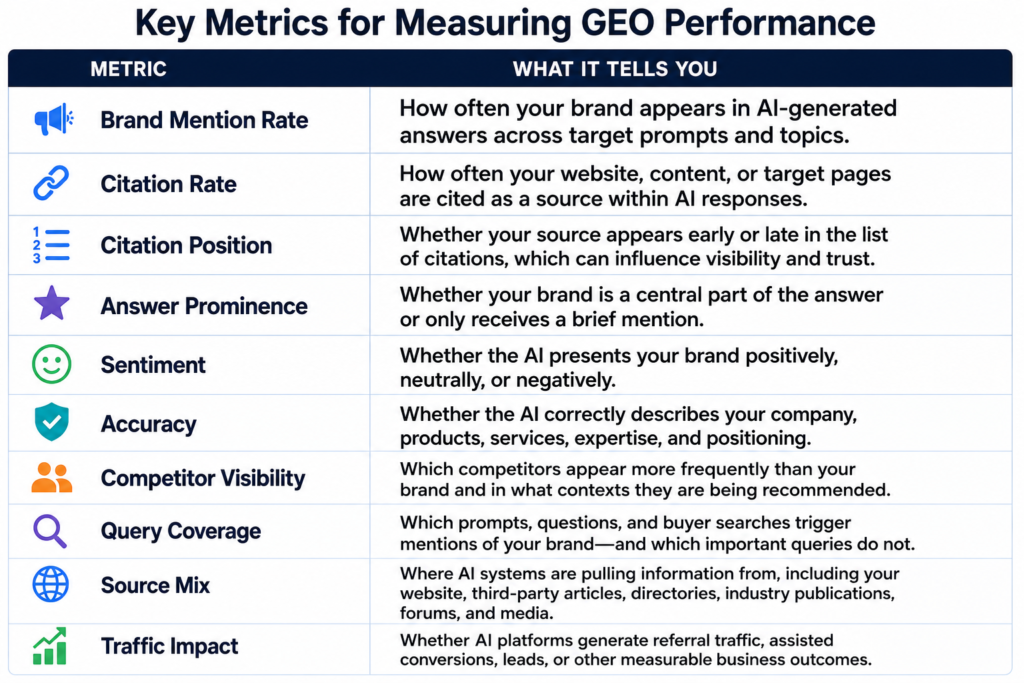
This is the foundation of LLM rank tracking, AI search tracking, and modern Generative Engine Optimization measurement.
Perplexity ranking is not the same as Google ranking
Traditional SEO is still important, but Perplexity visibility works differently.
In Google, the goal is often to move a URL from position 8 to position 3. In Perplexity, the goal is to become part of the answer and earn a citation that supports the user’s decision.
This is why businesses need a tracking model built specifically for AI answer engines.
Step 1: Build your Perplexity query set
The first step is to decide which prompts you want to track.
Do not only track branded searches. Perplexity users often ask natural, research-style questions. Your query set should include prompts that match real buyer intent.
Start with these categories:
For Shoden Global Communication, a Perplexity tracking set might include prompts around AI visibility, LLM SEO, Generative Engine Optimization, AI search tracking, digital PR, listicle inclusion, and citation engineering.
This also connects to the wider pillar topic: LLM Visibility Audit: How to Audit Brand Visibility on ChatGPT, Perplexity, and AI Overviews. That guide should help teams understand how to audit brand visibility on llms across multiple AI search environments.
Step 2: Segment prompts by search intent
A good rank tracker tool for Perplexity should not treat every query equally.
Some prompts are informational. Some are commercial. Some are directly tied to revenue. Segmenting prompts helps you understand which parts of the buyer journey you are winning.
Use these segments:
Informational prompts
These include questions such as “what is generative engine optimization” or “why is generative engine optimization important.” They help measure topic authority.
How-to prompts
These include questions such as “how to do generative engine optimization” and “how to optimize content for generative engines.” They show whether Perplexity sees your brand as a useful educator.
Comparison prompts
These include questions such as “answer engine optimization vs generative engine optimization” and “generative engine optimization vs traditional SEO.” They help you understand whether your content is being used to explain market differences.
Measurement prompts
These include questions such as “how to measure the success of generative engine optimization campaigns” and “how do I measure the ROI of generative engine optimization.” These are important because decision-makers often ask them before buying.
Commercial prompts
These include questions such as “best generative engine optimization platforms 2025,” “what are generative engine optimization services,” and “generative engine optimization agency.” These prompts are closer to conversion.
Once your prompts are segmented, you can track visibility by funnel stage instead of only tracking one blended score.
Step 3: Capture the answer, not just the citation
A simple citation count is useful, but it is not enough.
Your Perplexity tracking should capture the full answer because the wording matters. Being cited is good. Being cited as the leading solution is better. Being cited but misrepresented is a problem.
For every tracked prompt, record:
- The full Perplexity answer
- Whether your brand is mentioned
- Whether your website is cited
- Which exact URL is cited
- Citation order
- Competitors mentioned
- Competitors cited
- The wording around your brand
- The user intent of the prompt
- Date of the test
- Country or market tested
- Device or account conditions, when relevant
Over time, this gives you a clear view of where your AI visibility is improving and where competitors are still stronger.
Step 4: Score Perplexity visibility
To make tracking useful for business decisions, turn the data into a simple score. Here is a practical scoring model:
This gives each prompt a visibility score.
For example, if Perplexity recommends your brand, cites your website, cites the correct service page, and describes your business accurately, that prompt might score 8. If it only mentions your brand without citation, it might score 1 or 2.
The goal is not to create a perfect universal formula. The goal is to create a consistent way to measure change over time.
Step 5: Track citation quality
Not every citation has the same value.
A citation from your own website may support accuracy. A citation from a respected industry publication may support authority. A citation from a weak directory may give visibility but less trust. A citation from an outdated page may create risk.
Track citations by type:
Step 6: Compare your visibility against competitors
Perplexity tracking becomes more powerful when you measure competitors alongside your own brand.
For each important query, ask:
- Which brands are mentioned?
- Which brands are cited?
- Which competitors appear before us?
- Which competitor pages are being used as sources?
- Are competitors cited from their own websites or from third-party sources?
- What topics do competitors own that we do not?
- What content formats is Perplexity using most often?
This helps you identify content gaps and authority gaps.
For example, if competitors are cited in “best generative engine optimization platforms 2025” but your business is absent, the issue may not be one page. It may be a lack of third-party validation, comparison content, listicle inclusion, or clear service positioning.
Step 7: Use an AI search tracking dashboard
Manual checks can work at the beginning, but they quickly become hard to manage.
A proper AI search tracking dashboard should show:
- Prompt groups
- Brand visibility score
- Citation count
- Citation URLs
- Competitor visibility
- Sentiment trends
- Accuracy issues
- Visibility by funnel stage
- Changes over time
- High-priority optimization actions
This helps leadership understand whether AI visibility work is producing results.
Your dashboard should answer one simple question: Are we becoming easier for AI answer engines to find, trust, cite, and recommend?
How to improve Perplexity citations
Tracking is only useful if it leads to action.
Once you know where your brand is missing, you can improve your chances of being cited by making your content easier for search engines to understand and use.
Focus on these improvements:
- Answer the query clearly near the top of the page
Perplexity needs extractable answers. Add short definitions, direct explanations, and concise summaries. - Create content for high-opportunity questions
Build pages around questions such as “how does generative engine optimization work,” “how to measure the ROI of generative engine optimization,” and “is generative engine optimization the same as traditional SEO.” - Use comparison tables
AI answer engines often use structured comparisons. Tables can help clarify differences between GEO, AEO, LLM SEO, traditional SEO, and AI search tracking. - Strengthen entity signals
Make it clear who your company is, what it does, which services it offers, which industries it serves, and why it is credible. - Improve technical accessibility
Make sure important content is indexable, fast, well-structured, internally linked, and supported with schema where appropriate. - Build third-party authority
Perplexity may cite sources beyond your own website. Digital PR, listicle placements, expert quotes, and high-authority mentions can help reinforce your brand across the web. - Update content regularly
AI search visibility is not static. Refresh key pages when products, services, pricing, market language, or buyer questions change.
Helping Businesses Measure and Improve AI Visibility
Shoden Global Communication can help your business move from guessing to measurable AI visibility growth.
A strong Perplexity visibility program should include prompt research, LLM visibility audits, AI search tracking, content optimization, citation readiness, competitor analysis, digital PR, and monthly reporting.
Shoden Global Communication can help businesses identify where they are currently missing from AI answers, which topics they should own, which pages need improvement, and which external authority signals can help them become more visible.
For companies that want to be mentioned, cited, and chosen in AI-generated answers, the goal is not just more content. The goal is clearer positioning, stronger authority, better source signals, and consistent measurement.
FAQ
What is Generative Engine Optimization?
Generative Engine Optimization, often called GEO, is the process of improving how your brand, website, and content appear in AI-generated answers. It focuses on making your business easier for answer engines to understand, cite, and recommend.
Is Generative Engine Optimization the same as traditional SEO?
No. Traditional SEO focuses on rankings in search engines. GEO focuses on visibility inside AI-generated answers. The two overlap because technical SEO, content quality, authority, and crawlability still matter, but GEO also requires prompt tracking, citation analysis, entity clarity, and answer-level measurement.
How do you measure the success of Generative Engine Optimization campaigns?
Measure brand mention rate, citation rate, answer prominence, sentiment, competitor visibility, target page citations, AI referral traffic, and assisted conversions. A rank tracker tool for Perplexity should be part of this process.
How do you measure ROI from Perplexity visibility?
Start by tracking AI visibility improvements by prompt group. Then connect Perplexity referral traffic, assisted conversions, lead quality, branded search growth, demo requests, and sales conversations. ROI becomes clearer when AI search tracking is connected to your CRM and analytics tools.
What are Generative Engine Optimization services?
Generative Engine Optimization services help businesses improve their visibility in AI answer engines such as Perplexity, ChatGPT, Gemini, Claude, and AI Overviews. Services may include LLM visibility audits, content optimization, technical SEO, digital PR, entity optimization, citation tracking, and AI search reporting.
How often should you monitor Perplexity visibility?
For active campaigns, monthly tracking is a practical baseline. Competitive industries may need weekly checks for high-value prompts, especially around “best,” “top,” “vs,” “pricing,” “alternative,” and “agency” searches.
Conclusion
Perplexity visibility is now part of modern search performance.
A rank tracker tool for Perplexity helps you see whether your brand is being mentioned, cited, recommended, or ignored inside AI-generated answers. It also shows which competitors are winning, which sources Perplexity trusts, and which content gaps need to be fixed.
The businesses that measure AI visibility early will have a stronger advantage as buyers continue shifting from traditional search results to AI answer engines.
For Shoden Global Communication, this is the opportunity: help businesses build visibility where modern buyers are already asking questions, comparing providers, and choosing who to trust.































PR Outreach: How to Pitch Journalists in 2026
August 10, 2026