
AI brand visibility competitive analysis measures how often your brand appears against competitors across a fixed set of commercially relevant prompts in ChatGPT, Gemini, Perplexity, Google AI, and other answer engines. A useful analysis goes beyond mention counts. It compares recommendation frequency, citation sources, sentiment, answer accuracy, positioning, and buyer fit.
The objective is to determine why a competitor is repeatedly selected and convert that gap into concrete content, digital PR, authority, and positioning actions. The most reliable process uses the same prompts, platforms, and scoring rules each reporting period so changes can be compared consistently.
A general tracking report shows whether visibility changed. Competitive analysis investigates why a rival has an advantage and what may influence the gap. It can uncover clearer category language, stronger comparison pages, fresher proof, broader third-party coverage, or better alignment with a buyer persona.
Table of Contents
Download the AI Brand Visibility Competitive Analysis Template
This work should connect to the principles explained in our guide to what is AI visibility and support a measurable AI visibility service strategy. It is an assessment framework, not a promise of mentions, citations, or recommendations. Its purpose is to help teams understand how AI systems position brands relative to their competitors.
Why Do Competitors Appear in AI Answers Before Your Brand?
Competitors often appear first because the public evidence is clearer, more relevant, or easier to retrieve for the prompt. Strong positioning, decision-stage content, credible proof,and consistent third-party descriptions can make a competitor easier to understand and compare.
Typical advantages include:
- A precise category and ideal-customer definition
- Useful comparison, alternative, and best-fit content
- Verifiable case evidence and current product information
- Independent reviews, directories, media,or expert references
- Consistent descriptions across owned and third-party pages
For Google’s AI features, foundational SEO remains relevant: pages must be crawlable, indexed, and eligible to appear with a snippet. Google also says no special AI schema or machine-readable file is required.
Improve crawlability, retrieval, entity clarity, and evidence rather than looking for a shortcut.
Which Competitors Should You Benchmark?
Benchmark brands that solve the same problem for the same buyer, plus competitors that repeatedly appear in relevant AI answers. Three to five core competitors create a manageable set, with others added when they expose an important category or positioning shift.
Include direct, search, AI-answer, review, category, and emerging competitors. Exclude famous companies that are not realistic alternatives. Record why each competitor belongs so the benchmark remains defensible.
Which Buyer Prompts Should You Compare?
Compare prompts across the full decision journey, from category discovery to risk assessment. The set should represent genuine buyer needs, not many near-duplicate phrasings added only to enlarge the sample.
Cover these groups:
- Discovery: the type of solution for a problem
- Comparison: one brand versus another
- Best fit: the best option for a defined buyer or use case
- Alternatives: substitutes for a named provider
- Proof: evidence, experience, or results in an industry
- Implementation: adoption effort, integration, or support
- Risk: limitations, costs, compliance, or common concerns
Use buyer prompt research to validate persona, market, use case, and decision stage. Weight high-intent prompts more heavily, then keep their wording stable within each benchmark cycle.
How Do You Measure Competitor Share in AI Answers?
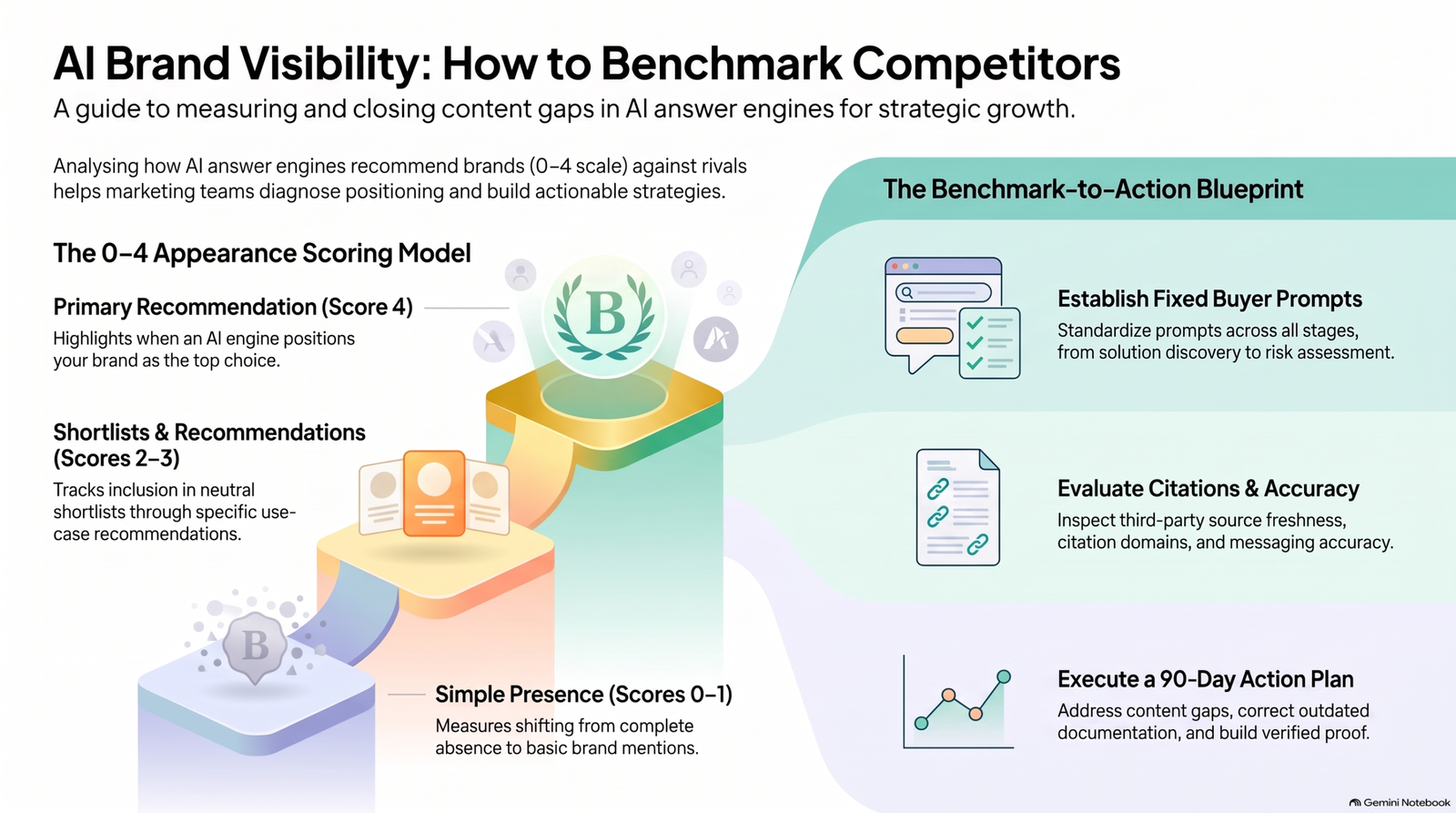
Measure competitor share by separating simple presence from recommendation strength. Track how often each brand appears, where it appears, whether it is recommended, and how much commercial weight the prompt carries.
A Practical Scoring Model
Use one appearance scale:
- 0 = absent
- 1 = mentioned
- 2 = included in a neutral shortlist
- 3 = recommended for a defined use case
- 4 = presented as the primary recommendation
Calculate weighted recommendation share as:
Brand recommendation points ÷ total recommendation points awarded to all benchmarked brands × 100
For a weighted benchmark, multiply each appearance score by its prompt weight before adding the brand’s points. Apply the same weights to every brand.
This is benchmark share, not market share. Report it with prompt presence, top-recommendation rate, citation rate, and platform-level results. Google notes that AI Overviews and AI Mode may use different models and techniques, so their answers and supporting links can vary.
Use AI search visibility metrics for the measurement framework and our guide to AI visibility tracking for capture rules.
AI Brand Visibility Competitive Analysis Scorecard
Use this scorecard to record how your brand and competitors appear in each AI answer and compare generative search visibility. Keep the prompt wording, competitor set, and scoring rules consistent across reporting periods. Record the AI engine, run date, language, and market alongside each observation.
The sample below uses fictitious SaaS brands and illustrative results. It does not represent actual platform testing or client data.
| Buyer prompt | Brand scores | Citation / source | Answer assessment | Next action |
| Best project management software for small agencies? | Our brand:0Comp A: 4Comp B: 2 | Cited: Company ASource:Independent comparison | Lead: Company ATone: Positive toward Company AAccuracy: Company A’s features correct | Create an agency comparison page with supporting evidence. |
| Which project management tools integrate with accounting software? | Our brand:1Comp A: 3Comp B: 0 | Cited: Our brandSource:Integration documentation | Recommendation:Company AOur brand:Mentioned; neutral toneAccuracy: Our details outdated | Update integration documentation and supporting proof. |
Apply the scale above to each brand listed in the Brand scores column. For each cited source, identify the brand it supports and retain the source URL. Specify whose prominence, sentiment, and accuracy you are assessing. If an answer includes several sources or conflicting descriptions, record those details separately in the spreadsheet.
Turn each finding into a specific action. A missing mention, an inaccurate description, and a competitor’s stronger third-party evidence require different responses. This makes prompt tracking useful for ongoing AI brand monitoring and competitor benchmarking.
Download the AI Visibility Competitive Scorecard
Download the spreadsheet to record buyer prompts, brand and competitor scores, citation sources, prominence, sentiment, accuracy, and recommended actions. It includes 200 blank observation rows, automatic mention and recommendation rates, and a separate fictitious SaaS example.
Use one row per AI answer. Enter zero when a brand is absent from an assessed answer, and leave unassessed scores blank. Keep the prompts, platforms, and scoring rules consistent when repeating the benchmark.
Download the AI visibility competitive scorecard (.xlsx)
Worked Example: Benchmarking a SaaS Brand Across Four AI Engines
This fictitious example illustrates the process. The figures are invented for demonstration and do not represent client results or actual platform testing.
Set Up the Benchmark
TaskHarbor, a fictional project management platform for small agencies, compares its visibility with three fictional competitors: FlowPilot, ProjectNest, and TeamLedger.
The benchmark uses 50 buyer prompts across ChatGPT, Gemini, Perplexity, and Google AI Mode, producing 200 answers in one reporting cycle. Each answer is assessed for all four brands using the same scoring rules.
The prompt set includes questions about agency workflows, software comparisons, integrations, implementation, pricing, and limitations.
Compare the Results
| Brand | Answers | ||
| Mentioning the brand | Recommending the brand¹ | Citing independent comparison sources supporting the brand | |
| TaskHarbor (our brand) | 40/200 (20%) | 18/200 (9%) | 12/200 (6%) |
| FlowPilot | 120/200 (60%) | 84/200 (42%) | 72/200 (36%) |
| ProjectNest | 70/200 (35%) | 40/200 (20%) | 28/200 (14%) |
| TeamLedger | 50/200 (25%) | 24/200 (12%) | 16/200 (8%) |
¹Recommendations include scores of 3 or 4. Each percentage uses all 200 answers as its denominator. Several brands can appear in one answer, so the percentages do not need to total 100%. These are presence and recommendation rates, rather than AI share of voice. The example and spreadsheet use unweighted rates; the weighted scoring model above is a separate calculation.
Identify the Competitor’s Advantage
FlowPilot leads the benchmark. Source review shows that it appears in more independent comparison articles addressing agency workflows and accounting integrations. These articles provide current feature details, clear buyer-fit explanations, and supporting evidence. TaskHarbor is missing from several of those comparisons, and its own integration documentation contains outdated information.
In this illustrative scenario, broader third-party comparison coverage is the leading explanation for FlowPilot’s advantage. Repeated citations support that diagnosis, but they do not prove that coverage alone caused the recommendations.
Turn the Gap Into Action
TaskHarbor prioritizes four actions:
- Correct outdated integration documentation.
- Publish an evidence-led comparison page addressing agency needs.
- Develop a verifiable customer case study demonstrating its agency workflow.
- Offer accurate product information and original evidence to relevant independent publishers for editorial consideration.
The next reporting cycle repeats the same prompts, engines, and scoring rules. The team reviews results by engine as well as overall, checking whether citation coverage, answer accuracy, and recommendation frequency improve.
Scores alone do not explain why one brand outperforms another. The next step is to analyze the sources, evidence, and narratives supporting each recommendation to understand why AI systems favor certain brands.
How Do You Analyze Citation Sources and Recommendation Quality?
Analyze citations by reviewing the domains used, their freshness, diversity, specificity, and relationship to the recommendation. A useful citation directly supports the claim being made rather than merely mentioning the brand.
For each answer, record the visible sources, supported claims, source type, publication date, evidence depth, and domains that recur across prompts. Distinguish owned pages from independent editorial, directory, review, and community sources.
Google’s documentation on AI features in Search describes supporting links in AI Overviews and AI Mode. Review the linked pages to understand what evidence supports the answer.
Do not assume one citation caused a recommendation. Look for repeatable patterns across prompts, runs, and platforms.
How Do You Identify Positioning and Narrative Gaps?
Identify narrative gaps by comparing how each brand is categorized, who it serves, what differentiates it, and what proof supports those claims. The problem may be an unclear or outdated public description rather than a simple content shortage.
Compare category label, ideal customer, use cases, differentiators, evidence, limitations, geographic relevance, and outdated statements. Then align current owned pages and important profiles with verifiable facts.
Focus on crawlability, source discovery, entity clarity, and public evidence. Do not claim that content can be inserted into model training data.
How Do You Identify Missing Comparison Content?
Find missing comparison content by mapping high-value prompts to the pages and sources that currently explain the buyer’s choice. A gap exists when buyers ask an important comparison question, but no clear, current, and evidence-led source answers it well.
Strong comparison content explains who each option suits, meaningful differences, implementation demands, verified pricing approaches, evidence, limitations, and alternatives. Add a visible review date for changing facts.
Use comparison content for AI answers to create fair, specific, and maintainable decision pages. Avoid unsupported superiority claims, copied feature grids, and pages for trivial keyword variations.
How Do Reviews and Community Discussions Reveal Competitor Positioning?
Reviews and community discussions reveal buyer language, associated use cases, and perceived trade-offs. Use them as buyer-intelligence and source-ecosystem inputs, never as a reason to manufacture mentions.
Record recurring strengths, objections, switching reasons, and unexpected category labels. Separate repeated themes from isolated anecdotes and verify factual claims elsewhere.
Google’s official guidance warns against seeking inauthentic mentions. Build genuine customer evidence, expert participation, and useful public resources instead.
What Should You Do After Finding AI Visibility Gaps?
Turn each gap into a prioritized action with an owner, deadline, and success measure. Rank opportunities by commercial impact, feasibility, diagnostic confidence, and likely time to influence public evidence.
A Repeatable Nine-Step Process
- Define the category, buyer personas, and decision stages.
- Choose direct and AI-visible competitors.
- Build a fixed, weighted prompt set.
- Test the same prompts across selected platforms.
- Score brand and competitor appearances.
- Analyze citations, source types, and answer language.
- Identify content, authority, review, community, and positioning gaps.
- Prioritize opportunities by commercial value and feasibility.
- Create a 90-day action plan and repeat the benchmark.
The plan may combine a corrected category page, an evidence-led comparison, refreshed case proof, updated third-party profiles, and outreach around an original first-party resource. Address the diagnosed gap instead of publishing more content by default.
Competitive-Analysis Checklist
Use this checklist to keep your competitive analysis consistent, document the evidence behind each finding, and turn visibility gaps into a prioritized action plan.
Define Your Competitive Set
☐ Select three to five competitors serving the same buyer and use case.
☐ Include brands that repeatedly appear in relevant AI answers.
☐ Record why each competitor belongs in the benchmark.
Build Your Buyer Prompt Set
☐ Cover discovery, comparisons, alternatives, buyer fit, proof, implementation, and risk.
☐ Validate prompts against actual buyer needs.
☐ Assign prompt weights and keep wording consistent across reporting periods.
Capture and Score AI Answers
☐ Use the same prompts across your selected AI engines.
☐ Record the engine, date, language, market, and search mode.
☐ Score each brand’s presence and recommendation strength using the same 0–4 scale.
☐ Assess prominence, sentiment, accuracy, and buyer fit.
Review Sources and Positioning
☐ Save cited URLs and identify which brands and claims they support.
☐ Distinguish owned content from independent comparisons, reviews, directories, and community sources.
☐ Check source relevance, freshness, and evidence quality.
☐ Identify missing comparison content, unclear positioning, and outdated information.
Turn Findings Into Action
☐ Prioritize gaps by commercial value, effort, and diagnostic confidence.
☐ Assign an owner, deadline, and success measure to each action.
☐ Build a focused 90-day improvement plan.
☐ Repeat the benchmark using consistent prompts, platforms, weights, and scoring rules.
How Often Should You Repeat the Analysis?
Repeat the full strategic analysis quarterly and monitor priority prompts monthly. This cadence can reveal material movement while reducing overreaction to one unusual answer.
Keep competitors, prompt wording, weights, and scoring rules consistent. Log the platform, date, search mode, and visible sources. Run an additional review after a major rebrand, product change, market entry, or competitor launch.
What Competitive-Analysis Mistakes Should You Avoid?
Avoid methods that create a precise-looking score without a reliable diagnosis. The most damaging mistakes are tiny samples, irrelevant competitors, raw mention counts, and failure to inspect the sources and language behind an answer.
Other errors include:
- Changing prompts between brands or benchmark periods
- Combining platforms without showing their differences
- Treating a neutral mention as a recommendation
- Ignoring inaccurate or outdated descriptions
- Publishing generic pages without evidence or update dates
- Failing to assign actions after the audit
A useful benchmark must be consistent enough to compare and practical enough to guide priorities.
Quick Answers
What is AI visibility competitive analysis?
It compares your brand with relevant competitors across prompts, recommendations, citations, accuracy, sentiment, positioning, and source quality.
Which competitors should be included?
Include direct competitors, AI-visible alternatives, search competitors, review leaders, and emerging brands serving the same buyer and use case.
What is competitor answer share?
It is the proportion of measured appearances or weighted recommendation points earned by each competitor in the benchmark.
How are citations compared?
Compare relevance, freshness, diversity, evidence depth, and how directly each source supports the answer.
What is a prompt gap?
It is a commercially relevant question where a competitor appears more strongly or your brand lacks useful supporting evidence.
How should sentiment be evaluated?
Assess surrounding language, recommendation strength, stated benefits, limitations, and risk framing.
How often should the analysis be repeated?
Monitor priority prompts monthly and complete a strategic review quarterly.
What action follows the benchmark?
Create a prioritized 90-day plan covering content, authority, public evidence, reviews, community participation, and positioning.
Conclusion
AI brand visibility competitive analysis is most useful when it explains why a competitor is being selected and what evidence-backed action should follow. Measure more than mentions, preserve a consistent baseline, and connect prompt, citation, narrative, and buyer-fit gaps to accountable work.
The goal is not to collect more metrics, it is to understand why competitors are being chosen and what actions are most likely to change the outcome.
Request an AI visibility competitive audit from Shoden Global to understand why competitors appear more often in AI answers and receive a prioritized plan to strengthen your content, authority, and positioning.
FAQ
How do I compare my brand with competitors in AI search?
Choose fixed competitor and weighted prompt sets, test them consistently, then score presence, recommendation strength, citations, accuracy, sentiment, and buyer fit. Preserve the baseline for later comparison.
Which AI visibility metrics are most useful for competitive analysis?
Use prompt presence, weighted recommendation share, top-recommendation rate, citation rate, source quality, description accuracy, USP clarity, buyer fit, and sentiment. No single metric explains the full gap.
How many competitors should be benchmarked?
Three to five core competitors usually provide a manageable benchmark. Add another when it reveals a meaningful narrative, source, or category shift.
Why can a smaller competitor appear more often?
A smaller competitor may have clearer positioning, more relevant decision content, or stronger public evidence for the use case. Company size alone does not determine answer relevance.
How do cited sources reveal a competitor’s advantage?
Repeated citations can show which domains, content types, and evidence support visibility. Review what each source proves and whether your brand has an equivalent or stronger public source.
Can community discussions change competitor positioning?
They can reinforce public narratives by repeating use cases, strengths and concerns. Use them to understand buyer language, but verify claims and never manufacture endorsements.
How do I prioritize the gaps found?
Score each gap by commercial value, effort, confidence, and time to influence. Address high-value accuracy and positioning issues before low-impact publishing opportunities.
Can Shoden Global conduct the analysis?
Yes. Shoden Global can build the competitor set, prompt framework, scoring model, citation review, and prioritized 90-day plan without guaranteeing mentions, citations or recommendations.





































PR Outreach: How to Pitch Journalists in 2026
August 10, 2026