

Effective PR outreach is not a volume game. It means finding a relevant journalist, presenting a credible story angle, and making the evidence easy to assess. In 2026, successful outreach must respect editorial independence while supporting earned mentions, source links, and measurable business goals.
PR outreach is the process of offering journalists, editors and publishers timely information, expert commentary, original data or a credible story idea that may help their audience. Strong outreach is personalised around relevance and evidence; it is not advertising and does not guarantee coverage.
Table of Contents
What Is PR Outreach?
PR outreach is a targeted editorial process: you offer information or access that may help a journalist produce useful coverage. The journalist independently decides whether the idea merits attention.
It is not advertising because no placement is bought or controlled. It is not generic link outreach because the offer is a story, source or evidence, not a backlink request. Unlike broad press release distribution, direct outreach selects people whose beat and audience match the idea.
Ethical outreach identifies the represented organisation, states claims accurately and discloses relevant commercial relationships. The PRSA Code of Ethics emphasises honesty, accuracy, transparency and disclosure of sponsors or conflicts.
What Makes a PR Story Newsworthy?
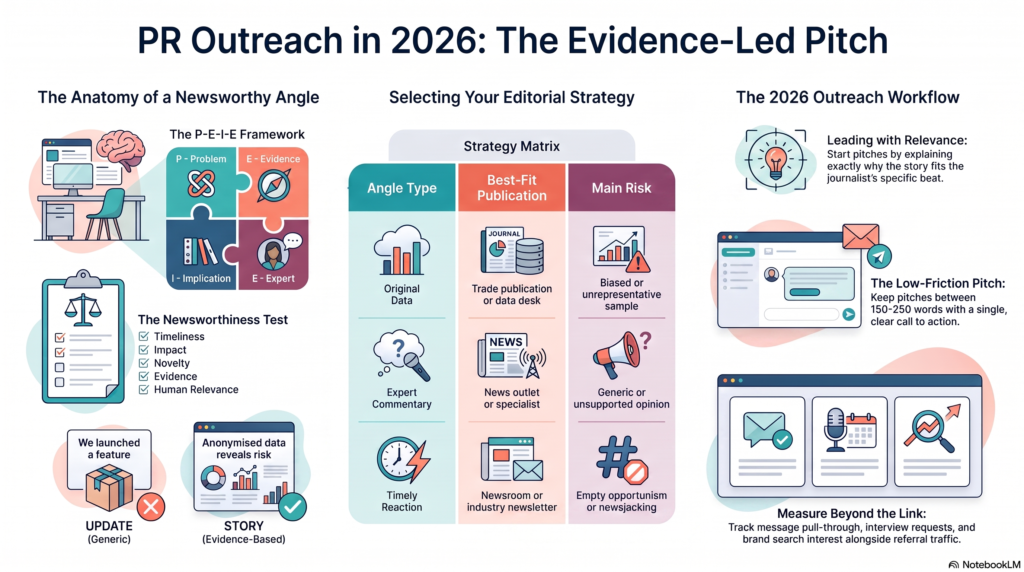
A PR story is newsworthy when it gives a defined audience a timely, consequential or genuinely new reason to care.
Test the idea against:
• Timeliness: Does it connect to a current development?
• Impact: Who is affected, and how?
• Novelty: What has changed or been discovered?
• Evidence: Can the main claim be checked?
• Human relevance: What does it mean for people?
• Tension: Is there a meaningful conflict or trade-off?
• Proximity: Does a place or community have special relevance?
• Expert access: Can a credible source explain the implications?
“We launched a feature” is an update. “Anonymised customer data reveals a new operational risk, with methodology and an expert available” is an editorial proposition.
How Do You Find the Right Journalists and Publications?
Find journalists by matching the story to their demonstrated beat, recent work, audience, geography and format.
Review recent bylines, author pages, newsletters, podcasts and source requests. Confirm the person still covers the subject and note whether they write news, analysis, features or opinion.
Build each list around one angle. A national reporter, trade editor and local journalist may value the same evidence for different reasons, so adapt the relevance honestly. Never claim to have read work you did not review.
Blogger Outreach Services may suit publishing relationships outside newsrooms, but it should not be presented as independent journalist coverage.
How Do You Build a Strong PR Angle?
Build a strong angle by connecting a real problem to verifiable evidence, explaining the implication, and offering a qualified expert.
Use the problem–evidence–implication–expert framework:
- Problem: State the audience problem or change.
- Evidence: Present data, documented cases, or an observable event.
- Implication: Explain what it could mean and for whom.
- Expert: Offer a named source who can interpret the evidence and its limits.
B2B example
A software company could analyse anonymised support records to identify an implementation failure, then offer its methodology, sector breakdown and an operations expert, not a product demonstration.
B2C example
A retailer could use consented returns data to examine sizing-related waste, supported by clear calculations, privacy safeguards and an independent specialist where possible.
What Does a Useful PR Pitch Angle Matrix Look Like?
A PR pitch angle matrix matches each idea to its evidence, publication type and editorial risk. The same evidence can support different editorial angles depending on the publication, audience, and news value.
Evidence-Led Editorial Angles
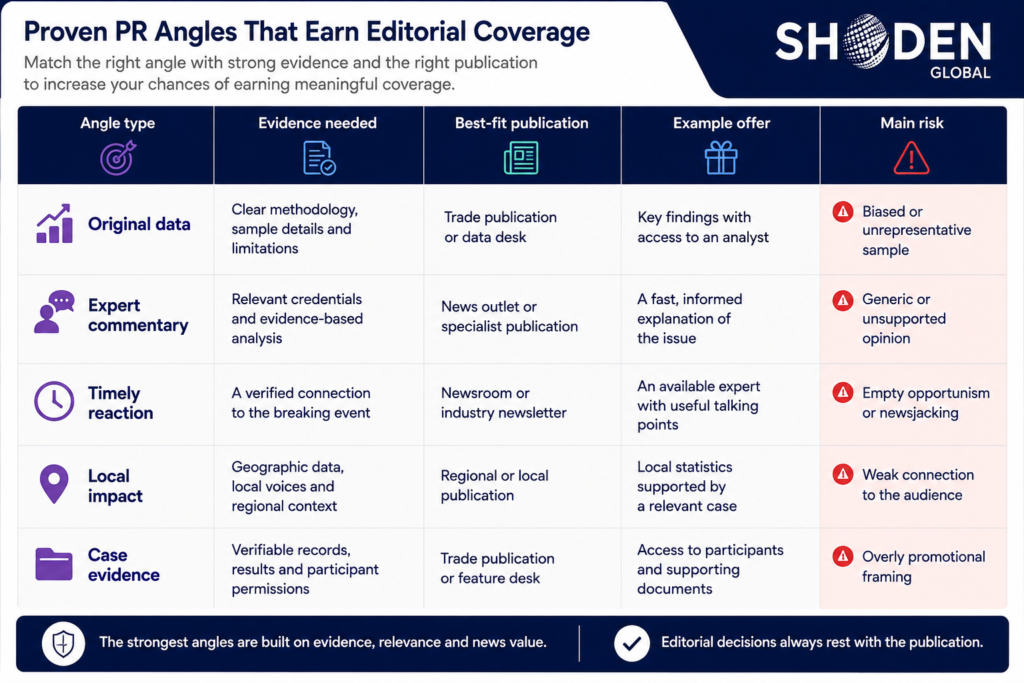
Choose the angle with the strongest editorial value, not simply the easiest asset to produce.
How Do You Run a PR Outreach Campaign Step by Step?
Run PR outreach as a controlled sequence from objective and evidence to targeting, communication, and measurement.
Skipping one stage often weakens the next: weak evidence leads to weak targeting, and weak targeting leads to weak outreach results.
- Define the business objective and audience.
- Choose a genuinely newsworthy angle.
- Collect evidence, expert access, and supporting assets.
- Build a focused journalist list by beat and recent coverage.
- Personalise the relevance, not superficial details.
- Write a short pitch with a clear offer and proof.
- Send, record and follow up professionally.
- Measure coverage quality and business impact, then refine the next angle.
Pre-send checklist:
• Angle is timely or meaningfully useful
• Pitch matches the journalist’s beat
• Subject line is specific and accurate
• Opening explains relevance immediately
• Claim is supported by evidence
• Named expert is available
• Assets and methodology are ready
• Commercial relationship is disclosed
• Call to action is simple
• Follow-up is respectful and limited
How Do You Write a Journalist Pitch?
Write a journalist pitch by leading with relevance, stating the story plainly, showing the proof and offering one simple next step.
Use this structure:
• Relevance: Why it fits the beat or audience
• Angle: The central finding, change or tension
• Evidence: Source, method, scale and limitations
• Offer: Interview, data, case access, images or documents
• Close: One low-friction question
Adaptable PR pitch template
Subject: [Specific finding or timely angle]
Hello [Name],
[One sentence explaining why this fits the journalist’s beat.]
[Organisation] has [analysed or documented] [evidence]. The main finding is [result], which may matter to [audience] because [implication].
We can provide [methodology], [named expert] and [supporting asset]. Important limitation: [limitation].
Would the evidence or an interview be useful?
[Name, role, organisation and contact details]
Use verifiable information. Avoid false familiarity, manufactured urgency and generic praise.
What Should a PR Pitch Subject Line Say?
A subject line should state the real editorial value accurately: the finding, affected audience, timely development or expert availability. It should help the journalist triage the email, not trick them.
Useful formats:
• New data: [finding] among [defined group]
• Expert available: What [development] means for [audience]
• Local figures: [issue] affecting [place]
• Case access: How [person] addressed [problem]
• Embargoed research: [topic] publishing [date]
Avoid “urgent,” “game-changing,” “exclusive” or “breaking” unless the description is true and supportable.
What Evidence Should You Include?
Include enough evidence for a journalist to assess the claim and investigate it independently.
Provide collection dates, methodology, sample definition and sample size where relevant. Explain exclusions, assumptions, uncertainty and commercial involvement. Prepare lawful access to data, charts, documents and case permissions.
Experts need relevant credentials and availability. Their comments should interpret evidence rather than repeat marketing copy. Marketing and endorsement claims must be truthful, non-deceptive and evidence-based; US campaigns should also assess FTC disclosure rules for material connections.
When and How Should You Follow Up?
Follow up after a reasonable editorial window while the pitch remains relevant. Timing should reflect urgency, publication cadence, and any deadline stated by the journalist.
One respectful follow-up is a sensible default. Send another only with material new value, such as updated data or a newly available source. Stop after a decline, opt-out, or expired angle.
Follow-up template:
Hello [Name],
Following up on the [specific angle] below. We can provide [strongest asset], and the key limitation is [limitation].
Would this be useful, or should I close the loop?
Thank you,
[Name]
How Can Expert Commentary Earn Mentions and Source Links?
Expert quotes and commentary can earn mentions and source links when it is relevant, prompt, attributable, and specific enough to improve the journalist’s work.
Prepare concise answers covering what changed, why it matters, what remains uncertain, and what the audience should watch. Include the expert’s full name, role, credentials and public profile. Meet the deadline and never invent expertise or conceal ghost-written commentary.
How Do You Measure PR Outreach?
Measure PR outreach from qualified engagement through coverage quality and business impact.
Track qualified replies, interviews, evidence requests, coverage, message pull-through, message accuracy, linked and unlinked mentions, referral traffic, branded search interest and assisted leads. Compare angles, publications and experts to identify meaningful outcomes.
Quality matters. A relevant trade feature may outperform a broad mention with no context. Google advises marking advertising or paid placements with rel="sponsored" or rel="nofollow"; earned editorial links should not be bought or disguised.
How Can PR Outreach Support AI Visibility?
PR outreach can support AI visibility by creating clear, crawlable and attributable third-party evidence about a brand, expert or claim. It cannot guarantee a mention, citation or recommendation.
Coverage may establish consistent entity details, named expertise and public context. Monitor whether credible sources appear for a defined prompt set, while treating results as variable observations rather than permanent rankings.
Google says established SEO practices remain relevant to its AI features, with no extra technical requirements beyond indexing and Search snippet eligibility. Helpful, reliable, people-first content remains foundational.
What Are the Most Common PR Outreach Mistakes?
The most common mistakes reduce trust or create unnecessary work for journalists.
Avoid:
• Scraped mass lists without beat validation
• Superficial personalisation
• Announcements with no audience consequence
• Hidden sponsorship or client representation
• Research without methodology or limitations
• Long introductions before the story
• Large unsolicited attachments
• Backlink requests disguised as editorial outreach
• Repeated follow-ups after silence or refusal
• Guarantees of coverage, rankings or AI citations
Google’s people-first guidance and the PRSA Code support the same practical rule: make the pitch useful enough to stand on its editorial merits.
Quick Answers
What is PR outreach?
Offering journalists relevant evidence, expert access or a credible story idea for independent editorial consideration.
How long should a PR pitch be?
Use the shortest length that establishes relevance, proof and an offer. Roughly 150–250 words is a working target, not a universal rule.
Should a pitch include a press release?
Only when it adds useful detail. Put the core story in the email.
How many journalists should receive one pitch?
Only contacts with a genuine beat and audience match. The number depends on the angle’s scope.
When should you follow up?
After a reasonable editorial window. Keep it brief and stop after a decline or opt-out.
Can PR outreach earn backlinks?
Coverage may include a useful source link, but the publisher controls whether and how it links.
How is PR outreach measured?
Measure qualified replies, interviews, coverage, links, message accuracy, referral activity, and business outcomes.
Can coverage improve AI visibility?
It can strengthen public evidence and source discovery, but cannot guarantee inclusion in AI answers.
Conclusion: What Makes PR Outreach Effective?
Effective PR outreach is built on relevance, evidence, and editorial independence. Strong campaigns match credible stories with the right journalists, provide clear proof, and respect the publication's role in deciding what deserves coverage.
Shoden Global can strengthen your PR outreach by developing evidence-led angles, identifying relevant journalists, preparing credible experts, and connecting coverage outcomes to measurable business objectives.
Explore Digital PR Services or ask Shoden Global to develop an evidence-led campaign designed to earn credible coverage, source links, and stronger public authority signals.
FAQ
How do you pitch a journalist?
Research the beat, lead with relevance, provide checkable evidence, offer useful access and close with one question.
What makes a PR pitch newsworthy?
Timeliness, impact, novelty, evidence, human relevance, proximity, tension and expert access can create audience value.
How do I find relevant journalists?
Use recent bylines, author profiles, newsletters, source requests and publication sections to identify recurring coverage.
What should a PR pitch subject line include?
Include the finding, affected group, timely issue or available expert. Remove unsupported promotional adjectives.
How many times should I follow up?
There is no universal number. One concise follow-up is a sensible default; send another only with material new value.
Does PR outreach guarantee coverage?
No. Journalists and editors control whether, when and how a story is covered.
Can digital PR support SEO?
It can earn relevant mentions, referral traffic and editorial links that build authority signals, but cannot guarantee rankings.
What results should a PR agency report?
Targeting quality, qualified responses, interviews, coverage, message accuracy, links, referral activity, leads, disclosures and next actions.





















































PR Outreach: How to Pitch Journalists in 2026
August 10, 2026