
Comparison Content for AI Answers
Overview
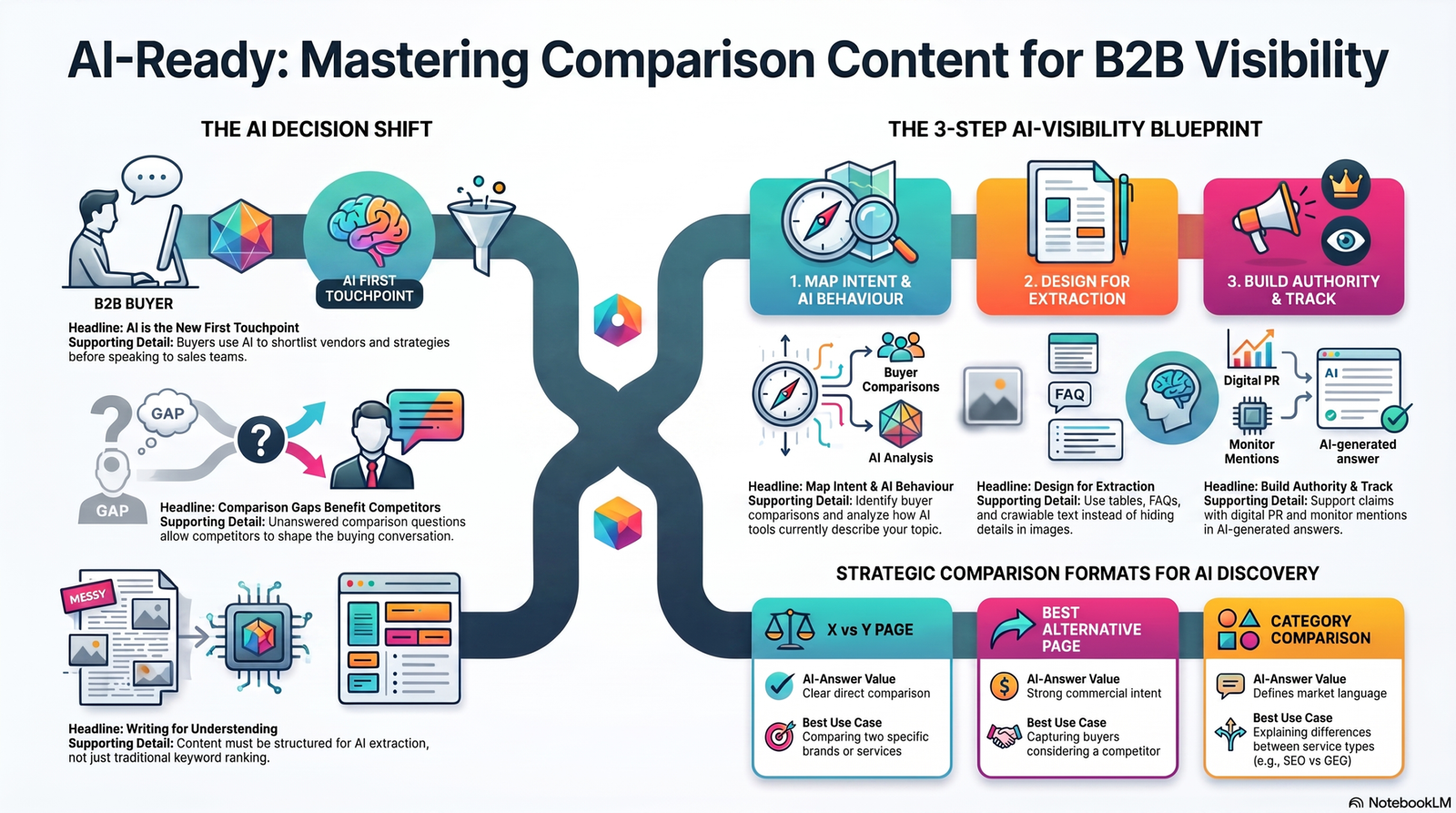
Buyers no longer search only to find products and services. They increasingly ask AI tools like ChatGPT, Perplexity, Gemini, Claude, and Google AI Mode to compare vendors, agencies, platforms, and strategies before ever visiting a website.
If your company doesn't publish clear comparison pages, AI systems may rely on competitors or third-party sources to answer those questions instead. In addition, it's important for your brand to appear on authority websites that publish comparison content that is relevant for your niche.These are cited and used as a source of truth in AI generated answers.
Every comparison question your company doesn't answer creates an opportunity for competitors to shape the buying conversation before your sales team ever has a chance to participate.
At Shoden Global, we help B2B companies create clear, structured, evidence-backed X vs Y content that makes their brand easier to understand, compare, cite, and recommend as part of a broader LLM SEO strategy.
Why Do AI Tools Use X vs Y Comparison Content?
AI tools use X vs Y comparison content because comparison questions are common, specific, and decision-driven. They help users move from general research to vendor selection, product evaluation, or strategy choice.
Google’s AI Mode is especially relevant here because Google describes it as useful for complex comparisons and says AI features may use query fan-out across related searches and supporting sources. That means a strong comparison page should not only answer one exact keyword. It should cover the surrounding questions a buyer would naturally ask while comparing options.
For example, a buyer asking “GEO vs SEO” may also want to know:
- Which one matters more for AI visibility?
- Does GEO replace SEO?
- Which service should a B2B company invest in first?
- What metrics should be tracked?
- Which agency can implement both?
A weak comparison page answers only the surface question. A strong AI-ready comparison page answers the main comparison and the next five questions a serious buyer is likely to ask.
This is where Shoden Global’s approach is different from generic content production. Our team builds comparison content around buyer intent, AI answer behavior, search demand, content structure, citation opportunities, and the commercial decision the page needs to support.
What Makes a Comparison Page Easier for AI Systems to Reuse?
A comparison page becomes easier for AI systems to reuse when it is clear, structured, specific, and supported by visible evidence.
The most important quality is clarity. AI tools need to understand what is being compared, what each option means, where each option is strongest, and what recommendation follows from the comparison. If the page is vague, overly promotional, or missing decision criteria, it becomes less useful as a source.
A strong AI-ready comparison page usually includes:
- A direct answer near the top of the page
- A short definition of each option
- A compact comparison table
- Clear use-case recommendations
- Pros and cons
- Pricing or cost considerations where possible
- Buyer-fit guidance
- FAQs written in natural question format
- Internal links to deeper service or product pages
- External authority signals where relevant
- Visible, crawlable text rather than important details hidden in images
Google’s structured data guidance also emphasizes that structured data should describe content that is actually visible on the page, and Google recommends JSON-LD when the site setup allows it.
For AI visibility, the content itself matters more than the markup alone. Schema can support understanding, but it cannot rescue a vague or thin comparison page. The page needs to be genuinely useful first.
How Does Shoden Global Create AI-Ready X vs Y Content?
Shoden Global creates AI-ready X vs Y content by combining buyer-intent research, LLM SEO, Generative Engine Optimization, answer-ready writing, structured page design, digital PR research, and ongoing AI visibility tracking.
The process is designed to help your brand become easier to compare and easier to recommend.
- Map the comparison opportunities
We identify the comparisons your buyers are already making. These may include brand vs brand, service vs service, category vs category, tool vs tool, or “best alternative to” searches.
- Analyze how AI tools currently answer
We review how AI systems describe the topic, which competitors appear, what sources are cited, what language is used, and where your brand is missing.
- Define the buyer decision criteria
We clarify what a real buyer needs to know. This may include pricing, implementation time, industry fit, technical depth, support model, proof, compliance, integrations, or strategic value.
- Build the page structure
We create a page that includes a direct answer, definitions, comparison table, criteria, use-case guidance, FAQs, internal links, and conversion paths.
- Write balanced and useful content
The goal is not to attack competitors or force a biased conclusion. The goal is to make the comparison honest enough to be trusted and clear enough to be reused.
- Add authority signals
Where appropriate, we support the page with digital PR, expert commentary, listicle inclusion, third-party citations, partner mentions, and related content.
- Track visibility over time
After publishing, we monitor whether the brand appears more often in AI answers, whether sentiment improves, which competitors are still appearing, and which sources AI tools continue to use.
This turns comparison content into an ongoing AI visibility asset rather than a one-time SEO article.
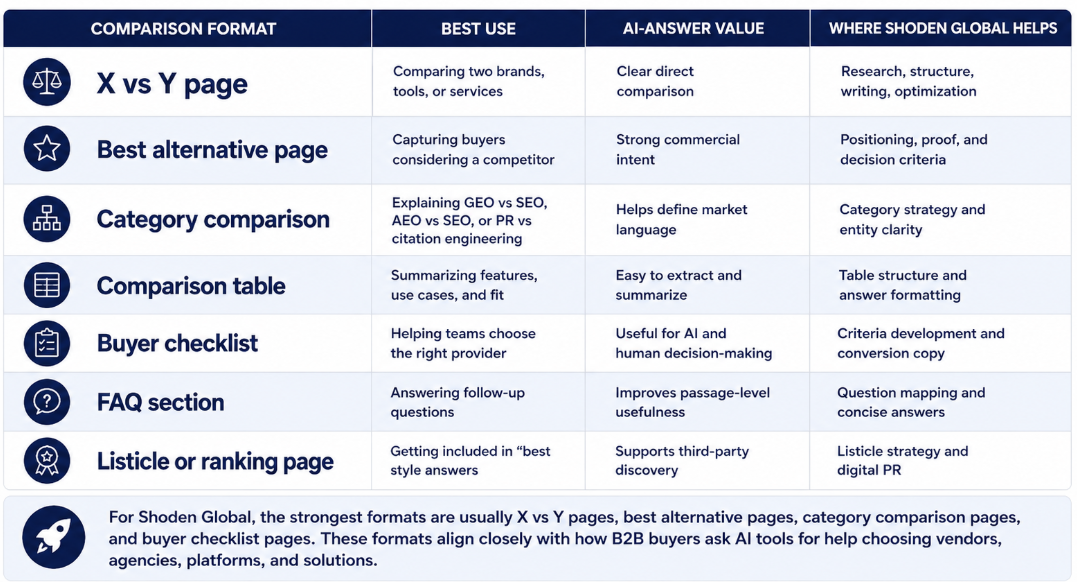
Which Comparison Formats Work Best for B2B Brands?
The best comparison format depends on the buyer’s decision stage. B2B buyers often need more than a simple pros-and-cons list because the decision may involve budget, risk, stakeholders, implementation, compliance, and long-term fit.
How Do You Choose the Right X vs Y Topics?
The right X vs Y topics are chosen by looking at buyer intent, AI answer behavior, competitor visibility, commercial value, and whether your brand has a credible reason to be part of the comparison.
Not every comparison deserves its own page. A good topic should meet at least one of these conditions:
- Buyers already compare the two options during sales calls
- Competitors appear in AI answers for that comparison
- The comparison has clear commercial intent
- The topic helps define your category
- Your brand has a strong, honest point of difference
- The comparison supports an important service or product page
- The answer can be supported with proof, examples, or third-party signals
For example, if we took Shoden Global we might recommend comparison content around topics such as:
- GEO vs SEO
- LLM SEO vs traditional SEO
- Digital PR vs link building for AI visibility
- Listicle inclusion vs guest posting
- AI visibility agency vs traditional SEO agency
- AI visibility tracking tools vs managed AI visibility services
- Content strategy vs citation engineering
- Shoden Global vs generic SEO agencies, written carefully and ethically
The goal is not to create comparison pages for every possible keyword. The goal is to build a focused library of decision content that helps buyers and AI systems understand when Shoden Global is the right fit.
What Should an AI-Ready Comparison Page Include?
An AI-ready comparison page should include enough structure, context, and proof to help both people and AI systems understand the decision clearly.
Use this checklist before publishing:
□ The page answers the comparison directly in the first few paragraphs
□ Each option is clearly defined
□ The comparison criteria are visible and specific
□ The page includes a simple comparison table
□ The content explains who each option is best for
□ The page includes pros, cons, and trade-offs
□ The recommendation is honest, not exaggerated
□ The page includes FAQs in natural question format
□ Important content appears as crawlable text
□ Internal links point to relevant service pages
□ Claims are supported with proof where possible
□ The page has a clear CTA
□ Structured data matches the visible page content
□ The page is updated when pricing, features, or market conditions change
Google’s guidance for AI features says important content should be available in textual form, content should be easy to find through internal links, and structured data should match the visible text on the page.
For B2B brands, this matters because AI tools need more than keywords. They need clear signals about what your company does, who you help, why you are relevant, and when you should be recommended.
What Are the Common Mistakes in AI Comparison Content?
The biggest mistake is creating a comparison page that reads like a sales pitch instead of a useful decision guide.
Here are the mistakes Shoden Global helps clients avoid:
- Writing a biased page that says your brand is best for everyone
- Ignoring the buyer’s actual decision criteria
- Hiding the answer too far down the page
- Using vague claims like “best,” “leading,” or “innovative” without proof
- Avoiding competitor names when buyers are clearly comparing options
- Creating tables with no meaningful differences
- Forgetting FAQs and follow-up questions
- Publishing one page and never updating it
- Failing to connect comparison content to digital PR and external authority
- Using schema that does not match visible content
- Measuring only rankings instead of AI mentions, citations, sentiment, and competitor movement
Another common mistake is treating comparison content as only an SEO asset. The best comparison pages can support sales calls, paid campaigns, customer education, partner enablement, and AI answer visibility at the same time.
Conclusion
Comparison content for AI answers is one of the fastest ways to help buyers and AI systems understand where your brand fits in the market. It gives your company a clear role in X vs Y questions, alternative searches, vendor comparisons, category definitions, and “best option for” prompts.
For B2B brands, this is especially important. Buyers are no longer only searching Google and clicking through ten links. They are asking AI tools to summarize, compare, shortlist, and recommend. If your brand is not represented clearly in those answers, competitors can become the default options.
Shoden Global helps B2B companies create comparison content that is structured, credible, useful, and connected to a wider AI visibility strategy. If you want your brand to appear more often in AI-generated comparison answers, start with a focused comparison content plan built around the questions your buyers are already asking.
What is the goal of comparison content for AI answers?
The goal is to make your brand easier for AI tools and buyers to understand when they compare options. A strong comparison page explains the difference between solutions, clarifies buyer fit, and gives AI systems structured information they can reuse.
Why is X vs Y content important for B2B brands?
X vs Y content is important because B2B buyers often use AI tools to compare vendors, services, strategies, and platforms before speaking to sales. If your brand is missing from those answers, competitors can shape the buyer’s shortlist before you are considered.
How does Shoden Global make comparison content AI-ready?
Shoden Global makes comparison content AI-ready by researching buyer questions, mapping competitor visibility, structuring the page around clear criteria, writing concise answers, adding comparison tables, strengthening internal links, and supporting the page with authority-building content.
Can comparison content help Shoden Global clients appear in ChatGPT and Perplexity?
Comparison content can improve the signals that make a brand easier to understand and recommend, but no agency can guarantee a specific mention in a specific AI answer. Shoden Global focuses on the controllable factors: content clarity, entity relevance, citations, internal architecture, and ongoing visibility tracking.
Should a comparison page be neutral or promotional?
It should be balanced. A comparison page can explain why your company is a strong fit, but it should also be honest about use cases, trade-offs, and buyer needs. Balanced content is more useful for readers and more credible as a source.
What is the difference between a comparison page and a normal service page?
A service page explains what you offer. A comparison page helps buyers evaluate options. The best AI visibility strategy uses both: service pages for clarity and conversion, comparison pages for decision support and AI-answer relevance.
How many comparison pages should a B2B company create?
A B2B company should start with the comparisons that matter most to revenue, sales conversations, and AI answer visibility. For many brands, the first set includes 5–10 high-intent comparison pages rather than dozens of thin pages.
What should I do before creating comparison content?
Start with an AI visibility audit. Identify where your brand is missing, which competitors appear, which sources are being cited, and which comparison questions have the strongest commercial intent.