
A niche edits service promises contextual links from pages that are already published, but an older page is not automatically safer. The decisive issue is whether the update serves readers and reflects an independent editorial decision, or whether it exists mainly to influence search rankings.
A niche edit is a link added to an existing published page, usually inside a relevant paragraph. The format is not automatically harmful. Risk increases when payment is intended to influence rankings, the link lacks editorial justification, the anchor is forced, or the publisher updates content without genuine reader value.
Table of Contents
What Is a Niche Edits Service?
A niche edits service adds a link to an article or resource that is already live. It may also be called contextual link insertion, editorial link insertion, or a link insertion service.
A legitimate update begins with a reason to improve the page: replacing a broken reference, supporting a claim, crediting an original source or adding current evidence. The publisher controls the decision, wording and destination.
A risky service starts with a buyer’s desire for ranking influence, then finds a page for the commercial link. Existing context can be useful, but compensation may create an edit that only appears editorial.
How Do Niche Edits Work?
Niche edits usually involve selecting a useful destination, finding an existing page that may need it, contacting the publisher, completing editorial review, and monitoring the update. A responsible process keeps the publisher in control.
The source should support the specific claim. The editor decides whether the page needs changing and approves the revised passage. Reporting should record the page, context, link attribute, commercial relationship and monitoring terms.
A provider that cannot explain who authorised the edit, why it was needed or how compensation was handled has not supplied enough evidence for approval.
Are Niche Edits Safe for SEO?
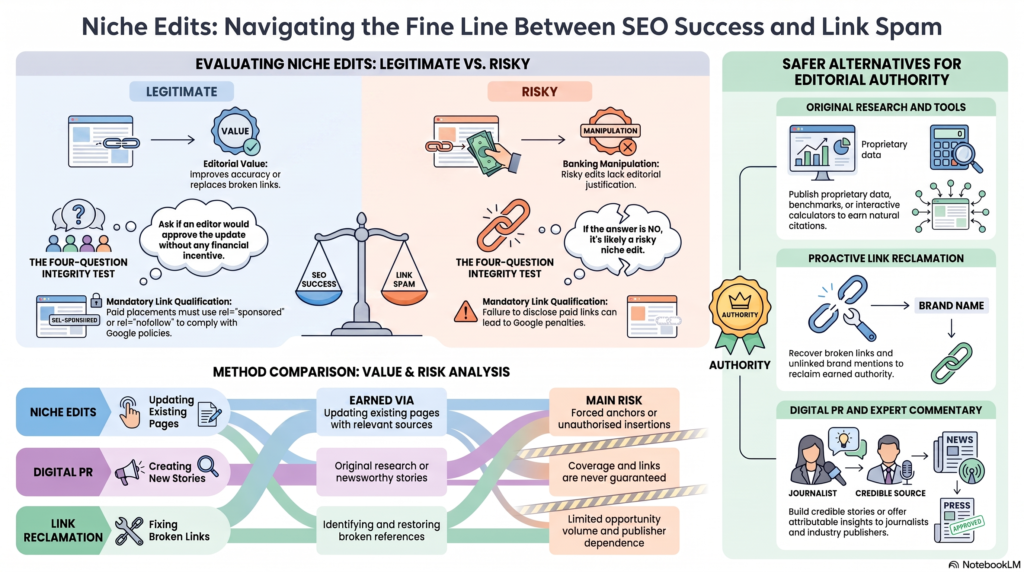
Niche edits can be legitimate, but they are not automatically safe. Risk depends on purpose, relevance, editorial independence, disclosure, link qualification, and audience value.
Google defines link spam as creating links to or from a site primarily to manipulate rankings. Examples include buying or selling links for ranking purposes and paid content containing links that pass ranking credit. Violations may be detected automatically or reviewed manually and can affect search visibility.
Google says paid placements should use rel="sponsored". Rel="nofollow" remains accepted, although sponsored is preferred.
Ask four questions:
• Would the publisher make this update without a ranking promise?
• Does the source materially improve the paragraph?
• Is any commercial relationship transparent and correctly qualified?
• Would an experienced editor approve the full context?
A “no” should trigger further review or rejection.
When Can an Existing-Content Link Be Legitimate?
An existing-content link can be legitimate when it improves accuracy, attribution, usability, or completeness and the publisher independently approves the change.
Valid reasons include:
• Replacing a broken or discontinued resource
• Citing a current primary source instead of an outdated statistic
• Adding new research that strengthens the explanation
• Crediting an expert whose original work is discussed
• Linking to official technical documentation
• Updating a resource list after a product or policy change
The destination should be the best source for the claim. A loosely related sales page is rarely a strong citation when an original report, dataset, or detailed guide is available.
What Risks Come With Paid Niche Edits?
Paid niche edits create policy, quality, operational, and brand risks when compensation drives the editorial decision. The strongest warning sign is a placement that cannot be justified without authority metrics or ranking outcomes.
- Link spam: An unqualified paid link intended to pass ranking credit can match Google’s link-spam examples.
- Irrelevance: A related domain can still contain a page with no meaningful connection to the destination.
- Unauthorised access: A provider unable to prove approval may be using a compromised workflow. Google classifies content placed without permission, including injected links, as hacked content.
- Placement footprints: Repeated templates, anchors and unrelated links can indicate a network-led campaign.
- Forced anchors: Keyword-heavy wording can distort the sentence and overstate relevance.
- Removal risk: Editors or future owners may delete the link or change the terms.
- Brand damage: Placement beside deceptive or unrelated commercial content can weaken trust.
- Weak referral value: A high metric does not ensure relevant visitors or commercial value.
Google recommends descriptive, concise, and relevant anchor text, written naturally rather than as a forced keyword combination.
How Can You Evaluate a Proposed Niche Edit?
Evaluate a proposed niche edit as an editorial and brand decision, not a metric purchase. Establish why the page needs the source, who controls the edit, what relationship exists, and whether the placement remains defensible without ranking claims.
Eight-Step Evaluation Process
- Confirm why the existing page genuinely needs the new source.
- Check topical relevance at page, site and audience level.
- Review the page’s publication history, authorship and editorial ownership.
- Inspect outbound links, anchors and signs of a placement marketplace.
- Clarify whether payment or another incentive is involved.
- Require correct disclosure and link qualification where applicable.
- Evaluate referral, brand and reader value beyond authority metrics.
- Document approval, monitoring and removal terms before proceeding.
Placement-Quality Checklist
• The link adds information or evidence the reader genuinely needs
• The destination page is the best source for the cited claim
• The publisher has a real audience and editorial identity
• The anchor reads naturally and is not over-optimised
• The surrounding paragraph remains accurate after the change
• Any paid relationship is disclosed and qualified appropriately
• The page is not overloaded with unrelated commercial links
• The placement can withstand a human editorial review
• The campaign is not dependent on guaranteed rankings
• The link is monitored for removal or material changes
Save approval records, screenshots, link attributes, and the original context for later review.
How Do Niche Edits Compare With Guest Posts, Digital PR and Link Reclamation?
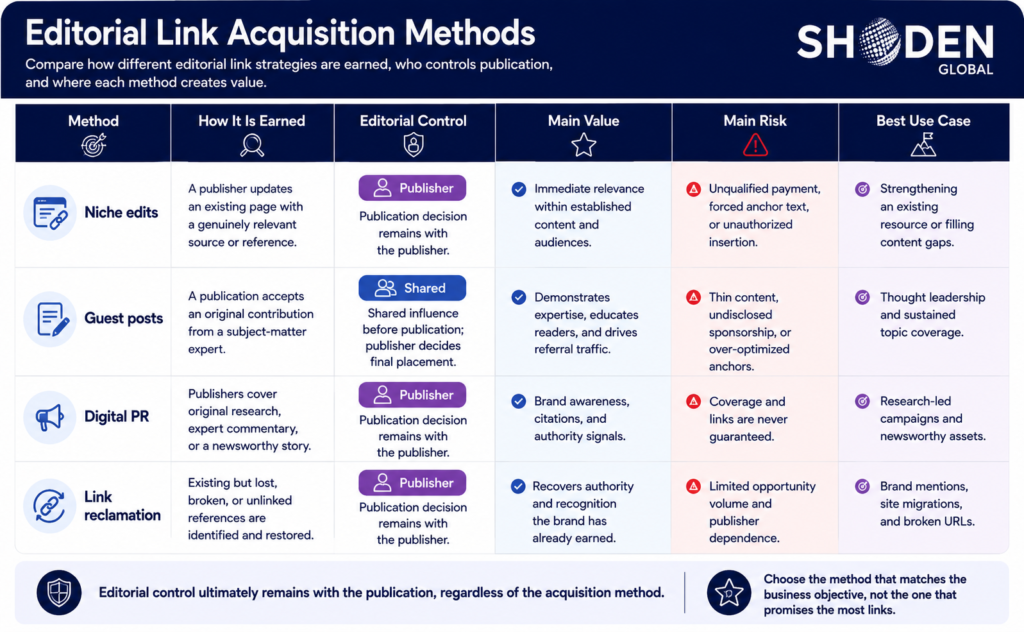
Niche edits work best when an existing page genuinely benefits from a new source, while guest posts and digital PR are stronger options when new evidence, expertise or broader awareness are required. Link reclamation is most valuable when recognition already exists but has been lost or disconnected.
A broader Off-Page SEO Services strategy can combine methods. Digital PR Services can build evidence, while SEO Outreach, Blogger Outreach Services and Link Acquisition and Editorial Links activity can connect useful assets with editors.
What Are Safer Alternatives to Niche Edits?
Safer alternatives create a genuine reason to cite the brand instead of buying access to an existing paragraph. They require stronger assets but can produce clearer editorial independence and more durable authority signals.
Create New Evidence
- Original research: Publish proprietary data, surveys, benchmarks or experiments.
- Useful tools: Create calculators, templates, checklists or interactive resources.
- Expert commentary: Offer attributable insight to journalists and industry publishers.
Earn Editorial Attention
- Digital PR: Build credible stories around data, market change or first-party experience.
- Editorial contributions: Submit original analysis that serves the publication's audience.
- Resource updates: Suggest accurate replacements for genuinely outdated sources.
Recover Existing Authority
- Link reclamation: Recover broken links, lost references and unlinked brand mentions.
- Partner pages: Earn inclusion through a real commercial, technical or community relationship.
Guidance on Reciprocal Linking can also help teams distinguish real partnerships from excessive exchanges performed mainly for cross-linking.
What Should You Ask a Niche Edits Provider?
Ask for evidence of editorial legitimacy, not just site lists and authority scores. The answers should reveal sourcing, approval and compensation.
• How was the publisher relationship established?
• Does an authorised editor approve every change?
• Why does the page need this source?
• Is money, a product, a service or another incentive involved?
• Who writes and approves the revised paragraph?
• How are page, site and audience relevance assessed?
• Which rel attribute will be used for a paid placement?
• What happens if the link is removed or the page changes?
• Will reporting include context, approval and link qualification?
• How are ownership changes and suspicious outbound links screened?
Reject claims that links are “undetectable” or guaranteed to rank. A defensible provider should accept transparency and human review.
What Are the Most Common Niche Edit Mistakes?
The most common mistakes treat links as interchangeable units, prioritising metrics, volume or exact-match anchors over purpose, audience and editorial ownership.
• Buying by DR or another score without reviewing the page
• Forcing exact-match commercial anchors
• Accepting only loosely related pages
• Ignoring ownership or editorial-policy changes
• Treating every established article as an insertion opportunity
• Overlooking clusters of unrelated commercial links
• Failing to record compensation and link qualification
• Counting a live URL as success despite no reader value
• Depending on replacement guarantees instead of quality
• Combining niche edits with excessive Reciprocal Linking
A stronger test is whether the placement adds verifiable value and remains credible under human review.
Quick Answers
What is a niche edit?
A link added to an existing published page, usually within a relevant paragraph.
Are niche edits against Google policies?
Not automatically. Links created or paid for mainly to manipulate rankings can violate policy when handled incorrectly.
Can a legitimate page update include a new link?
Yes. An editor may add a primary source, current research, expert credit or a replacement for a broken reference.
What makes a niche edit risky?
Undisclosed payment, forced anchors, weak relevance, unauthorised access, placement networks and no editorial reason.
Are niche edits better than guest posts?
Neither is inherently better. Quality depends on editorial purpose, audience value and publication control.
Should paid niche edits use rel=sponsored?
Yes. Google prefers rel="sponsored"; nofollow remains acceptable.
How should a provider be vetted?
Verify authorisation, acquisition method, relevance, compensation, editorial control, attributes, reporting and removal terms.
What is the safest alternative?
No method is risk-free, but original research, digital PR, expert commentary and reclamation provide clearer reasons to earn references.
Conclusion
A niche edits service should not be treated as a shortcut to authority. An existing-content link is defensible when the page genuinely benefits from the source, the publisher controls the change, the relationship is transparent, and any paid placement is qualified correctly.
Prioritise relevance, evidence and reader usefulness. Build assets worth citing and combine responsible outreach, digital PR, reclamation, and editorial contributions.
Request a safer editorial authority and link-risk review from Shoden Global. Our team will assess proposed placements, identify policy and brand concerns, and help shape an evidence-led off-page strategy that supports sustainable visibility.
FAQ
What does a niche edits service do?
It proposes links for existing pages and coordinates publisher review, insertion and reporting.
Are niche edits safe for SEO?
They may be legitimate when relevant and editorially independent. Unqualified paid links intended to influence rankings carry greater policy risk.
What is the difference between niche edits and guest posts?
A niche edit changes an existing page. A guest post adds a new contribution.
Can niche edits be paid?
Yes, but Google recommends rel="sponsored" for paid placements, with nofollow also accepted.
How do I evaluate a niche edit opportunity?
Review the editorial reason, relevance, publisher identity, compensation, attributes, reader value and monitoring terms.
What anchor text should be used?
Use concise, descriptive wording that fits naturally and represents the destination accurately.
Can a niche edit be removed later?
Yes. Editors, owners, and policies can change, so document monitoring and removal terms.
Which alternatives build stronger authority?
Original research, expert commentary, digital PR, useful tools, reclamation and credible editorial contributions build stronger public evidence.















































PR Outreach: How to Pitch Journalists in 2026
August 10, 2026