

Choosing between content marketing vs content creation services starts with one question: do you need help producing content, or do you need someone to manage the entire program? Both can support growth, but they solve different operational problems. One fills your production pipeline. The other connects research, strategy, creation, distribution, optimization, and reporting.
Content creation services produce assets such as blog posts, landing pages, case studies, videos, emails, and social content. Content marketing services cover the broader process of deciding what to create, why it matters, how it will reach the right audience, and how results will be measured and improved.
Table of Contents
What Are Content Marketing Services?
Content marketing services manage the system used to attract, educate, and convert an audience through useful content. The provider may own audience research, keyword planning, editorial strategy, production, publishing, distribution, promotion, performance analysis, and improvement.
A content marketing company does more than deliver assets. It helps decide which topics deserve investment, how they support business goals, which formats fit the buyer journey, and what should happen after publication.
Deliverables may include a content strategy, topic clusters, editorial calendars, search briefs, articles, landing pages, newsletters, social campaigns, content refreshes, and reporting. The exact mix should reflect the company’s audience, sales process, resources, and priorities.
What Are Content Creation Services?
Content creation services produce assets based on an agreed brief, strategy, or content plan. They are a strong fit when a company knows what it wants to publish but lacks the time, capacity, or specialist skills to create it consistently.
A creation partner may write articles, develop landing page copy, create graphics, edit videos, produce case studies, or repurpose long-form content. Responsibility often begins with a brief and ends with an approved asset.
Some providers also perform research, editing, SEO optimization, formatting, or uploading. They may not own strategy, distribution, campaign performance, or the editorial roadmap unless those tasks are included in the agreement.
What Is the Main Difference Between Content Marketing and Content Creation?
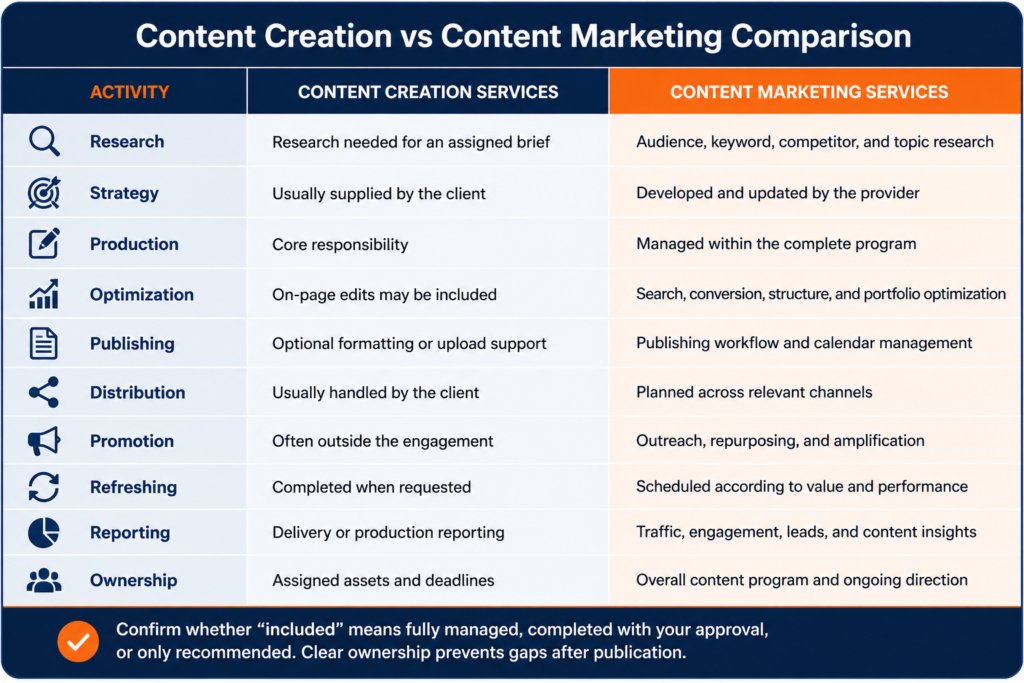
The main difference is scope and ownership. Content creation is the production function inside a larger content program. Content marketing includes production plus the decisions and processes that make content useful to the business.
Content creation asks, “What asset should we make from this brief?”
Content marketing asks, “What should we create, for whom, for what purpose, how will people find it, and how will we improve results?”
A creation provider is usually accountable for quality and deadlines. A content marketing agency may also own the editorial system, channel coordination, performance reporting, and recommendations for the next cycle.
Which Activities Belong to Strategy, Production, Distribution, and Measurement?
Responsibilities can overlap, so the service agreement should define who owns each activity.
Which Service Is Better for SEO Growth?
Content marketing services can be better suited to sustained SEO growth when a company needs strategy, optimization, internal linking, updates, and measurement in addition to production. A strong program needs topic selection, search intent alignment, internal linking, quality control, updates, and measurement over time. Shoden’s guide to GEO vs. SEO explains how traditional SEO foundations also support visibility in AI-assisted search.
Content creation services can support SEO when an internal team already owns those functions. An in-house SEO lead can supply briefs, target queries, page structures, internal links, and standards while an external team handles production.
Choose creation support when your SEO plan is sound, but execution is slow. Choose full content marketing when you need both the plan and the production engine.
Which Service Is Better for AI Visibility?
Content marketing services can be better suited to a coordinated AI visibility program when a company needs support across its broader content ecosystem rather than production for individual pages.
A complete program can identify recurring buyer questions, build authoritative topic coverage, place concise answers beneath question-based headings, strengthen brand consistency, cite credible sources, and keep important pages current. It can also connect supporting articles to pillar content rather than publishing disconnected posts.
Content creation services can be enough when your team already has a clear framework. Creators should then receive the target question, intended answer, supporting evidence, required internal links, and preferred format.
When Are Content Creation Services Enough?
Content creation services are enough when your company has clear strategic direction and needs dependable execution. This model works best when someone internally can prioritize topics, write briefs, review accuracy, manage publishing, distribute content, and evaluate results.
Creation-only support is suitable when:
- You have a content strategy and editorial calendar.
- Your team owns keyword and audience research.
- You need more capacity without permanent headcount.
- Internal experts can review brand and subject accuracy.
- Your team can publish, promote, refresh, and measure the work.
It also fits one-time projects such as a website rewrite, a batch of product pages, case studies, or executive thought-leadership drafts.
When Does a Company Need Full Content Marketing Services?
A company needs full content marketing services when it lacks the strategy, coordination, or ownership required to turn content into a repeatable growth program.
This model is appropriate when publishing happens without a roadmap, teams disagree about priorities, distribution is inconsistent, older assets are never updated, or performance data does not shape future work. It can also replace the burden of managing separate strategists, writers, editors, designers, publishers, and analysts.
Full-service support is valuable during a market launch, website expansion, SEO initiative, brand repositioning, or demand-generation program. The provider connects business goals to topics, formats, channels, workflows, and measurement.
How Do Content Marketing and Content Creation Costs Compare?
Content creation services may have a lower direct cost because the provider owns a narrower part of the process. Pricing may be based on each asset, monthly volume, project scope, format, or expertise required.
Content marketing services may require a higher investment because they can include planning, project management, production, distribution support, optimization, and reporting. The price may also cover a strategist, editor, writer, designer, SEO specialist, and account lead.
The lower quote is not always the better value. Creation-only work can become expensive when employees must spend significant time preparing briefs, correcting misalignment, coordinating publishing, and fixing distribution gaps. Compare total operating cost, not only the production fee.
Can One Provider Manage Both Services?
Yes. One provider can manage both content creation and content marketing, but the agreement should separate production deliverables from program responsibilities.
An integrated provider can reduce handoffs because strategists, creators, editors, and performance specialists work toward the same objectives. It can also improve consistency across briefs, brand voice, optimization, publishing, and reporting.
Do not accept “full service” as a vague promise. Ask who performs each task, how often strategy is reviewed, which channels are included, how approvals work, what reporting is provided, and who owns source files, accounts, and published content.
How Should You Choose the Right Service Model?
Choose the model by identifying the missing capability in your workflow. Buying a full program when you only need production adds complexity. Buying production when no one owns strategy creates assets without direction.
A Step-by-Step Buying Checklist
- Define the outcome, such as traffic, leads, sales enablement, customer education, or brand authority.
- Audit who owns research, strategy, briefing, editing, publishing, distribution, and reporting.
- Decide whether the main constraint is production capacity or program leadership.
- Assign every stage of the lifecycle to your team or the provider.
- Review how ideas become briefs, drafts, published assets, campaigns, and recommendations.
- Agree on success measures that reflect the content’s purpose.
- Start with a defined pilot, content roadmap, or content sprint.
The right model should remove bottlenecks while keeping accountability clear.
What Mistakes Do Companies Make When Buying Content Services?
The most common mistake is comparing providers only by the number of assets promised. Output does not reveal whether topics are strategically useful, whether the content will be distributed, or whether anyone will improve it after publication.
Other mistakes include buying content before defining the audience, expecting writers to create strategy from a thin brief, assuming basic optimization equals a full SEO program, skipping subject-matter review, and leaving publishing or promotion unassigned.
Companies also lose value when they measure activity instead of outcomes. Define the job each asset must perform, assign ownership across the lifecycle, and evaluate the provider against that responsibility.
Quick Answers
Is Content Creation Part of Content Marketing?
Yes. Content creation is one function within content marketing, which also includes strategy, distribution, promotion, measurement, and improvement.
Do Content Creation Services Include SEO?
They may include on-page optimization, but scope varies. Confirm whether research, briefs, internal links, metadata, updates, and tracking are included.
Are Content Marketing Agencies More Strategic?
They are generally hired for broader strategic ownership, but capabilities differ. Review the team, process, deliverables, and reporting rather than relying on the label.
Can an In-House Team Use Content Creation Services?
Yes. This model works well when the in-house team owns strategy and uses an external partner to increase production capacity.
Which Service Is Better for a Small Business?
A small business with a capable marketing lead may need only content creation. A business without a clear plan or channel owner may gain more from end-to-end content marketing services.
Should You Hire One Provider or Several Specialists?
One provider can simplify coordination. Several specialists can work when someone internally has the expertise and time to manage standards, deadlines, and handoffs.
Conclusion
The choice between content marketing and content creation services comes down to the ownership your company needs. Choose content creation when your team has the strategy, briefs, publishing process, and performance management in place but needs reliable production.
Choose content marketing when you need one partner to shape the plan, create assets, coordinate distribution, and improve the program over time.
Shoden Global offers both paths. Explore Content Creation Services when you need high-quality production built around your strategy. Choose Content Marketing Services when you need end-to-end management from research and planning through publishing, distribution, refreshing, and reporting.
FAQ
What Do Content Marketing Services Usually Include?
They commonly include research, strategy, editorial planning, production, optimization, publishing support, distribution, reporting, and ongoing recommendations.
What Do Content Creation Services Usually Deliver?
They typically deliver articles, web copy, landing pages, case studies, emails, social posts, graphics, or videos based on an approved brief.
Can Content Creation Services Generate Leads?
Yes, when assets address relevant buyer needs and are supported by suitable offers, distribution, internal links, and conversion paths. Production alone does not guarantee leads.
How Long Should a Content Marketing Engagement Last?
The right duration depends on the goal, competition, sales cycle, publishing pace, and starting position. The agreement should include milestones and review points.
Who Should Own the Content Strategy?
Ownership can sit with an internal marketing leader or an external partner. One accountable person or team should control priorities, standards, and performance decisions.
What Should Be Included in a Content Brief?
A useful brief defines the audience, search intent, primary question, desired outcome, key points, evidence requirements, brand guidance, internal links, format, call to action, and approval process.
Can You Start With Creation and Add Marketing Later?
Yes. Many companies begin with a production project and expand into strategy, distribution, or reporting after the provider has demonstrated quality and learned the business.








































PR Outreach: How to Pitch Journalists in 2026
August 10, 2026