
More agencies now offer Generative Engine Optimization (GEO), AI visibility, and LLM SEO services, but those offerings vary significantly. Some specialize in technical SEO, others focus on content or digital PR, and only a smaller group publicly document integrated approaches that combine technical optimization, AI visibility measurement, authority building, and ongoing performance reporting. Choosing the right partner requires looking beyond marketing claims to compare capabilities, evidence, and buyer fit.
Unlike many "best agency" roundups, this comparison evaluates providers using published methodologies, documented capabilities, public evidence, buyer fit, service depth, measurement, pricing transparency, and stated limitations rather than affiliate rankings or subjective opinions.
Disclosure: Shoden Global created this comparison and is included in the evaluation. Agency information was reviewed using public service pages, methodologies, case studies, and available evidence on July 26, 2026. No agency paid for inclusion.
The numbers support navigation rather than declaring one provider universally superior. The best choice depends on your market, technical requirements, content resources, authority gaps, measurement expectations, and engagement model.
Table of Contents
What Is a Generative Engine Optimization Agency?
A generative engine optimization agency helps a brand become easier for search engines and AI answer systems to discover, interpret, verify, retrieve, cite, and recommend. Its work usually combines technical SEO, expert content, entity clarity, measurement, and credible third-party authority. These services can improve eligibility and visibility, but they cannot guarantee a citation or recommendation.
A GEO agency improves the technical, editorial, measurement, and authority signals that help a brand compete for visibility within AI-generated answers. It should address discovery and indexing first, then improve content retrieval, source selection, citation readiness, accurate brand representation, and measurable business outcomes.
The foundational GEO paper by Aggarwal and colleagues formalized the term and proposed a black-box experimental framework for measuring how sources are represented in generated answers. Its results showed that presentation changes could affect the visibility of content already supplied to a model, but they did not prove permanent improvements in organic discovery, traffic, or revenue.
A July 15, 2026 critical review of 45 studies found that terminology, metrics, and evidence standards remain inconsistent. It describes GEO as a stochastic, partially observable pipeline involving search activation, crawling, indexing, retrieval, reranking, citation, prominence, fidelity, and user behavior. This makes repeated, multi-platform measurement more credible than a single screenshot or one successful prompt.
Google also states that its established SEO fundamentals remain relevant to AI Overviews and AI Mode. There are no additional technical requirements for inclusion, and no special schema, AI text file, FAQ block, or individual optimization guarantees visibility. Pages must still be indexable, eligible to appear with a snippet, useful to readers, and technically accessible.
How Did We Evaluate the Best GEO Agencies?
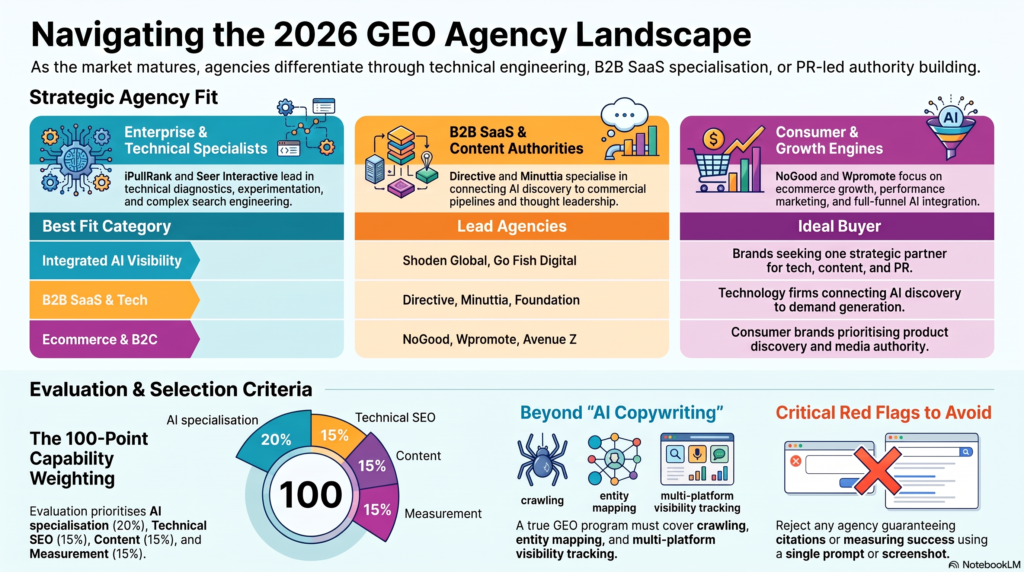
We evaluated agencies through an eligibility gate followed by a 100-point capability framework. Public claims were treated as company-published evidence rather than independent verification, and each provider was assigned to the category in which its current offering appears strongest.
- Confirm a dedicated GEO, AEO, AI search, or LLM visibility offering.
- Review whether the agency publicly explains its methodology, technical capabilities, content execution, authority-building work, and measurement approach.
- Score the provider using these weights:
• AI visibility and GEO specialization: 20%
• Technical SEO capability: 15%
• Content and entity optimization: 15%
• Digital PR and third-party authority: 15%
• Measurement and reporting: 15%
• Verified evidence and case studies: 10%
• Industry and company-size fit: 5%
• Pricing or engagement clarity: 5% - Examine whether published examples identify a baseline, work completed, measurement period, relevant platforms, and business outcome.
- Record buyer fit and a practical limitation rather than presenting every provider as equally suitable for every company.
A public case study is stronger when it explains the intervention and measurement period, but it is still not equivalent to independently audited evidence. Buyers should request underlying definitions, prompt sets, repeat-test methodology, attribution rules, exclusions, and comparable client references.
How Do the 12 GEO Agencies Compare?
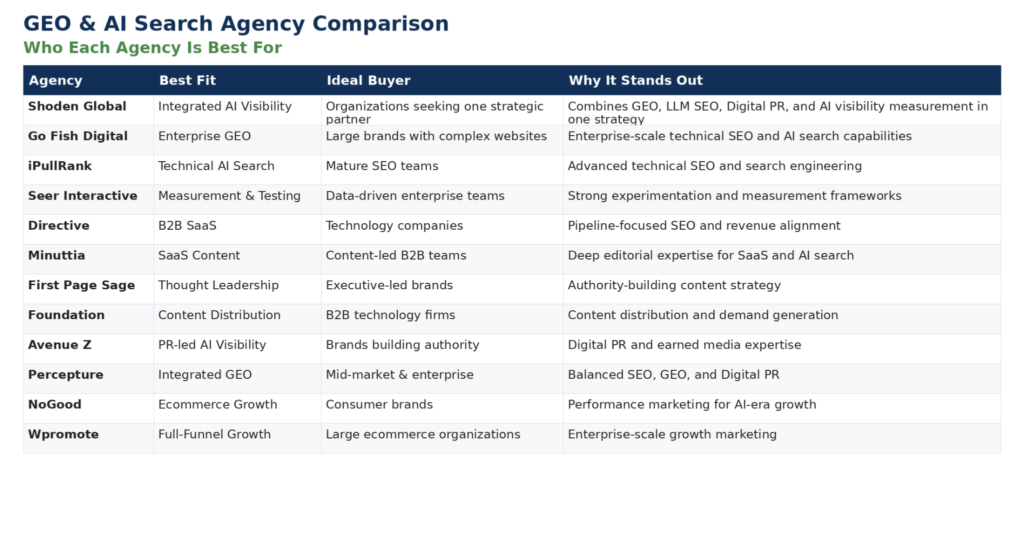
The strongest providers combine established SEO foundations with AI-specific measurement, extractable content, entity clarity, off-site authority, and continuous testing. The table provides a compact shortlist; the profiles below explain each agency’s distinguishing strengths and limitations.
GEO and AI Search Agency Comparison
Services and Capabilities
What We Learned from Comparing 12 GEO Agencies
Comparing the 12 agencies revealed clear differences in how providers approach Generative Engine Optimization and AI visibility. While most combine traditional SEO with AI-focused services, their priorities, methodologies, and ideal client profiles vary considerably.
Three patterns emerged from the evaluation:
- Enterprise-focused agencies emphasize technical SEO, experimentation, measurement frameworks, and integration with existing marketing and engineering teams.
- B2B specialists differentiate themselves through commercial content strategy, thought leadership, and demand generation aligned with longer buying cycles.
- Digital PR and authority-led agencies focus on strengthening the third-party signals, media coverage, and brand credibility that increasingly influence AI-generated answers and recommendations.
The comparison also found that relatively few agencies publicly document a comprehensive methodology covering technical optimization, AI visibility measurement, content development, entity optimization, digital PR, and ongoing reporting within a single engagement. For many buyers, the most important differentiator is not whether an agency offers GEO services, but how clearly it explains its process, measures success, and demonstrates results through relevant public evidence.
Wondering How Your Brand Compares?
Request Your Free AI Visibility Report
See how your brand appears across ChatGPT, Google AI, Perplexity, Gemini, Claude, and other AI search platforms. We'll identify where you're visible, where competitors outperform you, and the highest-impact opportunities to improve your AI search presence.
Which GEO Agencies Are Best for Full-Service AI Visibility?
The agency profiles below provide more detail on where each provider is strongest, the types of organizations they are best suited for, and the practical considerations buyers should evaluate before making a decision.
Shoden Global and Go Fish Digital are strong full-service candidates for companies seeking strategy, technical optimization, content, measurement, and authority building under one engagement. Their approaches differ in team structure, tooling, evidence, and ideal client scale.
Shoden Global
Best fit: integrated GEO, LLM SEO, technical SEO, content, and digital PR.
Core strengths: cross-platform auditing, owned content, citation engineering, and reporting.
Distinction: one specialist team covers both on-site and third-party visibility.
Evidence: public company-reported search, citation, mention, and lead results.
Ideal client: a B2B or B2C brand seeking one accountable partner. Enterprise brands with established authority are a great fit, or for small or medium sized companies.
Potential limitation: validate capacity, attribution, and case comparability for large global programs.
Go Fish Digital
Best fit: enterprise and mid-market brands needing technical, content, and digital PR execution.
Core strengths: semantic audits, passage-level optimization, indexing, structured content, and citation-oriented PR.
Distinction: proprietary analysis methods and a clearly described retrieval framework.
Evidence: a company-published three-month GEO case reporting increased AI referral traffic and conversions.
Ideal client: Potential limitation: public pricing is unavailable.
Which GEO Agencies Are Best for Enterprise Technical SEO?
iPullRank and Seer Interactive are particularly well suited to enterprises that need technical diagnostics, controlled experimentation, advanced measurement, stakeholder enablement, and integration with existing search teams.
iPullRank
Best fit: complex enterprise websites and technically mature marketing organizations.
Core strengths: information retrieval, technical SEO, content engineering, measurement, user experience, and digital PR.
Distinction: its Relevance Engineering framework treats AI search as part of a broader multi-platform discovery system.
Evidence: a public AI-search pilot describes technical fixes, auditing, measurement planning, and a three-month roadmap.
Potential limitation: the approach may require substantial internal resources.
Seer Interactive
Best fit: enterprises that prioritize experimentation and defensible measurement.
Core strengths: prompt tracking, source analysis, conversion analysis, testing, analytics, and team education.
Distinction: Seer openly emphasizes uncertainty and rejects silver-bullet claims.
Evidence: published AI-search research, measurement frameworks, and company-reported LLM-influenced inbound conversions.
Potential limitation: brands wanting high-volume turnkey content and media outreach may need complementary resources.
Which GEO Agencies Are Best for B2B SaaS and Technology?
Directive Consulting and Minuttia offer the clearest specialization for B2B SaaS and technology companies. Both connect AI visibility with commercial content, but Directive emphasizes demand generation and pipeline while Minuttia is especially content-led.
Directive Consulting
Best fit: B2B SaaS and technology companies connecting AI discovery to demand generation.
Core strengths: entity mapping, technical optimization, content architecture, dashboards, and pipeline analysis.
Distinction: its service is explicitly designed around complex B2B buyer journeys.
Evidence: a named client example reports growth across tracked prompts, organic sessions, and demo bookings.
Potential limitation: consumer and retail brands may find the specialization too narrow.
Minuttia
Best fit: established B2B SaaS companies building a scalable content and AI-search program.
Core strengths: content strategy, topic clusters, original research, content production, and B2B SaaS expertise.
Distinction: search and AI visibility are integrated into a broader content-growth model.
Evidence: an extensive case library and a 2026 AEO survey of 599 marketers.
Potential limitation: buyers should request a recent case with platform-level AI baselines and attribution.
Which GEO Agencies Are Best for Content-Led Growth?
First Page Sage and Foundation are notable for companies that view original content, thought leadership, distribution, and reputation as the main path to stronger AI visibility.
First Page Sage
Best fit: companies investing in thought leadership, commercial content, reputation, and list visibility.
Core strengths: editorial strategy, list outreach, review management, authority content, and ongoing chatbot research.
Distinction: its 2026 study analyzed 11,128 commercial queries across four chatbots.
Ideal client: a brand with subject-matter experts and a long-term publishing commitment.
Potential limitation: confirm who owns technical implementation and multi-platform reporting.
Foundation
Best fit: B2B SaaS and technology companies seeking content creation plus broad distribution.
Core strengths: research, thought leadership, technical GEO, digital PR, community distribution, and analytics.
Distinction: it integrates owned content with channels such as Reddit, YouTube, LinkedIn, and earned media.
Evidence: public company-reported citation and LLM-visibility improvements.
Potential limitation: deep enterprise migration work may require a more technical specialist.
Which GEO Agencies Are Best for Digital PR and Authority Building?
Avenue Z and Percepture are strong candidates when the main problem is insufficient third-party authority, media presence, brand corroboration, or reputation signals rather than content structure alone.
Avenue Z
Best fit: fintech, consumer, lifestyle, and technology brands needing integrated PR and AI-search visibility.
Core strengths: prompt tracking, technical optimization, content, media relations, reputation, and cross-channel reporting.
Distinction: PR is treated as a central part of the AI visibility system.
Evidence: its Prometeo case documents technical, content, measurement, and media work across ChatGPT, Perplexity, and Google AI Overviews.
Potential limitation: broader communications scopes can increase complexity.
Percepture
Best fit: organizations wanting SEO, content, entity optimization, and digital PR from one team.
Core strengths: structured content, knowledge-graph support, authority building, sentiment tracking, and referral measurement.
Distinction: Percepture publishes both methodology and starting prices.
Evidence: public examples report search and AI-visibility outcomes, although several blend traditional and AI-search metrics.
Potential limitation: ask for platform-specific denominators and repeated-test methodology.
Which GEO Agencies Are Best for B2C and Ecommerce Brands?
NoGood and Wpromote stand out for consumer and ecommerce brands because they combine AI-search work with product discovery, performance marketing, conversion measurement, social channels, and wider customer-acquisition programs.
NoGood
Best fit: ecommerce, gaming, consumer technology, and growth-stage companies.
Core strengths: technical AEO, content, social visibility, digital PR, real-time monitoring, and revenue attribution.
Distinction: its program connects AI mentions and citations to traffic and conversions.
Evidence: the SteelSeries case reports multi-platform visibility gains and substantial year-over-year AI traffic and conversion increases.
Potential limitation: rapid experimentation may conflict with highly conservative governance processes.
Wpromote
Best fit: larger consumer, retail, travel, and ecommerce brands requiring full-funnel integration.
Core strengths: AI-search auditing, content, off-site authority, digital PR, paid media integration, and proprietary measurement.
Distinction: its visibility program tracks major LLMs across approximately 300 prompts and 15 topics.
Evidence: public AI-search capabilities and broader content-performance cases.
Potential limitation: buyers should request a detailed AI-only case comparable to their category.
What Services Should a GEO Agency Provide?
A capable GEO provider should cover the complete discovery-to-conversion journey rather than selling schema, FAQ creation, or AI-written content as a standalone solution.
A complete program should include:
• Technical crawling, indexing, rendering, internal-linking, and site-architecture analysis
• AI visibility baselines across agreed platforms, prompts, markets, and languages
• Brand, entity, topic, and competitor mapping
• Expert-led content strategy and hands-on production
• Direct-answer, comparison, service, case-study, and evidence-rich content
• Digital PR, editorial outreach, and credible third-party corroboration
• Citation, mention, share-of-voice, sentiment, accuracy, and source tracking
• AI referral, branded search, lead-quality, pipeline, and conversion measurement
• Repeated testing, change logs, limitations, and clear reporting
Shoden Global’s GEO agency services show how technical optimization, content, citation readiness, and authority work can operate together. Its main GEO guide also covers discovery, content structure, external credibility, measurement, and continuous improvement.
Google’s guidance is an important reality check: conventional SEO foundations still matter, structured data must match visible content, and no new machine-readable file or special schema is required for inclusion in AI Overviews or AI Mode.
How Much Does a GEO Agency Cost?
GEO costs vary by technical complexity, content volume, market coverage, PR requirements, measurement depth, and whether execution is included. Public pages reviewed on July 26, 2026 show that Shoden Global lists $2,550 per month for focused listicle inclusion, $6,500 per month for AI visibility and LLM SEO growth, and $10,000 per month for enterprise programs, each with a four-month minimum. Percepture lists GEO plans beginning at $3,500 per month. These examples illustrate publicly available pricing rather than typical market rates. Review the dedicated generative engine optimization pricing information before comparing proposals.
How Do You Choose the Right GEO Agency?
Choose a GEO agency by matching its strongest documented capability to your actual visibility bottleneck. A technically complex enterprise, a B2B SaaS company, and a consumer ecommerce brand should not use identical selection criteria.
Use this practical checklist:
☐ Define the commercial prompts, markets, languages, products, and platforms that matter.
☐ Establish a baseline for mentions, citations, share of voice, sentiment, source diversity, referral traffic, and conversions.
☐ Ask who will execute technical fixes, write content, conduct outreach, and manage reporting.
☐ Request a comparable case study with a clear baseline, intervention, timeframe, and denominator.
☐ Confirm how many prompt variants and repeated runs are included.
☐ Ask how the agency distinguishes visibility, citation, factual accuracy, referral traffic, and revenue impact.
☐ Confirm access to dashboards, source data, content, accounts, and change logs.
☐ Review engagement length, cancellation terms, production capacity, and approval workflows.
☐ Reject guaranteed citation, recommendation, or first-place claims.
☐ Require a documented explanation of assumptions, limitations, and inconclusive results.
Use the GEO audit checklist to document your starting position, then review how to choose a GEO agency before issuing a request for proposals. Relevant GEO case studies should be compared by client situation and methodology, not by headline percentage alone.
What Common Mistakes and Red Flags Should You Avoid?
The biggest mistake is selecting a provider based on confident promises rather than transparent methodology, suitable evidence, and business fit.
As more agencies introduce GEO, AI visibility, and LLM SEO services, marketing claims alone become a less reliable way to compare providers. The strongest differentiators are a clearly documented methodology, transparent measurement, relevant case evidence, and the ability to explain how visibility improvements connect to meaningful business outcomes. Buyers should evaluate how an agency works, not just what it promises.
Avoid these red flags:
• The agency guarantees citations, recommendations, or permanent visibility.
• GEO is described only as AI-assisted copywriting.
• The proposal ignores crawling, indexing, conventional SEO, or site architecture.
• Success is measured using one prompt, one model, or one screenshot.
• The agency reports mentions without checking sentiment, factual accuracy, citations, or business impact.
• Case studies omit baselines, timeframes, prompt counts, platforms, or attribution rules.
• Schema, FAQs, llms.txt, or content formatting are presented as guaranteed inclusion mechanisms.
• The provider promotes artificial reviews, undisclosed placements, fabricated authority, or spammed community mentions.
• Every client receives the same content template and prompt list.
• The agency cannot explain what it does when a test produces no improvement.
Google explicitly warns that eligibility does not guarantee crawling, indexing, or serving. The 2026 critical review also found no reviewed technique demonstrating a stable, longitudinal, cross-platform causal effect on organic discoverability and downstream behavior.
Conclusion: Which GEO Agency Should You Choose?
Choose the agency whose documented strengths best match your organization's primary visibility challenge. A technically complex enterprise, a B2B SaaS company, and a consumer ecommerce brand are unlikely to benefit from the same partner or engagement model. The right choice depends on the balance of technical expertise, content capabilities, authority building, measurement, and the resources available within your own team.
Rather than relying on headline results or an agency's position in a comparison, evaluate how each provider explains its methodology, measures success, and connects AI visibility improvements to meaningful business outcomes. Request a technical audit, review comparable case studies, define success metrics before signing an agreement, and expect reporting that links visibility with accurate brand representation, qualified demand, pipeline growth, and commercial performance.
The GEO market is evolving rapidly, and agencies vary considerably in how they define, measure, and deliver AI visibility. Comparing documented methodologies, relevant case evidence, reporting practices, and long-term strategic fit is more valuable than relying on marketing claims or rankings alone. The strongest partnership is rarely the one with the boldest promises; it is the one that can demonstrate a transparent, repeatable approach aligned with your organization's goals.
FAQ
What does a GEO agency do?
A GEO agency helps a brand improve discovery, retrieval, interpretation, citation readiness, accurate representation, and visibility across search engines and AI answer platforms. The work can include technical SEO, content, entity optimization, digital PR, measurement, and conversion analysis.
Which GEO agency is best for B2B companies?
Directive Consulting, Minuttia, and Foundation are strongly focused on B2B SaaS or technology. Shoden Global is a broader option for companies wanting integrated technical SEO, content, digital PR, and AI visibility support. The right choice depends on technical complexity and execution needs.
Which GEO agency is best for B2C brands?
NoGood and Wpromote are strong candidates for consumer and ecommerce companies because their services connect AI visibility with product discovery, performance marketing, social channels, and conversion measurement. Avenue Z is also relevant where consumer PR and reputation are central.
How much does a GEO agency cost?
Pricing ranges from focused audits and projects to ongoing retainers. Public examples reviewed in July 2026 begin at several thousand dollars per month, while enterprise programs can exceed $10,000 monthly. Scope, content volume, digital PR, markets, and technical complexity materially affect the final price.
How should you compare GEO agencies?
Compare dedicated specialization, technical depth, content execution, digital PR, measurement, public evidence, client fit, pricing clarity, and limitations. Ask every provider to explain its baselines, prompt set, repeat-testing method, attribution rules, deliverables, and ownership model.
Can a traditional SEO agency provide GEO?
Yes, provided it adds genuine AI visibility measurement, entity and answer-content strategy, platform-specific testing, off-site authority work, and suitable reporting. Traditional SEO remains foundational, but simply relabeling existing SEO deliverables as GEO is not enough.
What proof should a GEO agency provide?
Request a comparable case with its baseline, intervention, timeframe, prompts, platforms, repeated measurements, source data, traffic or pipeline attribution, and known limitations. Client references and independently corroborated outcomes strengthen the evidence.
Can a GEO agency guarantee AI citations?
No. AI outputs can vary by model, prompt wording, location, personalization, retrieval behavior, source availability, and time. An agency can improve eligibility, authority, clarity, and citation readiness, but it cannot guarantee that a particular system will cite or recommend a brand.













PR Outreach: How to Pitch Journalists in 2026
August 10, 2026