

Perplexity answers questions with a generated response and cited sources. That gives businesses more to track than a traditional search position: whether the brand is mentioned, whether its website is cited, and how the answer describes it.
A Perplexity answer is a snapshot, and it can vary across prompts and checks. So treat “rankings” as a way to describe visibility in answers, not as a fixed position. A useful monitoring process tracks patterns across a consistent set of questions.
This guide explains how to build that process, compare results over time, and decide what good visibility looks like.
Table of Contents
Download the Perplexity AI Rankings Template
What Are Perplexity AI Rankings?
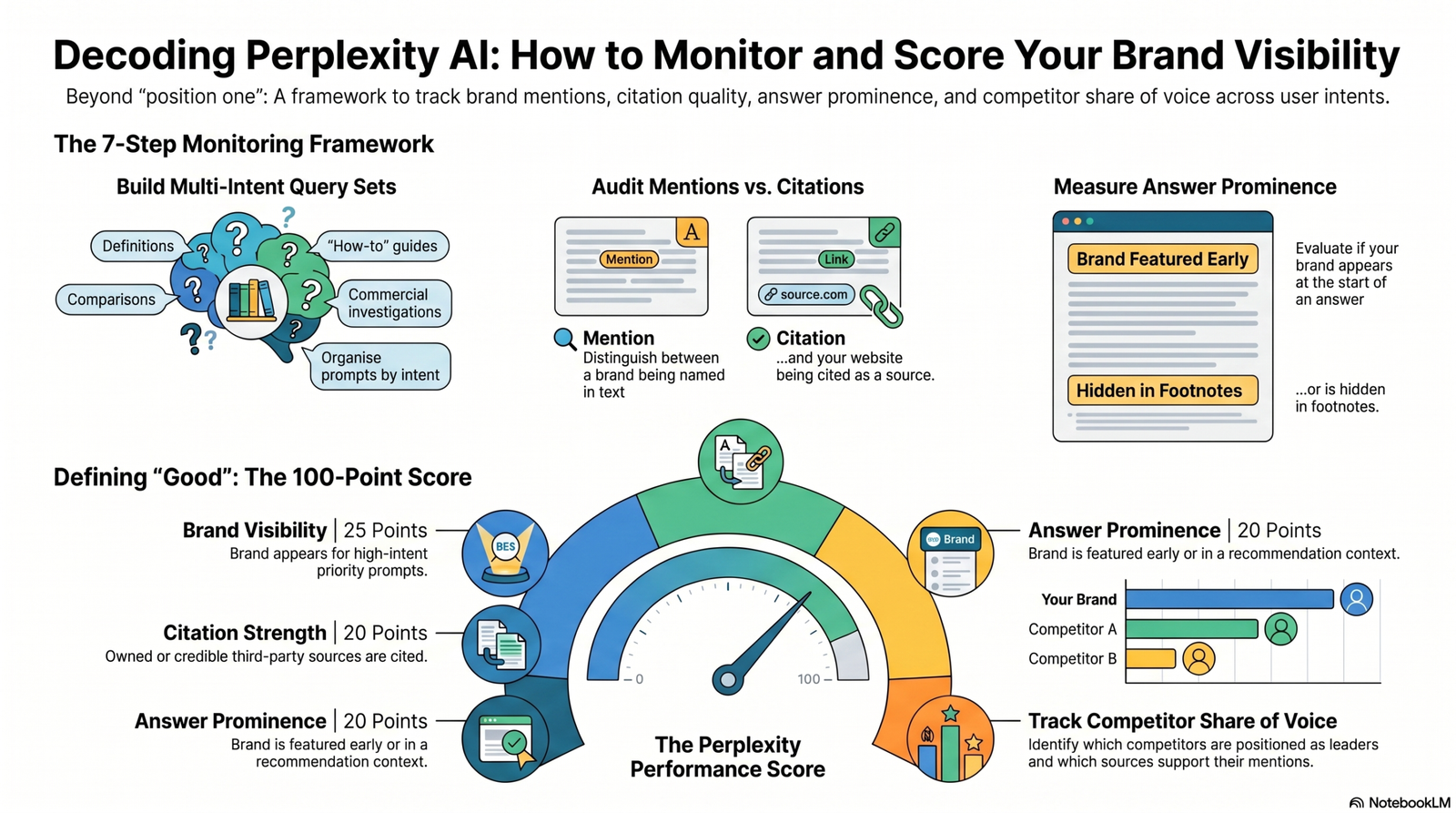
Perplexity does not present a conventional list of ten blue links. It generates an answer and cites sources. Perplexity’s overview of how its search works explains its use of web sources and citations.
When teams talk about Perplexity rankings, they may mean several things:
- Your brand is named in the answer.
- Your website is cited as a source.
- A third-party source supports a claim about your brand.
- Your product or service appears in a recommendation.
- Competitors appear for relevant questions, but your brand does not.
- Your brand appears with inaccurate, outdated, or incomplete information.
Monitoring Perplexity visibility means tracking how often your brand appears, how it is supported, and how it is presented across relevant questions.
Why Monitoring Perplexity Visibility Matters
People use AI search to research topics, compare options, and evaluate providers. If your brand does not appear in answers to relevant questions, potential customers may not encounter it during their research. If competitors appear more consistently, they may be considered first.
Monitoring shows where your brand appears, where it is missing, which sources are cited, and how competitors are presented. Those findings can guide changes to your content and digital PR and citation engineering.
How to Monitor Perplexity AI Rankings
The goal is to create a repeatable process. A single prompt check can be useful for troubleshooting, but it cannot show whether your visibility is improving across a broader set of questions.
Step 1: Build a query set
Start with questions your audience might ask. Group them by intent so that you can compare like with like.
Definition queries
- What is generative engine optimization?
- What is AI search tracking?
- What is an LLM visibility audit?
Comparison queries
- How does generative engine optimization compare with traditional SEO?
- What is the difference between answer engine optimization and generative engine optimization?
How-to queries
- How do I measure visibility in AI search?
- How can a business improve its visibility in AI-generated answers?
Commercial research queries
- What are the best AI visibility platforms?
- How do I choose a generative engine optimization agency?
Transactional queries
- Which agency provides generative engine optimization services?
- Who can help my company monitor AI search visibility?
Keep the wording stable between checks. If you change the prompt, record the new wording and treat it as a separate query.
Step 2: Track brand mentions
For each prompt, record whether the answer names your brand. Then note how it appears:
- Direct mention: The answer names your brand.
- Recommendation: The answer presents your brand as an option or provider.
- Contextual mention: The brand appears as background information, rather than as a recommendation.
- Cited visibility: A source about your brand is cited, even if the answer does not name it prominently.
A mention alone does not tell you whether the answer is useful. Record the wording and the context. “One possible provider” is different from a clear description of whom the provider serves and what it does.
Step 3: Track citations
Record the sources cited in each answer. At minimum, note:
- Whether your own website is cited.
- Whether an independent source about your brand is cited.
- Which competitors are cited.
- Whether the cited page supports the point made in the answer.
- Whether a source is outdated or no longer accurate.
Perplexity’s documentation for Pro Search describes its use of multiple searches and cited sources for more complex queries. The feature may differ from a standard search, so record which Perplexity experience you checked.
Step 4: Measure prominence
A mention near the beginning of an answer may be more noticeable than a passing reference near the end. Use a consistent scale:
- High: The brand is named early and clearly recommended or discussed as a leading option.
- Medium: The brand appears in a list or supporting paragraph.
- Low: The brand appears only in a citation or secondary context.
- None: The brand does not appear.
This is a practical tracking label, not a score assigned by Perplexity.
Step 5: Compare with competitors
For each prompt, note which alternatives appear and how they are described. Your AI search competitors may include review sites, directories, media outlets, communities, comparison pages, or companies you do not usually track in organic search.
Look for patterns. If competitors are named but your brand is absent, you may have a discovery gap. If both are named, but competitors have clearer descriptions or stronger supporting sources, you may have a positioning or citation gap.
Step 6: Check accuracy and sentiment
Record whether the answer describes your brand correctly. Check for:
- Incorrect or outdated services.
- Missing areas of expertise.
- Vague or confusing descriptions.
- Unsupported claims.
- Negative or mixed sentiment.
- Comparisons that omit an important distinction.
If you find an error, look at the cited sources and the pages that explain your business. Clearer service pages, useful FAQs, expert content, and accurate third-party information may help address the source of the confusion.
Step 7: Track results over time
Choose a schedule that your team can maintain, such as monthly. Use the same prompts, market, language, and Perplexity experience for each check. Save the answer or a screenshot, along with the date, so you can review what changed.
Track these measures:
- Brand mention rate.
- Brand website citation rate.
- Prominence.
- Competitor share of voice.
- Accuracy and sentiment.
- Results by query intent.
A spreadsheet can make the checks consistent. Record each prompt, run date, answer, citations, competitors, prominence, accuracy, and notes. Use the same definitions each time.
Download the Perplexity AI Visibility Tracker spreadsheet to record prompts, mentions, citations, prominence, and competitor results.
What Does “Good” Look Like in Perplexity?
Good performance depends on your industry, brand awareness, competition, and the questions you track. Rather than aiming for one universal score, look for progress across a few useful patterns.
Your brand appears for relevant questions
Visibility for high-intent questions may be more valuable than visibility for broad questions that are not connected to your services. Check whether your brand appears for the topics and buying situations that matter to your audience.
Your brand is supported by relevant sources
A mention is useful, but a relevant citation gives you more context about what supports the answer. Look at whether Perplexity cites your website, independent coverage, reviews, or another source, and whether that source supports the description.
Your brand appears across more than one query type
A brand that appears only for searches containing its name has limited discovery visibility. Check whether it appears for relevant educational, comparison, and commercial questions, too.
Your brand is described accurately
A strong result is not simply a mention. The answer should explain what your business does and who it serves without mixing it up with another company or relying on outdated information.
Competitors do not appear in every relevant answer without you
You do not need to appear in every response. However, if competitors consistently appear for your priority questions and your brand rarely does, that is a useful signal to investigate.
Practical Metrics to Track
Use clear definitions so your results mean the same thing from one reporting period to the next.
| Metric | Definition |
| Brand mention rate | Prompts with at least one brand mention divided by prompts checked. |
| Brand website citation rate | Prompts where your website is cited divided by prompts checked. |
| Prominence rate | Prompts where your brand receives high prominence divided by prompts checked. |
| Accuracy rate | Brand mentions assessed as accurate divided by brand mentions reviewed. |
| Share of voice | Your brand’s mentions divided by all tracked brand and competitor mentions across the same prompt set. |
For example, if your brand appears in 12 of 30 prompts, its mention rate for that check is 40%. This is a way to compare your own results over time. It is not an industry benchmark or a guarantee of performance.
Manual Checks and Tracking Tools
Manual checks help you inspect the full answer, verify the citations, and understand how your brand is described. They work well for a smaller prompt set or for investigating a specific change.
Tracking tools can help teams organize a larger set of prompts and compare results across reporting periods. Tool coverage and metrics vary, so confirm what each tool records and check important results in Perplexity itself. A tool’s reported “position” or visibility score should not be treated as an official Perplexity ranking unless the provider explains exactly how it is calculated.
A practical workflow can combine both: use a consistent tracker for routine checks, then manually review answers when you see a meaningful change.
Common Problems When Monitoring Perplexity
Avoid these common mistakes:
- Tracking too few prompts. One question cannot represent your full visibility.
- Mixing different intents. A definition question and a provider comparison are not equivalent.
- Counting mentions without reviewing context. A passing reference is not the same as a recommendation.
- Ignoring citations. Sources help explain why an answer may describe your brand in a particular way.
- Overreacting to one result. A single answer is a snapshot. Look for patterns across repeated checks.
- Measuring without taking action. Use findings to prioritize content updates, source improvements, or clearer positioning.
How Perplexity Monitoring Connects to GEO
Monitoring Perplexity is one part of a broader generative engine optimization strategy. The process helps you understand which questions trigger your brand, which sources support the answers, and where competitors have stronger visibility.
The findings can inform your content and authority-building priorities. For a wider view of how brands can become more visible in AI answers, see Shoden’s guide to LLM visibility and becoming the answer.
How Shoden Global Communication Can Help
Shoden Global Communication helps businesses assess how they appear in AI-generated answers, where competitors are more visible, and which sources influence those answers.
A project may include prompt research, AI visibility monitoring, citation analysis, content recommendations, or digital PR. Learn more about our AI Visibility Service.
Quick Answers
What should I track?
Brand mentions, citations, prominence, accuracy, sentiment, and competitors.
How often should I check?
Use a consistent schedule, such as monthly, and keep the prompt wording and settings stable.
What counts as good visibility?
Your brand appears for relevant questions, is described accurately, and has useful supporting sources.
Final Thoughts
Perplexity visibility is not a fixed search position. It is a set of signals, including brand mentions, citations, prominence, accuracy, and competitor presence.
A repeatable prompt set helps you see whether your brand appears for relevant questions, how Perplexity describes it, which sources support the answer, and how those patterns change over time. Use those findings to make focused improvements and check again.
FAQs
Does Perplexity have a fixed ranking position for each brand?
No. Perplexity generates answers with sources rather than providing a single, fixed position for every brand. Track presence and context across a consistent set of prompts.
How many prompts should I track?
Start with a manageable set that covers your main topics and query types. Add prompts when you identify new customer questions or meaningful gaps.
Should I track mentions and citations separately?
Yes. A mention shows that the answer names your brand. A citation shows that a source was used or linked. Record both, then check whether the cited source supports the answer.
Can I use an AI visibility tool instead of checking Perplexity manually?
A tool can help organize or monitor results at scale, depending on its features. Manually review important answers and citations to confirm the context and accuracy.
Why might a competitor appear when my brand does not?
The answer may cite sources that describe the competitor more clearly or match the prompt more closely. Review the cited pages and compare how each company is represented for that query.































PR Outreach: How to Pitch Journalists in 2026
August 10, 2026