

AI search visibility metrics KPIs are now essential for brands that want to understand whether they are being mentioned, cited, and recommended in AI-generated answers. As buyers use ChatGPT, Perplexity, Gemini, Claude, Google AI Mode, and other AI search experiences to compare options, brands need a way to measure visibility beyond rankings, impressions, and clicks.
AI search visibility metrics and KPIs measure how often, how accurately, and how favorably your brand appears in AI-generated answers. They track brand mentions, cited sources, prompt coverage, competitor visibility, recommendation rate, sentiment, AI referral traffic, and business impact.
Table of Contents
What Are AI Search Visibility Metrics and KPIs?
AI search visibility metrics and KPIs are the measurements used to track whether your brand appears in AI-generated answers and whether those appearances are useful for business growth.
Traditional SEO metrics tell you how your website performs in search engines. AI search visibility metrics tell you how your brand performs inside generated answers. That difference matters because a buyer may now ask an AI system to recommend vendors, compare solutions, summarize alternatives, or explain which company is best for a specific problem before visiting any website.
A useful AI search measurement system should answer four questions:
- Is your brand appearing?
- Is your brand being cited?
- Is your brand being recommended?
- Is your brand being positioned correctly?
A mention alone is not always enough. A brand can appear in an AI answer but be described vaguely, incorrectly, or less favorably than a competitor. The strongest measurement framework looks at visibility, citations, sentiment, source quality, prompt relevance, and business outcomes together.
Why Are Traditional SEO Metrics Not Enough for AI Search?
Traditional SEO metrics are still important, but they do not fully show how your brand appears in AI-generated answers.
Google says its generative AI search features are rooted in core Search ranking and quality systems, so foundational SEO still matters. Google also explains that AI Mode may use query fan-out, where related searches across subtopics and sources help build a more complete response.
That means rankings, clicks, impressions, backlinks, and organic sessions still matter, but they are incomplete. A brand could rank well for a traditional keyword and still be missing from AI-generated comparison answers. Another brand could receive fewer clicks but be repeatedly recommended in AI answers for high-intent buyer prompts.
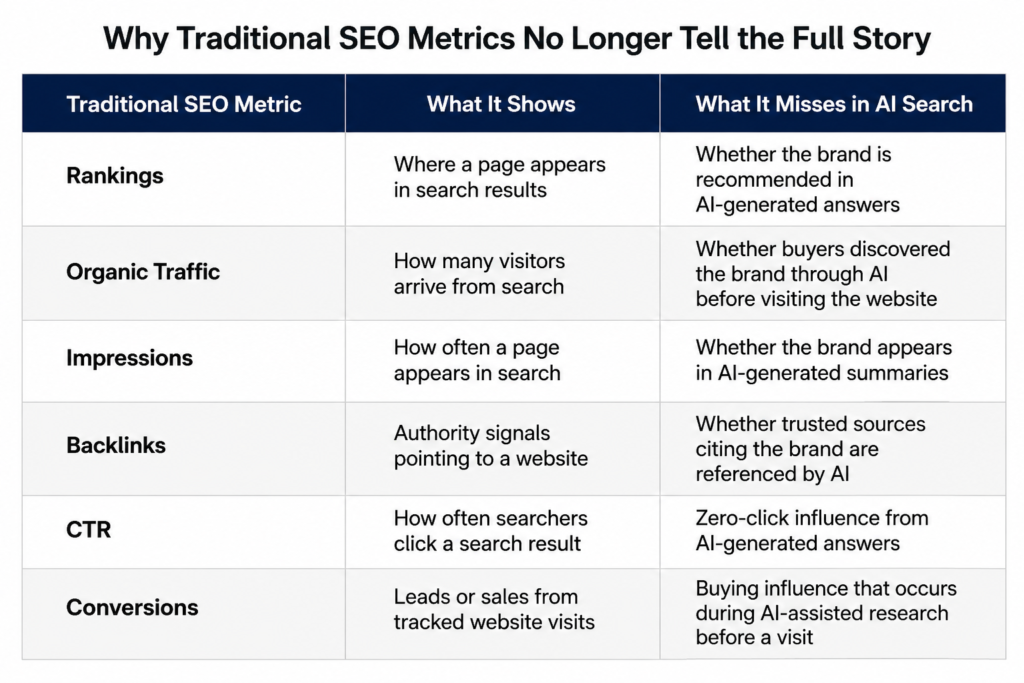
AI search visibility measurement adds the missing layer. It shows whether your brand is part of the answer before the buyer clicks.
What Are the Most Important AI Search Visibility KPIs?
The most important AI search visibility KPIs are AI visibility score, brand mentions, share of AI answer, citation frequency, prompt coverage, recommendation rate, sentiment, source quality, AI referral traffic, and revenue influence.
AI visibility platforms commonly track concepts such as visibility score, mentions, cited pages, prompts, competitor benchmarks, and source opportunities. These metrics are useful starting points because they help brands see where they appear, where they are missing, and how they compare against competitors.
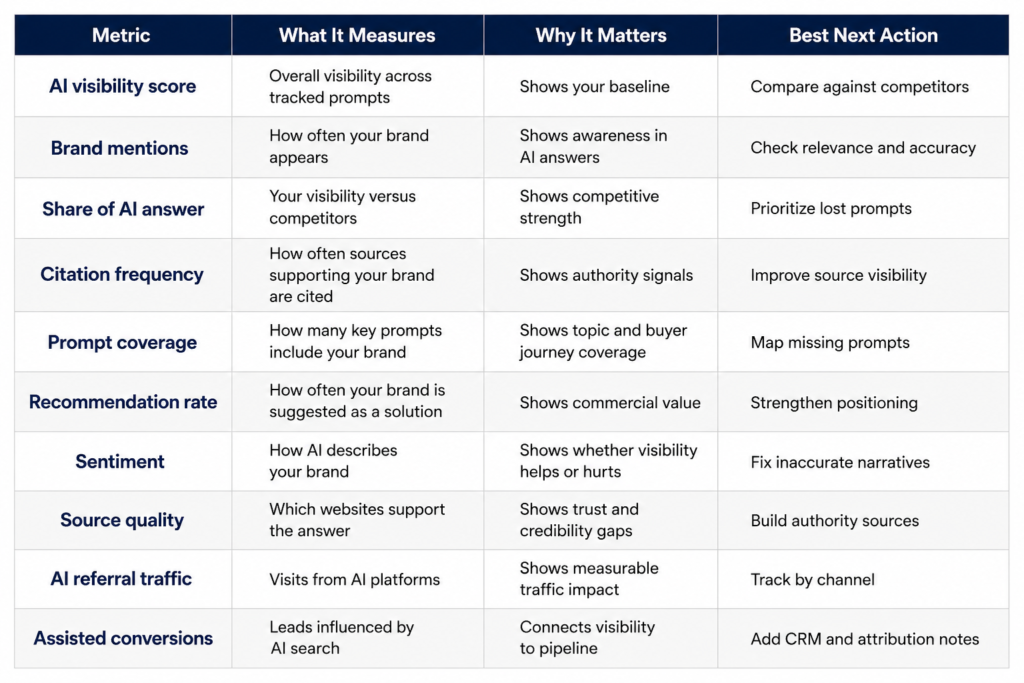
The best KPI set depends on your goals. A SaaS company may care most about alternative prompts and demo requests. A B2B service provider may care more about recommendation prompts, competitor comparisons, and high-authority citations.
How Do You Measure AI Visibility Against Competitors?
You measure AI visibility against competitors by tracking the same prompts across your brand and the companies your buyers already compare you with.
A standalone visibility score is useful, but it does not tell the full story. Your brand might appear in educational prompts while competitors appear in buying prompts. Your company might be mentioned, but competitors might be recommended. Your website might be visible, but competitors might have stronger third-party sources supporting them.
A proper competitor benchmark should compare:
- Brand mentions
- Recommendation frequency
- Cited source
- Prompt coverage
- Source quality
- Sentiment
- Positioning
- Missing prompts
- Competitor-owned topics
- Third-party authority
For example, if a buyer asks “Which agency can help improve AI visibility for B2B brands?” and competitors appear while your brand does not, that is a prompt gap. If the AI answer recommends competitors for a problem your company solves, that gap is commercially important.
Shoden Global uses competitor prompt-gap analysis to identify where your brand is invisible, where competitors are being positioned better, and which prompts should become the highest priority.
What Is a Good AI Visibility Score?
A good AI visibility score depends on your niche, competitors, prompt set, buyer journey, and commercial intent.
There is no universal score that means “good” for every brand. A score is only meaningful when it is compared against the right competitors and the right prompts. A company with a modest overall score may still be winning if it appears in the highest-value prompts. A company with a higher score may still be weak if most of its mentions are low-value, generic, or irrelevant.
A useful score should be evaluated with these questions:
- Which prompts created the score?
- Are those prompts relevant to buyers?
- How does the score compare to competitors?
- Are the mentions accurate?
- Are the mentions favorable?
- Are cited sources strong?
- Is the brand being recommended or only mentioned?
- Is visibility improving month over month?
At Shoden Global, we treat the AI visibility score as the starting benchmark. The real value comes from human analysis that explains why the score looks the way it does and what must happen next.
How Do You Track AI Citations?
You track AI citations by recording which sources AI systems use or display when supporting answers about your category, competitors, and brand.
Citations matter because they show the source ecosystem behind AI-generated answers. Your own website may be one source, but AI systems may also rely on editorial articles, comparison content, forums, reviews, videos, partner pages, directories, and trusted industry publications.
Track these citation categories:
- Owned pages from your website
- Third-party editorial articles
- Comparison content
- Review platforms
- Directories
- Reddit and Quora discussions
- Forums and community sites
- YouTube videos and transcripts
- LinkedIn articles
- Industry publications
- Partner or marketplace pages
Citation tracking should not only ask “Are we cited?” It should also ask, “Are the right sources supporting the right positioning?”
If competitors are being cited by stronger sources, Shoden Global may recommend digital PR, comparison content for AI answers, editorial citation campaigns, Reddit or Quora strategy, or technical fixes depending on the source gap.
How Do You Measure Prompt Coverage?
You measure prompt coverage by grouping important AI prompts into buyer-journey categories and tracking whether your brand appears in each group.
Prompt coverage is one of the most important AI visibility KPIs because it shows whether your brand is visible across the real questions buyers ask. A brand should not chase every possible prompt. It should focus on prompts that match its services, audience, differentiators, and sales journey.
Instead of measuring isolated queries, evaluate coverage across the major prompt categories that influence purchase decisions. This provides a more complete view of your AI visibility and helps identify where additional content, authority building, or optimization is needed.
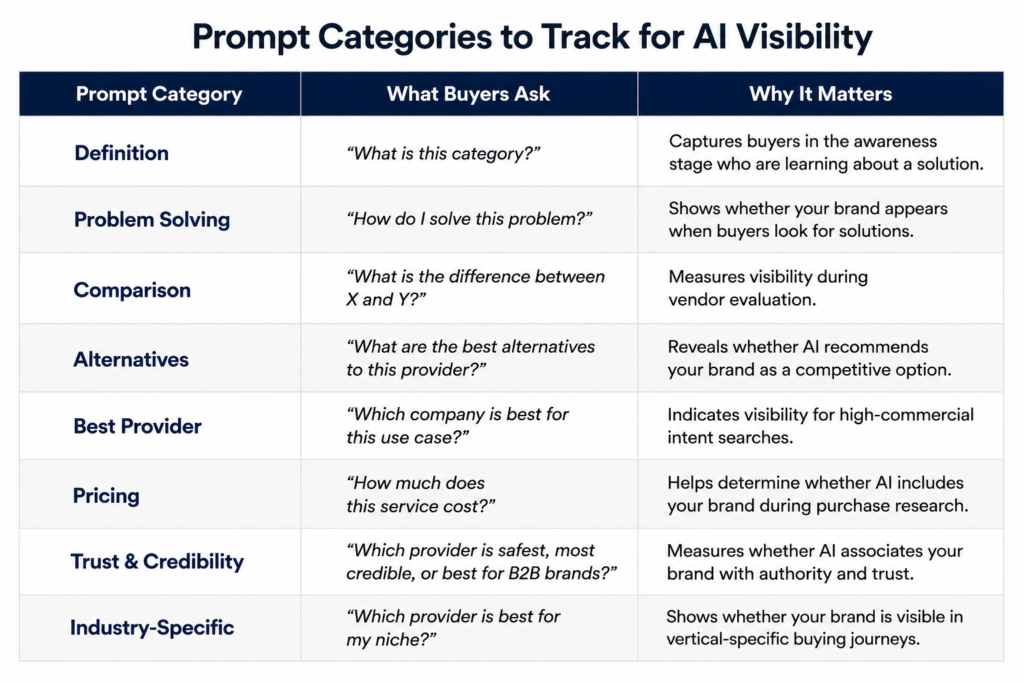
Each category represents a different stage of the buyer journey. Strong prompt coverage means your brand is visible not only when buyers first learn about a topic but also as they compare providers, evaluate pricing, assess trust, and make a final decision. Reviewing coverage by prompt category also helps prioritize content creation and identify competitive gaps that may not be obvious from traditional SEO metrics alone.
Shoden Global evaluates prompt coverage by mapping client brands against the buyer prompts that matter most to their industry, services, and sales journey. Rather than measuring random AI queries, we focus on commercially relevant prompts where visibility is most likely to influence purchasing decisions. This approach helps identify high-impact content opportunities, competitive gaps, and areas where additional authority signals can improve AI visibility.
How Do You Measure AI Search Sentiment?
You measure AI search sentiment by reviewing how AI-generated answers describe your brand, competitors, strengths, weaknesses, pricing, trust signals, and use cases.
Sentiment is not only positive or negative. In AI visibility, the more useful categories are:
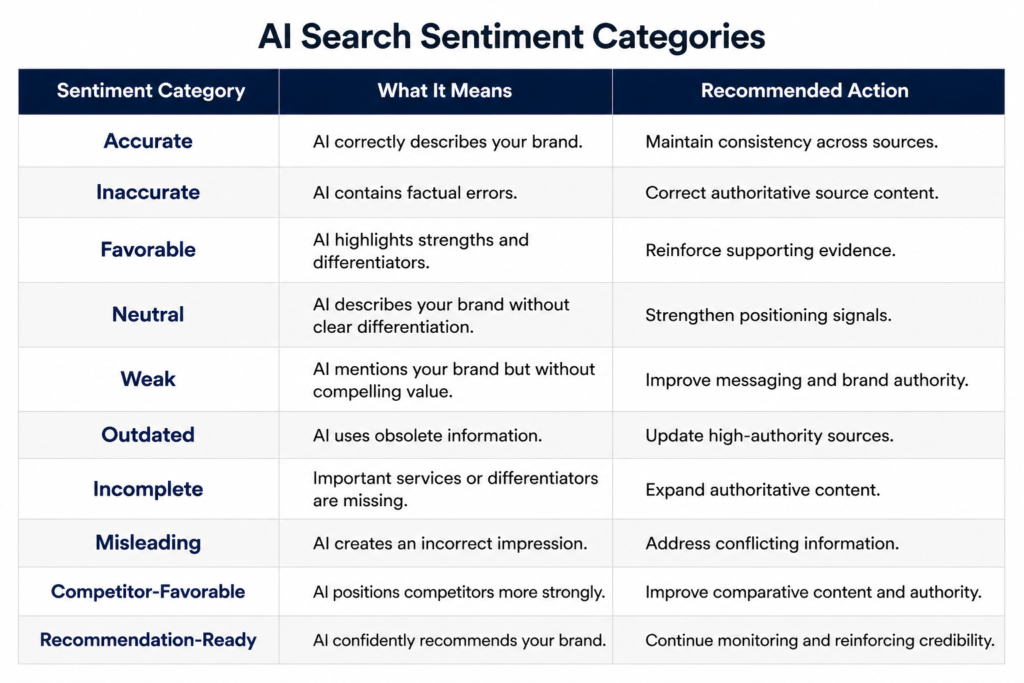
Each sentiment category highlights a different type of visibility opportunity. Accurate and favorable descriptions reinforce trust, while inaccurate, incomplete, outdated, or competitor-favorable answers reveal where your messaging, content, or authority signals need improvement. Reviewing sentiment over time also helps determine whether optimization efforts are strengthening how AI systems understand and recommend your brand.
A brand mention can appear positive while still being strategically weak. For example, an AI answer might describe your company as a general SEO agency when your actual positioning is AI visibility for B2B brands. Although technically accurate, the description fails to communicate your differentiation, making it a visibility problem rather than a sentiment problem alone.
Strong AI search sentiment means AI consistently associates your brand with the right audience, problems, services, expertise, and outcomes. The goal is not simply to receive positive mentions, but to ensure AI explains why buyers should choose your business instead of a competitor.
Because AI-generated answers often require context and interpretation, Shoden Global evaluates AI search sentiment through manual reviews rather than relying solely on automated scoring. This approach helps identify positioning issues, inaccurate narratives, and subtle messaging gaps that automated tools frequently overlook, especially in complex B2B markets.
How Do AI Search KPIs Connect to Leads and Revenue?
AI search KPIs connect to leads and revenue when visibility is measured across the full buyer journey, not only at the traffic level.
AI-generated answers may influence a buyer before a website visit. That makes attribution harder than traditional SEO, but it does not make measurement impossible. The key is to track direct signals and supporting indicators together.
No single KPI proves AI search ROI. Instead, organizations should evaluate a combination of traffic, attribution, conversion, and pipeline metrics to understand how AI visibility influences revenue.
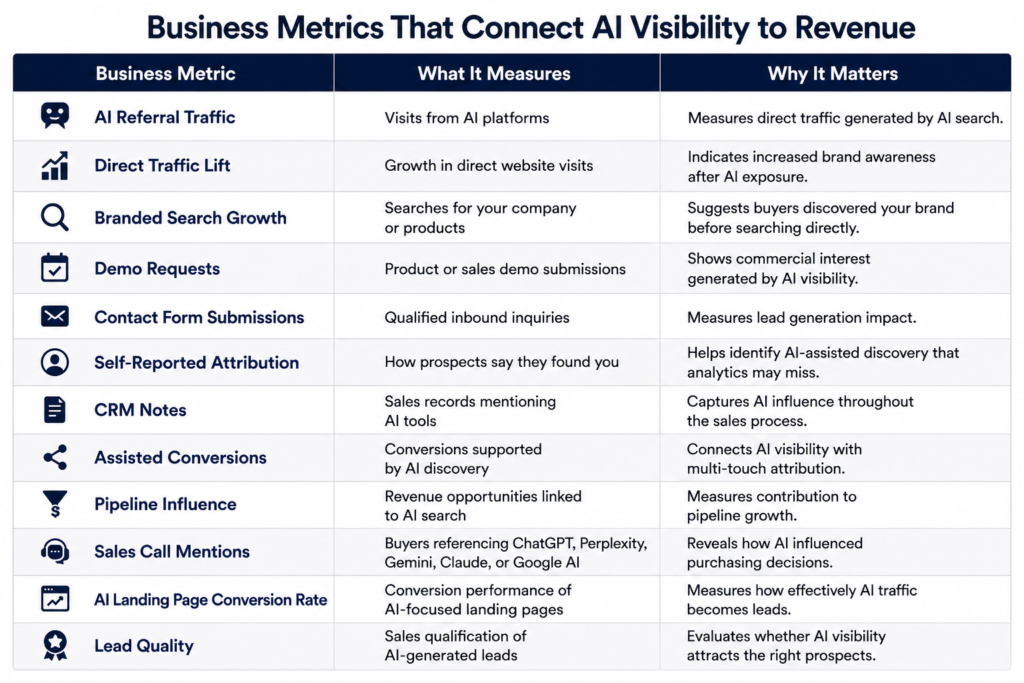
The strongest approach is to combine AI visibility tracking with analytics, CRM notes, and sales feedback. If your brand starts appearing more often in high-intent prompts, and branded demand or qualified leads increase at the same time, AI visibility may be contributing to pipeline growth.
Shoden Global measures AI business impact by combining visibility metrics with analytics, CRM attribution, and sales insights. This multi-layered approach helps distinguish meaningful commercial growth from simple increases in impressions or mentions, giving businesses a clearer understanding of how AI visibility contributes to revenue.
What Should an AI Search Visibility Dashboard Include?
An AI search visibility dashboard should combine visibility, competitors, citations, prompts, sentiment, sources, and commercial impact into a single reporting view. Instead of reviewing disconnected metrics across multiple tools, teams should be able to understand current performance, identify opportunities, and prioritize the next actions from one dashboard.
While every organization tracks different KPIs, the most effective AI search visibility dashboards prioritize metrics that influence business outcomes instead of reporting every available data point. The framework below outlines the core sections and metrics that most AI search visibility dashboards should include.
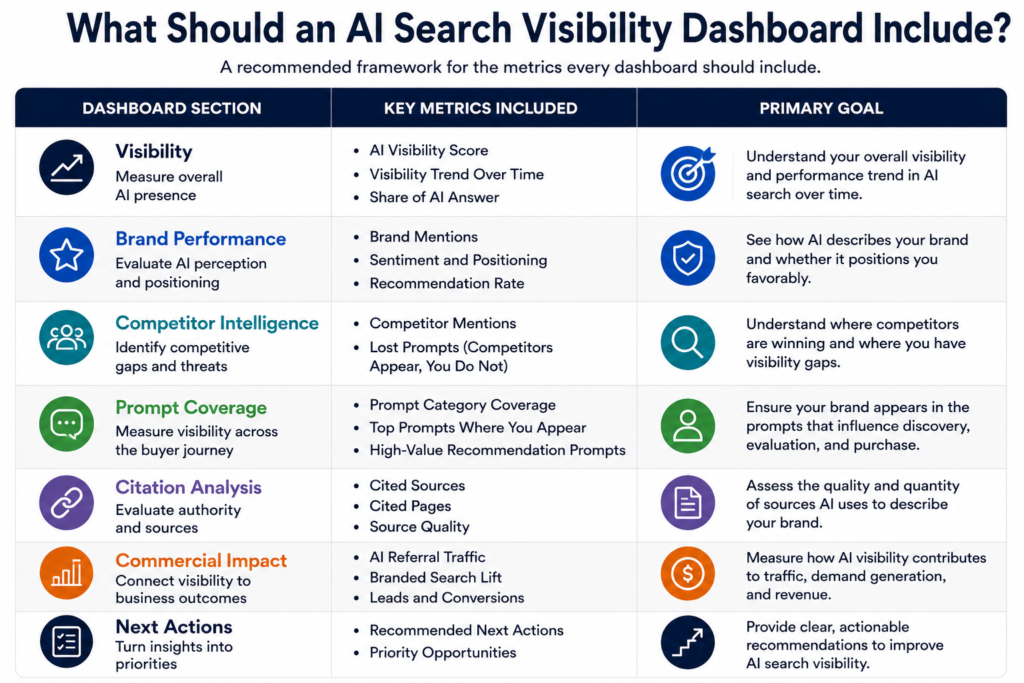
A dashboard should not only report numbers. It should show what the team should do next. If a competitor is winning comparison prompts, the next action may be comparison content. If third-party sources are weak, the next action may be digital PR and citation engineering. If the website is unclear, the next action may be LLM SEO or GEO.
The most effective dashboards also highlight trends over time rather than isolated snapshots. Tracking changes in visibility, recommendations, citations, and commercial impact helps teams understand whether optimization efforts are improving AI search performance.
Because AI search spans multiple channels and touchpoints, no single metric tells the whole story. Combining visibility, competitor intelligence, citation quality, prompt coverage, sentiment, and business outcomes provides a more complete picture of how AI search contributes to brand awareness, buyer consideration, and revenue growth.
How Do You Measure AI Search Visibility Step by Step?
You measure AI search visibility by starting with a benchmark, comparing against competitors, mapping prompts, reviewing citations, analyzing sentiment, and tracking progress over time.
- Define the competitors
Choose direct competitors, alternative solutions, category leaders, and brands that already appear in AI answers for your target topics.
- Build the prompt set
Group prompts by buyer stage, including definitions, problems, comparisons, alternatives, pricing, trust, and best-provider questions.
- Benchmark your visibility
Record where your brand appears, where competitors appear, which sources are cited, and how each answer positions the brand.
- Identify prompt gaps
Find the prompts where competitors are visible and your brand is missing.
- Analyze cited sources
Review whether AI systems are relying on owned pages, third-party publications, forums, reviews, videos, or comparison content.
- Review sentiment and positioning
Check whether your brand is described accurately and whether your unique value proposition is clear.
- Prioritize high-value gaps
Focus first on prompts that influence buyer decisions, not every low-value mention.
- Create the action plan
Choose the right mix of LLM SEO, GEO, comparison content, digital PR, citation engineering, technical SEO, and source-specific campaigns.
- Track movement monthly
Measure mentions, citations, prompt coverage, competitor movement, sentiment, traffic, leads, and revenue influence over time.
- Update the strategy
AI answers change. Your content, source strategy, and prompt priorities should improve as new gaps and opportunities appear.
Common Mistakes in AI Search Visibility Measurement
The biggest mistake is measuring AI visibility like traditional SEO and ignoring the answer itself.
Common mistakes include:
- Tracking traffic but not mentions
- Tracking mentions but not recommendation
- Ignoring competitor prompt gaps
- Treating all prompts as equally valuable
- Ignoring citations and source quality
- Failing to check sentiment
- Measuring only owned website visibility
- Ignoring Reddit, Quora, forums, and review platforms where relevant
- Not connecting AI visibility to sales feedback
- Treating AI visibility as a one-time audit
- Creating low-value content at scale instead of useful pages
- Trying to manipulate AI answers instead of building real authority
Google’s spam policies warn against scaled content abuse, especially when many pages are created primarily to manipulate rankings rather than help users. For AI visibility, the safer and stronger strategy is to create clear, useful, original, well-supported content that helps buyers make better decisions.
How Does Shoden Global Measure AI Search Visibility?
Shoden Global measures AI search visibility by combining benchmark data, competitor prompt-gap analysis, human review, source mapping, content strategy, and ongoing tracking.
Our process starts by comparing your brand against top competitors. We then identify the prompts where your brand is visible, where it is missing, where competitors are being recommended, and which sources appear to support the answer.
From there, our team reviews whether the prompts are commercially relevant, whether the brand is positioned correctly, and what actions are needed to improve visibility.
That action plan may include:
- LLM SEO
- Generative Engine Optimization
- Comparison content for AI answers
- Digital PR and citation engineering
- Editorial comparison content
- Technical SEO for AI discovery
- Reddit, Quora, and forum strategy where relevant
- AI-ready service pages and FAQs
- Ongoing AI visibility tracking
The goal is not to chase every AI mention. The goal is to help your brand become mentioned, cited, and recommended in the AI-generated answers that matter most to your buyers.
Ready to Measure the AI Search KPIs That Matter?
Start with Shoden Global’s AI Visibility Growth Starter Service, starting from $2,600. We benchmark your brand, compare you against top competitors, identify prompt gaps, analyze cited sources, and build a tailored plan to improve your visibility in relevant AI-generated answers.
Button text:
Start AI Visibility Growth From $2,600
Quick Answers
What are AI search visibility metrics?
AI search visibility metrics measure whether your brand appears in AI-generated answers, how often it is mentioned, which sources are cited, and whether the answer positions your brand accurately.
What are the most important AI visibility KPIs?
The most important KPIs are AI visibility score, brand mentions, share of AI answer, citation frequency, prompt coverage, recommendation rate, sentiment, source quality, AI referral traffic, and assisted conversions.
What is prompt coverage?
Prompt coverage measures how many important buyer prompts include your brand. It helps show whether your brand appears across definition, comparison, alternative, pricing, trust, and recommendation questions.
What is share of AI answer?
Share of AI answer compares how often your brand appears against competitors across a target prompt set. It helps show whether your brand is gaining or losing visibility in AI-generated answers.
How do you measure AI citations?
Track which sources AI systems cite or use when answering questions about your brand, category, and competitors. Then compare source quality, relevance, and competitor presence.
Can AI visibility be connected to revenue?
Yes, but it requires more than traffic tracking. Use AI referral traffic, branded search lift, direct traffic, self-reported attribution, CRM notes, assisted conversions, and pipeline influence.
How often should AI visibility be measured?
AI visibility should be monitored at least monthly for important prompts. Competitive markets may require more frequent tracking because answers, sources, and competitor positions can change.
Can Shoden Global help measure AI search visibility?
Yes. Shoden Global helps B2B brands benchmark visibility, compare against competitors, identify prompt gaps, analyze citations, and build a tailored plan to improve AI-generated answer visibility.
FAQ
What are AI search visibility metrics and KPIs?
AI search visibility metrics and KPIs are measurements that show how often and how accurately your brand appears in AI-generated answers. They include mentions, citations, prompt coverage, share of AI answer, sentiment, source quality, traffic, and lead impact.
Why are AI search KPIs important for B2B brands?
AI search KPIs are important because B2B buyers increasingly use AI tools to compare providers, evaluate alternatives, and ask for recommendations. If competitors appear in those answers and your brand does not, your company may lose visibility before the buyer visits your website.
What is the difference between an AI mention and an AI citation?
An AI mention means your brand appears in an AI-generated answer. An AI citation means a source is used or displayed to support the answer. Both matter, but citations can help reveal which sources influence visibility.
What is a good AI visibility score?
A good AI visibility score depends on your competitors, prompt set, industry, and buyer journey. The score is most useful when compared against competitors and reviewed alongside prompt relevance, recommendations, citations, and sentiment.
How do I know if my AI visibility is improving?
AI visibility is improving when your brand appears in more relevant prompts, earns stronger citations, gains share against competitors, receives more accurate positioning, and contributes to traffic, leads, or sales conversations.
Do traditional SEO rankings still matter?
Yes. Traditional SEO rankings still matter because search engines and AI experiences often rely on indexed, useful, technically accessible content. However, rankings alone do not show whether your brand is being recommended in AI-generated answers.
What should be included in an AI visibility report?
An AI visibility report should include a visibility score, competitor comparison, prompt gaps, brand mentions, citations, source quality, sentiment, recommendation rate, AI referral traffic, conversions, and next recommended actions.
How can Shoden Global help with AI search visibility measurement?
Shoden Global is a certified Semrush Partner and helps by benchmarking your visibility, comparing your brand against competitors, identifying prompt gaps, mapping citation sources, reviewing sentiment, and building a custom plan to improve mentions, citations, and recommendations.



























PR Outreach: How to Pitch Journalists in 2026
August 10, 2026