
Knowing how to track AI visibility is essential when buyers use AI systems to research problems, compare providers and shortlist solutions. A useful programme does not chase a single “rank.” It measures repeatable patterns across prompts, platforms, competitors, sources and commercial outcomes, then turns the evidence into owned actions.
AI visibility tracking measures whether a brand appears, is accurately described, is cited and is recommended across a fixed set of buyer prompts. Unlike traditional rank tracking, it must account for changing answers, platform differences, competitor presence, source quality and the commercial importance of each prompt.
Table of Contents
What Does It Mean to Track AI Visibility?
To track AI visibility, record the quality and context of each appearance: mention, accurate description, citation, recommendation, prompt coverage, share of answer, and source visibility.
Core Measurements
Mentions and Descriptions
A mention confirms that the brand appeared. Description accuracy checks whether the answer correctly explains the company, offer, audience, market, and differentiators. Keep them separate because visibility with inaccurate positioning can damage trust.
Citations and Recommendations
A citation links the answer to your site or a credible third-party source. A recommendation shortlists or endorses the brand for the stated need. Prompt coverage is the percentage of eligible prompts where the brand appears; share of answer measures prominence relative to competitors.
Shoden Global's guide to AI Strategic Visibility can help teams standardise these definitions and establish a consistent framework for measuring AI visibility across search and AI-generated answers.
Why Is AI Visibility Tracking Different From Rank Tracking?
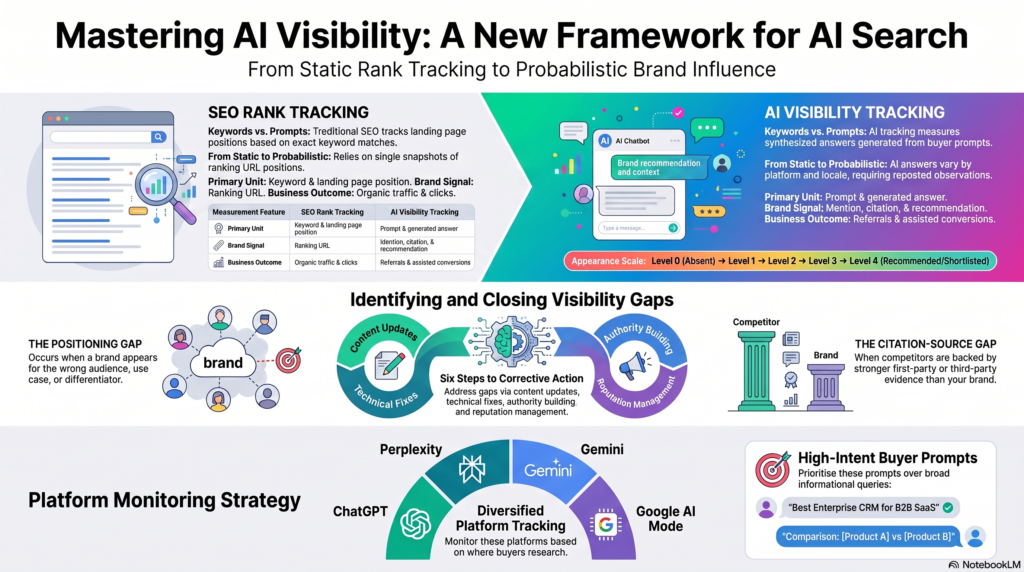
AI visibility tracking is prompt-based and probabilistic rather than position-based. Answers can change with wording, platform, model or mode, locale, account state, date, and retrieved sources, so one manual check cannot establish a dependable trend.
Google states that AI Mode and AI Overviews may use different models and techniques, causing responses and supporting links to vary. Repeated observations and saved evidence are therefore essential.
SEO Rank Tracking vs AI Visibility Tracking
Which AI Platforms Should You Monitor?
Monitor the platforms your buyers use during research and decision-making. Begin with the most relevant experiences, then expand when customer interviews, sales conversations, referral data or market behaviour support it.
ChatGPT
Record whether search is used, brand treatment and inline citations or source links. OpenAI confirms that search responses may show both.
Perplexity
Capture the answer, citation order and source domains. Perplexity says answers include numbered links to original sources.
Google AI Mode and AI Overviews:
Track brand inclusion, supporting links, and query context. Google describes both as AI search experiences that surface supporting websites.
Gemini
Record the answer, related sources when shown, account state and mode. Score cited and uncited responses separately.
Copilot
Include it when your audience uses Microsoft’s ecosystem. Microsoft says web-grounded responses can expose a Sources button.
For deeper platform analysis, use Shoden Global’s ChatGPT visibility tracker and Perplexity monitoring guide.
Which Buyer Prompts Should You Track First?
Track prompts that represent real buying decisions before broad informational curiosity. Segment them by audience, product, market, journey stage and commercial intent.
Build a Buyer-Journey Prompt Taxonomy
Brand and Discovery Prompts
Use brand, category and problem prompts, such as “What does [brand] do?” and “Which providers solve [problem] for [persona]?” These test entity clarity and category inclusion.
Evaluation and Decision Prompts
Add comparison, alternative, best-fit, pricing, risk, and final-decision prompts. Examples include “[brand] vs [competitor] for global teams” and “Best [category] provider for a regulated company.” Weight decision prompts more heavily, and keep benchmark wording fixed. Treat materially different phrasings as separate prompts.
How to Track AI Visibility Across AI Search Engines?
Use a controlled workflow that preserves the prompt, test environment, answer, and cited evidence. This creates a baseline that can be retested and acted upon.
- Define the audiences, markets, and products to monitor.
- Build a fixed prompt set by buyer journey and intent.
- Choose the platforms that matter to those buyers.
- Record brand appearance, description, recommendation and citation status.
- Capture cited sources and answer screenshots or exports.
- Score competitor presence and recommendation strength.
- Tag each gap by content, technical, authority, reputation or positioning cause.
- Assign corrective actions and owners.
- Retest on a fixed schedule and connect changes to leads and conversions.
How Do You Build a Reliable Prompt-Tracking Baseline?
Hold test conditions as constant as practical and document every material variable. Record exact wording, platform, date, locale, language, account state, model or mode, device, and whether web search was active. Save the complete answer and collect repeated observations for high-value prompts.
Prompt-Tracking Quality Checklist
• Prompt has a clear buyer persona and intent
• Platform, date, locale, and account state are recorded
• Answer evidence is saved
• Mention and recommendation are scored separately
• Citations and source domains are captured
• Competitor share is calculated
• Inaccurate descriptions are flagged
• High-intent prompts receive higher weighting
• AI referrals and assisted conversions are reviewed
• Every gap has a recommended action
How Do You Measure Brand Mentions and Recommendations?
Score mentions and recommendations separately, then combine them only when an executive summary needs a weighted index. This prevents a basic name check from being presented as meaningful buyer influence.
A Practical Five-Level Appearance Scale
Appearance Score
0 = Absent
1 = Mentioned
2 = Accurately described
3 = Cited or supported by a source
4 = Recommended, shortlisted or selected
Retain separate accuracy, citation and recommendation fields because the evidence behind the score explains why performance moved.
Intent Weight
Use an agreed weight, such as 1 for research, 2 for evaluation and 3 for decision intent.
Weighted visibility index = observed weighted points ÷ maximum possible weighted points × 100
Also report prompt coverage, recommendation rate, citation rate and answer accuracy. Appearing in 18 of 40 prompts equals 45% coverage; recommendations in 6 of 20 decision prompts equal a 30% recommendation rate. These are transparent internal measures, not universal standards.
How Do You Track Competitor Share in AI Answers?
Score every named competitor under the same rules. This reveals who owns the category narrative, receives the strongest recommendations, and wins head-to-head prompts.
Three Competitor Views
Share, Strength and Ownership
Calculate AI share of voice as your weighted appearance points divided by all tracked brands’ weighted points. Pair it with recommendation strength, citation frequency and share of answer so weak mentions do not inflate the result.
Category ownership identifies the brand repeatedly presented as the default or safest choice. Head-to-head performance shows who wins direct comparisons and why. Save the language used for strengths, weaknesses and fit because it often exposes the missing proof or positioning.
How Do You Find an AI Visibility Gap?
Compare required visibility with observed prompt coverage, positioning, citations, accuracy, proof, and competitor strength.
• Prompt gap: The brand is absent from an important category or decision prompt.
• Positioning gap: The brand appears for the wrong audience, use case or differentiator.
• Citation-source gap: Competitors are supported by stronger first-party or third-party evidence.
• Accuracy gap: The answer is outdated, incomplete, or incorrect.
• Proof gap: Needed claims lack accessible cases, specifications, reviews, or expert evidence.
• Technical gap: Important pages are difficult to crawl, index, render or interpret.
More than one gap may affect the same prompt, so prioritise the underlying cause rather than treating each symptom independently.
For Google’s AI features, supporting pages must be indexed and eligible to appear in Search with a snippet. Google also says no special AI markup guarantees inclusion. Prioritise crawlability, useful content and accurate structured data.
What Should an AI Visibility Dashboard Include?
Give leaders a concise trend view while preserving prompt-level evidence for analysts. Every headline metric should drill down to the answer, source and test conditions behind it.
Executive View
Show weighted visibility, prompt coverage, recommendation rate, citation rate, accuracy, AI share of voice, platform trends, identifiable AI referrals, leads and assisted conversions.
Analyst View
Show prompt ID, persona, journey stage, weight, platform, mode, locale, account state, date, full response, screenshot, score, competitors, cited domains, accuracy flag, gap type, action, owner and retest date.
Do not rely on one composite score. It cannot explain whether change came from recommendations, citations, coverage, accuracy or competitor movement.
How Often Should Brands Monitor AI Visibility?
Create a full baseline, then run a consistent monthly review for stable programmes. Monitor high-intent prompts more frequently during launches, major updates, competitive events or reputation risks. Keep the core prompt set stable, document additions and compare like-for-like test conditions.
What Should You Do After Tracking Your Visibility?
Convert each material gap into an owned action, deadline and retest date. Tracking creates value only when it improves content, technical access, source discovery, entity clarity, reputation evidence or positioning.
• Content: Update a page or create focused comparison, alternative, use-case or decision content.
• Technical: Fix crawling, indexing, rendering, internal linking or structured-data conflicts.
• Authority: Earn credible third-party coverage, expert references and relevant source mentions.
• Reputation: Address recurring concerns, review evidence and outdated public information.
• Positioning: Clarify the audience, differentiators and best-fit use case.
• Measurement: Improve referral tracking, CRM attribution and assisted-conversion reporting.
Google recommends Search Console for performance in its generative AI search features and analytics tools for on-site conversions. Cross-platform prompt evidence should sit beside those outcome metrics.
What Are the Most Common AI Visibility Tracking Mistakes?
The biggest mistakes make results incomparable, unauditable, or commercially irrelevant.
• Testing random prompts
• Drawing conclusions from one answer
• Reporting a vanity score without its components
• Changing wording or test conditions without recording them
• Saving snippets instead of full answers and sources
• Counting a mention as a recommendation
• Ignoring inaccurate or negative descriptions
• Omitting competitors and buyer outcomes
• Treating identifiable referrals as the only influence
• Finding gaps without owners or retest dates
Quick Answers
Measurement Basics
What Is AI Visibility Tracking?
It is repeated measurement of brand mentions, descriptions, citations and recommendations across controlled buyer prompts and AI platforms.
Can AI Visibility Be Represented by One Score?
One score can show direction, but it needs supporting coverage, recommendation, citation, accuracy, platform and competitor metrics.
How Many Prompts Should a Company Track?
There is no universal number. Begin with 30–50 commercially relevant prompts, then expand by audience, market, product and journey stage.
Which AI Platform Should Be Tracked First?
Start with the platform your buyers use most. When uncertain, test ChatGPT, Google’s AI search experiences and Perplexity, then prioritise from evidence.
Operations and Attribution
What Is AI Share of Voice?
It is your proportion of tracked, weighted visibility compared with named competitors under consistent scoring rules.
What Is the Difference Between a Mention and Recommendation?
A mention names the brand. A recommendation presents it as suitable, preferred, shortlisted or worth choosing for the stated need.
How Often Should Prompts Be Retested?
Retest monthly for stable programmes and more frequently for launches, major changes, high-intent prompts or reputation-sensitive topics.
Can AI Visibility Be Connected to Leads?
Yes. Compare prompt and citation trends with identifiable referrals, landing-page behaviour, lead sources, sales notes and assisted conversions.
Conclusion
A defensible AI Visibility programme replaces occasional brand searches with controlled measurement. It shows where your company appears, how accurately it is represented, which sources and competitors shape answers, and what should improve next.
Ask Shoden Global to build a cross-platform prompt-tracking dashboard and AI visibility action plan through our AI Visibility Service. The result is a prioritised programme of content, technical, authority, reputation and measurement actions.
FAQ
How Do I Track AI Visibility?
Create fixed buyer prompts, choose relevant platforms, document test conditions, save answers and citations, score your brand and competitors, classify gaps, assign actions and retest consistently.
How Is AI Visibility Different From SEO Rank Tracking?
SEO tracking observes a page’s search position. AI visibility tracking evaluates generated answers for mentions, accuracy, citations, recommendations, competitor presence, and source quality, so it needs repeated prompt-level observations.
Which Platforms Should My Company Monitor?
Monitor the experiences your buyers use. Common starting points are ChatGPT, Perplexity, Google AI Mode and AI Overviews, Gemini and Copilot, but customer behaviour should determine the final mix.
What Prompts Should Be Included in an AI Visibility Audit?
Include brand, category, problem, comparison, alternative, best-fit, pricing, risk and final-decision prompts. Segment them by persona, market, product and journey stage, then weight commercial and reputational importance.
How Do I Calculate AI Share of Voice?
Score every tracked brand consistently. Divide your brand’s weighted points by all tracked brands’ weighted points, then multiply by 100. Keep mentions, recommendations, and citations visible beside the percentage.
How Often Should AI Visibility Be Checked?
Run a baseline and monthly operational checks, increasing frequency during launches, major updates, competitive changes or reputation risks. Review high-value decision prompts more often when justified.
Why Do AI Answers Change Between Tests?
Answers can change with wording, date, locale, account state, model, mode and retrieved sources. Record those conditions and use repeated observations rather than treating one answer as fixed.
What Should I Do After Finding an AI Visibility Gap?
Classify the cause as content, technical, authority, reputation or positioning. Assign the relevant update, comparison asset, technical fix, digital PR, review work or source outreach, then retest comparably.




























PR Outreach: How to Pitch Journalists in 2026
August 10, 2026