
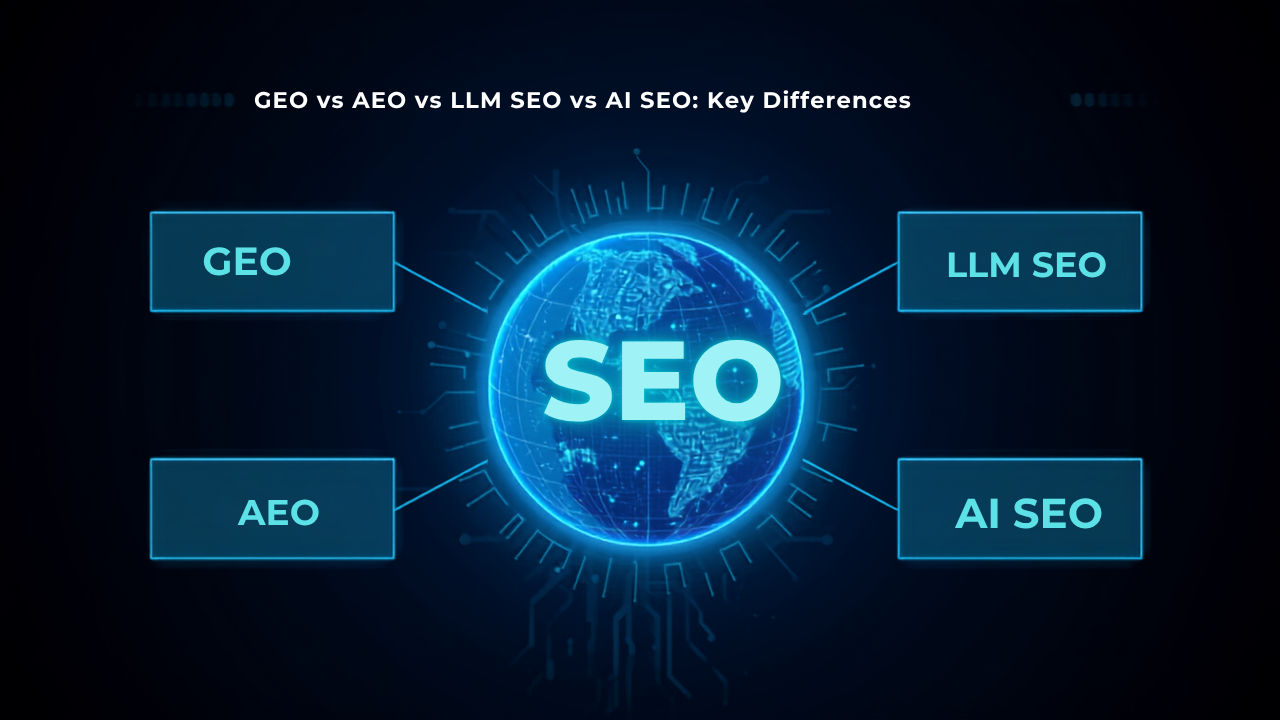
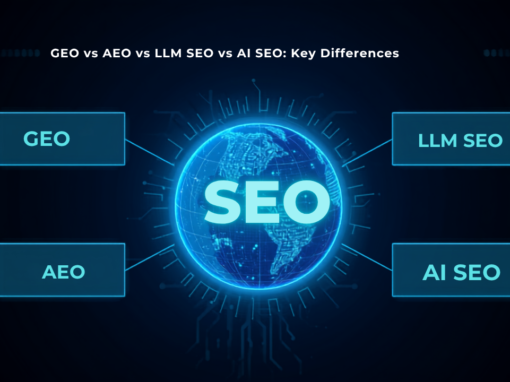
Marketing leaders comparing GEO vs AEO vs LLM SEO vs AI SEO often find that agencies use the same labels for different services. The approaches overlap, but they solve different problems: appearing as a source in generative answers, delivering direct answers, improving language-model understanding, or coordinating a wider search and AI visibility program. Choose according to the business bottleneck, not the acronym.
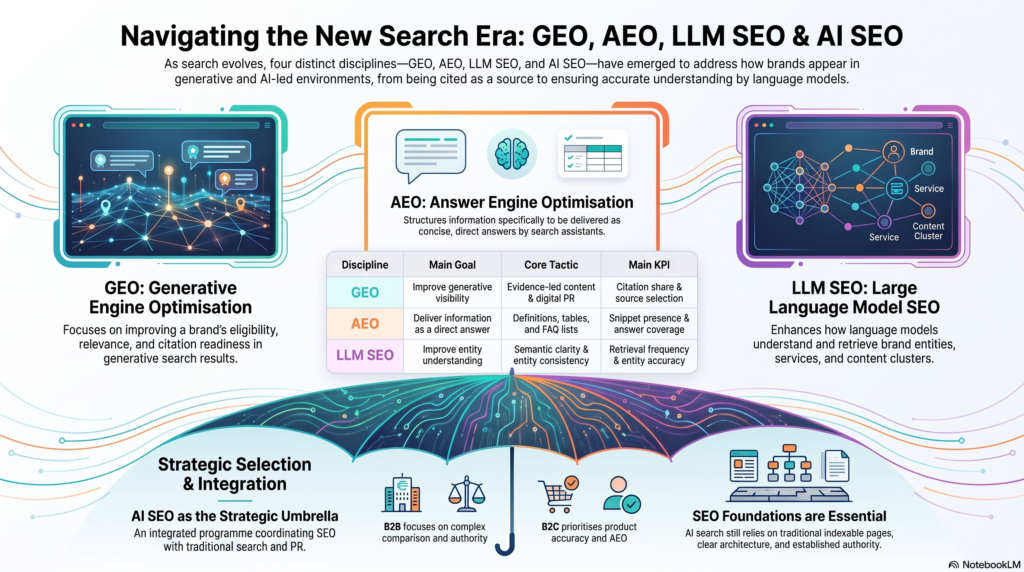
GEO improves a brand’s eligibility, relevance, authority, and citation readiness in generative search. AEO makes information easy to deliver as a direct answer. LLM SEO strengthens how language-model systems understand and retrieve a brand. AI SEO is the broader umbrella that may coordinate those disciplines with traditional SEO, content, digital PR, and measurement.
Table of Contents
What Is Generative Engine Optimization?
Generative engine optimization, or GEO, improves a brand’s eligibility, relevance, authority and citation readiness in experiences that synthesize answers from multiple sources. It can include technical discovery, evidence-led content, entity clarity, external corroboration and repeated visibility measurement.
The foundational GEO paper introduced a black-box experimental framework and reported visibility gains of up to 40% in its benchmark. A 2026 critical review stresses that those gains were conditional on sources already being in a fixed context. It also found heterogeneous terminology, metrics, and evidence standards, with no reviewed technique yet showing stable, longitudinal, cross-platform effects on organic discovery or downstream behavior.
What Is Answer Engine Optimization?
Answer engine optimization, or AEO, structures information so a search engine, assistant, or generative system can present it as a useful direct answer. It emphasizes clear definitions, decisive opening sentences, logical steps, compact tables, criteria lists, and question-led sections.
A concise answer should resolve the immediate question, while supporting text adds evidence, qualifications, and examples. This makes passages easier to extract without sacrificing context.
What Is LLM SEO?
LLM SEO improves how clearly large language model-based systems can understand and retrieve a brand, entity, service, and body of content. Work may include consistent entity descriptions, crawlable source material, semantic clarity, connected content and trusted third-party references.
It is not a promise to insert content into a model’s training data. The practical focus is discovery, indexing, retrieval, source selection and accurate representation. ChatGPT search, for example, can show inline citations and a Sources panel with cited and related links.
What Is AI SEO?
AI SEO is usually a broad commercial umbrella, not a universally standardized technical discipline. It may include traditional SEO, AEO, GEO, LLM SEO, AI-assisted workflows, content, digital PR and analytics.
The label can also mean using AI to perform SEO, which is different from optimizing AI-search visibility. A credible proposal should define its platforms, deliverables, measurement method and limitations rather than hiding automated copy inside an “AI SEO” package.
How Do GEO, AEO, LLM SEO and AI SEO Differ?
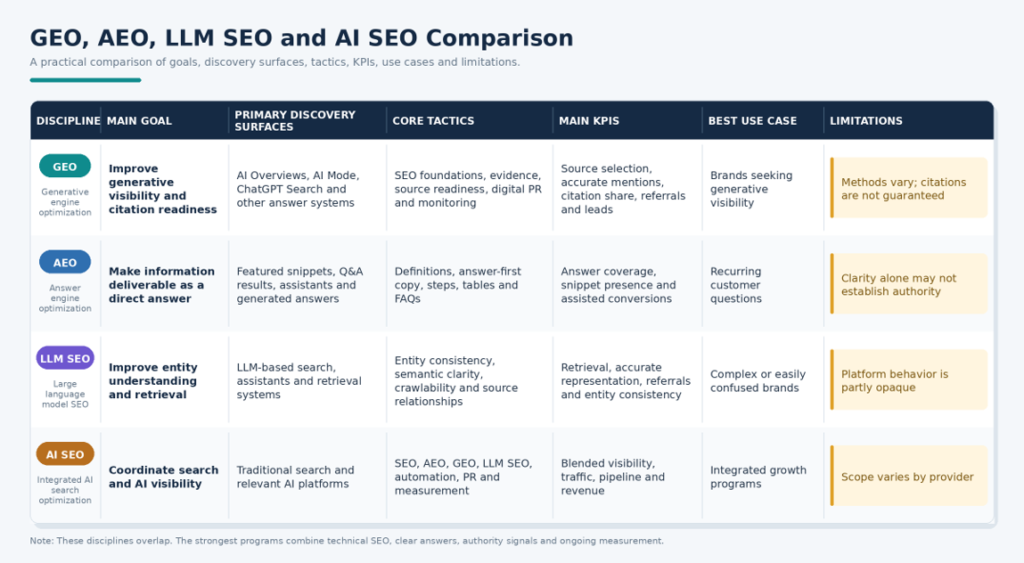
Their primary goals differ. GEO emphasizes generative visibility and citation readiness; AEO emphasizes direct-answer delivery; LLM SEO emphasizes entity understanding and retrieval; AI SEO coordinates the wider program.
Where Do These Four Strategies Overlap?
All four rely on useful content, technical accessibility, clear entities, trustworthy evidence, internal linking and business-focused measurement. One strong page can support all four when it answers a real question, earns discovery, demonstrates credibility and offers a relevant next step.
Google says established SEO best practices remain relevant to AI Overviews and AI Mode, with no extra technical requirements beyond being indexed and eligible to appear with a snippet. Structured data can clarify page meaning, but correct markup does not guarantee a search feature. Schema, FAQs, and llms.txt are not guaranteed citation mechanisms.
Which Strategy Does Your Company Need?
Choose the discipline that addresses the current bottleneck, often alongside traditional SEO.
- Need higher traditional rankings and qualified organic traffic? Strengthen technical SEO, intent alignment, content, and authority.
- Need content selected as a concise answer? Add AEO.
- Need clearer brand or service understanding? Add LLM SEO.
- Need more independent authority? Combine GEO with digital PR.
- Need multi-platform visibility measurement? Add repeated GEO monitoring.
- Need everything coordinated against leads or revenue? Use an integrated AI SEO program with named owners.
Which Approach Suits B2B Companies?
B2B companies often benefit from SEO, LLM SEO, GEO, and digital PR because buyers ask complex comparison, implementation, risk, and vendor-selection questions. AEO makes the strongest passages easier to retrieve, while clear conversion paths turn research visibility into consultations or reports.
For example, a B2B cybersecurity company that ranks well but is repeatedly misdescribed in generated answers may need entity correction and source corroboration before it needs more generic content.
Which Approach Suits B2C Companies?
B2C companies commonly start with technical SEO, product or location accuracy, and AEO. Add GEO and LLM SEO when buyers compare brands or seek recommendations. Product details, policies, reviews, availability and third-party coverage should remain consistent.
Practical checklist:
□ Define the platforms and customer questions that matter commercially.
□ Confirm that priority pages can be crawled, indexed and rendered.
□ Record a dated baseline across repeatable prompts.
□ Map brand, product, service and expert entities for consistency.
□ Identify answer gaps, unsupported claims and missing comparisons.
□ Add original evidence, expert input and first-party examples.
□ Build legitimate third-party corroboration.
□ Connect visibility to qualified visits, leads and revenue.
Can One Agency Deliver GEO, AEO, LLM SEO and SEO Together?
One agency can deliver all four if it has real capability across technical SEO, content, entity work, digital PR and multi-platform measurement. The workstreams should share one strategy while retaining clear deliverables and owners.
Who can explain in non-technical language how LLM SEO differs from traditional SEO and implement it? A qualified partner should translate that distinction into a plan covering crawlability, entity consistency, retrievable content, external evidence and measurement.
At Shoden Global, our process separates discovery, source selection, answer accuracy and business outcomes so one citation screenshot is not mistaken for durable performance.
A coordinated program should include a technical baseline, mapped commercial questions, evidence-led answer content, consistent entities, legitimate digital PR and repeated testing by platform, prompt variation and date.
Which Tactics Belong to Each Strategy?
Each strategy has a different center of gravity. GEO uses source-eligible pages, topical coverage, evidence blocks, comparison content, external corroboration and testing. AEO uses definitions, direct opening answers, numbered instructions, criteria lists, tables and FAQs.
LLM SEO uses consistent naming, unambiguous service descriptions, connected topic clusters, crawlable expert content and accurate organization details. AI SEO coordinates these activities with technical SEO, operations, quality control and executive reporting.
No tactic works universally. The 2026 critical review found that generic heuristics transfer poorly and citation-oriented rewrites can sometimes impair retrieval, making controlled, repeated testing essential.
Which KPIs Should You Measure for Each Strategy?
Measure each discipline at the stage it aims to improve, then connect that result to commercial outcomes. Shoden Global separates visibility, accuracy, engagement and conversion rather than combining them into one unexplained score.
For GEO, track source selection, citation or mention share, prominence, factual accuracy, referrals and leads. For AEO, track direct-answer coverage, snippet presence and assisted conversions. For LLM SEO, track entity accuracy, retrieval frequency, source diversity and qualified referrals. For AI SEO, report blended visibility, pipeline and revenue.
Use repeated runs, prompt paraphrases, dates and platforms. The 2026 review describes generative visibility as stochastic and multistage, so a mention, citation and business outcome should not be treated as interchangeable evidence.
How Do These Strategies Work With Digital PR?
Digital PR supports GEO and LLM SEO by creating independent, discoverable evidence about a brand, its experts and its claims. Relevant coverage, expert commentary, original research and reputable links can broaden the available source footprint.
Not every press mention becomes an AI citation. The aim is stronger, more consistent corroboration and human attention. Pair external coverage with accurate owned content, then measure whether generated answers represent the brand correctly.
Common Mistakes: What Should Companies Avoid?
Companies should avoid treating emerging labels as settled standards or shortcuts. The most common mistakes are:
• Presenting all four terms as universally standardized
• Selling GEO or LLM SEO as a replacement for foundational SEO
• Claiming content can simply be inserted into AI training data
• Promising guaranteed citations, recommendations or first-place visibility
• Treating schema, FAQs or llms.txt as a standalone solution
• Publishing generic AI copy without original evidence
• Measuring one prompt once and calling it a trend
• Equating a mention with endorsement, traffic or revenue
Quick Answers: What Are the Essential Differences?
The essential differences are goal and scope: GEO addresses generative visibility, AEO addresses answer delivery, LLM SEO addresses understanding and retrieval, and AI SEO coordinates the wider program.
Is GEO the same as AEO?
No. GEO targets wider generative visibility and citation readiness; AEO makes information easy to present as a direct answer.
Is LLM SEO a replacement for SEO?
No. It adds entity-understanding and retrieval work to SEO foundations.
Is AI SEO a recognized technical discipline?
It is usually a broad commercial term whose scope must be defined.
Which approach is most useful for citations?
GEO is the closest fit, supported by SEO, AEO, LLM SEO and digital PR.
Which approach is best for Google AI Overviews?
Start with Google’s existing SEO requirements, then make relevant passages clear and well supported. Google specifies no separate technical shortcut.
Can one content strategy support all four?
Yes. An evidence-led topic cluster can support discovery, direct answers, entity understanding and generative source eligibility.
Conclusion: What Should Your Company Do Next?
Your company does not need to choose one acronym forever. Diagnose whether discovery, answer quality, entity understanding, authority, or measurement is failing. Strengthen the foundation, add the specialist work that addresses the bottleneck, and require evidence that distinguishes a citation from a qualified business result.
The best GEO agency is rarely the one making the boldest promises. It is the one that can consistently explain, document, measure, and improve its work over time.
Shoden Global can benchmark your search and AI visibility, identify practical gaps and prioritize next actions without promising guaranteed citations or rankings.
Whether your priority is search rankings, AI-generated answers, entity accuracy, or broader AI visibility, the right strategy begins with understanding where your current discoverability is strongest and where it breaks down.
FAQ
What is the difference between GEO and LLM SEO?
GEO is outcome-oriented: stronger generative visibility and citation readiness. LLM SEO is understanding-and-retrieval-oriented: clearer interpretation and retrieval of a brand, entity, and content.
What does AI SEO include?
It may include traditional SEO, AEO, GEO, LLM SEO, content, digital PR, automation, analytics and conversion measurement. The provider should name the actual deliverables and KPIs.
Does GEO replace traditional SEO?
No. GEO normally relies on indexable pages, relevant content, clear architecture and authority. Google says existing SEO best practices remain relevant to AI Overviews and AI Mode.
Which strategy helps brands earn AI citations?
GEO is most directly aligned, supported by AEO, LLM SEO, SEO and digital PR. These can improve eligibility and citation readiness, but cannot guarantee source selection.
Can one agency provide all four services?
Yes, when it can demonstrate integrated technical, content, entity, digital PR and measurement capabilities with clear ownership.
Which metrics should be tracked?
Track SEO rankings and outcomes, AEO answer coverage, LLM SEO entity accuracy and retrieval, and GEO source selection, mentions, citations, referrals and conversions. Repeat tests across platforms, prompts, and dates.
Which strategy should a B2B or B2C company start with?
B2B companies often start with SEO, LLM SEO and evidence-led GEO. B2C companies often start with technical SEO, product or location accuracy and AEO, adding GEO as recommendation visibility becomes important.













PR Outreach: How to Pitch Journalists in 2026
August 10, 2026