
Search is changing. People still use Google, but they are also asking ChatGPT, Gemini, Perplexity, Claude, and AI search features for direct answers, product recommendations, comparisons, and business advice.
That change has created a new question for marketing teams:
Should we focus on SEO, GEO, or both?
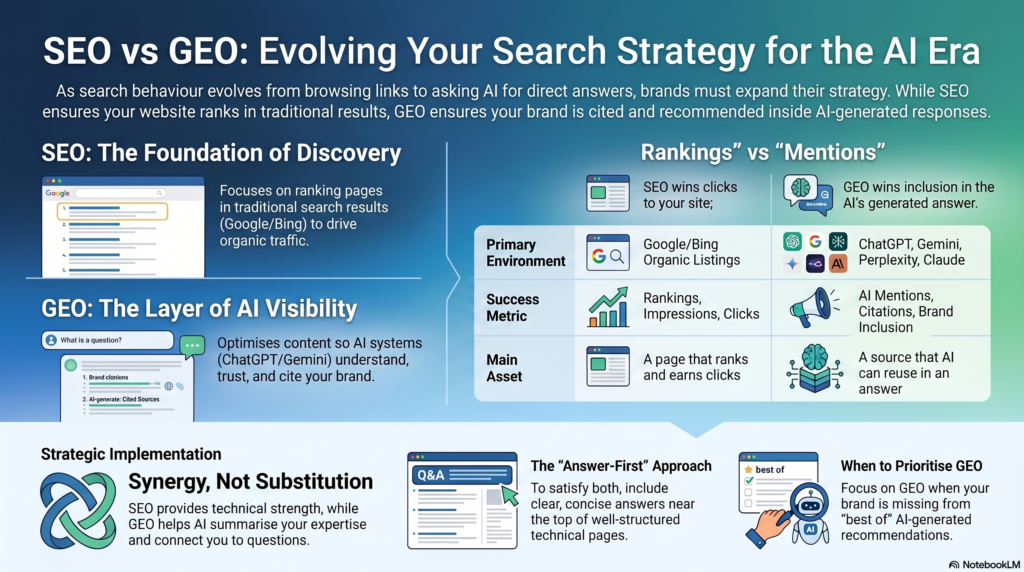
The answer is simple. SEO helps your website appear in traditional search results. GEO helps your brand appear, be cited, and be recommended inside AI generated answers.
You do not need to choose one forever. You need to know when to use each, how they work together, and how to build a visibility strategy that covers both search engines and generative engines.
Table of Contents
Is GEO the same as traditional SEO?
No. Generative Engine Optimization is not the same as traditional SEO, although the two are closely connected.
SEO focuses on improving a website’s visibility in search engine results pages. GEO focuses on improving a brand’s visibility inside AI generated answers.
Traditional SEO asks:
Can this page rank for the search query?
GEO asks:
Can this brand, page, expert, product, or service become part of the answer?
Google Search Central says SEO fundamentals still matter for generative AI features in Google Search, including AI Overviews and AI Mode. Google also says pages must meet Search technical requirements and be eligible to appear in Search with a snippet to be shown as supporting links in these AI features.
What is SEO?
SEO stands for Search Engine Optimization.
It is the process of improving your website so search engines can crawl it, understand it, rank it, and show it to users who are searching for relevant topics.
SEO usually focuses on:
• Keyword research
• Technical website health
• Content quality
• On page optimization
• Internal linking
• Backlinks
• Search intent
• User experience
• Search rankings
• Organic traffic
The main goal of SEO is to help your pages appear higher in traditional search results and attract relevant visitors to your website.
For example, a B2B software company might use SEO to rank for:
• best workflow automation software
• workflow automation pricing
• how to automate approval processes
• workflow automation for finance teams
In this case, the company wants users to find its pages in Google, click through, read the content, and convert.
What is GEO?
GEO stands for Generative Engine Optimization.
It is the process of improving your content, brand signals, and digital presence so generative AI systems can understand, trust, cite, mention, and recommend your business in AI generated answers.
A GEO strategy usually focuses on:
• Clear answer first content
• Brand fact consistency
• Expert led explanations
• Comparison content
• FAQ content
• Third party mentions
• Listicle inclusion
• Digital PR
• Citation worthy content
• AI answer tracking
• Prompt visibility
• AI citation monitoring
The main goal of GEO is not only to win a ranking. The goal is to become a reliable source or recommended brand inside the answer itself.
For example, a user might ask an AI tool:
What are the best cybersecurity platforms for mid market companies?
If your brand is mentioned, cited, or recommended in the generated response, GEO is working.
A Princeton associated research paper on GEO framed the concept around improving the visibility of source content in generative engine responses, which reflects the broader shift from ranking only in search results to being surfaced inside AI generated answers.
GEO vs SEO: The main difference
Here is the clearest way to understand the difference.
SEO helps your website rank.
GEO helps your brand become part of the generated answer.
SEO is built around search results. GEO is built around AI answers.
SEO helps people find your page. GEO helps AI systems understand why your brand should be mentioned, cited, or recommended.
GEO vs. SEO Comparison
| Category | SEO | GEO |
| Main goal | Rank higher in traditional search results | Appear in AI-generated answers, citations, and recommendations |
| Primary environment | Google search results, Bing search results, organic listings | ChatGPT, Gemini, Perplexity, Claude, Google AI Overviews, and AI Mode |
| Main asset | A page that ranks and earns clicks | A brand, page, expert, or source that AI can reuse in an answer |
| Content style | Keyword aligned, intent matched, well-structured content | Answer-first, sourceable, comparison-rich, easy to cite content |
| Success metric | Rankings, impressions, clicks, organic traffic, conversions | AI mentions, AI citations, brand inclusion, answer visibility, assisted conversions |
| Best use case | Driving organic traffic from search engines | Building visibility in AI-assisted research and recommendation journeys |
| Biggest risk | Ranking without converting | Being invisible in AI answers even when your SEO is strong |
How GEO and SEO work together
GEO does not replace SEO. It builds on it.
A page that cannot be crawled, indexed, understood, or trusted is unlikely to perform well in either traditional search or AI search. Google’s guidance for AI features says the same SEO best practices remain relevant, including crawlability, internal links, page experience, textual content, helpful content, and accurate structured data where applicable.
Think of SEO as the foundation and GEO as the visibility layer above it.
SEO gives your website technical strength, topical relevance, and search authority.
GEO helps AI systems understand your brand’s role, summarize your expertise, and connect your business to the right questions.
A strong strategy uses both.
When to use SEO
Use SEO when your main goal is to increase organic traffic from traditional search results.
SEO is the right priority when:
• Your website has crawl or indexing issues
• Your pages do not rank for important keywords
• You need more organic traffic
• Your product or service category has strong search volume
• Your competitors outrank you in Google
• Your website needs better technical structure
• Your content does not match search intent
• You want more leads from organic search
SEO is especially useful for pages such as:
• Service pages
• Product pages
• Local landing pages
• Blog posts
• Comparison pages
• Pricing pages
• Category pages
• Glossary pages
For example, if a business wants to rank for “B2B SEO agency” or “technical SEO audit,” traditional SEO should be a major part of the strategy.
When to use GEO
Use GEO when your main goal is to appear in AI generated answers and AI assisted buying journeys.
GEO is the right priority when:
• Buyers ask AI tools for recommendations in your category
• Your competitors appear in AI answers and you do not
• Your brand is missing from “best tools” or “best agencies” responses
• AI tools describe your business incorrectly
• Your website ranks, but AI platforms do not cite it
• Your content is too vague for AI systems to summarize
• You need stronger third party signals
• Your business depends on comparison based decisions
GEO is especially useful for content such as:
• “What is” guides
• “How to” guides
• Comparison articles
• Best practices posts
• FAQ pages
• Buyer guides
• Use case pages
• Expert explainers
• Listicles
• Case studies
For example, if a business wants to appear when a user asks “best AI visibility agencies for B2B brands,” GEO should be part of the strategy.
When to use both GEO and SEO
Most businesses should use both.
SEO is still essential because search engines remain a major discovery channel. GEO is becoming essential because AI tools increasingly shape how buyers research, compare, and shortlist options.
Use both when:
• Your buyers search on Google and ask AI tools for advice
• Your sales cycle involves research and comparison
• Your brand needs stronger authority signals
• Your website has useful content but weak AI visibility
• You want more organic traffic and more AI mentions
• You want to build a durable content cluster around a major topic
• You want visibility before the user clicks a result
For example, a SaaS company might use SEO to rank for “best project management software for agencies,” while using GEO to make sure AI tools mention the company in answers about project management tools, agency workflows, and software comparisons.
The best strategy is not SEO or GEO.
The best strategy is SEO plus GEO.
Example: How the same topic changes for SEO and GEO
Imagine a company wants to target this query:
Generative engine optimization vs traditional SEO
An SEO focused page would include:
• Keyword optimized title
• Search intent matching content
• Related keywords
• Internal links
• Meta description
• Headings
• Schema where useful
• Backlinks
• Conversion call to action
A GEO focused page would add:
• A direct answer near the top
• A clear GEO vs SEO comparison
• Definitions AI can easily reuse
• Examples of when to use each
• FAQ answers
• Consistent brand facts
• Expert explanations
• Citations and trusted references
• Links to related topic cluster pages
• Content that answers follow up questions
The best page includes both approaches.
It ranks well for search engines and gives generative engines a clear, trustworthy answer to reuse.
How generative engines change search behavior
Generative engines change search because users no longer need to open every result to get an initial answer.
They can ask a complex question and receive a summary, recommendation, or comparison immediately.
Google says AI Mode is useful for queries that involve further exploration, reasoning, or complex comparisons, and that AI Overviews and AI Mode can use query fan out, where the system issues multiple related searches across subtopics and sources to develop a response.
This matters because one user question may trigger several hidden sub questions.
For example, a user asks:
Should I hire a GEO agency or an SEO agency?
A generative engine may also look for:
• What is GEO?
• Is GEO different from SEO?
• What does a GEO agency do?
• How do you measure GEO success?
• Is GEO useful for B2B websites?
• GEO best practices
• Risks of GEO
That means your website should not rely on one isolated blog post. It needs a connected content cluster.
GEO vs SEO examples
Example 1: A B2B agency
A B2B agency wants more leads from Google.
SEO goal:
Rank for terms such as “B2B marketing agency,” “content marketing agency,” and “technical SEO services.”
GEO goal:
Appear in AI answers when users ask for the best agencies for B2B growth, AI visibility, digital PR, or content strategy.
Best approach:
Use SEO to build rankings and traffic. Use GEO to become visible in AI generated recommendations.
Example 2: A SaaS company
A SaaS company sells compliance software.
SEO goal:
Rank for compliance software keywords, use case pages, industry pages, and comparison queries.
GEO goal:
Appear when buyers ask AI tools which compliance platforms are best for their industry.
Best approach:
Create SEO optimized product and use case pages, then build GEO focused comparison content, FAQs, third party mentions, and citation worthy guides.
Example 3: A local professional service
A local law firm wants more clients.
SEO goal:
Rank for local legal service searches and practice area pages.
GEO goal:
Appear in AI answers when users ask what type of lawyer they need, what legal steps to take, or how to compare local firms.
Best approach:
Use SEO for local visibility and GEO for educational authority, FAQs, and answer based content.
Example 4: An ecommerce brand
An ecommerce brand sells premium office chairs.
SEO goal:
Rank category pages, product pages, and buying guides.
GEO goal:
Appear in AI answers for questions such as “best ergonomic chair for remote workers” or “what office chair is best for back support.”
Best approach:
Use SEO for product discovery and GEO for comparison guides, product criteria, reviews, and expert buying advice.
How to optimize a page for both SEO and GEO
1. Start with the search intent
Before writing, define what the user wants.
Are they looking for a definition, a comparison, a tutorial, a tool, a service, or a buying decision?
For this post, the intent is comparison.
The user wants to know:
• What is GEO?
• What is SEO?
• How are they different?
• Which one should I use?
• Do I need both?
2. Give the direct answer early
Generative engines prefer content that resolves the question clearly.
Use a concise answer near the top of the page:
GEO helps brands appear in AI generated answers. SEO helps pages rank in traditional search results. Use SEO to win rankings and traffic. Use GEO to win AI mentions, citations, and recommendations. Use both when your buyers search on Google and ask AI tools for advice.
3. Build a clear comparison structure
Comparison pages should be easy to scan.
Include sections such as:
• GEO vs SEO definition
• Main differences
• When to use SEO
• When to use GEO
• When to use both
• Examples
• FAQs
4. Add internal links
Internal links help users and search systems understand the topic cluster.
You can also link later to:
• How to Do GEO
• Optimize Content for Generative Engines
• GEO KPIs
• How to Measure GEO Success
• Risks and Downsides of GEO
5. Use answer based headings
Good headings match the way people ask questions.
Examples:
• Is GEO the same as traditional SEO?
• When should you use SEO?
• When should you use GEO?
• Does GEO replace SEO?
• How do you measure GEO vs SEO?
6. Include examples
Examples make the content easier for humans to understand and easier for AI systems to summarize.
Instead of only saying “GEO improves AI visibility,” show what that means in a buyer journey.
7. Strengthen trust signals
For both SEO and GEO, trust matters.
Add:
• Expert authorship
• Clear service definitions
• Updated dates
• Original examples
• Case studies
• Credible references
• Accurate brand information
• Consistent service language
8. Track both search and AI visibility
Do not measure GEO with only traditional SEO metrics.
Track SEO with:
• Rankings
• Organic impressions
• Clicks
• Organic traffic
• Conversions
• Search Console data
Track GEO with:
• AI answer mentions
• AI citations
• Brand visibility across prompts
• Accuracy of AI generated descriptions
• Referral traffic from AI platforms
• Assisted conversions
• Changes in branded search
Google says AI feature appearances are included in overall Search Console performance reporting under the Web search type, while businesses can also use analytics tools to track conversions and engagement from search traffic.
GEO vs SEO measurement
SEO measurement is more mature. GEO measurement is newer, but it can still be tracked with a clear framework.
SEO KPIs
• Keyword rankings
• Organic clicks
• Organic impressions
• Click through rate
• Organic sessions
• Conversions
• Revenue from organic traffic
• Backlinks
• Indexed pages
• Core Web Vitals
GEO KPIs
• AI answer visibility
• Brand mentions in AI responses
• Citations from AI answers
• Competitor mentions
• Share of AI answer presence
• Referral traffic from AI tools
• Prompt level visibility
• Accuracy of AI summaries
• Assisted conversions
• Branded search lift
The key difference is that SEO measures how well your pages perform in search results. GEO measures how often your brand becomes part of AI generated answers.
Common mistake: Treating GEO as a shortcut
GEO is not a shortcut around SEO.
If your website has thin content, weak technical health, unclear positioning, and no authority signals, GEO will be difficult.
Google’s current guidance also warns against focusing on unnecessary AI specific hacks, such as special AI text files, rewriting content only for AI systems, or pursuing inauthentic mentions. The stronger long term approach is useful, reliable, people first content supported by solid SEO fundamentals.
The best GEO strategy starts with a strong SEO foundation.
Then it adds the elements AI systems need:
• Clear answers
• Consistent facts
• Trusted mentions
• Expert explanations
• Structured comparisons
• Strong internal links
• Citation worthy content
Does GEO replace SEO?
No. GEO does not replace SEO.
SEO still matters because search engines still crawl, index, rank, and surface web pages. GEO matters because AI systems increasingly summarize, recommend, and cite information before users click.
A business that ignores SEO may struggle to be discovered.
A business that ignores GEO may rank well but stay invisible inside AI answers.
The strongest brands will build both.
How Shoden Global Communication can help your business
Shoden Global Communication can help your business build a search and AI visibility strategy that connects SEO, GEO, LLM SEO, content, listicle inclusion, and digital PR into one clear plan.
Shoden Global Communication can help you:
• Audit where your brand appears in traditional search and AI answers
• Identify GEO and SEO opportunities across your buyer journey
• Build a pillar and supporting content cluster around your most important topics
• Create comparison content that answers buyer questions clearly
• Optimize service pages, guides, FAQs, and listicles for search and AI visibility
• Improve internal linking across your GEO content hub
• Strengthen brand fact consistency across your website and external mentions
• Develop citation worthy content that AI systems can understand and reuse
• Track rankings, AI mentions, citations, and visibility changes over time
• Build a practical roadmap for when to use SEO, when to use GEO, and when to combine both
Shoden Global Communication’s services include LLM SEO, Generative Engine Optimization, Digital PR and Citation Engineering, listicle services, guest posting and outreach, and expert content creation, which makes it well positioned to support brands that want visibility in both search results and AI generated answers.
Which should you invest in first?
The right order depends on your current situation.
Invest in SEO first if:
• Your website has technical problems
• Your pages are not indexed
• You have little organic traffic
• You do not rank for important search terms
• Your content does not match search intent
• Your site structure is weak
Invest in GEO first if:
• Your SEO foundation is already strong
• Your brand is missing from AI answers
• Your competitors are cited by AI tools
• Your category is recommendation heavy
• Buyers compare providers before contacting you
• Your content is accurate but not answer friendly
Invest in both if:
• You want long term visibility across search and AI
• You sell in a competitive B2B market
• Your buyers research before they convert
• You need rankings, mentions, citations, and authority
• You want to future proof your content strategy
For most growth focused businesses, both is the smartest answer.
Practical GEO and SEO action plan
Step 1: Audit your current SEO foundation
Check:
• Indexing
• Crawlability
• Site speed
• Technical errors
• Internal links
• Content quality
• Keyword rankings
• Search intent alignment
Step 2: Audit your AI visibility
Test important prompts across AI tools.
Examples:
• What is the best solution for your category?
• Which companies help with your service area?
• What are the top tools for your buyer persona?
• Your brand vs competitor brand
• Best agencies for your niche
• How to solve the problem your product solves
Track whether your brand appears, whether competitors appear, and whether the answer is accurate.
Step 3: Build your content cluster
For the GEO topic cluster, a simple structure could be:
• Support 1: GEO vs SEO
• Support 2: How to Do GEO
• Support 3: Optimize Content for Generative Engines
• Support 4: GEO KPIs
• Support 5: How to Measure GEO ROI
• Support 6: Risks and Downsides of GEO
• Support 7: Best AI Tools for GEO
• Support 8: What Are GEO Services?
Step 4: Write for humans first
AI visibility should not come at the cost of useful content.
Your content should be clear, helpful, specific, and easy to read.
Good GEO content helps humans make better decisions and gives AI systems reliable information to cite.
Step 5: Measure and improve
Review your performance monthly.
Look at:
• Which SEO pages gained rankings
• Which pages gained organic traffic
• Which AI prompts mention your brand
• Which AI answers cite your pages
• Which competitors appear more often
• Which content needs better structure
• Which topics need stronger external authority
FAQ
What is the difference between GEO and SEO?
SEO helps pages rank in traditional search results. GEO helps brands, pages, and experts appear inside AI generated answers, citations, and recommendations.
Is generative engine optimization the same as traditional SEO?
No. GEO and SEO overlap, but they are not the same. SEO focuses on rankings and organic traffic. GEO focuses on AI answer visibility, brand mentions, citations, and recommendation signals.
When should I use SEO?
Use SEO when you want to improve rankings, organic traffic, technical website health, keyword visibility, and conversions from search engines.
When should I use GEO?
Use GEO when you want your brand to appear in AI answers, be cited by answer engines, and become visible during AI assisted research and comparison journeys.
Do I need GEO if I already have SEO?
Yes, if your buyers use AI tools or AI search features to research your market. Strong SEO helps, but it does not automatically guarantee that your brand will be mentioned or cited in AI generated answers.
Does GEO replace SEO?
No. GEO does not replace SEO. It adds a new layer to your visibility strategy. SEO helps your content get discovered. GEO helps your brand become part of the answer.
How do you measure GEO vs SEO?
Measure SEO with rankings, impressions, clicks, organic traffic, and conversions. Measure GEO with AI mentions, citations, prompt visibility, competitor visibility, referral traffic from AI platforms, and assisted conversions.
What content works best for GEO?
GEO friendly content includes definition guides, comparison posts, FAQs, best practices articles, buyer guides, listicles, case studies, expert explainers, and pages with clear answers supported by credible evidence.
What content works best for SEO?
SEO friendly content includes service pages, product pages, category pages, blog posts, location pages, comparison pages, technical guides, and resources that match search intent.
Can Shoden Global Communication help with both GEO and SEO?
Yes. Shoden Global Communication can help businesses improve traditional search visibility and AI answer visibility through SEO, GEO, LLM SEO, content strategy, listicle inclusion, digital PR, and AI visibility tracking.
Conclusion
GEO and SEO are different, but they are strongest together.
SEO helps your website appear in search results.
GEO helps your brand appear inside AI generated answers.
SEO builds the foundation. GEO builds the AI visibility layer.
If your buyers use Google, you need SEO. If your buyers ask AI tools for answers, comparisons, and recommendations, you need GEO. If your buyers do both, your strategy should combine both from the start.
A strong GEO and SEO strategy gives your business the best chance to be found, understood, trusted, cited, and chosen across the full modern search journey.































PR Outreach: How to Pitch Journalists in 2026
August 10, 2026