
Brand mentions SEO connects digital PR, reputation management, link acquisition, and AI visibility. When credible publishers, customers, industry communities and comparison sites refer to a business accurately, they create public evidence that can support discovery, referral traffic and trust. Quality depends on the source, context and audience.
A backlink can add a crawlable path and a recognised link signal, while an unlinked mention remains a textual reference. Both can be useful, but not in the same way. The practical goal is to earn accurate mentions, monitor their context, reclaim links selectively and measure business impact without promising rankings or AI citations.
A brand mention is any public reference to a company, product, service or expert. Mentions may be linked or unlinked and can appear in news coverage, reviews, directories, communities, podcasts, comparison pages and AI-generated answers. Their value depends on relevance, accuracy, source quality, context and audience.
Table of Contents
What Are Brand Mentions in SEO?
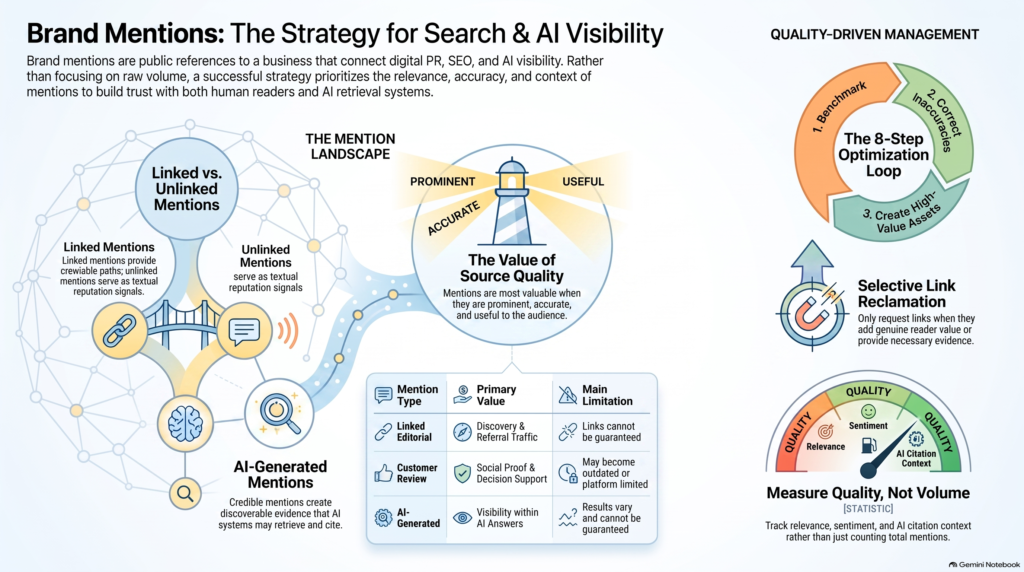
Brand mentions in SEO are public references to a business, product, service or named expert across third-party sources. They may improve discovery, reputation, referral opportunities and entity consistency, but their value varies according to the source, context, accuracy and audience.
Linked mentions contain a clickable link. Unlinked mentions name the brand without one. Editorial mentions come from journalists, analysts or publishers; customer mentions appear in reviews; community mentions occur in professional groups and forums; and AI brand mentions appear in generated answers, sometimes with a citation.
One reference may fit several categories. A journalist could quote a Shoden Global specialist, link to original research, and later have that article cited in an AI answer. Track the source, wording, destination, and sentiment rather than the mention alone.
What Is the Difference Between a Brand Mention and a Backlink?
A brand mention is a reference; a backlink is a hyperlink from one web page to another. A linked brand mention is both, while an unlinked mention is not a backlink. Google publicly states that links help it discover pages and act as a relevance signal, so the two should not be treated as technically interchangeable.
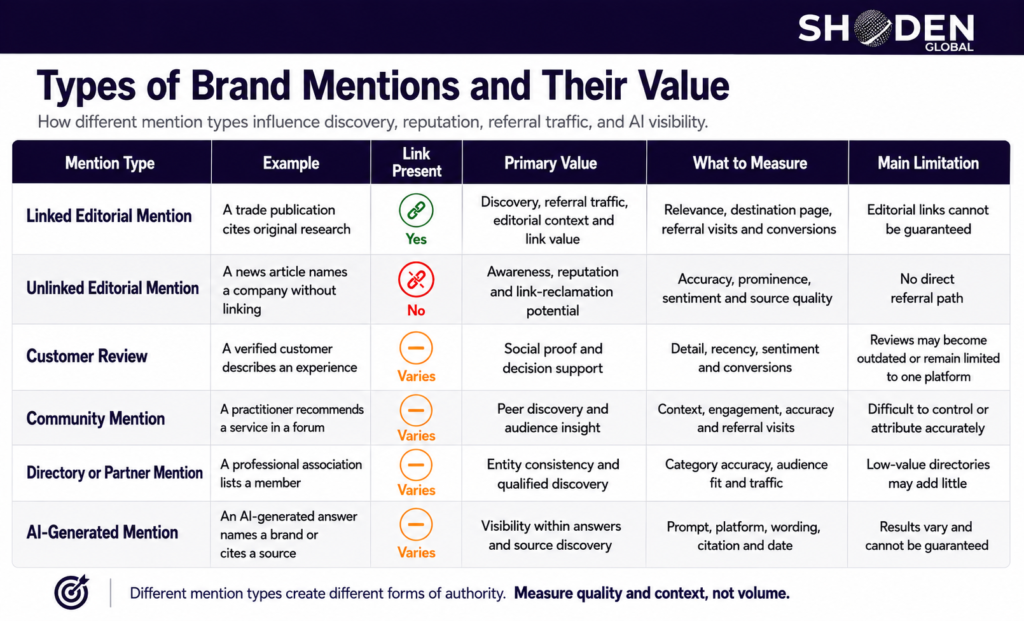
Set separate goals for Link Acquisition and Editorial Links, reviews, communities, directories, podcasts and AI answers.
Do Unlinked Brand Mentions Improve Google Rankings?
Unlinked brand mentions should not be described as a confirmed direct Google ranking factor. Google’s public guidance explains how links support discovery and relevance, but it does not present every plain-text mention as a backlink equivalent. Treat unlinked mentions as indirect assets rather than guaranteed ranking signals.
A relevant unlinked mention may reach a qualified audience, reinforce consistent naming, prompt branded searches, or create a reclamation opportunity. These outcomes can support a wider strategy without proving that the mention caused a ranking change.
Avoid turning reclamation into a quota. A forced link from an irrelevant, low-quality, or paid source may add little reader value. Google’s spam policies apply to manipulative link practices, so editorial independence and source quality matter more than volume.
Which Brand Mentions Are Most Valuable?
The most valuable brand mentions are accurate, relevant, prominent and useful to the source’s audience. Strong mentions usually come from publishers, customers, partners or communities with a genuine reason to discuss the brand, and they place the reference in meaningful context.
Assess relevance, authority, context, accuracy, prominence, audience fit, sentiment and commercial intent. A niche article read by decision-makers may be more valuable than a high-traffic but irrelevant page, while a balanced review may be more credible than generic praise.
Brand Mention Quality Checklist
☐ Correct company and product name
☐ Accurate category and service description
☐ Relevant source and audience
☐ Clear editorial or customer context
☐ No undisclosed incentive
☐ Useful source link where appropriate
☐ Positive, neutral or negative sentiment recorded
☐ Prominence and recency recorded
☐ Referral and conversion tracking enabled
☐ AI mention or citation context captured separately
Use this checklist before contacting a publisher, amplifying coverage or adding a mention to a report. Correct failures in accuracy or disclosure before celebrating reach.
The value of a brand mention is no longer limited to search rankings or referral traffic. Accurate public references can also become part of the evidence retrieved by AI systems.
How Can Brand Mentions Support AI Visibility?
Credible public mentions can support AI visibility by creating discoverable evidence that retrieval-enabled systems may find, compare and cite. They can clarify what a company does, who recognises it and where claims originated. Platform behaviour varies, so no individual mention guarantees an AI citation, recommendation or inclusion.
Google says its AI search features can run multiple related searches and identify supporting web pages, while ChatGPT Search may show inline citations and source links when web search is used. This makes accessible, well-sourced evidence strategically relevant, but it does not mean every mention is retrieved or used.
Improve eligibility with consistent names, original evidence, clear authorship, third-party references, and accessible source pages. Track mentions separately from citations because an answer may name a brand without linking.
How Do You Find and Track Brand Mentions?
Find and track brand mentions by combining a controlled naming list with web monitoring, media research, review checks, community searches, analytics, and repeatable AI prompt tests. No single tool captures every source, so consistency matters more than a supposedly complete total.
Start with the official company name, product and executive names, campaign terms, previous names and common misspellings. Monitor news, podcasts, directories, reviews, forums and relevant social communities. Use analytics for referral visits and search or link data for branded-query and external-link clues.
For AI tracking, use fixed commercial questions. Record the platform, mode, prompt, date, wording, source, citation context, sentiment, competitors, and accuracy. Repeat tests on a schedule. Brand Mentions and Reviews Impact AI Visibility provides a companion framework.
When Should You Reclaim an Unlinked Mention?
Reclaim an unlinked mention when the source is relevant, the reference is accurate, and a link would help readers reach evidence, research, a product page or another useful destination. Keep the request selective, polite and easy for the editor to assess.
Good candidates include articles quoting original data without linking to the study, interviews that omit an expert profile and resource lists that name a service without a destination. Do not push for a link where it adds no reader value, conflicts with editorial policy or turns a neutral reference into a promotional placement.
When compensation or another material relationship exists, use appropriate disclosure and link qualification. Google advises marking advertisements or paid placements with the sponsored attribute.
How Do You Build More High-Quality Brand Mentions?
Build high-quality brand mentions by creating evidence and expertise worth referencing, then promoting those assets through transparent digital PR, partnerships, customer proof, and targeted PR Outreach. Strong campaigns begin with audience value rather than a demand for coverage or links.
An Eight-Step Brand Mention Process
- Create a list of official brand, product, executive and common misspelling variants.
- Benchmark current linked, unlinked, review, community and AI mentions.
- Classify each source by relevance, accuracy, audience and commercial value.
- Correct materially inaccurate or outdated descriptions.
- Reclaim a source link only where it improves the reader’s access to evidence.
- Create expert, data, comparison and customer-proof assets worth mentioning.
- Run transparent digital PR and outreach campaigns.
- Measure mention quality, search performance, AI visibility and leads over time.
Useful assets include surveys, benchmark reports, expert commentary, case evidence, comparison pages and consented customer stories. Keep material concise and verifiable.
Do not buy fake reviews, suppress genuine criticism or condition an incentive on positive sentiment. In the United States, the FTC’s Consumer Reviews and Testimonials Rule took effect on October 21, 2024, and the FTC also provides guidance on endorsements, influencers and reviews. Requirements vary by jurisdiction, so campaigns should be reviewed for each market.
Once mentions have been earned and tracked, the next challenge is distinguishing meaningful signals from raw volume.
How Should Brand Mentions Be Measured?
Brand mentions should be measured by quality, context and business contribution, not by count alone. A practical scorecard combines source type, relevance, accuracy, sentiment, linked status, prominence, referral activity, conversions and AI citation context.
Track volume by source type so low-value directory listings do not mask a decline in editorial coverage. Record whether each mention is accurate, linked, recent, prominent and positive, neutral or negative. Add referral visits, engaged sessions, enquiries, assisted conversions and attributable revenue where reliable tracking exists.
For AI mentions, retain the prompt, date, platform, citation URL, context and competitor set. Report an observed sample, not universal coverage, and separate leading indicators from outcomes such as qualified leads.
What Are the Most Common Brand-Mention Mistakes?
The most common mistakes are chasing low-quality volume, using inconsistent names, manipulating reviews, ignoring inaccuracies, and reporting mentions without source context. These practices create noisy dashboards and can damage trust rather than build authority signals.
Do not value every mention equally: a scraped directory entry is not equivalent to a detailed industry review. Maintain one approved naming and description list. Never create fake reviews or hide material incentives; the FTC rule addresses deceptive review practices, and disclosure expectations should be checked before publication.
Correct objective errors with evidence, but do not pressure publishers or customers to remove legitimate criticism. Preserve context: a positive sentence on an irrelevant site may be less useful than a neutral mention in a trusted guide.
Quick Answers
Definitions and SEO Value
What is a brand mention?
A public reference to a company, product, service or expert in editorial coverage, reviews, directories, communities, podcasts or AI-generated answers.
Is a brand mention the same as a backlink?
No. A backlink is a clickable hyperlink; a mention can be linked or unlinked.
Do unlinked mentions help SEO?
They may support discovery, reputation, branded demand and link opportunities, but they are not confirmed direct ranking signals.
Are reviews brand mentions?
Yes. Assess them for authenticity, detail, recency, sentiment and disclosure.
AI Visibility, Tracking and Reclamation
Can brand mentions help AI visibility?
Credible public mentions can provide discoverable third-party evidence, but retrieval and citation depend on the platform and query.
How can mentions be tracked?
Use a naming list, web and media monitoring, review checks, community searches, analytics, and repeatable AI prompt tracking.
When should an unlinked mention be reclaimed?
Request a link when it gives readers useful access to evidence or context and respects the publisher’s policy.
What makes a mention valuable?
Relevance, accuracy, source quality, audience fit, context, prominence, sentiment and commercial usefulness.
Conclusion
Brand mentions sit at the intersection of digital PR, reputation, search discovery and AI visibility. Strong programmes earn accurate third-party evidence, distinguish mentions from backlinks, reclaim links selectively and measure source quality alongside leads. They do not rely on unsupported ranking claims or assume every mention will appear in an AI answer.
The strongest brand-mention strategies focus on earning accurate public evidence, not simply increasing the number of references across the web.
Request a Brand Mention and AI Visibility Audit from Shoden Global to benchmark current coverage, identify high-value reclamation opportunities and build a practical plan for stronger public evidence.
FAQ
What are brand mentions in SEO?
They are public references to a business or its people, products and services. Their value can include awareness, reputation, referral potential, entity consistency and legitimate editorial-link opportunities.
Do unlinked brand mentions improve rankings?
There is no confirmed basis for treating every unlinked mention as a direct ranking factor. Evaluate indirect value and reclaim a link only when it helps readers.
How do brand mentions differ from backlinks?
A mention is the reference itself. A backlink is the technical link to another page; a linked mention combines both.
Can digital PR increase brand mentions?
Yes, when it gives journalists and communities timely expertise, original evidence or useful stories. Digital PR Services should prioritise relevance and editorial value over guaranteed placements.
How can I track brand mentions in AI-generated answers?
Create a fixed prompt set and record the platform, date, wording, citations, sentiment and competitors. Repeat the test because outputs can vary.
What is brand mention reclamation?
It is finding an unlinked reference and requesting a useful source link when the destination adds evidence or practical context.
How should negative or inaccurate mentions be handled?
Separate opinion from factual error. Correct material inaccuracies with concise evidence, respond respectfully where appropriate and do not suppress legitimate criticism.
Which brand mention metrics matter most?
Prioritise source relevance, accuracy, sentiment, prominence, linked status, referral visits, conversions and AI citation context. Use raw volume as one diagnostic measure.



























PR Outreach: How to Pitch Journalists in 2026
August 10, 2026