

Buyer prompt research for AI visibility helps SEO and content teams identify the questions buyers ask before they discover, compare, or choose a solution. Keyword data remains valuable, but it often misses who is asking, which constraints apply, what alternatives are under review, and what evidence could change the decision. A structured prompt universe turns those details into a content plan.
Buyers increasingly ask AI systems questions that never appear in traditional keyword reports. Those conversations influence vendor shortlists, comparisons, and purchase decisions long before someone visits a website. If a content strategy reflects only search demand, it may overlook the questions that matter most when buyers are deciding who to trust.
Buyer prompt research is the process of identifying the complete set of questions potential customers ask AI systems as they discover, compare, validate, and choose solutions. It goes beyond keywords by capturing persona, context, constraints, objections, and the decision criteria that shape an AI-generated recommendation.
Table of Contents
What Is Buyer Prompt Research for AI Visibility?
Buyer prompt research for AI visibility identifies and organizes the conversational questions buyers may ask AI tools across the purchasing journey. Its business purpose is to reveal where a company must be clearly understood, credibly compared, and supported by useful evidence.
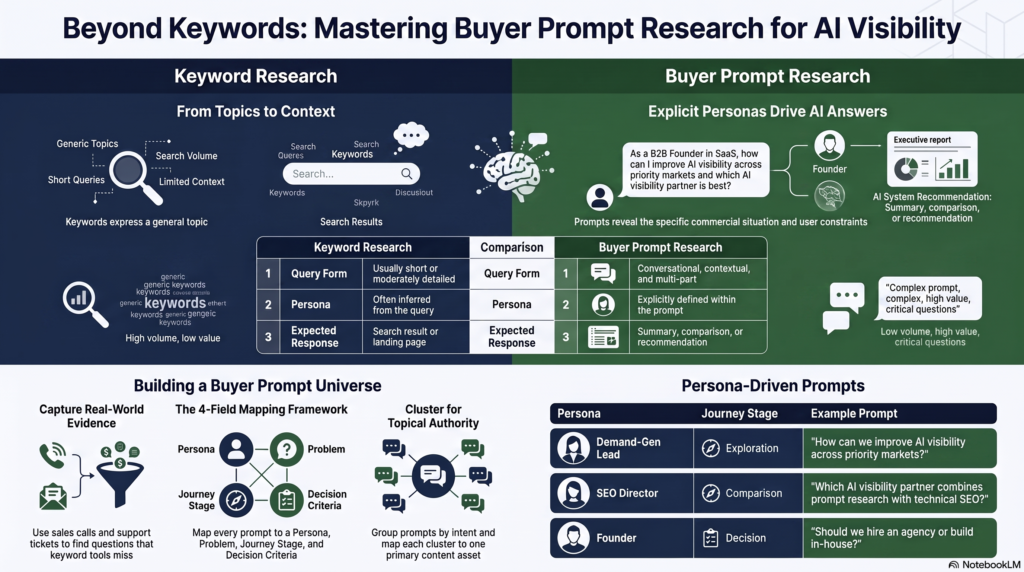
A keyword such as “AI visibility service” expresses a topic. A buyer prompt can reveal the commercial situation: “Which AI visibility service suits a multilingual B2B software company that needs competitor tracking and executive reporting?” That version exposes persona, market, use case, and evaluation criteria, helping the team choose the right service page, comparison, guide, or proof asset.
How Is Prompt Research Different From Keyword Research?
Prompt research complements keyword research rather than replacing it. Keyword research shows established demand patterns and common language; prompt research adds conversational context, buyer roles, constraints, follow-up questions, and the answer format needed to support a decision.
Keyword Research vs Buyer Prompt Research
Understanding how prompt research differs from keyword research is only part of the picture. The more important question is why those conversational prompts influence AI visibility and buyer decisions in ways that traditional keyword data often cannot.
Why Do Buyer Prompts Matter for AI Visibility?
Buyer prompts matter because they expose where a brand needs to be discoverable, understandable, and credible, including the trade-offs, objections, and proof points that may shape an answer.
Google explains that its generative search features can support nuanced questions, complex comparisons and related query fan-out. OpenAI states that ChatGPT search can use conversational context and follow-ups while linking to web sources. Prompt research helps brands prepare useful source material, although inclusion, citation and visibility are never guaranteed.
The goal is not to insert content into model training data. It is to improve crawlability, retrieval, source discovery, entity clarity, citation readiness and the quality of public evidence around the brand.
What Is Prompt Volume in AI Visibility?
Prompt volume is an estimate of how often a prompt, or a closely related prompt family, may be used within an AI-search context. In AI visibility products or SEO tools, that estimate should be treated as directional unless the provider clearly explains its source, sampling method, clustering, and update frequency.
A low-volume prompt can still matter when it represents a high-value service, a frequent sales objection, or a final vendor-selection question. Conversely, a broad prompt with a larger estimate may be too generic to influence revenue. Record the figure where available, but score commercial importance separately and avoid presenting modelled prompt volume as exact user behaviour.
Which Prompts Influence Buyer Discovery?
Discovery prompts help buyers name a problem, understand a category and explore possible approaches. They include problem-aware questions, definitions, educational prompts, use-case questions and early category searches.
Problem-Aware and Educational Prompts
Examples include "Why is our brand absent from AI answers?", "What is AI visibility?" and "How does AI visibility affect the buyer's journey?" Imagine a demand-generation leader at a growing B2B SaaS company beginning to explore AI visibility for the first time. These early prompts help define the problem before the buyer starts evaluating specific solutions. They need clear explanations, diagnostic guidance, and links to deeper resources.
Category and Use-Case Prompts
Examples include “What type of service improves brand visibility in AI search engines?” and “How can a global software company build authority signals for AI discovery?” These prompts should lead to category pages, use-case guides, and credible examples rather than premature sales claims.
Which Prompts Influence Buyer Decisions?
Decision prompts help buyers compare options, reduce risk, and justify a choice. The most commercially useful groups often include best-for-use-case, alternatives, versus comparisons, pricing, implementation, proof, security, reputation, and vendor-selection questions.
Comparison and Alternative Prompts
A strong comparison asset explains fit, limitations, decision criteria, and meaningful differences. It should help the buyer choose, not force every reader towards the same conclusion. Shoden Global’s Comparison Content for AI Answers service can turn recurring comparison prompts into structured, evidence-led pages.
Proof and Risk Prompts
Questions about results, methodology, timelines, data sources, governance and implementation reveal what could block a purchase. Address them with transparent service details, case evidence, expert commentary, FAQs and clearly scoped claims.
How Do You Map Prompts to Buyer Personas?
Map each prompt through four fields: persona, problem, buyer stage, and decision criteria. This prevents a general topic from becoming a vague asset that serves nobody particularly well.
Example:
Buyer-Persona Prompt Framework
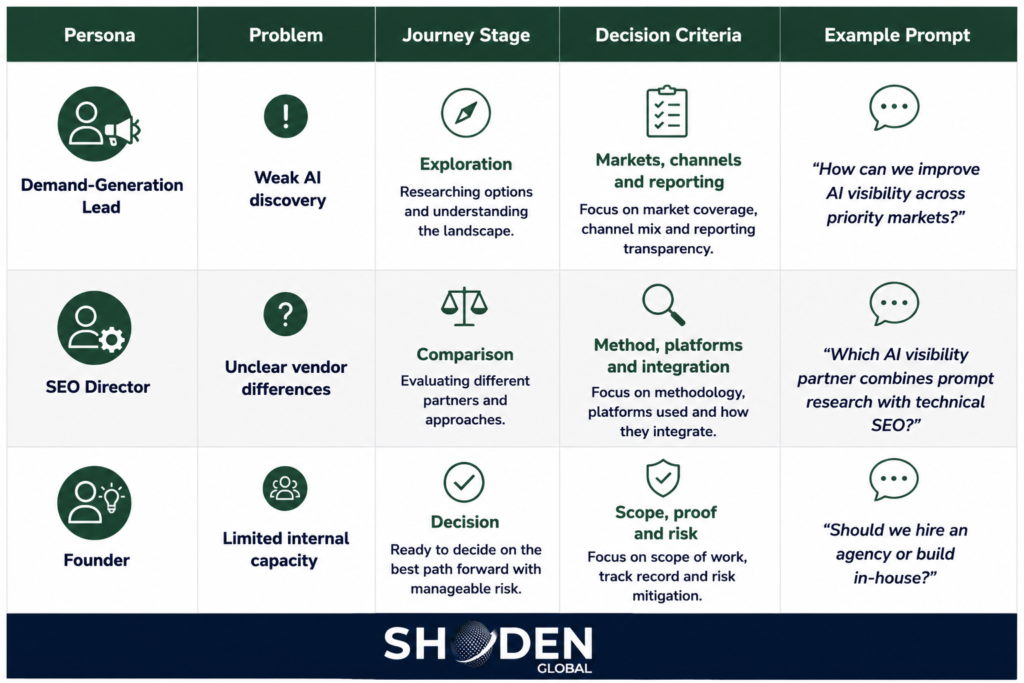
The same commercial topic often produces different prompts depending on who is asking. A founder evaluating investment, an SEO director responsible for implementation, and a demand-generation leader focused on pipeline may all research AI visibility, but each will prioritise different evidence, constraints, and success criteria.
How Do You Build a Buyer Prompt Universe Step by Step?
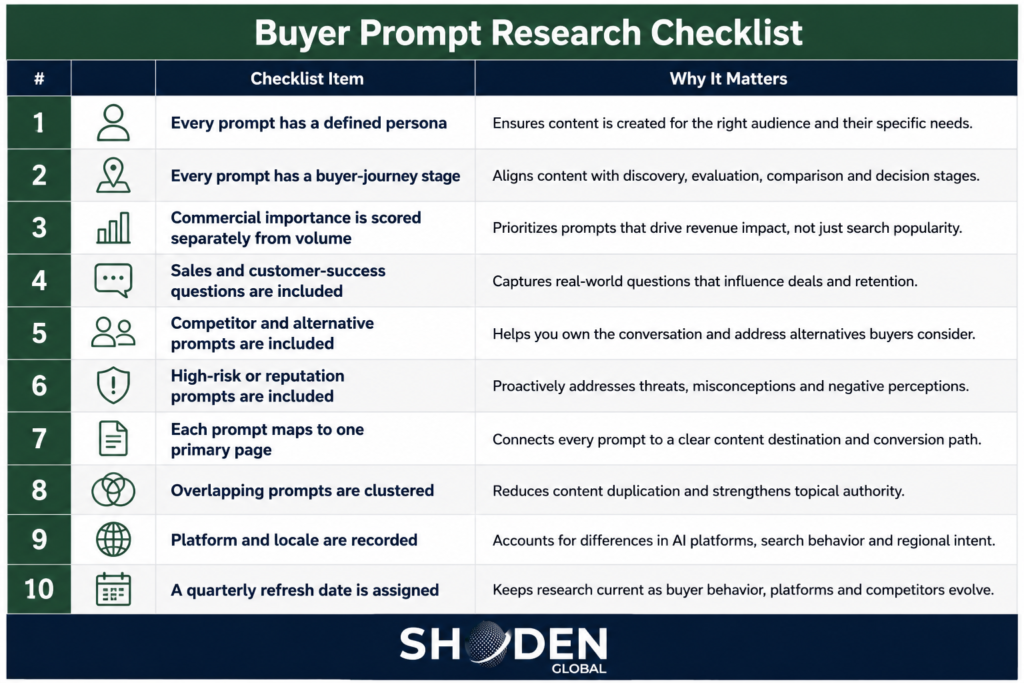
Build a buyer prompt universe by collecting real questions, expanding them systematically, grouping overlapping intent, and assigning every cluster to one primary asset. The goal is not to collect the largest number of prompts but to build a structured, maintainable research framework that reflects real buyer conversations and supports long-term content planning. The process should be repeatable rather than based on a one-off brainstorm.
- List priority products, services and markets so research focuses on commercially important areas first.
- Interview sales, customer success and subject-matter experts to capture recurring buyer questions and objections that keyword tools rarely reveal.
- Collect questions from calls, tickets, reviews, communities and search data so the prompt universe reflects real buying conversations rather than assumptions.
- Expand each question by persona, use case, constraint and buyer stage to uncover the full decision context behind every prompt.
- Group prompts into brand, category, competitor, alternative, comparison and risk clusters to organise research around distinct buyer needs.
- Test representative prompts across relevant AI platforms to understand how different systems interpret and answer them.
- Score commercial value, brand relevance, competitor pressure and content readiness so priorities reflect business impact rather than estimated volume alone.
- Map each prompt cluster to one primary page or content asset to create clear ownership and avoid content overlap.
- Establish a baseline and repeat the research quarterly so the prompt universe evolves alongside buyer behaviour, products and competitors.
Keep the exact prompts, but cluster variants that require substantially the same answer. This reduces cannibalisation and makes ownership clear.
How Do You Prioritise Prompts Without Reliable Search Volume?
Prioritise prompts with a balanced score that reflects business value and answer readiness, not volume alone. Score commercial intent, offer relevance, frequency in sales conversations, competitor pressure, answer opportunity, and content feasibility on a consistent scale.
Give the highest priority to prompts that are close to revenue, central to the brand’s expertise, and currently answered poorly or without strong evidence. A prompt should move down the list when it is novel but commercially irrelevant, depends on proof the company cannot provide, or duplicates an existing cluster.
How Do You Turn Buyer Prompts Into Content?
Research identifies what buyers ask. Content strategy determines how those questions should be answered. Once prompt clusters have been prioritised, each one should be matched to the content format most likely to satisfy the buyer's intent while strengthening the overall content ecosystem.
Turn each prompt cluster into the asset best suited to its intent: service pages for offer and fit questions, comparisons for choices, guides for education, FAQs for objections, case studies for proof, digital PR assets for original evidence, and community answers for genuine participation.
Give each cluster one owning page, supported by related assets. A service-comparison page, for example, may be reinforced by a methodology guide, case study, or FAQ. Connecting related content through a logical internal-linking structure helps buyers explore a topic in greater depth while giving search engines and AI systems clearer signals about how information is organised.
Link every new cluster article to the AI Visibility Service pillar and at least two relevant resources, such as What Is AI Visibility?, How to Improve Brand Visibility in AI Search Engines or AI Search Visibility Metrics and KPIs.
Google’s current guidance emphasises crawlable, helpful, original content and says there is no special AI-only markup required for its generative search features. Structured data should still match visible page content.
How Should Brands Track Prompt Performance Over Time?
Brands should track prompt performance through repeatable testing, source visibility and business outcomes. Record the platform, locale, date, prompt, response type, brand presence, linked or cited sources, competitors shown, landing-page traffic and conversions.
Use a stable sample of prompts for trend analysis, then add exploratory prompts as buyer language changes. Google’s current guidance points site owners to its generative AI performance reporting in Search Console. OpenAI states that eligible ChatGPT referral links include a trackable source parameter, which can support analytics attribution.
Refresh the prompt universe quarterly and after major product, pricing, market, or competitor changes. Consistent testing methods and a stable baseline make it easier to distinguish genuine changes in AI visibility from differences caused by evolving prompts or evaluation criteria.
What Prompt-Research Mistakes Should You Avoid?
Avoid generic prompt lists disconnected from buyers, revenue, and evidence. Common mistakes include copying public lists, ignoring personas, chasing novelty, relying only on estimated volume, excluding sales input, and omitting ownership or refresh dates.
Do not create a separate page for every wording variation. Google advises against producing many query-variant pages primarily to manipulate rankings or generative responses. Build substantial pages around distinct needs, original expertise, and clear internal links instead.
Finally, do not confuse monitoring with strategy. Repeatedly checking whether a brand appears does not explain what buyers need or create the evidence required to support a useful answer.
Quick Answers
What is buyer prompt research?
It is the collection, clustering and prioritisation of questions buyers ask AI systems during a purchase journey.
Is a prompt the same as a keyword?
No. Keywords name topics; prompts can include persona, context, constraints, criteria and a desired output.
What is prompt volume?
It is a directional estimate for a prompt or related prompt family, not a universally precise count.
Which prompts are most valuable?
Those with strong commercial intent, offer relevance, sales importance and a realistic content opportunity.
How many prompt clusters should a company create?
There is no universal number. Create one for each distinct need requiring a meaningfully different answer.
Where can real buyer prompts be found?
Use calls, tickets, reviews, communities, site search, search data and expert interviews.
How are prompts mapped to content?
Assign each cluster to one primary asset, then support it with proof and internal links.
How often should prompt research be updated?
Review it quarterly and after significant market, product, or competitor changes.
Conclusion
Buyer prompt research is not simply another research technique. It reflects a fundamental shift in how organisations understand demand in an AI-driven search environment. While keywords continue to reveal what people search for, buyer prompts reveal how people evaluate, compare and decide.
The organisations that build lasting AI visibility will not be those that publish the most content, but those that answer the most important buyer conversations with clarity, credibility and evidence. A structured buyer prompt research process helps identify those conversations, prioritise them according to commercial impact and translate them into a content strategy that serves both people and AI systems.
As search continues to evolve beyond keywords and rankings, understanding buyer prompts will become an increasingly important capability for any organisation seeking to build authority, earn recommendations and remain visible throughout the modern buying journey.
Have Shoden Global map the buyer prompts that influence discovery, comparison and purchase in your category, then connect each priority cluster to the page, proof and tracking framework it needs.
FAQ
Why is keyword research not enough for AI visibility?
Keywords often omit the buyer’s role, constraints, and follow-up logic. Prompt research adds that context while keyword research shows established demand and language.
How do I find the prompts buyers ask AI tools?
Start with sales, support, and customer questions. Expand them by persona, stage, use case, constraint, alternative, and decision criterion, then test representative versions.
Can prompt volume be measured accurately?
It can be estimated, but results depend on methodology, sample and clustering. Treat volume as directional rather than a complete measure of commercial importance.
Which buyer stages should prompt research cover?
Cover problem awareness, category discovery, education, comparison, validation, selection, implementation and relevant post-purchase expansion.
How do I prioritise a low-volume prompt?
Raise its priority when it concerns a valuable service, recurring objection, strategic market, reputation risk or final decision and the brand has credible evidence.
What content should be created from prompt research?
Choose the format that best satisfies intent: a service page, guide, comparison, FAQ, case study, original research or expert contribution.
How do competitor prompts fit into the process?
Use them to understand alternatives, comparison criteria and evidence gaps. Keep content accurate and useful rather than making unsupported superiority claims.
Who should contribute to buyer prompt research?
Include content, SEO, demand generation, sales, customer success, product, and subject-matter experts because each sees a different part of the journey.




































PR Outreach: How to Pitch Journalists in 2026
August 10, 2026