

Online Reputation Management Services for Companies and Executives
SEO reputation management helps companies and executives improve the accuracy, credibility, and resilience of what people discover across branded search results, public profiles, reviews, media coverage, and AI-generated answers. Shoden Global brings those signals into one coordinated, confidential program.
Our work combines search analysis, ethical SEO, credible owned content, entity consistency, digital PR, monitoring, and clear escalation. The objective is not to manufacture a perfect image. It is to make trustworthy information easier to find, reduce avoidable inconsistencies, and help decision-makers respond to genuine reputation risks with discipline.
SEO reputation management is the structured use of search analysis, content, technical optimization, profile consistency, third-party authority, and monitoring to improve and protect how a company or executive is represented online. It does not provide control over search engines, publishers, review platforms, or AI models.
Reputation Work That Shows Up in the Data
Here's a real result from a recent repositioning engagement, where building positive sentiment was the whole point.
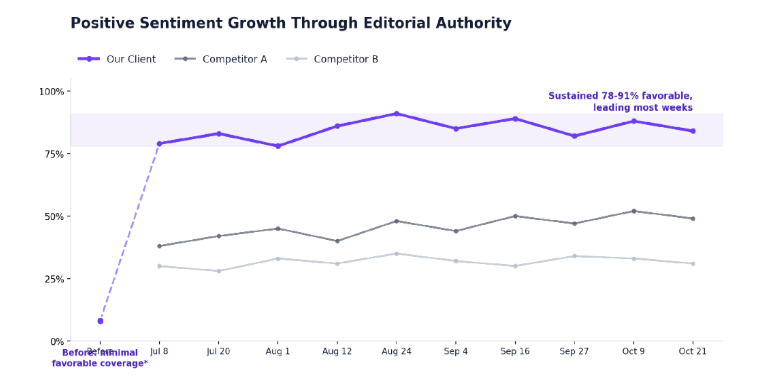
Sentiment tracked and reported on an ongoing basis – not a one-time snapshot – showing sustained favorable sentiment built through high-authority editorial placements rather than manufactured content.
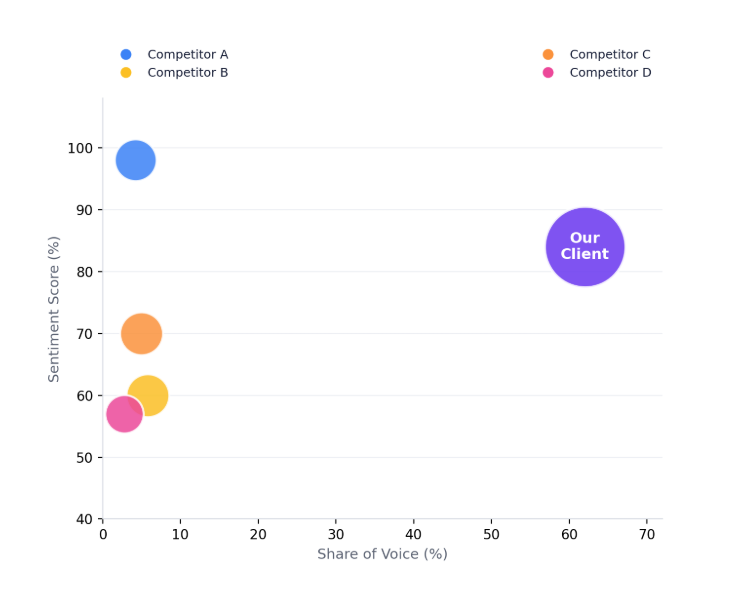
Share of voice and sentiment tracked together, since visibility without positive sentiment is an incomplete picture of digital reputation.
What Is SEO Reputation Management?
SEO reputation management improves the quality and visibility of accurate, relevant information connected to a company or executive in search. It is one part of broader online reputation management, which also considers reviews, profiles, media coverage, public discussion, and AI-generated answers.
A sound program identifies what appears, which assets are trusted, where information conflicts, and what stakeholders are likely to search. Work may then strengthen corporate pages, executive biographies, newsrooms, profiles, entity information, thought leadership, and credible third-party references.
The goal is a more complete and dependable digital record. Information should be visible, accurate, useful, consistent, attributable, and appropriate for the audience finding it.
Who Are Online Reputation Management Services For?
Online reputation management services are for organizations and leaders whose digital presence can affect stakeholder confidence, commercial conversations, recruitment, partnerships, or media interest.
The service may fit:
- Companies with inconsistent or outdated branded search results
- Enterprises managing multiple brands, business units, locations, or executives
- CEOs, founders, and senior leaders with fragmented or sensitive digital footprints
- Communications, legal, or leadership teams monitoring an emerging issue
- Organizations preparing for a leadership change, launch, transaction, or increased scrutiny
- Companies seeking proactive monitoring and escalation rather than emergency-only support
An active issue may also require crisis communications alongside longer-term reputation work.
What Does Shoden Global Monitor and Analyze?
Shoden Global analyzes the public information environment around the approved company, brand, product, or executive entities. The baseline shows what is visible, missing, inconsistent, or potentially material.
Assessment may cover:
- Branded searches, name variations, modifiers, and stakeholder questions
- Corporate sites, leadership pages, biographies, newsrooms, and other owned assets
- Executive and company profiles across relevant professional, social, directory, and industry platforms
- News coverage, interviews, citations, reviews, and credible third-party results
- Names, titles, descriptions, relationships, imagery, and profile details
- Claims, inaccuracies, cited sources, and sentiment patterns in AI-generated answers as part of broader Generative Engine Optimization (GEO) efforts.
- New results, material ranking changes, duplicate profiles, and emerging issues
- Review activity when review management is included
The output is a prioritized action plan, not merely a list of links.
Every finding is evaluated using a consistent framework that helps prioritize actions based on business impact rather than individual search results.
How Does the Online Reputation Management Process Work?
The process turns a complex information environment into documented decisions, actions, measurements, and escalation points.
- Define the scope. Confirm entities, markets, audiences, known issues, approvals, and ethical boundaries.
- Establish the baseline. Review branded search results, assets, profiles, third-party references, relevant reviews, and selected AI prompts.
- Prioritize. Assess visibility, credibility, accuracy, relevance, persistence, response options, and sensitivity.
- Strengthen the source environment. Correct owned pages, improve technical structure, align profiles, develop credible content, and clarify entity relationships.
- Build legitimate authority. Use digital PR, expert commentary, thought leadership, and other earned opportunities where appropriate.
- Monitor and escalate. Track progress against the baseline and route material issues through approved channels.
The plan remains adaptive because search results, coverage, reviews, and AI answers change.
How Does Shoden Global Approach Online Reputation Repair?
Online reputation repair begins with diagnosis, not a promise to delete or bury information. The response depends on who controls the content, whether it is accurate, whether policy grounds may apply, and what credible information is missing.
Owned assets may be corrected, consolidated, restructured, or expanded. Third-party options may include documented correction requests, publisher outreach, platform reporting, or coordination with the client’s legal counsel when legal review is necessary.
When lawful third-party content remains available, Shoden Global focuses on improving accurate, useful, and legitimate sources. Results cannot be guaranteed, and our team does not make legal determinations.
How Are Corporate, Enterprise, and Executive Reputations Managed?
The same core method applies, but scale, entity relationships, approvals, and audiences differ.
Corporate and enterprise reputation management
Corporate work covers the company’s brands, products, leadership, locations, profiles, reviews, news, and owned information. Enterprise programs may coordinate multiple business units, regions, executive entities, stakeholder groups, and escalation owners under one governance model.
CEO and executive reputation management
Executive work focuses on name-based searches, profiles, biographies, company associations, interviews, speaking activity, thought leadership, and recurring questions. The executive’s public identity should support the company’s verified record, while separate approvals and confidentiality are preserved where required.
How Does Online Reputation Management Differ From Related Services?
- Online reputation management coordinates the complete digital reputation. Related services have narrower primary roles.
- Service Main role What it does not replace
- Online Reputation Management Improve and protect the complete digital reputation Active crisis command or guaranteed content removal
- Digital PR earn credible editorial visibility and third-party mentions Full search, profile, review, and AI monitoring
- Crisis Communications Coordinate messaging during an active issue Long-term search and asset development
- Review Management Monitor and respond to customer reviews Broader corporate, executive, search, or media reputation work
- SEO Improve the visibility and structure of owned web assets Third-party reputation governance or crisis response
These disciplines can support one another without becoming interchangeable.
Can Negative Content Be Removed or Suppressed?
Specific content may sometimes be corrected, voluntarily removed by its publisher, or removed by a platform when valid policy or legal grounds apply. Shoden Global cannot guarantee removal of lawful content, guarantee suppression, or promise a particular search position.
Our team assesses legitimate options, documents evidence, uses appropriate reporting or outreach channels, and improves the quality of owned information. When legal judgment is required, the client’s counsel should lead.
Shoden Global does not offer:
- Fake or purchased reviews
- Review gating
- Impersonation or deceptive profiles
- Fabricated media coverage
- Guaranteed removal or suppression
- Control over Google, review platforms, publishers, or AI models
How Do AI-Generated Answers Affect Reputation Management?
AI-generated answers create another reputation surface alongside conventional search results. Shoden Global monitors what selected systems say, which sources they reference, and which claims or sentiment patterns recur.
The work may include defining priority prompts, recording answers and citations, classifying inaccuracies or gaps, comparing outputs with verified information, correcting owned sources, pursuing credible corroboration, and tracking material changes over time.
Monitoring does not equal control. Outputs can vary, and no preferred description or sentiment can be guaranteed.
What Does Review Monitoring and Response Include?
When included, review management centers on authentic feedback, consistent monitoring, proportionate escalation, and useful responses. It does not involve manufacturing ratings or filtering customers by expected sentiment.
Work may include monitoring agreed profiles, categorizing issues, identifying potential policy violations, drafting privacy-conscious responses, routing operational or legal concerns, and tracking recurring themes. Reviews should reflect genuine experiences, and public responses should be supported by real operational follow-through.
What Does Confidential Reporting and Escalation Look Like?
Confidential reporting tells approved stakeholders what changed, what was done, what remains unresolved, and what requires a decision. Format and cadence are agreed according to sensitivity and scope.
Reports may include branded-search changes, priority asset status, entity inconsistencies, content activity, third-party visibility, review themes when relevant, AI-answer observations, open dependencies, owners, and escalation records.
Thresholds are defined in advance. A material new result, spreading inaccuracy, executive issue, coordinated review pattern, legal concern, or active media inquiry may require accelerated escalation. Distribution remains limited to the client-approved group.
How Is Online Reputation Management Success Measured?
Online reputation management should be measured through improvements in information quality, consistency, visibility, and governance rather than promises to remove content or guarantee search positions. The objective is to strengthen the overall information environment while helping organizations identify, prioritize, and respond to reputation risks more effectively.
Depending on the agreed scope, reporting may measure:
- Branded search-result quality and stability
- Visibility of priority corporate and executive assets
- Profile and entity consistency across key platforms
- Accuracy of company and executive information
- Credible third-party references and media coverage
- Review trends and recurring customer issues
- AI-generated answer accuracy, citations, and sentiment observations
- Resolution of identified inconsistencies or outdated information
- Escalation response times and issue status
- Progress against the agreed reputation roadmap
Some indicators improve quickly, while others depend on publishing cycles, media activity, search behavior, and independent platforms. Shoden Global reports measurable progress while acknowledging that search engines, publishers, review platforms, and AI systems remain outside any agency's control.
What Should You Look for in a Reputation Management Partner?
A credible partner should be transparent about methods, limitations, approvals, reporting, and the difference between influence and control.
Use this checklist:
- Evidence-based baseline and priorities
- Cross-functional search, content, profile, digital PR, review, and AI analysis
- Clear distinction between ongoing reputation work and active crisis communications
- Client approval for content and outreach
- Defined confidentiality, reporting, and escalation
- No fake reviews, impersonation, fabricated coverage, or deceptive publishing
- No guaranteed removal, suppression, rankings, or platform control
- Progress measures that do not depend on promised outcomes
What Common Reputation Management Mistakes Should Companies Avoid?
Common mistakes include waiting until an issue is escalating, treating reputation as a deletion project, publishing thin content, leaving profiles inconsistent, confusing digital PR with complete reputation management, responding defensively to reviews, selectively requesting positive feedback, and measuring only rankings.
It is also a mistake to assume AI-generated answers can be controlled. A better approach is to monitor representative outputs, strengthen credible sources, correct inconsistencies, and report uncertainty honestly.
What Are the Quick Answers About SEO Reputation Management?
Is reputation management only for a crisis?
No. Proactive monitoring and stronger assets can reduce avoidable risk before an issue becomes urgent.
Is SEO enough on its own?
No. Broader work may include profiles, reviews, digital PR, executive coordination, and AI-answer monitoring.
Can negative articles be guaranteed removed?
No. Removal depends on the publisher, platform policy, applicable law, and the facts.
Does Shoden Global create owned content?
Yes, when scoped. Content should be accurate, useful, credible, approved, and connected to an audience need.
Are review responses included?
They may be included where review management is offered and agreed.
Can executive reputation be managed separately?
Yes, while keeping the executive’s public identity consistent with verified company information.
Can AI-answer sentiment be monitored?
Yes. Prompts, claims, citations, and sentiment patterns can be tracked, but outputs cannot be controlled.
How is progress measured?
Measures may include search-result quality, asset visibility, entity consistency, credible references, issue movement, review trends, and AI observations.
Conclusion: How Can Shoden Global Help Build a More Resilient Digital Reputation?
A resilient reputation is built through accurate information, credible sources, consistent entities, disciplined monitoring, and clear decisions. Shoden Global combines those elements in a confidential program for companies, enterprises, CEOs, and senior executives.
Request a Confidential Reputation Assessment
Start with a private discussion about the search results, profiles, reviews, media references, or AI-generated answers that matter to your organization.
FAQ: What Do Companies Ask About SEO Reputation Management?
What is SEO reputation management?
SEO reputation management uses search analysis, ethical optimization, credible content, profile consistency, and monitoring to improve how a company or executive is represented in search. It sits within broader online reputation management.
What do online reputation management services include?
Scope may include branded-search monitoring, result and asset analysis, reputation repair, owned-content development, entity consistency, digital PR, review monitoring when offered, AI-answer monitoring, reporting, and escalation.
Can Shoden Global remove negative content from Google?
Shoden Global can assess correction, publisher outreach, platform-reporting, and content-strengthening options, but cannot guarantee removal of lawful content or control Google’s results. Legal questions belong with qualified counsel.
How long does SEO reputation management take?
Timing depends on the search environment, issue severity, content ownership, approvals, publishing opportunities, and platform behavior. Shoden Global reports progress without promising a fixed completion date or outcome.
Does Shoden Global manage CEO and executive reputations?
Yes. Work may include name-based search analysis, biographies, profiles, company associations, thought leadership, media references, entity consistency, AI monitoring, and confidential escalation.
How is online reputation management different from digital PR and crisis communications?
Online reputation management coordinates the digital reputation over time. Digital PR earns credible third-party visibility. Crisis communications coordinates messaging and stakeholders during an active issue.
Does Shoden Global provide review management?
Review monitoring and response may be offered within an agreed scope. It excludes fake or purchased reviews, review gating, and selective solicitation of positive reviews.
Can Shoden Global control what AI models say about a company or executive?
No. Shoden Global can monitor outputs, analyze sources, correct owned information, improve entity consistency, and support credible third-party references, but cannot control independent AI models.