

AI search is changing how customers discover brands. People no longer rely only on Google results, paid ads, or traditional rankings. They now ask ChatGPT, Perplexity, Gemini, Copilot, and AI Overviews for recommendations, comparisons, explanations, and buying advice.
That means your business has a new visibility challenge.
When a potential customer asks ChatGPT about your category, does your brand appear? Is your company mentioned as a trusted option? Are your pages, articles, studies, or PR mentions used as sources? Do competitors receive more visibility than you in AI-generated answers?
A ChatGPT visibility tracker helps answer these questions. It gives your business a practical way to monitor where your brand appears, which prompts trigger mentions, what sources influence the answer, and how much share of answer you own compared with competitors.
For brands investing in SEO, digital PR, Generative Engine Optimization, and AI visibility, tracking ChatGPT visibility is becoming a core part of modern search performance.
Table of Contents
What Is a ChatGPT Visibility Tracker?
A ChatGPT visibility tracker is a monitoring system that checks how often your brand, competitors, products, services, or executives appear in ChatGPT responses for selected prompts.
Instead of tracking only blue link rankings, it tracks AI answer presence.
A strong tracker can help you measure:
- Whether your brand is mentioned in ChatGPT answers
- Which competitors are recommended more often
- What sources appear to shape the answer
- Whether ChatGPT describes your business accurately
- How often does your brand appear across commercial, informational, and comparison prompts
- Your share of answer across a group of high-value queries
- Changes in visibility over time
For example, if you run a B2B software company, you might track prompts such as “best platforms for sales enablement,” “top alternatives to [competitor],” or “how to choose a sales training provider.” If your brand does not appear, that is a visibility gap. If your competitors appear repeatedly, that is a competitive intelligence signal.
This is why ChatGPT visibility tracking now sits alongside SEO rank tracking, brand monitoring, and digital PR measurement.
Why ChatGPT Visibility Matters for Business Growth
Your customers are already using AI tools during the discovery and decision-making process. They use them to shortlist vendors, compare services, understand problems, and ask for recommendations.
If your brand is absent from these answers, you may be invisible during an important part of the buyer journey.
ChatGPT visibility matters because it can influence:
- Brand awareness
- Trust and authority
- Referral traffic
- Sales conversations
- Category positioning
- Competitive perception
- Lead quality
- Content strategy
- Digital PR priorities
Traditional SEO asks, “Where do we rank?” AI visibility asks, “Are we included in the answer?”
That distinction matters. As we explain in our Generative Engine Optimization (GEO) vs. SEO guide, AI visibility is not the same as traditional search visibility. A brand can rank on Google and still be missing from ChatGPT responses. A competitor with stronger third-party mentions, clearer topical authority, better structured content, and more credible external references may receive more AI visibility.
This is where a focused ChatGPT visibility tracker becomes valuable.
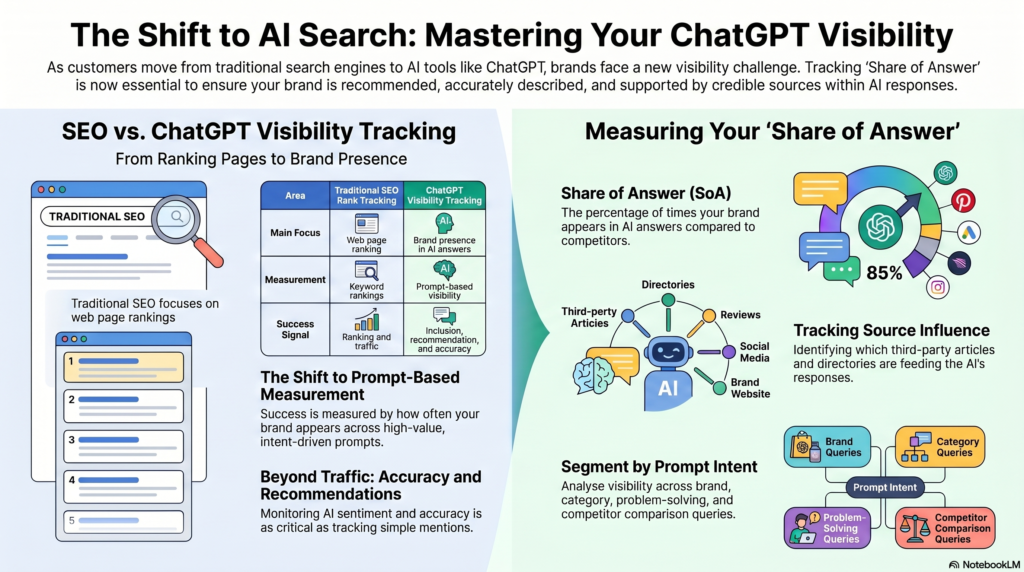
Mentions: Are You Included in the AI Answer?
The first thing to monitor is simple: does ChatGPT mention your brand?
Brand mentions can appear in several ways. ChatGPT may list your company as a recommended provider, compare you with competitors, describe your solution, mention your research, or cite your brand as an example in your industry.
A tracking process should separate mentions into useful categories:
Direct brand mention: Your company name appears clearly in the answer.
Product or service mention: ChatGPT references a specific solution, offer, or platform connected to your business.
Competitor only answer: Your competitors appear, but your brand does not.
Category answer without brands: ChatGPT explains the topic, but does not recommend any companies.
Incorrect or outdated mention: Your brand appears, but the description is inaccurate.
This gives your team a clearer picture of visibility quality. Being mentioned is useful, but being mentioned accurately and in the right context is much more valuable.
Sources: What Is Influencing the Answer?
Tracking sources is one of the most important parts of AI visibility work.
In AI search, your brand does not only need content on your own website. It also benefits from credible signals across the wider web. These can include high-quality articles, industry directories, reviews, thought leadership, expert contributions, interviews, case studies, research pages, and trusted third-party mentions.
A ChatGPT visibility tracker should help identify which sources appear to influence answers.
Look for patterns such as:
- Does ChatGPT rely on your website?
- Are competitors supported by stronger third-party sources?
- Are old articles still shaping the answer?
- Do industry publications mention competitors more often than your brand?
- Are your product pages clear enough for AI systems to understand?
- Are your service pages connected to the right topics and entities?
- Are there trusted sources that should include your brand but currently do not?
This source analysis helps you move from guessing to action. Instead of simply asking “Why are we not appearing?” you can identify the content, authority, and reputation gaps that need to be fixed.
Share of Answer: How Much AI Visibility Do You Own?
Share of answer measures how much presence your brand has inside AI-generated responses compared with competitors.
In SEO, teams often measure share of voice. In AI visibility, the share of answer is becoming a more useful metric.
For example, imagine you track 100 prompts related to your industry. Across those prompts:
- Your brand appears in 18 answers
- Competitor A appears in 42 answers
- Competitor B appears in 35 answers
- Competitor C appears in 21 answers
Your share of answer is lower than that of key competitors, which shows a visibility gap. But the real value comes from segmenting those prompts by intent.
You can track the share of answer across:
- Informational prompts
- Commercial investigation prompts
- Comparison prompts
- “Best provider” prompts
- Problem-solving prompts
- Local or market-specific prompts
- Alternative and competitor prompts
This makes the data more actionable. If your brand performs well in educational prompts but poorly in commercial recommendation prompts, your content and authority strategy should change.
Which Prompts Should You Track?
A good ChatGPT visibility tracker starts with the right prompt set. The goal is not to test random questions. The goal is to monitor the prompts that reflect real customer behavior.
Start with these categories.
1. Brand Prompts
These show how ChatGPT understands your business.
Examples:
- What is [brand name]?
- What does [brand name] do?
- Is [brand name] a good company?
- What are the main services of [brand name]?
- Who are the competitors of [brand name]?
These prompts help detect inaccurate descriptions, missing services, weak positioning, or outdated information.
2. Category Prompts
These show whether your brand appears when people search your market.
Examples:
- Best digital marketing agencies for AI visibility
- Top companies for Generative Engine Optimization
- Best LLM SEO agencies
- How to improve brand visibility in ChatGPT
- Agencies that help businesses appear in AI search
These prompts are especially important because they capture demand before the user has chosen a provider.
3. Problem-Based Prompts
These reflect the questions buyers ask before they know what solution they need.
Examples:
- Why is my brand not appearing in ChatGPT?
- How do I track brand mentions in AI answers?
- How do I monitor AI search visibility?
- How can a business improve visibility in AI-generated answers?
Problem-based prompts are useful for content planning because they reveal where educational content can influence future recommendations.
4. Comparison Prompts
These prompts show how your brand is positioned against alternatives.
Examples:
- [Brand] vs [competitor]
- Best alternatives to [competitor]
- Which company is better for AI visibility?
- Best agency for LLM visibility audit
Comparison prompts are often close to purchase intent. If competitors dominate these answers, your business may be losing late-stage demand.
5. Generative Engine Optimization Prompts
These prompts connect ChatGPT tracking to the wider GEO strategy.
Examples:
- What is generative engine optimization?
- Why is generative engine optimization important?
- How does generative engine optimization work?
- How to do generative engine optimization
- How to optimize content for generative engines
- Generative engine optimization vs traditional SEO
- Answer engine optimization vs generative engine optimization
- How to measure the success of generative engine optimization campaigns
- What are generative engine optimization services?
These topics are valuable because they match high-potential AI answer queries and can support both organic search and AI search visibility.
How to Build a ChatGPT Visibility Tracking Process
A practical tracking process should be consistent, repeatable, and focused on business outcomes.
Step 1: Define the Entities You Want to Track
List your company, products, services, executives, competitors, and category terms.
For Shoden Global Communication clients, this might include:
- Brand name
- Service names
- Competitor brands
- Industry keywords
- AI visibility topics
- GEO and LLM SEO terms
- Target market locations
- Buyer pain points
The goal is to help AI systems connect your brand with the right topics and customer needs.
Step 2: Build Your Prompt Set
Create a prompt list across the five categories above. Keep it organized by intent and priority.
Your highest value prompts should reflect commercial opportunity. These include “best,” “top,” “agency,” “provider,” “platform,” “services,” “alternatives,” and “comparison” prompts.
Step 3: Record Mentions and Position
For every prompt, record whether your brand appears, where it appears, and how it is described.
Useful fields include:
- Prompt
- Date checked
- Brand mentioned
- Competitors mentioned
- Position in answer
- Sentiment
- Accuracy
- Source references
- Recommended action
This turns AI visibility into a measurable workflow rather than a one-time manual check.
Step 4: Review the Sources Behind the Answer
Look at the types of pages and references that seem to shape the answer. Your own website matters, but so do third-party signals.
Common source opportunities include:
- Service pages
- Blog posts
- Research pages
- Case studies
- Founder profiles
- Review platforms
- Digital PR articles
- Industry publications
- Partner pages
- Comparison content
If your competitors are supported by stronger sources, your AI visibility strategy should include both content optimization and authority building.
Step 5: Calculate Share of Answer
Group your prompts by topic and calculate how often each brand appears.
A simple model:
Brand mentions across tracked prompts divided by total tracked prompts equals share of answer.
You can also create weighted scores. For example, a mention in a high-intent “best agency” prompt may be worth more than a mention in a broad educational prompt.
Step 6: Turn Insights Into Action
Tracking is only useful if it improves visibility.
Your action plan may include:
- Updating unclear service pages
- Adding stronger answer-focused content
- Creating comparison pages
- Publishing expert guides
- Improving author and company entity signals
- Building third-party mentions
- Strengthening digital PR
- Creating content for missing prompts
- Fixing outdated or inaccurate brand descriptions
- Expanding topical authority around GEO, LLM SEO, and AI search tracking
This is also where broader LLM rank tracking becomes important. ChatGPT is one key platform, but your visibility should also be reviewed across Perplexity, Gemini, Copilot, Google AI Overviews, and other answer engines.
ChatGPT Visibility Tracker vs Traditional SEO Rank Tracking
Traditional SEO rank tracking monitors where a web page appears in search results. A ChatGPT visibility tracker monitors whether your brand appears inside generated answers.
Both are useful, but they measure different things.
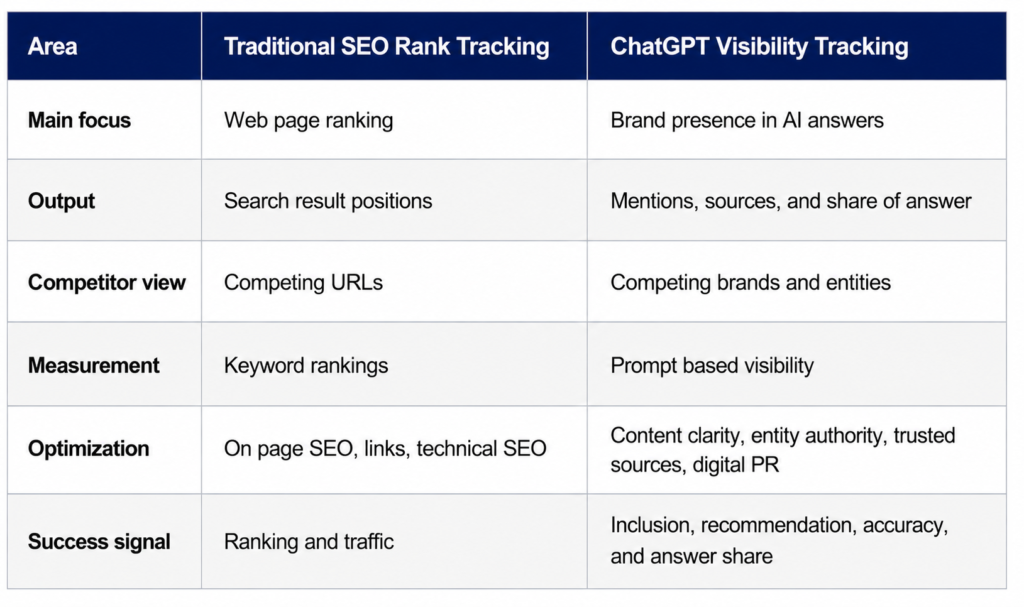
SEO is still important. But AI discovery adds a new layer. Brands need to know how they appear when users ask complete questions, not only when they type short keywords.
How This Connects to Generative Engine Optimization
Generative Engine Optimization, often called GEO, focuses on improving how your brand appears in AI-generated answers.
A ChatGPT visibility tracker gives you the measurement layer for GEO. It shows whether your optimization work is improving brand inclusion, answer accuracy, source quality, and competitor share.
This also supports the question many marketing teams are now asking: how to audit brand visibility on LLMs.
A proper audit should look at ChatGPT, Perplexity, AI Overviews, and other AI-powered search experiences. It should review prompts, mentions, sources, competitors, content gaps, and technical visibility signals.
From there, your team can build a roadmap that connects GEO with SEO, digital PR, content strategy, and conversion-focused website improvements.
Common Metrics to Include in a ChatGPT Visibility Dashboard
A useful dashboard should be simple enough for executives and detailed enough for marketing teams.
Recommended metrics include:
- Brand mention rate
- Competitor mention rate
- Share of answer
- Prompt level visibility
- Source frequency
- Sentiment and accuracy score
- Missing prompt opportunities
- High intent visibility
- Category visibility
- AI answer changes over time
- Content actions completed
- Visibility improvement by topic
This dashboard helps your business see whether AI visibility is improving or declining.
It also helps prevent a common mistake: treating AI visibility as a one-time experiment. AI answers can change as models update, sources change, competitors publish new content, and market signals evolve.
How Shoden Global Communication Can Help Your Business
Shoden Global Communication helps businesses improve visibility across AI search, ChatGPT answers, LLM-driven discovery, and modern search experiences.
For your business, this means turning AI visibility from a vague concern into a measurable growth channel.
Shoden Global Communication can help you:
- Audit how your brand appears in ChatGPT and other AI answer engines
- Identify missing prompts where competitors are more visible
- Track mentions, sources, and share of answer
- Improve website content so AI systems can better understand your expertise
- Build topical authority around your services
- Strengthen digital PR and third-party visibility signals
- Create content designed for both search engines and generative engines
- Monitor progress through AI search tracking and LLM visibility reporting
The result is a clearer path to being found, understood, and recommended when potential customers use AI tools to research your market.
For businesses that want to grow visibility in ChatGPT specifically, the next step is to combine tracking with optimization. Read the related guide: How to Increase Visibility in ChatGPT Searches.
Best Practices for Using a ChatGPT Visibility Tracker
To get reliable insights, avoid checking a few prompts once and making major decisions. AI visibility needs structure.
Use these best practices:
- Track prompts consistently
- Separate branded, category, problem, and comparison queries
- Monitor competitors alongside your own brand
- Record the quality of the mention, not just the presence of the mention
- Review sources and supporting content
- Check whether descriptions are accurate
- Connect findings to content and PR actions
- Track changes over time
- Combine ChatGPT tracking with broader AI search tracking
- Use the data to guide GEO and SEO priorities
A tracker should not just produce a report. It should produce decisions.
FAQs
What is a ChatGPT visibility tracker?
A ChatGPT visibility tracker is a system used to monitor how often a brand, product, service, executive, or topic appears in ChatGPT responses. Instead of tracking website rankings, it tracks AI answer visibility, including mentions, recommendations, source influence, and share of answer across selected prompts.
How do you track brand mentions in ChatGPT?
Brand mentions can be tracked by creating a list of prompts related to your business, industry, products, services, and competitors. For each prompt, you record whether your brand appears, how it is described, where it appears in the answer, which competitors are mentioned, and whether the information is accurate. Over time, this creates a measurable view of AI visibility performance.
What is share of answer?
Share of answer measures how frequently your brand appears in AI-generated responses compared with competitors. It is similar to share of voice in traditional marketing but focuses on AI answers rather than search rankings or media coverage. A higher share of answer generally indicates stronger AI visibility within your market category.
What is the difference between ChatGPT visibility tracking and SEO rank tracking?
SEO rank tracking measures where webpages appear in search engine results. ChatGPT visibility tracking measures whether a brand is included, recommended, or referenced within AI-generated answers. While both support digital visibility, they track different outcomes and require different optimization strategies.
How often should ChatGPT's visibility be monitored?
Most businesses should review AI visibility at least monthly. Organizations operating in highly competitive industries or actively investing in Generative Engine Optimization, digital PR, and content marketing may benefit from biweekly or weekly monitoring. Regular tracking helps identify changes in recommendations, sources, competitor visibility, and answer accuracy.
Can ChatGPT visibility be improved?
Yes. ChatGPT visibility can often be improved by strengthening content quality, increasing topical authority, improving entity clarity, building trusted third-party mentions, earning authoritative citations, publishing useful expert content, and supporting these efforts with SEO, digital PR, and Generative Engine Optimization strategies.
Does ChatGPT use website rankings to determine visibility?
Website rankings can influence visibility, but they are only one signal. AI systems may also consider content quality, topical relevance, structured information, entity relationships, authoritative sources, third-party references, expert mentions, and overall reputation across the web when generating answers.
What sources influence ChatGPT answers?
Depending on the platform and search settings, AI-generated answers may be influenced by company websites, industry publications, research reports, review platforms, directories, expert contributions, digital PR coverage, comparison content, educational resources, and other trusted sources. Understanding which sources support your competitors can reveal opportunities to improve your own visibility.
What are the most important metrics in a ChatGPT visibility dashboard?
Useful metrics include brand mention rate, competitor mention rate, share of answer, prompt-level visibility, source frequency, sentiment, accuracy score, category visibility, commercial prompt visibility, and visibility trends over time. Together, these metrics provide a more complete picture of AI search performance.
Is ChatGPT visibility tracking part of Generative Engine Optimization?
Yes. ChatGPT visibility tracking is an important measurement component of Generative Engine Optimization (GEO). GEO focuses on improving how brands appear in AI-generated answers, while visibility tracking measures whether those efforts are producing meaningful improvements in mentions, recommendations, source quality, and share of answer.
Final Thoughts
A ChatGPT visibility tracker helps your business understand how it appears in one of the most important AI discovery environments. It shows whether your brand is mentioned, which competitors dominate, what sources influence answers, and how much share of answer you own.
For modern marketing teams, this is no longer optional. Customers are using AI tools to research services, compare options, and decide who to trust. If your brand is not visible in those answers, your competitors may be shaping the conversation instead.
By tracking ChatGPT visibility and connecting the findings to GEO, SEO, digital PR, and content strategy, your business can build a stronger presence across the future of search.
Shoden Global Communication can help you monitor, measure, and improve that presence so your brand has a better chance of being included when customers ask AI tools for answers.


































PR Outreach: How to Pitch Journalists in 2026
August 10, 2026