

ChatGPT is no longer only a place where people ask general questions. It is becoming a discovery channel where potential customers research companies, compare services, ask for recommendations, and look for trusted sources.
That creates a new challenge for businesses.
You may rank well on Google, have an active website, publish content, and still be invisible when someone asks ChatGPT about your category, service, or market.
This is why brands now need a practical way to track and improve their AI visibility. A ChatGPT visibility tracker helps you understand where your brand appears, where competitors are being mentioned instead, and what signals you need to improve.
This guide explains how to increase visibility in ChatGPT searches using a checklist that is simple, repeatable, and built for real business outcomes.
OpenAI explains that ChatGPT search can provide timely answers with links to relevant web sources, and that ChatGPT may search automatically or when a user manually chooses search. That means brand visibility now depends not only on traditional SEO, but also on whether your business is easy for AI systems to understand, verify, and cite.
Table of Contents
What Is a ChatGPT Visibility Tracker?
A ChatGPT visibility tracker is a process or tool used to monitor how often your brand, website, products, services, executives, and content appear in ChatGPT answers. It helps answer questions such as:
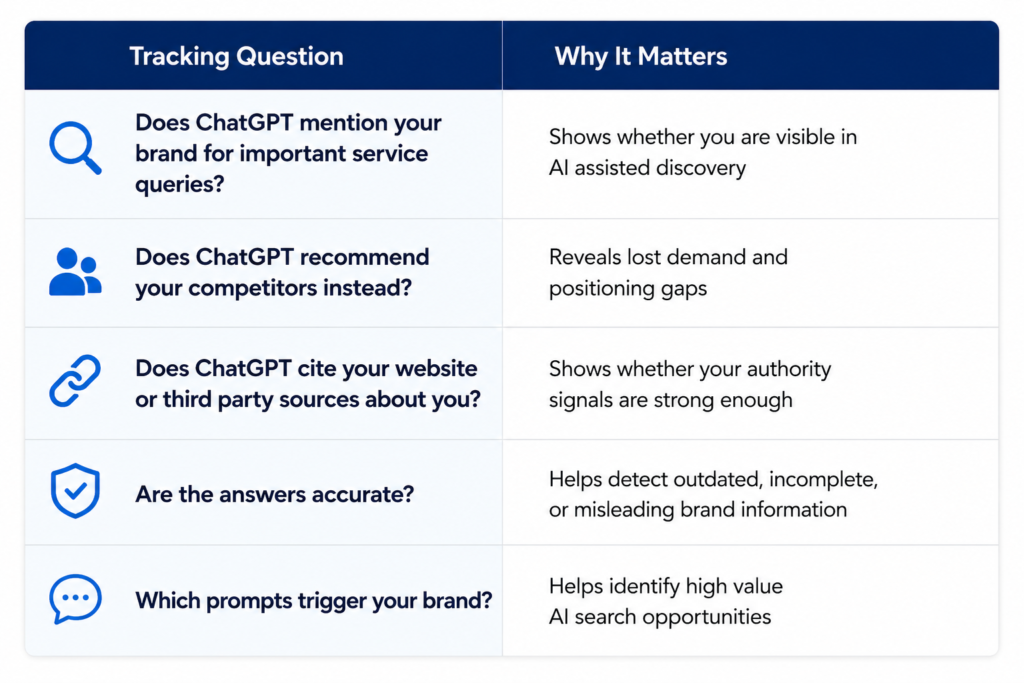
A tracker is not only for reporting. It is a decision-making system. It tells you what content to create, which pages to improve, which sources to strengthen, and where digital PR can help.
ChatGPT Visibility Tracking Is Directional, Not Exact
Unlike traditional search rankings, ChatGPT visibility cannot be measured with perfect precision.
AI-generated answers can change based on factors such as the prompt used, the sources available at the time, whether web search is enabled, and updates to the underlying model. Two people asking similar questions may not always receive the exact same answer.
That does not mean visibility cannot be tracked.
The goal is not to find a single ranking position. The goal is to identify patterns over time. Is your brand appearing more often? Are competitors being recommended instead? Are your citations increasing? Are more buyer questions triggering your brand?
A ChatGPT visibility tracker helps answer those questions.
Think of it as a measurement system rather than a ranking tool. When used consistently, it can help you identify visibility gaps, monitor competitors, and measure the impact of your content, SEO, GEO, and digital PR efforts over time.
Why Businesses Need to Increase Visibility in ChatGPT Searches
People use ChatGPT differently from traditional search engines.
Instead of typing short keywords, users ask full questions, such as:
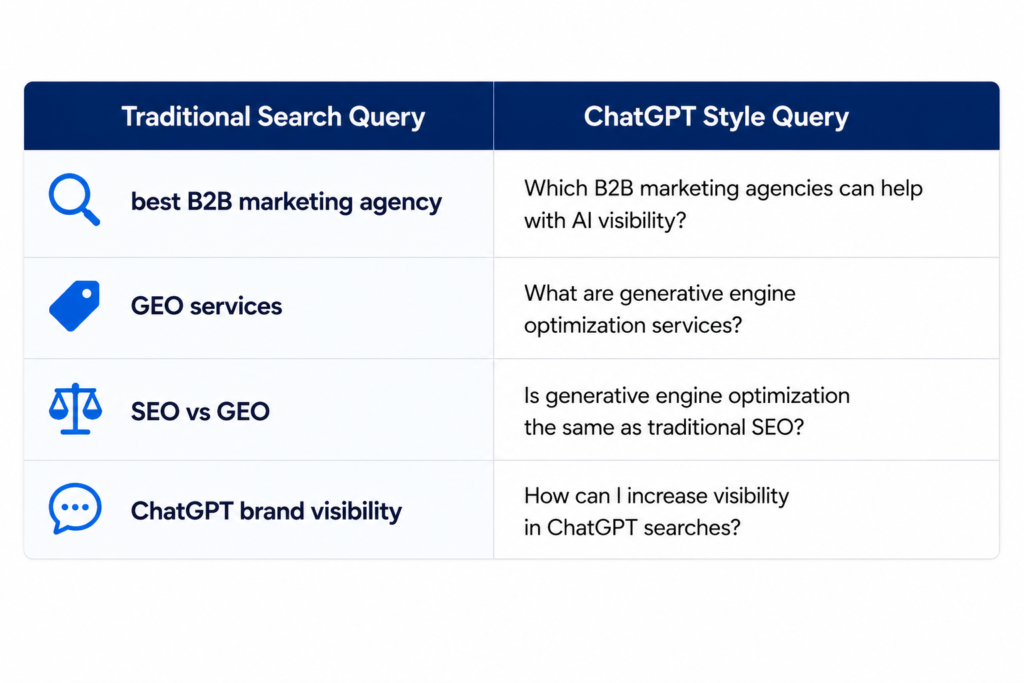
This shift matters because ChatGPT often gives synthesized answers. Users may not scroll through ten blue links. They may trust the answer, compare the options mentioned, and move forward with the brands that appear.
If your business is missing from those answers, you may be missing demand before the customer ever visits a search engine results page.
ChatGPT Visibility Is Not the Same as Google Ranking
Traditional SEO focuses on search engine rankings, clicks, backlinks, content quality, technical performance, and user intent.
Generative Engine Optimization, also called GEO, focuses on how AI systems understand, summarize, recommend, and cite your brand.
Both matter, but they are not identical.This is why companies need both SEO and GEO. SEO helps people find your website. GEO helps AI systems understand why your business deserves to be included in answers.
What Is Generative Engine Optimization?
Generative Engine Optimization is the practice of improving how your brand, website, and content appear in AI-generated answers.
In simple terms, GEO helps AI tools understand:
- Who your business is
- What you offer
- Who you help
- Why you are credible
- Which sources support your expertise
- When your brand should be included in recommendations
This is closely connected to answer engine optimization, AI search tracking, LLM rank tracking, and AI Overviews optimization.
If you are planning a full strategy, you should start with an LLM visibility audit. This helps you understand your current position before investing in content, digital PR, or technical improvements. The exact phrase some teams search for is how to audit brand visibility on LLMs, and it should lead readers to your main pillar guide.
Why Generative Engine Optimization Is Important
Generative Engine Optimization is important because AI search changes how people discover companies.
A potential buyer may ask ChatGPT:
“Which companies can help me improve visibility in AI search?”
“Who offers LLM SEO services for B2B companies?”
“What agency should I hire for generative engine optimization?”
“What are the best AI visibility strategies for a growing business?”
If your competitors are mentioned and your business is not, they gain early trust.
The goal is not to manipulate ChatGPT. The goal is to build clear, consistent, credible signals that make your business easier to understand and more likely to be included when relevant.
How Does Generative Engine Optimization Work?
GEO works by improving the information environment around your brand.
AI systems may use many signals when forming answers, including website content, publicly available information, trusted sources, structured content, relevant mentions, topical authority, and source consistency.
OpenAI notes that ChatGPT search can use information from the web and provide links to relevant sources, which makes source quality and clarity important for businesses that want to be discoverable in AI-assisted research.
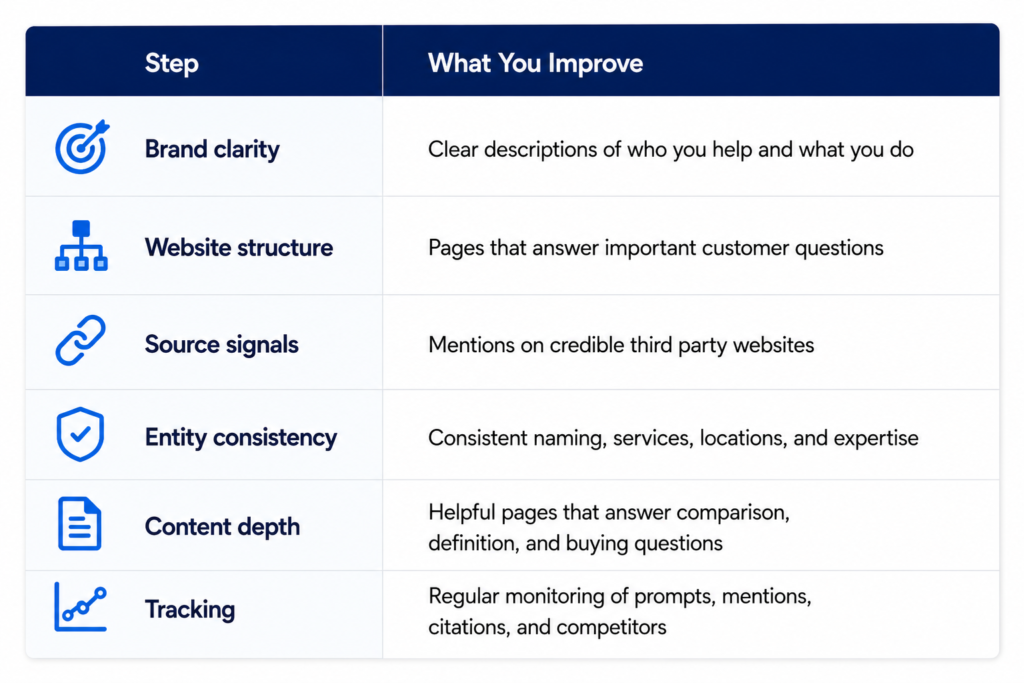
A practical GEO process usually includes:
The Practical Checklist to Increase Visibility in ChatGPT Searches
Use this checklist as a repeatable workflow.
1. Build a Prompt List Around Real Buyer Questions
Start by creating a list of prompts your customers may ask ChatGPT.
Do not only track your brand name. Track category, comparison, service, problem, and buying intent prompts.
Examples:
Your tracker should include at least 30 to 50 prompts across the buyer journey.
2. Track Whether Your Brand Appears
For each prompt, record whether ChatGPT mentions your brand.
Use a simple scoring system:
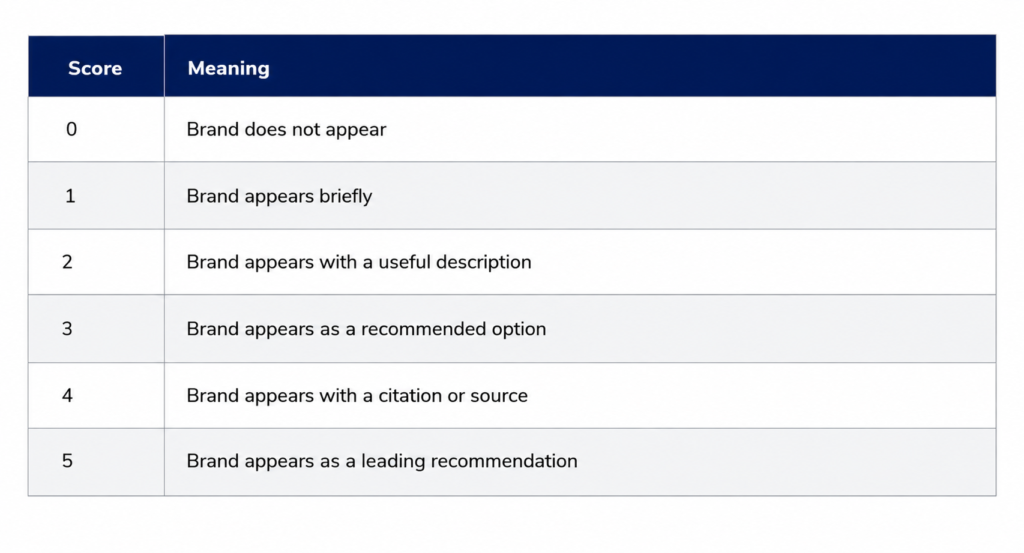
This gives you a practical baseline. You can then rerun the same prompt set monthly to measure improvement.
This is where a ChatGPT visibility tracker becomes valuable. It turns AI visibility from a vague idea into a measurable process.
3. Track Competitor Mentions
Visibility is relative.
If your brand does not appear, ask who does.
Record:
- Which competitors are mentioned
- How they are described
- Which sources are used
- Whether they appear repeatedly across prompts
- What topics they seem to own
This helps you identify what your competitors have that you may lack. It may be stronger service pages, more educational content, better third-party mentions, clearer positioning, or better topical coverage.
4. Check Whether ChatGPT Understands Your Brand Correctly
Visibility is only useful if the answer is accurate.
Review whether ChatGPT correctly understands:
- Your company name
- Your services
- Your target audience
- Your location or service area
- Your industry expertise
- Your differentiators
- Your proof points
If the answer is incomplete or unclear, your website and public brand signals may not be strong enough.
A common issue is vague positioning. If your website says you “help businesses grow” but does not clearly explain your services, target markets, proof, and expertise, AI systems may struggle to place you in the right answers.
5. Create Answer Ready Content
To increase visibility in ChatGPT searches, your website needs content that answers the questions people ask AI tools.
Good GEO content is specific, structured, and useful.
Create pages or blog posts around questions such as:
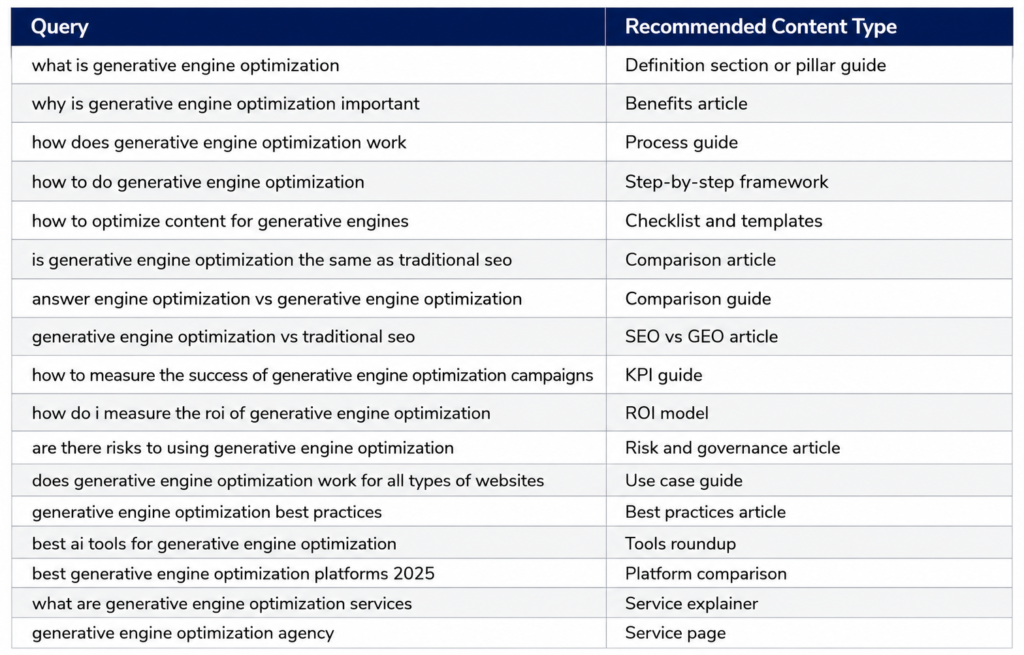
This content should not be thin. Each page should provide clear definitions, examples, comparisons, steps, and practical recommendations.
6. Strengthen Your Core Service Pages
Blog content helps build topical authority, but service pages help AI systems understand what your business actually offers.
Your service pages should clearly answer:
- What service do you provide?
- Who is it for?
- What problems does it solve?
- What is included?
- What makes your approach different?
- What results should a business expect?
- What related services support it?
For example, a page about Generative Engine Optimization services should explain GEO, LLM SEO, AI visibility, ChatGPT visibility tracking, AI search tracking, and how the service supports business growth.
7. Improve Entity Consistency Across the Web
AI visibility depends heavily on consistency. AI systems often understand businesses as entities rather than simply as websites.
An entity can include your company, products, services, founders, executives, locations, and areas of expertise. The clearer and more consistent those entities are across the web, the easier it becomes for AI systems to understand who you are, what you do, and when your brand should be included in relevant answers.
For example, if your website, author bios, guest articles, directory listings, and social profiles consistently describe your company as a Generative Engine Optimization agency, AI systems have a stronger foundation for connecting your brand with GEO-related queries.
When descriptions, services, expertise, or company details vary significantly across sources, it becomes harder to build a clear and trustworthy brand profile.
Your business name, website, services, descriptions, and leadership information should be consistent across your website, social profiles, business directories, author bios, guest articles, PR mentions, and partner pages.
Check for inconsistencies such as:
- Different versions of the company name
- Outdated service descriptions
- Old locations or contact details
- Conflicting niche positioning
- Thin or duplicate author bios
- Missing company schema
- Inconsistent links to your website
When information is consistent, your brand becomes easier to verify.
8. Build Third-Party Trust Signals
Your own website matters, but third-party validation can be powerful.
Creating helpful content on your own website is important, but AI systems often look beyond a single source when evaluating a business.
When your expertise, services, and reputation are consistently supported by industry publications, partner websites, directories, case studies, expert contributions, and other credible sources, it becomes easier to validate who you are and what you do.
This is why source diversity matters. A brand that appears across multiple trusted sources often has a stronger foundation for AI visibility than a brand that relies only on its own website.
The goal is not simply to earn more mentions. The goal is to build a consistent, trustworthy presence across the places where customers, search engines, and AI systems look for information.
To improve AI visibility, work on earning mentions in credible places such as:
- Industry publications
- Expert roundups
- Partner websites
- Podcasts
- Webinars
- Digital PR features
- Case studies
- Software directories
- Niche association pages
- Comparison articles
This is especially important for commercial investigation queries, where users ask for the best providers, platforms, agencies, or tools.
For example, if someone asks ChatGPT for a “generative engine optimization agency,” a business with strong service pages plus credible third-party mentions has a better foundation than a business relying only on its homepage.
9. Use Structured Data Where It Helps
Structured data will not guarantee inclusion in ChatGPT answers, but it can help search engines and other systems understand your content more clearly.
Consider adding schema for:
- Organization
- Local Business, when relevant
- Article
- FAQ
- Service
- Person
- Review, where appropriate and compliant
- Breadcrumbs
The goal is clarity. Your website should make it easy to understand who you are, what you offer, and how your pages connect.
10. Track Citations and Source Mentions
When ChatGPT provides sources, record which websites are being used. When tracking AI visibility, it is helpful to distinguish between mentions and citations.
A mention happens when ChatGPT includes your brand in an answer.
A citation happens when ChatGPT also references a source that supports that mention.
Both are valuable, but citations often provide stronger visibility because they help users verify information and learn more about your business. If ChatGPT recommends your company and cites your website, an industry publication, or another trusted source, that visibility may carry more weight than a simple mention with no supporting source.
Track:
- Your own website citations
- Competitor website citations
- Media citations
- Directory citations
- Review platform citations
- Educational content citations
- Outdated or inaccurate citations
This helps you understand which sources influence the answer.
If the same competitor source appears repeatedly, study it. Look at its structure, authority, relevance, and the type of information it provides. This can reveal content gaps, authority gaps, or opportunities to strengthen your own visibility.
A strong ChatGPT visibility tracker should monitor both brand mentions and citations over time.
11. Compare ChatGPT with Perplexity and AI Overviews
A complete AI visibility strategy should not stop at ChatGPT.
Track your brand across:
- ChatGPT
- Perplexity
- Google AI Overviews
- Gemini
- Claude, where relevant
- Copilot
Different AI systems may use different sources and answer formats. A brand may appear in Perplexity but not in ChatGPT. It may appear in Google AI Overviews but not in conversational recommendations.
This is why AI search tracking should include more than one platform.
12. Measure Progress Monthly
AI visibility should be tracked over time. Create a monthly report that includes:
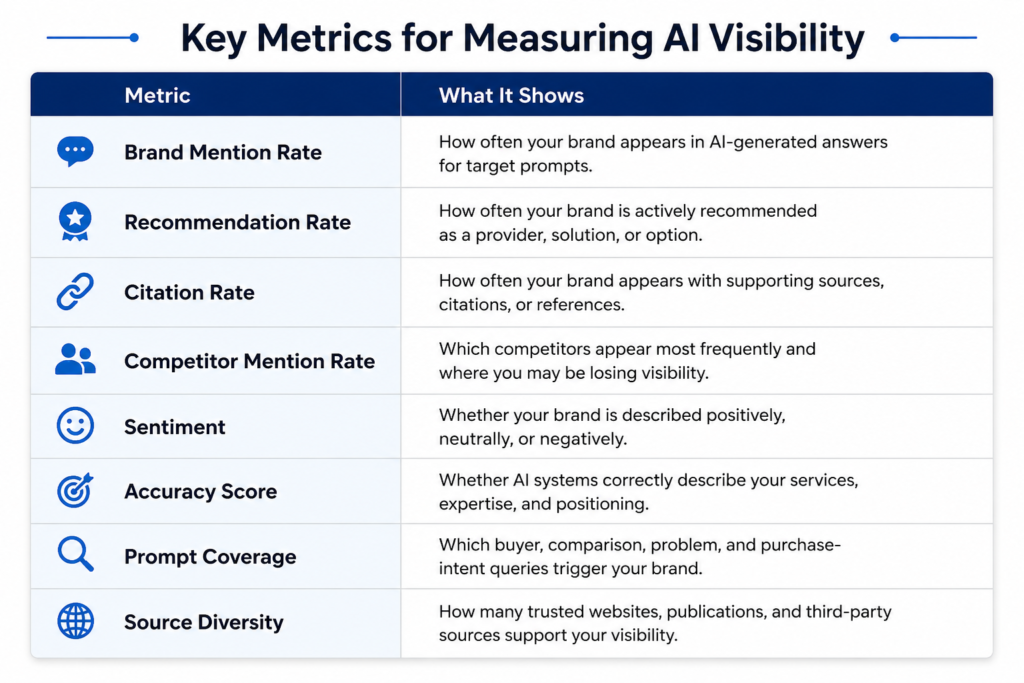
This turns GEO into a measurable business process.
How to Measure the ROI of Generative Engine Optimization
The ROI of GEO can be measured by connecting visibility improvements to business outcomes.
Look at:
- More branded search demand
- More referral traffic from AI tools and cited sources
- More demo requests or contact form submissions
- More sales conversations mentioning ChatGPT or AI search
- Higher conversion rates from educational content
- More inclusion in comparison and recommendation answers
- Lower dependency on paid acquisition over time
As AI search adoption grows, businesses should look beyond traffic alone. A brand that appears consistently in AI-generated recommendations may influence buying decisions long before a visitor reaches a website. Over time, organizations can begin tracking how AI visibility contributes to qualified leads, sales conversations, influenced opportunities, and overall pipeline growth.
The exact measurement model will vary by business, but the goal is the same: connect improvements in AI visibility to meaningful business outcomes.
Are There Risks to Generative Engine Optimization?
Yes. Poor GEO can create risks.
Avoid:
- Publishing low-quality AI-generated content at scale
- Making unsupported claims
- Using fake reviews or fake authority signals
- Creating doorway pages
- Ignoring accuracy
- Over-optimizing for prompts instead of users
- Treating GEO as a shortcut instead of a credibility strategy
The safest approach is to build real authority, publish helpful content, improve source clarity, and make your business easier to verify.
Does GEO Work for Every Website?
GEO can help many types of websites, but the strategy depends on the business model.
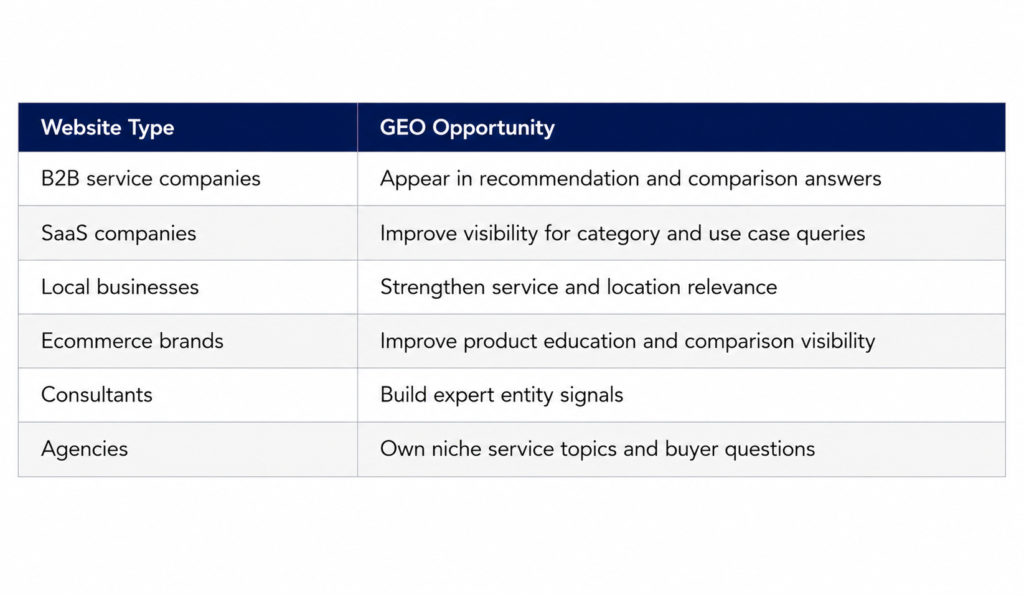
Some websites need technical cleanup first. Others need better content. Others need a stronger third-party authority. This is why an audit should come before execution.
Best Practices to Increase Visibility in ChatGPT Searches
Use this practical checklist:
- Build a prompt set around real customer questions
- Track brand mentions, citations, competitors, and accuracy
- Create answer ready content for definition, comparison, and buying queries
- Strengthen service pages with clear positioning
- Add structured data where useful
- Improve brand consistency across the web
- Earn credible third-party mentions
- Refresh outdated content regularly
- Compare visibility across ChatGPT, Perplexity, and AI Overviews
- Connect AI visibility metrics to leads, pipeline, and revenue
The strongest AI visibility strategies combine SEO, GEO, content strategy, digital PR, and measurement.
How Shoden Global Communication Can Help Your Business
Shoden Global Communication can help your business move from guessing to measuring.
A practical AI visibility program can include:
- Auditing your current visibility across ChatGPT, Perplexity, Google AI Overviews, and other AI discovery platforms
- Building a ChatGPT visibility tracker for your most valuable prompts
- Identifying competitor visibility gaps
- Improving website content so your services are easier to understand and recommend
- Creating GEO-focused content around high-value customer questions
- Strengthening brand authority through digital PR and third-party source signals
- Connecting LLM rank tracking and AI search tracking to business goals
- Building a long-term roadmap for SEO, GEO, LLM SEO, and AI visibility growth
For businesses that want to increase visibility in ChatGPT searches, the goal is not only to appear more often. The goal is to appear in the right answers, for the right queries, with the right message.
Final Checklist
Before you publish your next page or campaign, ask:
| Do we know which ChatGPT prompts matter to our buyers? |
| Do we know whether our brand appears for those prompts? |
| Do we know which competitors appear instead? |
| Is our brand information accurate in AI answers? |
| Do our service pages clearly explain what we do? |
| Do we have content for definition, comparison, and buying queries? |
| Are our third-party mentions strong enough? |
| Are we tracking citations and sources? |
| Are we comparing ChatGPT with Perplexity and AI Overviews? |
| Are we measuring progress every month? |
If you answered no to several of these questions, your business has an AI visibility gap.
A ChatGPT visibility tracker gives you the starting point. A structured GEO strategy gives you the path forward.
FAQ
What is a ChatGPT visibility tracker?
A ChatGPT visibility tracker is a system for monitoring whether your brand appears in ChatGPT answers for important prompts. It can track brand mentions, competitor mentions, citations, accuracy, sentiment, and recommendation frequency.
How can I increase visibility in ChatGPT searches?
You can increase visibility in ChatGPT searches by improving website clarity, creating answer ready content, strengthening service pages, earning credible third-party mentions, using structured data, and tracking prompts regularly.
Is generative engine optimization the same as traditional SEO?
No. Traditional SEO focuses on ranking in search engines. Generative Engine Optimization focuses on how AI systems understand, summarize, cite, and recommend your brand. The two strategies work best together.
What is the difference between answer engine optimization and generative engine optimization?
Answer engine optimization focuses on appearing in direct answers. Generative Engine Optimization focuses more broadly on visibility inside AI-generated responses, including summaries, comparisons, recommendations, and cited answers.
How do I measure the success of generative engine optimization campaigns?
Measure brand mention rate, recommendation rate, citation rate, competitor visibility, sentiment, answer accuracy, AI referral traffic, branded demand, and lead quality.
What are generative engine optimization services?
Generative Engine Optimization services help businesses improve visibility in AI-generated answers. This can include LLM visibility audits, content strategy, AI search tracking, service page optimization, digital PR, and authority building.
Can ChatGPT's visibility be measured accurately?
ChatGPT's visibility cannot be measured with perfect precision because answers may vary based on prompts, sources, and model updates. However, businesses can track visibility trends over time by monitoring prompts, mentions, citations, recommendations, competitors, and answer accuracy across a consistent set of questions.
What should I track besides ChatGPT?
Track Perplexity, Google AI Overviews, Gemini, Copilot, and other AI discovery platforms that matter to your buyers. A broader AI search tracking process gives a clearer view of your market visibility.























PR Outreach: How to Pitch Journalists in 2026
August 10, 2026