
LLM content optimization is the page-level process of making important information easier for people and AI systems to identify, understand, compare, and reuse. The goal is not to write for a machine. It is to remove ambiguity, answer the right questions directly, support important claims, and organize the page so its meaning survives summarization.
A well-optimized page tells a reader what the subject is, who it is for, what is true, why it is credible, and what to do next. Those qualities also support LLM visibility by giving answer systems clearer material to retrieve and summarize.
LLM content optimization improves a specific page so its definitions, claims, entities, evidence, and recommendations can be accurately extracted and attributed. It combines human-first editing with explicit context, logical structure, and verifiable support. It cannot guarantee a citation, but it can make a page less ambiguous and more useful as a source.
Table of Contents
What Is LLM Content Optimization?
LLM content optimization means editing a page for clear understanding and reliable extraction. Instead of merely adding keywords, you define the subject, state the main answer early, explain relationships between entities, show evidence, and make each section useful on its own.
At the page level, LLM optimization is primarily an editorial task. The usual unit of work is a priority URL, not an entire website. An editor reviews the page’s purpose, opening, headings, claims, examples, links, author information, and update signals. LLM-friendly content remains accurate and understandable when a paragraph, table row, or list is viewed outside the page’s full narrative.
How Is LLM Content Optimization Different From SEO, AEO, and GEO?
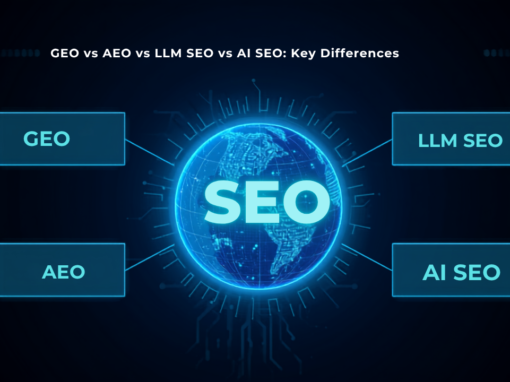
SEO helps a page become discoverable, indexable, relevant, and competitive in search. AEO emphasizes concise responses to questions. GEO focuses on visibility within generative answers. LLM content optimization is narrower: it is the editorial method used to improve one page’s clarity, extractability, evidence, and citation readiness.
These practices overlap. Google’s current guidance says established SEO practices still apply to its generative search features, and publishers do not need special AI markup, arbitrary micro-chunks, or “AI-only” prose to qualify. Useful, crawlable, well-structured content remains the foundation.
Which Pages Should You Optimize First?
Start with pages that already influence revenue, authority, or recurring customer questions. A strong candidate has meaningful demand, an important business role, and a clear gap between what the reader needs and what the page explains.
Prioritize pages with:
• High impressions or rankings near page one
• Existing traffic but weak engagement or conversion
• Core product, service, category, or use-case relevance
• Frequent use in sales or support conversations
• Strong backlinks but outdated or vague copy
• Topics where competitors are cited and your page is absent
• Proprietary data, expert insight, or original examples
Avoid beginning with hundreds of low-value posts. Optimize a small group of consequential URLs, assess whether their answers and positioning become clearer, then reuse the editing pattern.
How Do You Write Clear and Extractable Answers?
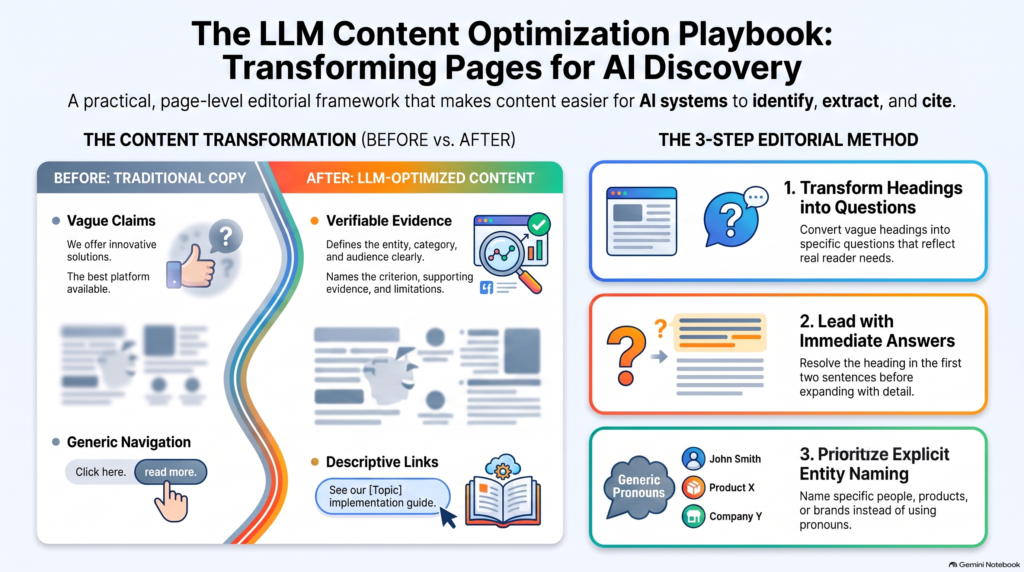
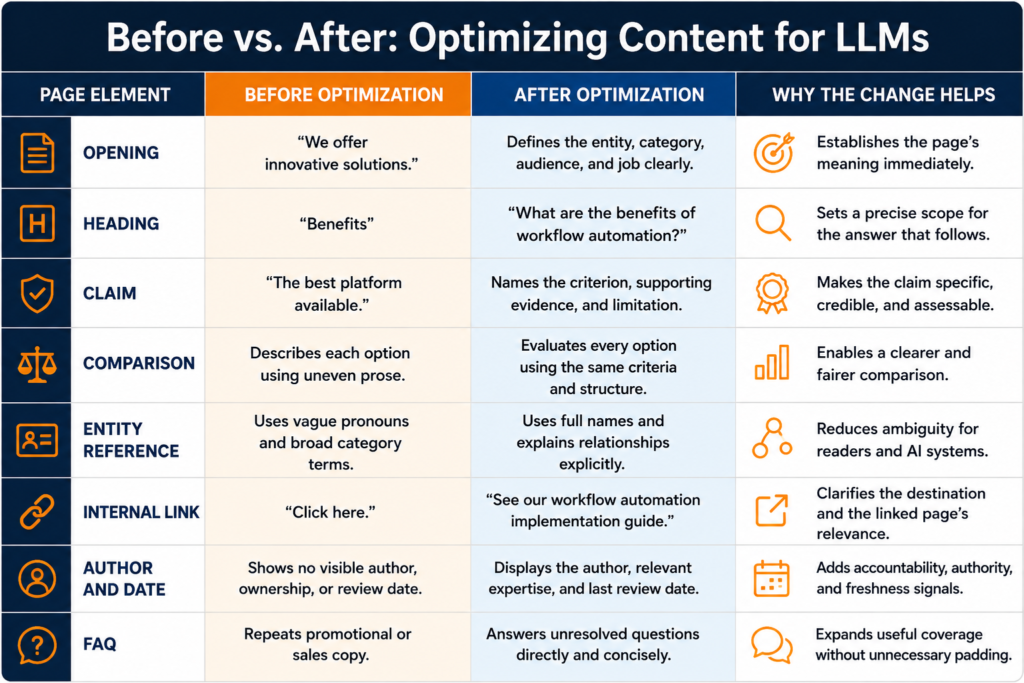
Begin each question-based section with a concise response that resolves the heading before expanding. The opening paragraph should identify the subject, give the answer, and add the most important condition or limitation.
A Six-Step Editing Method
- Turn a vague heading into a real question.
- Answer it in the first one or two sentences.
- Name the entity instead of relying on “it” or “this solution.”
- Add the deciding criteria, conditions, or exceptions.
- Support material claims with a source, method, or example.
- Expand with steps, implications, and practical detail.
How Do You Add Entities and Context to a Page?
Name the people, companies, products, categories, locations, standards, and concepts that matter, then explain how they relate. An entity mention without context is only a name; useful context tells the reader what it is and why it appears.
Use the full brand or product name on first reference. State the category, target audience, primary use case, and meaningful differentiator. Distinguish similarly named products, spell out uncommon acronyms, and keep facts consistent across the title, opening, author box, body copy, structured data, and linked pages.
A useful pattern is: “[Entity] is a [category] for [audience] that [primary function], especially when [condition].” Use it only where clarification is needed.
How Do You Support Claims With Evidence and Sources?
Support claims that could affect a decision, including performance statements, market leadership, savings, product comparisons, and numerical results. Link to original research, official documentation, first-party data, or a named expert whenever possible.
For original findings, explain the sample, time period, method, and limitations. For customer results, identify the baseline and measurement window. For recommendations, disclose criteria and commercial relationships. Replace “best,” “leading,” and “proven” with an observable reason.
Google’s people-first content guidance encourages clear evidence, sourcing, author background, and links to author or About pages when those details help establish trust.
Which Page Structures Work Best for Comparisons and Recommendations?
Comparison and recommendation pages work best when the decision method is visible. Define the audience, list the criteria, explain how options were evaluated, present comparable facts in the same order, identify trade-offs, and recommend by use case rather than declaring one universal winner.
A useful sequence is: short answer, criteria, comparison table, option summaries, best-fit scenarios, limitations, methodology, sources, and update date.
How Do Internal Links Strengthen Topic Meaning?
Internal links connect a page to definitions, evidence, related processes, and next-step resources. Use descriptive anchor text that states what the destination explains. Link a specialized article to its pillar page, then laterally to closely related supporting pages when that helps the reader.
Place links where the relationship becomes relevant, not in a generic SEO block. Avoid “read more” when a precise label is available. Google recommends crawlable links and descriptive words in link text because they help users and search systems discover and understand connected pages.
What Roles Do Authors, Expertise, and Content Freshness Play?
Visible ownership gives a claim accountability. Add a real author or reviewer, a short description of relevant experience, and a link to a detailed profile. On sensitive or technical topics, separate the writer from the qualified reviewer when appropriate.
Freshness should reflect meaningful review, not an automatically changed date. Check facts, examples, screenshots, pricing, standards, product names, and external links. Article structured data can describe author and date information, but markup should match visible content. Google recommends author URLs in Article markup to clarify author identity.
How Should Tables, Lists, and FAQs Be Used?
Use a table when readers need to compare the same attributes across options. Use a numbered list for a sequence, a checklist for pass-or-fail review, and bullets for parallel points. Introduce each asset and use specific column labels or list items.
FAQs should answer genuine residual questions that the main article does not resolve cleanly. Avoid near-duplicates added only to repeat keywords. Structured data may help search systems interpret eligible content, but it is not a special requirement for generative visibility and does not guarantee a rich result.
How Do You Test Whether an LLM Understands a Page?
Testing is diagnostic, not proof that a system has indexed, trusted, or will cite the page. Give the page text or accessible URL directly to several tools, use the same prompts, record the outputs, and look for recurring misunderstandings.
Use questions such as:
• What is this page mainly about, and who is it for?
• What are its three most important claims?
• Which entities appear, and how are they related?
• What answer would you extract for each H2?
• Which claims lack evidence or attribution?
• What would prevent you from citing this page?
Correct the source page, not the generated answer. Repeat after editing and compare accuracy, omissions, unsupported inferences, and consistency.
Page-Level LLM Content Optimization Checklist
☐ The title and H1 describe one clear purpose.
☐ The primary topic appears naturally in the opening.
☐ A short definition or answer appears near the top.
☐ Question headings match real reader needs.
☐ Each question section starts with a concise answer.
☐ Important entities are named and categorized.
☐ Acronyms and specialist terms are defined.
☐ Pronouns do not create unclear references.
☐ Decision-critical claims have credible support.
☐ Statistics include source, date, and context.
☐ Original research explains its method and limits.
☐ Comparisons use consistent criteria.
☐ Recommendations state who each option suits.
☐ Tables have descriptive headers and comparable values.
☐ Internal links use descriptive anchor text.
☐ The page links to relevant definitions and evidence.
☐ Author or reviewer credentials are visible.
☐ The review date reflects a real content check.
☐ FAQs answer unresolved questions rather than repeat copy.
☐ Structured data matches visible content.
☐ The page is crawlable and its main text accessible.
☐ Test summaries preserve the intended meaning.
☐ The final edit improves clarity for humans first.
Which Common LLM Content Optimization Mistakes Make a Page Hard to Cite?
The most damaging mistakes are ambiguity, unsupported certainty, inconsistent facts, and structure that hides the answer. Examples include long introductions, vague claims, unexplained entities, mismatched dates, promotional comparisons, missing source links, and tables that use different criteria by row.
Other problems include publishing near-duplicate question pages, forcing every paragraph into an artificial “chunk,” adding schema for invisible content, or changing dates without reviewing facts. Content optimization for AI should reduce interpretive work, not produce repetitive prose.
Quick Answers
Does LLM content optimization replace SEO?
No. It builds on technical accessibility, relevance, authority, and other SEO fundamentals.
How long should an extractable answer be?
Long enough to answer accurately, often two to four sentences, followed by support.
Should every H2 be a question?
No. Use questions for answers and descriptive headings for frameworks or resources.
Do short paragraphs guarantee AI citations?
No. Clarity helps, but citation also depends on retrieval, relevance, source quality, system behavior, and the query.
Should every page include an FAQ?
Only when it resolves meaningful questions not already answered clearly.
Is schema required for LLM visibility?
No universal AI-specific schema is required. Use valid schema when it represents visible content.
How often should a page be refreshed?
Review it when facts, products, evidence, rules, or reader needs change.
What is AI citation optimization?
It makes claims specific, attributable, supported, and reusable without losing context.
Conclusion
LLM content optimization is disciplined editing: make the answer visible, name the entities, explain relationships, support claims, structure comparisons fairly, and connect the page to evidence and context.
Use the checklist on high-impact URLs, test for misunderstandings, and revise until readers and systems can describe the page accurately.
For hands-on implementation across page structure, entity clarity, internal linking, FAQs, and citation readiness, explore Shoden Global’s LLM SEO service.
FAQ
What is the first change to make on an unclear page?
Rewrite the opening so it identifies the subject, audience, purpose, and main answer. This often exposes other missing context.
Can an existing page become LLM-friendly without a full rewrite?
Yes. Focused edits to the opening, headings, answer paragraphs, entities, evidence, links, and author information can materially improve clarity.
How do you avoid cannibalizing a commercial page?
Keep the commercial page focused on the offer, fit, proof, process, and conversion. Let the informational article own the step-by-step method and link to the service only for implementation help.
Should external sources open in a new tab?
That is a user-experience choice. More important is linking to the correct primary source with descriptive context.
Can AI-generated copy be used?
Yes, provided a knowledgeable human checks accuracy, originality, relevance, tone, sources, and consistency.
How can editors measure page-level improvement?
Compare whether test summaries identify the right topic, entities, claims, audience, and limitations. Also review engagement, assisted conversions, and feedback from sales or support.
What is the difference between extraction and citation?
Extraction means a system can isolate and summarize information. Citation means it also attributes or links that information to the page. Clear extraction does not guarantee citation.





















PR Outreach: How to Pitch Journalists in 2026
August 10, 2026