

The role of expert quotes in earning LLM citations is not to manipulate AI platforms or force a brand mention. It is to turn expertise into precise, verifiable commentary that editors can use. An editorial mention can create discoverable evidence connecting a named expert, claim and organisation. This may improve citation readiness, but inclusion remains dependent on the platform, query and source-selection process.
An expert quote is a concise, attributable statement from a qualified person that adds analysis, evidence or practical context to a story. When a credible publisher uses it, the quote can earn an editorial mention or source link and add verifiable public evidence around the expert and brand. AI citation remains platform-dependent and cannot be guaranteed.
Table of Contents
What Is an Expert Quote for AI Citation Readiness?
An expert quote for AI citation readiness is an attributable statement that gives a publisher original, accurate value. Its purpose is to help the reader; any search or AI visibility benefit is secondary.
A strong quote explains a decision, interprets evidence, identifies a limitation or gives practical direction. The expert should be real, relevant and available for verification. Published attribution should make the relationship between the person, role and organisation easy to understand.
Why Do Journalists and Editors Use Expert Quotes?
Journalists and editors use expert quotes to add interpretation, specialist context, practical advice, credible disagreement and informed perspective. A useful source helps show readers what reported facts mean in practice.
Editors may also need someone who can clarify a technical issue, challenge an assumption or explain uncertainty. A strong response meets that need without pressuring the publisher. Editors retain control over whether a quote is used, edited or accompanied by a link.
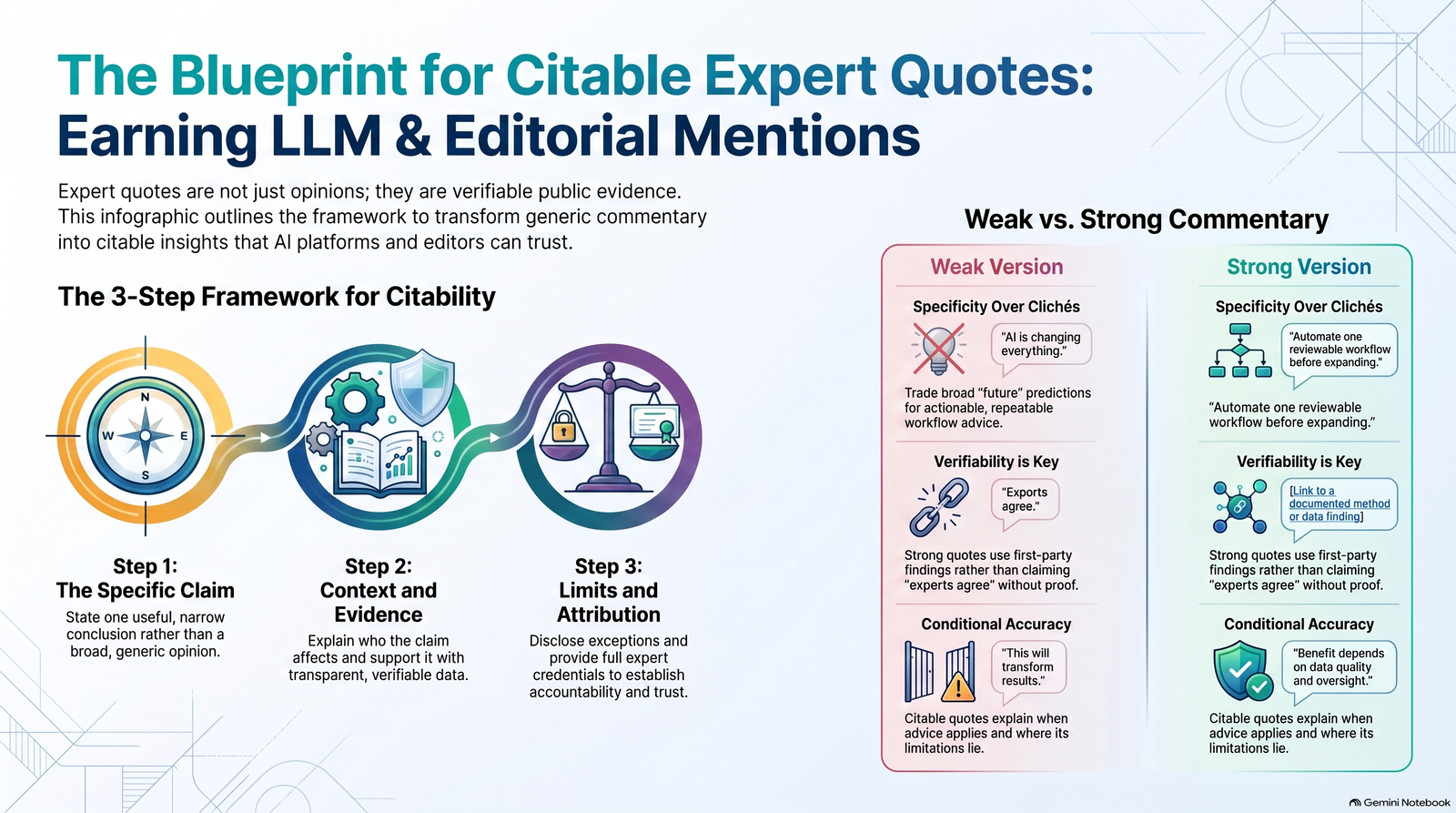
What Makes an Expert Quote Citable?
A citable expert quote combines one clear claim with context, evidence, an appropriate limitation and complete attribution. These elements make the statement easier to understand, verify, and use responsibly.
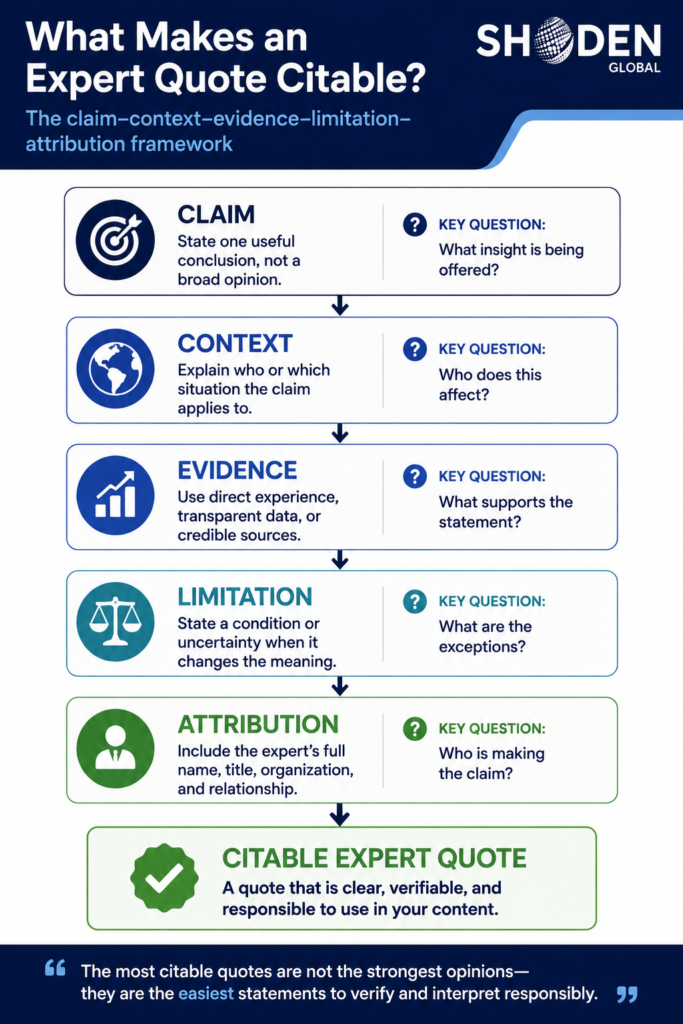
Quote-quality checklist:
• Named, real and relevant expert
• One clear claim
• Useful context for the reader
• Evidence or direct experience
• No unsupported prediction
• Important limitation included
• Plain language
• Accurate job title and company
• Conflict or commercial relationship disclosed
• Source link adds genuine value
Missing one of these elements does not automatically invalidate a quote, but the absence of several signals makes commentary harder for editors and readers to trust.
Why Do Generic Expert Quotes Fail?
Generic quotes fail because they add little that an editor could not write independently. Clichés, sales language, jargon, unsupported predictions, and answers that repeat the question create work without improving the story.
The difference between generic commentary and useful expertise is specificity, evidence and context. Strong quotes help readers understand not only what is true, but also when it applies and where its limitations lie.
How Do You Write a Strong Expert Quote Step by Step?
Write the quote by narrowing the question, then build a concise answer around one defensible claim. This process keeps the commentary useful and easy to verify.
- Choose a genuinely qualified named expert.
- Define the exact question and audience.
- Write one clear claim rather than a broad opinion.
- Add context explaining why the claim matters.
- Support it with first-party experience, data, or a credible source.
- State an important limitation or condition where needed.
- Remove jargon and promotional language.
- Provide accurate attribution, credentials and a useful source link.
Before-and-after quote example
Before: "AI is the future, and businesses must embrace it now to remain competitive."
After: "Start with one repeatable workflow where errors can be reviewed quickly. Automating a high-risk decision before defining human oversight can make a fast process less reliable, not more useful."
The revision is narrower, practical, and conditional. When evidence exists, add its scope and methodology rather than an impressive but unverifiable statistic.
How Do You Find Relevant Source Opportunities?
Find opportunities where the expert’s knowledge genuinely matches the publication, audience and question. Relevance is more valuable than answering many loosely related requests.
Monitor journalist source requests, newsroom callouts, editorial calendars, trade publications, conferences, professional associations and relevant reporters. Build expert profiles showing subject areas, credentials, previous commentary, disclosures and contact availability. Original research and documented case evidence can create reasons for outreach.
A coordinated PR outreach programme should connect these opportunities with Digital PR, AI visibility initiatives and supporting resources that help publishers verify claims and understand the expert's perspective. The objective is not to appear everywhere, but to contribute where the organisation can offer knowledge that meaningfully improves the story.
How Should You Pitch Expert Commentary?
Pitch with the answer first, followed by the credentials and evidence needed to establish relevance. A concise, deadline-aware response is easier to assess than a long company introduction.
Source-response template
Subject: Expert comment on [specific question]
Hello [name],
[Insert a concise quote that directly answers the question.]
Source: [Full name], [accurate job title], [organisation]
Relevant expertise: [One sentence about direct experience]
Supporting source or methodology: [Useful link or short explanation]
Disclosure: [Material relationship or conflict, if applicable]
[Expert name] is available for fact-checking before [time].
Speed matters, but accuracy comes first. Confirm names, titles, claims, and permission before sending. Leave out irrelevant biographies, awards and sales material.
What Evidence and Attribution Should Support a Quote?
Evidence should match the claim and be clear enough for an editor to check. Attribution should identify who is speaking, why that person is qualified, and whether a commercial relationship could affect interpretation.
Support may include a methodology page, dated first-party research, a public dataset, a regulatory source or an approved case study. Distinguish measured findings from opinion.
The PRSA Code of Ethics centres values including honesty, expertise, independence and fairness. For commercial content in the United States, FTC guidance says advertising claims must be truthful, non-deceptive and evidence-based and highlights disclosure of relevant brand relationships.
How Can Expert Quotes Earn Editorial Mentions and Links?
Expert quotes can earn editorial mentions and links when they improve a publication’s usefulness, but the publisher decides what to include. A link is most defensible when it helps the reader verify evidence, understand the expert, or explore a relevant source.
A link acquisition and editorial links strategy should point editors to an expert profile, research method, original report, glossary or case study. Avoid making a sales page the default destination. Google’s guidance says crawlable links help it discover pages and that descriptive, relevant anchor text helps people and Google understand the destination.
What Is the Role of Expert Quotes in Earning LLM Citations?
The role of expert quotes in earning LLM citations is to create credible, discoverable material, not to guarantee selection by an AI system. Clear attribution supports entity clarity, while evidence-backed commentary can make a source more useful for human and machine-led research.
Publish quotes on accessible pages, maintain consistent expert profiles, link supporting evidence and use descriptive internal links. Google states that SEO fundamentals remain relevant to its AI features, that no special optimisation guarantees inclusion and that eligible content may still not be crawled, indexed or served. Its guidance also recommends unique, expert-led content that adds value beyond common knowledge.
Do not describe a placement as proof that content entered model training data or will be remembered. The defensible outcome is stronger public evidence and improved eligibility for source discovery.
How Should Expert-Quote Performance Be Measured?
Measure performance across editorial quality, source visibility, audience response and commercial relevance. One link or observed AI mention does not show the programme’s full value.
No single metric captures the impact of expert commentary. Editorial quality, discoverability and business outcomes should be evaluated together.
Track:
• Qualified placements in relevant publications
• Accuracy of the message and attribution
• Editorial mentions and useful source links
• Referral traffic and engaged visits
• Branded search and expert-name discovery
• AI mentions or citations recorded by platform, query and date
• Enquiries, assisted leads and tracked conversion events
• Repeat requests and media-relationship quality
Treat AI observations as samples, not permanent rankings or proof of causation.
What Are the Most Common Expert-Quote Mistakes?
The most damaging mistakes are fabricated expertise, ghost experts, generic outsourced answers, undisclosed conflicts, unsupported claims, and approvals that miss the deadline.
Other failures include inflated titles, presenting opinion as research, omitting important conditions, forcing product language into the quote, and linking to an irrelevant sales page. Use a pre-approved process for credentials, evidence, disclosure and legal review, while keeping final approval fast enough for editorial deadlines.
Quick Answers
What is an expert quote?
It is a concise, attributable statement from a qualified person that adds analysis, evidence or practical context.
Can expert quotes earn backlinks?
Yes, a publisher may link to a useful profile, study or source page, but neither placement nor a backlink is guaranteed.
Do expert quotes guarantee AI citations?
No. They can improve public evidence and citation readiness, while selection remains platform- and query-dependent.
How long should an expert quote be?
As a working range, aim for roughly 40–100 words unless the request specifies otherwise. Clarity matters more than an exact count.
What credentials should be included?
Use the expert’s full name, accurate title, organisation and experience directly relevant to the question.
Should every quote include data?
No. Documented experience can support a quote, but factual claims should be verifiable and appropriately limited.
How quickly should a source respond?
Respond as soon as an accurate, approved answer is available and within the stated deadline.
How should results be measured?
Measure qualified coverage, message accuracy, source links, referral activity, observed AI visibility, leads and relationship quality.
Conclusion
Expert quotes become valuable when they are accurate, specific, attributable and genuinely useful. A disciplined expert-source programme can build editorial relationships, create verifiable public evidence and improve citation readiness without making promises that no publisher or AI platform can guarantee.
Ask Shoden Global to build an expert-source, digital PR and AI citation-readiness programme that transforms organisational knowledge into responsible commentary, useful source material and measurable authority signals.
FAQ
How can expert quotes support AI visibility?
They create attributable public material that may clarify the relationship between an expert, organisation and topic. This can improve eligibility for discovery, but it cannot ensure a citation.
What makes an expert quote citable?
It contains one clear claim, relevant context, suitable evidence, an honest limitation and complete attribution.
How do I find journalist source requests?
Monitor newsroom callouts, journalist-request platforms, trade publications, professional associations and relevant reporters. Build direct relationships instead of relying only on open requests.
Can an agency write a quote for an executive?
An agency can interview the executive, shape a draft and edit it for clarity. The named expert must verify and approve the final statement; the agency must not invent expertise or create a ghost source.
Should an expert quote include a link?
Include one when it helps verify evidence, review methodology or understand the expert. Do not force a link that exists only for promotion or ranking.
How should conflicts of interest be disclosed?
State any employment, client, investment, sponsorship or other material relationship that could affect interpretation. Make the disclosure clear enough for the publisher to assess.
Do media mentions guarantee LLM citations?
No. A mention creates public evidence, but platforms select and present sources differently, and outputs can change by query, location, timing and model.
What should an expert-source campaign report?
Report relevant placements, message accuracy, attribution, links, referral engagement, branded discovery, observed AI mentions, leads, disclosure compliance and relationship progress. Record the query and date for each AI visibility observation.




























PR Outreach: How to Pitch Journalists in 2026
August 10, 2026