

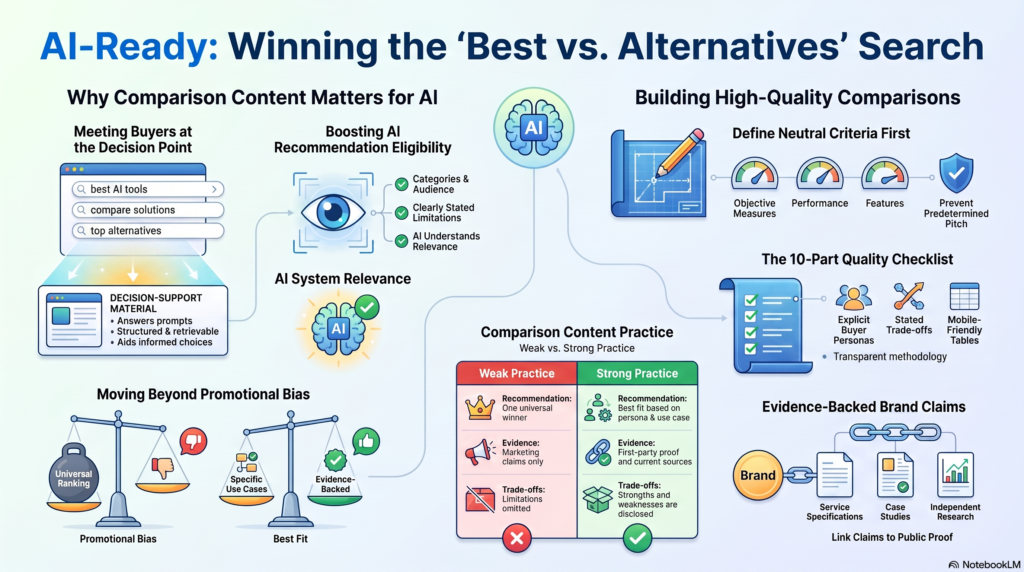
Comparison content for AI visibility meets buyers where research becomes a decision. Instead of another promotional page, a brand explains the options, criteria, evidence and trade-offs. This can improve eligibility for search and AI-generated answers while giving readers a clearer next step.
The goal is not to manufacture a favourable ranking. It is to show who each option suits and why the conclusion is reasonable.
Comparison content helps buyers evaluate options through consistent criteria, clear trade-offs, best-fit use cases and verifiable evidence. For AI visibility, it gives answer systems structured, retrievable material for responding to “best,” “versus,” “alternatives” and “which provider” prompts without forcing a promotional conclusion or implying that one choice suits every buyer.
Table of Contents
What Is Comparison Content for AI Visibility?
Comparison content for AI visibility is decision-support content that evaluates options through transparent, consistent criteria. It answers questions such as “Which solution fits my use case?”, “What are the alternatives?” and “How does one provider differ from another?”
A strong page defines the buyer and shows where each option fits. One provider may suit an international enterprise, another a specialist team and a third a buyer prioritising price or implementation speed.
An answer system may quote, summarise or retrieve this material. It improves the likelihood of visibility; it does not guarantee a mention, citation or recommendation.
Why Do AI Prompts Often Become Comparison Prompts?
AI prompts often become comparisons because conversational search lets buyers add context and constraints. A broad question can quickly become a request for the best option for a particular industry, budget, market, team size, technical environment or migration need.
A buyer might ask what generative engine optimization is, then which providers serve international companies or suit an in-house team. “Compare top generative engine optimisation platforms for AI visibility” signals an emerging shortlist, not simple curiosity.
Research the complete prompt, including qualifiers such as geography, maturity, risk, integrations, support and desired outcome.
How Does Comparison Content Help AI Recommend a Brand?
Comparison content can help an AI system understand when a brand is relevant by clearly stating its category, audience, strengths, limitations and evidence. This improves source discovery and recommendation eligibility, although the response still depends on the prompt, system and sources available at retrieval time.
The page should explain who the offer is for, what it solves, how it differs and when it may not fit. Claims should lead to public proof such as service specifications, approved case studies, documented methodology or independent evidence.
For Google’s generative AI features, foundational SEO remains relevant. Google advises publishers to create valuable, non-commodity content and ensure pages are publicly accessible, crawlable, indexed and eligible to appear in Search. It also says there is no special schema or AI text file required for inclusion.
Which Comparison Formats Should a Brand Create?
A brand should create the format that matches a genuine buyer decision, rather than publishing every possible “versus” combination. Prioritise prompts with commercial relevance, distinct criteria and enough evidence to support a useful conclusion.
Useful formats include:
• Brand versus competitor pages for a named shortlist
• Alternative pages for buyers replacing a provider or approach
• “Best for” pages based on a defined use case or constraint
• Category lists with transparent selection methodology
• Use-case comparisons for different company types or maturity levels
• Service comparisons, such as consultancy versus software
• Migration pages covering transition effort, risk and dependencies
Each format needs a distinct purpose. Alternatives should explain why someone might switch, “best” pages must define best, and migration pages should address the change rather than disguise a sales pitch as advice.
What Should a High-Quality Comparison Page Include?
A high-quality comparison page should let buyers understand the recommendation, inspect the evidence and choose a sensible next step.
This 10-part checklist keeps the content balanced and maintainable.
- Transparent selection or comparison methodology
- The same criteria applied to every option
- An explicit buyer persona and use case
- Clearly stated trade-offs
- Current, linked sources
- Evidence-backed brand claims
- Disclosure of sponsorship or commercial relationships
- A mobile-readable comparison table
- A clear next step
- A visible last-reviewed date
Define the criteria before evaluating the options. Useful measures might include strategic depth, implementation effort, market coverage, integrations, governance, reporting, support and total operating burden.
How Do You Position Your USP Without Sounding Biased?
Position your USP by linking a specific differentiator to a defined buyer need and supporting it with evidence. Explain where the advantage matters, who benefits and what trade-off accompanies it.
“Shoden Global is the best choice” is unsupported. A stronger statement says Shoden Global may suit a team seeking integrated AI visibility strategy, buyer-prompt research and content execution, then points to methodology, deliverables and case evidence. Another buyer may prefer self-service software or a narrow audit.
This is transparent advocacy: the reader can inspect the proof and judge the fit.
How Do You Compare Competitors Fairly?
Compare competitors fairly by applying the same current criteria, using primary sources and separating facts from editorial judgement. State what was reviewed, when and how corrections can be requested.
Do not score incomplete evidence. Explain why each criterion matters, include limitations and disclose sponsorship, affiliate compensation or other material relationships.
For US-facing content, the FTC’s endorsement guidance emphasises truthful representations and clear disclosure of material connections; check the requirements in every market served.
Weak Comparison Content vs AI-Ready Comparison Content
Weak vs. Strong Practice
How Do You Connect Comparison Content to Buyer Personas?
Connect comparison content to buyer personas by mapping every criterion to the person’s responsibilities, risks, use case and buying stage. The same feature can matter differently to a CMO, SEO lead, procurement manager or content operations team.
A CMO may prioritise accountability and market impact; an SEO lead, crawlability and measurement; procurement, governance and terms; and a content team, workflow and editorial capacity.
State the persona near the top. For materially different needs, use distinct sections or genuinely differentiated support pages instead of duplicating the comparison.
How Do You Build Comparison Content Step by Step?
Build comparison content by starting with a meaningful buyer prompt, defining neutral criteria and gathering evidence before reaching a conclusion. This order prevents the page from becoming a predetermined sales argument.
- Select one commercially meaningful buyer prompt tied to a shortlist, alternative search or provider decision.
- Define the exact persona, use case, market, maturity, constraints and desired outcome.
- Choose neutral decision criteria before evaluating any option.
- Gather current first-party facts and credible sources, preferring official documentation where available.
- State which option is best for which situation rather than forcing one universal winner.
- Explain trade-offs, limitations, dependencies and unsuitable scenarios.
- Support the brand’s USP with documented services, experience, case evidence or original research.
- Add a consistent, concise and mobile-friendly summary table.
- Link to deeper service, feature, case-study and pricing information.
- Set a review date, assign an owner and provide a correction route.
How Do You Avoid Thin or Duplicated Comparison Pages?
Avoid thin or duplicated pages by publishing only when a prompt requires distinct criteria, evidence or guidance. Consolidate near-identical comparisons into a stronger hub and use sections or anchored links for close variations.
Changing competitor names inside the same template adds little value. Every page should contribute original analysis, first-party experience and a conclusion shaped by its persona. Plan canonicals and redirects when merging overlaps.
Google’s people-first guidance favours useful, reliable content, while its spam policies warn against scaled pages created mainly to manipulate rankings or generative AI responses. Publishing many AI-generated pages without meaningful added value may breach those policies.
How Should Comparison Content Link to Service Pages?
Comparison content should link to a service page when the reader needs a logical next step. Use descriptive anchor text beside the problem, method or deliverable that the destination explains.
A buyer could move to the Shoden Global AI Visibility Service for scope, then read How to Improve Brand Visibility in AI Search Engines. Related support can include Buyer Prompt Research, AI Brand Visibility Competitive Analysis and Best GEO Tools and Platforms.
The service pillar should link back to its strongest support articles, connecting education, evidence and conversion without forcing one CTA.
What Mistakes Make Comparison Content Untrustworthy?
Comparison content becomes untrustworthy when the conclusion is predetermined, the methodology is hidden or the facts cannot be checked. The worst examples appear independent while operating as undisclosed advertising.
Common mistakes include:
- Inventing rankings or scores without a defined method
- Selecting weak competitors to favour the brand
- Applying different standards to different options
- Repeating claims without checking primary sources
- Hiding sponsorship or commercial incentives
- Omitting limitations and implementation effort
- Publishing duplicated alternative pages
- Leaving prices, features or policies unreviewed
- Guaranteeing rankings, citations or AI recommendations
- Sending every reader to the same CTA regardless of fit
A trustworthy page gives readers enough information to disagree with its conclusion.
Quick Answers
What is comparison content?
It evaluates choices using defined criteria, evidence, trade-offs and best-fit use cases so a buyer can make a more informed decision.
Why do comparison prompts matter for AI visibility?
They express commercial intent and create an opportunity to answer “best,” “versus,” “alternatives” and provider-selection questions clearly.
Should a brand compare itself with competitors?
Yes, when the comparison reflects a real decision and uses current facts, consistent criteria, transparent methodology and balanced language.
Can a comparison page be objective?
It can be fair and evidence-led, although editorial judgement remains. Make the methodology, sources, relationships and limitations visible.
What should a comparison methodology include?
Define the audience, use case, inclusion rules, criteria, evidence, scoring approach if used, review date and correction process.
How often should comparison pages be updated?
Review them after any material change and on a scheduled cycle suited to the market. Fast-changing prices or features need closer checks.
Are alternative pages useful?
Yes, when they explain why a buyer might switch and compare fit, transition requirements and trade-offs instead of repeating a template.
Does comparison content guarantee AI recommendations?
No. It can improve clarity, authority signals and retrieval eligibility, but cannot guarantee rankings, citations, mentions or recommendations.
Conclusion
Comparison content for AI visibility works when it behaves like buyer guidance, not disguised advertising. Define the prompt and persona, apply consistent criteria, show the evidence and explain the trade-offs. The result is useful to people and easier for search and AI systems to discover and retrieve.
Ask Shoden Global to build a comparison-content map around the prompts where buyer discovery and buyer decisions happen. Our team can connect those prompts to evidence-led pages, supporting content and conversion paths that increase the likelihood of qualified visibility without making promises no publisher can control.
FAQ
What types of comparison content work best?
The best format matches a real decision: brand-versus-competitor pages, alternatives, best-for guides, use-case comparisons, service comparisons, category lists or migration pages. Define the buyer and prompt first.
How should competitors be selected?
Choose providers a real buyer would reasonably consider for the same job. Publish inclusion rules such as market, scope, customer type, availability or feature set.
Can a company rank itself first in its own comparison?
It can reach that conclusion, but should not claim universal superiority without transparent methodology and strong evidence. State where the company is the best fit and where another option may suit better.
How do you keep a comparison page accurate?
Use primary sources, display a review date, assign an owner and maintain a correction process. Recheck pricing, features, scope, policies and relationships before publication and after material changes.
What evidence should support a recommendation?
Use current official documentation, verifiable service details, first-party testing, client-approved case evidence, original research and attributed independent sources. Separate observed facts from editorial conclusions.
How is comparison content different from a thin listicle?
A strong comparison explains its audience, method, criteria, evidence, trade-offs and best-fit conclusions. A thin listicle repeats surface descriptions and contributes little original value.
How should comparison pages link to services?
Link from a relevant need or criterion to the service, feature, methodology, case study or pricing information that helps the reader validate fit and take the next step.
Can comparison content support both SEO and AI visibility?
Yes. Useful comparison content can address search demand while clarifying entities, relationships, criteria and evidence for retrieval systems. Strong technical SEO and people-first value improve eligibility, not certainty.
















































PR Outreach: How to Pitch Journalists in 2026
August 10, 2026