
Learning how to choose a GEO agency is less about bold AI claims and more about process, evidence, measurement, and commercial accountability. A partner should explain what it will change, how progress will be tested, what it cannot control, and how the work supports revenue.
GEO spans technical SEO, expert content, digital PR, analytics, and conversion. To hire GEO experts for AI search ranking, ask these 12 questions, request evidence, and score providers consistently.
A credible GEO agency combines technical SEO, expert-led content, prompt and citation monitoring, and third-party authority building to improve a brand’s eligibility for discovery and source selection in AI-generated answers. The best partner sets a documented baseline, tests changes against repeatable prompts, reports uncertainty, and connects visibility gains to business outcomes.
Table of Contents
What Should a GEO Agency Actually Do?
A GEO agency should coordinate technical accessibility, expert content, entity consistency, digital PR, prompt monitoring, and business measurement. It should not package GEO as schema alone, an llms.txt file, generic articles, or guaranteed citations.
The foundational GEO paper introduced a visibility framework. A July 15, 2026 critical survey found that terminology, metrics, and evidence standards remain inconsistent, and that controlled gains do not prove organic discovery or durable commercial impact.
How Does the Agency Measure Your Current AI Visibility?
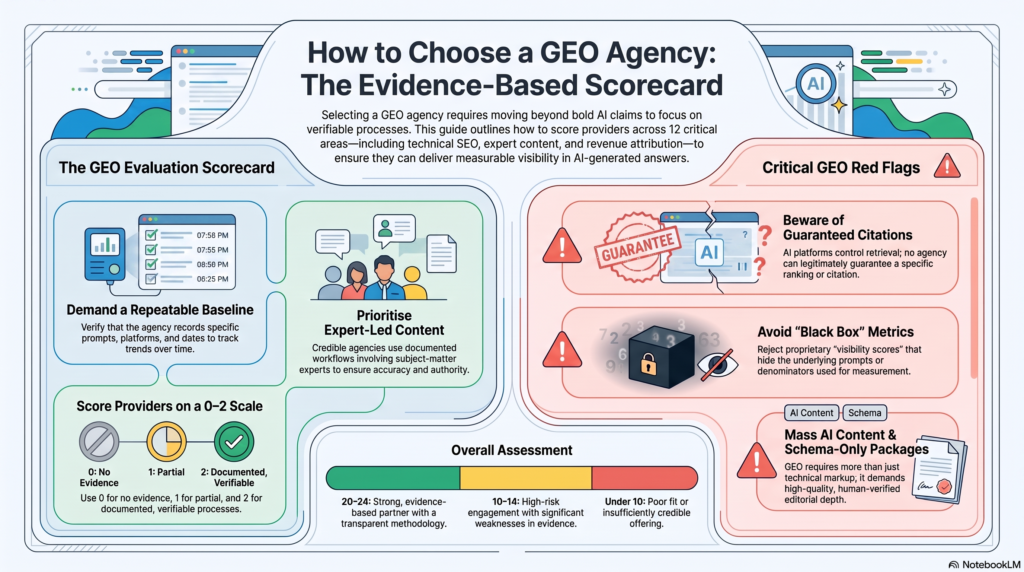
The agency should create a repeatable baseline before prescribing tactics. Record the prompt, platform, date, market, language, brand mentions, citations, competing sources, factual accuracy, and relevant landing page.
Include branded, non-branded, comparison, problem, and purchase-intent questions across multiple runs. A screenshot cannot show variability or trend. The deeper diagnostic belongs in a GEO audit checklist; during selection, verify that the provider can reproduce its baseline and provide the underlying observations.
Which AI Platforms and Prompt Sets Does the Agency Track?
The agency should track the platforms and prompt families your buyers use, not every interface. Scope may include Google AI Overviews or AI Mode, ChatGPT Search, Perplexity, Gemini, and Microsoft Copilot, adjusted by market and journey.
Ask how prompts are sourced, grouped, localized, refreshed, and repeated. Cover educational, comparison, alternative, objection, use-case, and recommendation queries. The 2026 critical survey supports repeated measurements, paraphrases, controls, and human validation because results vary.
How Does the Agency Choose Which Topics and Pages to Prioritize?
The agency should prioritize by commercial relevance, visibility gap, feasibility, available evidence, authority requirements, and conversion potential. Search volume alone is insufficient.
Ask for a scoring model. A strong plan may improve an established comparison page used in sales before creating a broad glossary article. Each recommendation should identify the target question, source role, proof required, owner, effort, internal links, and next customer action.
How Does the Agency Handle Technical SEO and Site Accessibility?
The agency should verify that important pages can be crawled, rendered, indexed, understood, and reached through internal links. Review robots directives, canonicals, status codes, JavaScript rendering, sitemaps, duplication, mobile experience, and structured data matching visible text.
Google says SEO fundamentals remain relevant to AI Overviews and AI Model, with no additional technical requirements or special schema. Supporting pages must be indexed and eligible to appear with a snippet.
Google also says it ignores llms.txt for Search, so that file should never displace indexing work.
How Does the Agency Improve Content for AI-Generated Answers?
The agency should make content easier to understand, verify, retrieve, and use while keeping it valuable for people. Useful improvements include concise answers, clear definitions, comparisons, first-party examples, expert review, update dates, and sources for material claims.
The original GEO experiments found gains from evidence-oriented changes in their test setting. The 2026 survey cautions that those findings assumed documents were already available in a fixed context, not that they would be discovered.
Google recommends unique, people-first content and says no special AI writing style is required.
How Does the Agency Build Third-Party Authority and Citations?
The agency should earn relevant third-party corroboration through digital PR, expert commentary, industry publications, credible directories, partnerships, research, and editorial contributions, not mass mentions on unrelated sites.
Request prospecting criteria, source rationale, editorial standards, disclosure rules, outreach ownership, and reporting that separates linked coverage, unlinked mentions, citations, syndication, and paid placements. Google cautions against inauthentic mentions as an AI-search shortcut.
How Does the Agency Work With Subject-Matter Experts?
The agency should use a documented interview, drafting, fact-checking, approval, and update workflow. It should never add an executive byline without meaningful expert involvement.
Ask who interviews experts, verifies claims, keeps source notes, handles legal review, and schedules revalidation. A practical workflow collects the expert’s position, creates a claims log, drafts the answer, obtains approval, and records the reviewer and date. Google favors firsthand viewpoints over recycled summaries.
What Case Studies and Evidence Should the Agency Provide?
The agency should show a baseline, timeframe, platform, prompt set, sample size, market, intervention, result, and business context. Screenshots illustrate outcomes but cannot establish repeatability or causation alone.
Ask what changed, what stayed constant, whether measurements were repeated, and whether qualified demand moved alongside visibility. Use the best GEO agencies comparison to assess providers, then review GEO case studies for the expected depth of proof. The 2026 survey notes that testimonials, single runs, and controlled tests support different conclusions.
Which GEO KPIs Will the Agency Report?
The agency should report discovery, citation, accuracy, competitive, traffic, and commercial metrics. No “AI visibility score” is useful without its definition and denominator.
Measures may include prompt coverage, mention rate, citation rate, cited-page distribution, share of answer, source diversity, factual accuracy, competitor overlap, referrals, assisted conversions, qualified leads, and influenced pipeline. Require platform, market, date range, run count, and prompt-set version.
Understanding which metrics matter is only part of the evaluation. Buyers should also understand how each KPI is defined, measured, and validated across AI platforms. Read our complete guide to Generative Engine Optimization KPIs to learn which metrics best reflect AI visibility, business impact, and long-term performance.
How Will the Agency Connect AI Visibility to Leads and Revenue?
The agency should map visibility to customer actions through analytics, CRM records, landing-page performance, referral tracking, assisted conversions, and self-reported attribution. It must distinguish a mention from a citation, a visit from a qualified lead, and a lead from revenue.
Define conversions before work begins. Thirty extra mentions with no relevant inquiries may be less valuable than visibility around a few purchase-intent prompts that create sales-qualified conversations. Ask how sales will review lead quality and how direct and assisted impact will be reported.
What Can the Agency Realistically Guarantee?
A credible agency can guarantee its process, deliverables, review standards, reporting, and accountability not a ranking, citation, recommendation, or revenue result. Platforms control retrieval, source selection, answer generation, and display.
Google says best-practice compliance does not guarantee crawling, indexing, or serving, and third parties do not have access to internal Google ranking or AI metrics.
Schema, FAQs, and llms.txt do not guarantee AI citations. Structured data can clarify page meaning and support rich-result eligibility, not source selection.
What Will Happen During the First 90 Days?
The first 90 days should establish the baseline, repair critical barriers, launch focused improvements, and create enough observations to decide what to scale not months of undirected production.
A Five-Step 90-Day Process
- Discover: Confirm goals, audiences, competitors, markets, conversions, and prompts.
- Baseline: Audit technical access, mentions, citations, competing sources, and factual gaps.
- Prioritize: Score opportunities by value, feasibility, evidence, authority needs, and conversion path.
- Seed: Fix critical issues, improve selected pages, involve experts, and begin qualified outreach.
- Earn and evaluate: Repeat measurements, compare the baseline, review lead quality, and select the next tests.
Shoden Global uses this Discover, Seed, and Earn logic to keep work tied to evidence and outcomes.
How Should You Score and Compare GEO Agencies?
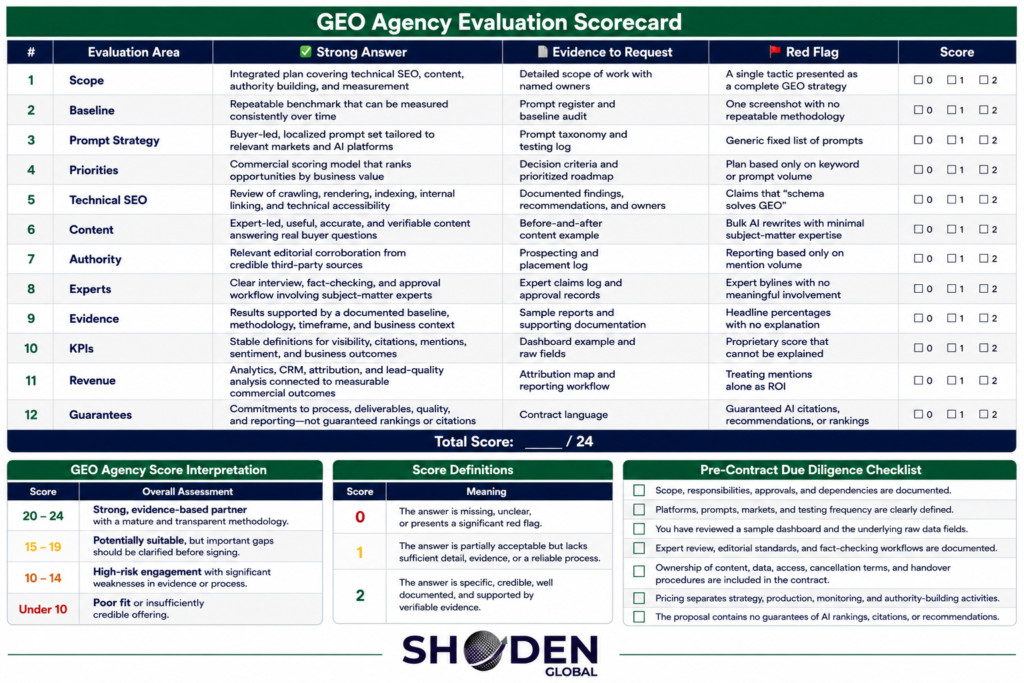
Evaluate every GEO agency against the same twelve criteria using a simple three-point scale: 0 for no evidence, 1 for partial evidence, and 2 for a documented process supported by verifiable proof. Applying the same framework to every proposal makes comparisons more objective and reduces the influence of marketing claims.
What Are the Biggest GEO Agency Red Flags?
The biggest red flags are guaranteed citations, secret platform access, “internal” ranking metrics, schema-only packages, mass AI content, irrelevant mention campaigns, anonymous results without baselines, and dashboards that hide prompts or denominators.
Be cautious when a provider dismisses technical SEO, measures prompts only once, or reports visibility without lead quality. Google warns that third parties do not have access to its internal ranking or AI systems.
What Common Mistakes Should You Avoid?
The most common mistake is choosing an agency by its pitch rather than its evidence. Buyers also compare proposals with different scopes, accept vague scores, confuse mentions with qualified demand, and expect immediate, stable results from changing systems.
Complete the baseline before approving a large content calendar. Preserve strong existing URLs unless there is a documented migration reason, and involve sales, analytics, experts, legal, and web teams early enough to prevent approval and measurement bottlenecks.
Quick Answers
What is the best way to compare GEO agencies?
Use the same 12 questions, request evidence, and score each provider from 0 to 2.
Can SEO agencies do GEO?
Yes, when they add prompt research, answer-focused content, authority work, repeated measurement, and commercial attribution.
Should an agency track every AI platform?
No. Prioritize platforms and prompts that match your buyers and markets.
Is schema enough for GEO?
No. It can clarify content but cannot guarantee discovery or citations.
How often should prompts be measured?
Repeat them on a defined cadence and record platform, market, date, and version.
What makes a useful GEO case study?
A baseline, method, timeframe, sample, intervention, outcome, and business context.
Should pricing be based on citation volume?
Usually not. Citation counts fluctuate and do not prove business impact.
What should the agency guarantee?
Its process, deliverables, controls, reporting, and accountability.
Conclusion: Which GEO Agency Should You Choose?
Choose the GEO optimization service provider that makes its work inspectable. The strongest partner will connect technical SEO, expert content, third-party authority, repeated measurement, and revenue attribution while remaining explicit about uncertainty and platform control.
The best GEO agency is rarely the one making the boldest promises. It is the one that can consistently explain, document, measure, and improve its work over time.
Shoden Global helps companies assess AI visibility, identify high-value gaps, and build a measurable plan for stronger discovery, citation readiness, and commercial impact.
FAQ
What should I ask a GEO agency?
Ask about its baseline, prompts, priorities, technical SEO, content, authority, expert review, evidence, KPIs, revenue attribution, and guarantees.
How do I know whether a GEO agency is credible?
Look for a transparent method, stable metrics, sample reports, contextual evidence, clear limits, qualified specialists, and no guaranteed outcomes.
Can a traditional SEO agency provide GEO?
Yes, if it adds prompt research, AI visibility monitoring, answer-focused content, entity work, corroboration, repeated measurement, and commercial attribution. Google treats generative-AI search optimization as part of the broader search experience.
What proof should a GEO provider show?
Request baseline and follow-up data, prompts, platforms, dates, interventions, cited URLs, business outcomes, and verification detail.
How long should a GEO engagement last?
Use the first 90 days to establish the baseline and validate early work. Total duration depends on technical debt, content, authority gaps, sales cycle, publishing speed, and measurement needs.
Should I hire an agency or build an internal team?
Hire an agency for faster specialist capacity. Build internally when work is continuous and every discipline can be staffed. A hybrid model can combine external expertise with internal governance.
Can a GEO agency guarantee citations?
No. It can improve eligibility and build competitive signals, but it cannot control whether an AI system retrieves, cites, describes, or recommends a source.
What should happen during the first month?
Define goals, audiences, competitors, prompts, platforms, conversions, technical barriers, current visibility, reporting rules, and the prioritized 90-day roadmap before large-scale production.



























PR Outreach: How to Pitch Journalists in 2026
August 10, 2026