
When marketing leaders compare off-page SEO services, the central question is whether a programme can build credible external evidence, reach relevant audiences, protect the brand and connect AI visibility with commercial outcomes. A strong approach combines authority-building, transparent standards, and conversion-ready website pages.
Off-page SEO services improve the external signals and public evidence surrounding a brand. Depending on the strategy, this can include digital PR, editorial link acquisition, expert commentary, relevant brand mentions, review development, publisher outreach, link reclamation and measurement of authority, referral traffic and search performance.
Table of Contents
What Are Off-Page SEO Services?
Off-page SEO services strengthen relevant, credible signals beyond a company’s own website. They can include editorial coverage, links, expert contributions, brand references, reviews, partnerships and publisher relationships, but every activity should support a defined audience and business objective.
Off-page work is most effective when the website already provides useful, technically accessible, and conversion-ready experiences. Google uses links to discover pages and as one signal for understanding relevance, so priority pages should be crawlable and supported by descriptive internal links.
Credible offsite SEO services therefore begin with an audit of priority markets, commercial topics, existing authority, reputational risks and conversion pages; not a pre-set placement list.
What Should an Off-Page SEO Programme Include?
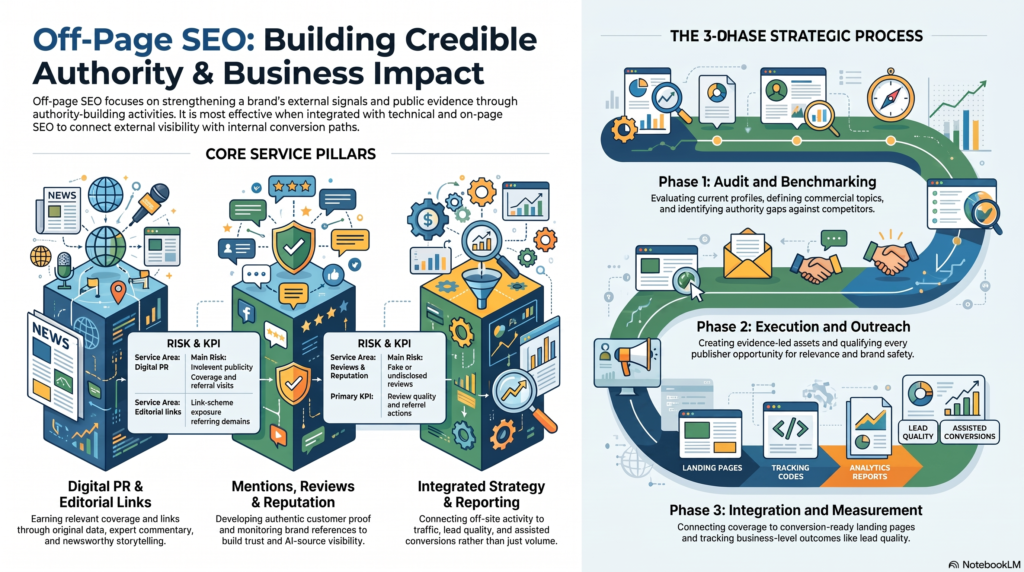
A credible programme should include auditing, strategy, digital PR, selective link acquisition, publisher outreach, mention monitoring, reclamation, review governance, partnerships and business-focused reporting. The mix should reflect the market, available evidence, risk tolerance and growth priorities rather than a fixed monthly link quota.
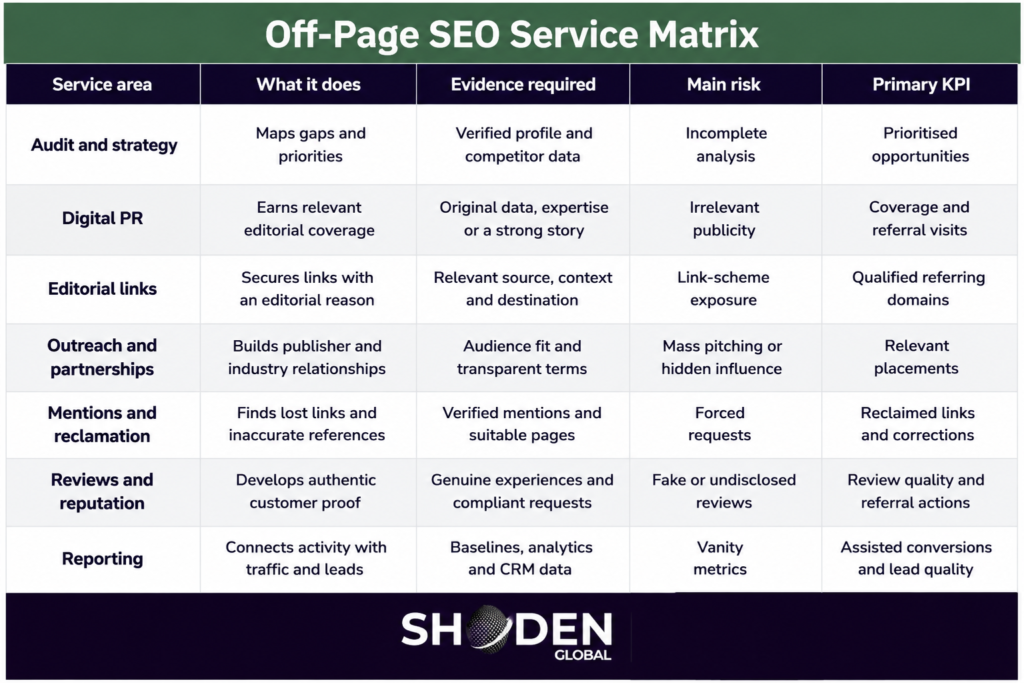
Off-Page SEO Service Matrix
An Eight-Step Off-Page SEO Process
- Audit the current link, mention, review and publisher profile.
- Define commercial topics, audiences and conversion pages.
- Benchmark competitors and identify meaningful authority gaps.
- Select the right mix of digital PR, outreach, reclamation and partnerships.
- Create evidence-led assets and expert positioning.
- Qualify every opportunity for relevance, editorial quality and brand safety.
- Connect coverage to useful landing pages and conversion paths.
- Measure search, referral, authority, AI visibility and lead outcomes.
How Is Off-Page SEO Different From On-Page and Technical SEO?
Off-page SEO develops external references and reputation, on-page SEO improves website content and structure, and technical SEO supports crawling, rendering, and indexing. They are separate disciplines, but dependable growth usually requires them to work together.
The disciplines depend on one another. A strong link to a thin page may produce little engagement, while a site with no distinctive evidence gives publishers little reason to cover it. The practical model combines useful content, reliable infrastructure, credible proof and a clear conversion journey.
How Does Digital PR Support Off-Page SEO?
Digital PR supports off-page SEO by turning expertise, data, opinions and company developments into stories that relevant publishers may choose to cover. Strong campaigns earn attention because the material is useful or newsworthy, not because someone requested a keyword-rich link.
Useful assets include original research, expert commentary, timely reactions and case evidence. Coverage may produce links, mentions, referral visits or reputational value; not every placement delivers every outcome.
Publisher relationships must be transparent. PRSA’s ethics guidance emphasises honest communication and disclosure of conflicts or commercial relationships, especially when experts, creators, gifts or sponsored opportunities are involved.
Explore Shoden Global’s Digital PR Services for connected storytelling, expertise and measurement.
What Role Do Editorial Links and Link Acquisition Play?
Editorial links help search systems discover pages and understand relevance while giving qualified visitors a path from trusted third-party content. Their value depends on the source, surrounding discussion, destination page, and audience; not a domain metric alone.
A sound link acquisition service needs a legitimate editorial reason to cite a page, such as original evidence, a useful resource, specialist commentary or a correction. Quality checks should cover topical fit, readership, editorial standards, anchor language and brand safety.
Review Link Acquisition and Editorial Links for the full framework. SEO Outreach and Blogger Outreach Services support relationship-led publisher contact.
Google classifies links created mainly to manipulate rankings as link spam, including buying or selling ranking links, automated creation and excessive exchanges. A credible provider cannot promise a fixed number of “do-follow” links regardless of editorial independence.
How Do Brand Mentions, Reviews and Third-Party Proof Help?
Brand mentions, reviews and third-party proof support discovery, reputation, referral paths and public evidence. They should not be described as confirmed direct ranking factors in every context, and an unlinked mention is not the same as an editorial link.
Relevant mentions can introduce the brand, clarify its identity or lead to later coverage. Authentic reviews reduce buyer uncertainty, while expert profiles, interviews and association listings help people verify company claims.
Public, crawlable evidence may improve citation readiness for AI-assisted discovery, but no provider can guarantee an AI mention. Google says standard SEO practices remain relevant for its AI features and no special technical requirements apply.
Different forms of evidence support different outcomes. Editorial links, expert mentions, reviews, and publisher citations should complement one another rather than be treated as interchangeable signals.
Review activity requires care. For campaigns reaching U.S. consumers, the FTC prohibits buying or selling fake reviews and says incentives must not depend on a particular sentiment; material incentives may require disclosure.
Which Off-Page SEO Tactics Should You Avoid?
Companies should avoid tactics intended to simulate authority, manipulate rankings or manufacture trust. These methods can create search risk, reputational damage and low-quality traffic.
Avoid:
• Paid-link schemes designed to pass ranking influence
• Private blog networks created mainly to transfer authority
• Irrelevant guest posts placed at scale
• Forced exact-match anchor text
• Excessive reciprocal linking for ranking benefit
• Automated links, mass directories and comment spam
• Fake reviews or incentives tied to positive sentiment
• Undisclosed sponsorships, gifts or commercial relationships
Payment itself is not always the issue; hidden ranking manipulation is. Google recommends marking paid placements with rel="sponsored", while rel="nofollow" may also be appropriate. User-generated links can use rel="ugc".
How Do You Choose an Off-Page SEO Agency?
Choose an off-page SEO agency by examining its standards, evidence, transparency and ability to connect authority work with business outcomes. The provider should explain what it will pursue, what it will reject, how relationships are disclosed, and how success will be assessed.
Use this provider checklist:
□ Clear business and audience objective
□ Documented source-quality standards
□ Editorial relevance before authority metrics
□ Transparent paid-relationship policy
□ No guaranteed ranking or dofollow promises
□ Integrated content and internal-link plan
□ Brand safety and factual review
□ Link and mention monitoring
□ Business-impact reporting
□ Defined client approval process
Ask for anonymised qualification, outreach and reporting examples. Confirm who approves claims, pays third-party fees and handles removed links.
Google recommends asking prospective SEO providers about prior work, expected outcomes, measurement and adherence to Search Essentials. It warns against guarantees of first place in search results.
How Should Off-Page SEO Be Measured?
Off-page SEO should be measured across execution quality, search discovery, audience response and commercial impact. No single metric shows whether a programme is building relevant authority or useful demand.
Track qualified referring domains, coverage relevance, destination pages, anchor context and link retention. Then assess referral visits, engaged sessions, branded search trends and the organic performance of supported pages. At the business level, report assisted conversions, enquiries, opportunity quality and sales influence.
Third-party authority scores can aid comparison, but they are diagnostic indicators rather than Google metrics or business outcomes. Report them beside relevance and performance, not as the headline result.
AI-source visibility can be observed across an agreed set of representative questions by recording cited brands, sources and landing pages over time. Treat this as directional reporting because outputs vary and inclusion cannot be guaranteed.
Google notes that Search Console and analytics data can be combined to understand discovery and conversions, although their metrics do not match exactly.
What Affects the Cost of Off-Page SEO Services?
Pricing reflects the resources required to build credible authority, not simply the number of placements delivered. Programmes built around original research, expert positioning, high-quality publisher outreach, and rigorous measurement naturally require more investment than volume-based link acquisition.
The cost of off-page SEO services depends on scope, competition, geography, research, creative production, expert access, outreach complexity, quality controls and reporting depth. A local reclamation project and an international data-led PR campaign require different resources.
Other drivers include regulated-sector review, market count, publisher specialisation and CRM integration. A useful proposal separates strategy, production, outreach, third-party costs and measurement, while stating exclusions.
Review Shoden Global’s pricing page for available engagement structures, then compare scope and safeguards rather than headline placement volume.
What Are the Most Common Off-Page SEO Mistakes?
The most common mistakes are measuring only domain authority, pursuing volume without relevance, ignoring conversion paths, using weak internal links, and failing to monitor lost coverage. These errors separate activity from business purpose.
Common failures include:
• Treating every referring domain as equally valuable
• Sending most links to the homepage
• Creating campaigns without distinctive evidence
• Reporting placements without audience or lead outcomes
• Ignoring disclosure, review, and brand-safety requirements
• Letting coverage point to outdated or low-converting pages
• Failing to monitor removed links and inaccurate descriptions
• Building attention while priority pages remain isolated internally
Internal linking helps people and crawlers find related pages and understand their context. Relevant coverage should lead to a useful landing page that guides visitors toward supporting resources and a clear next action.
Quick Answers
Scope, Safety and Timing
What is included in off-page SEO services?
Auditing, strategy, digital PR, editorial link acquisition, outreach, reclamation, review governance, partnerships, monitoring and outcome reporting may all be included.
Is off-page SEO only link building?
No. It can also support relevant coverage, public evidence, brand discovery, reviews, referral traffic and expert authority.
What is the safest off-page SEO tactic?
No tactic is universally risk-free, but accurate, useful evidence and transparent relationships provide a sound foundation for earning relevant coverage.
How long does off-page SEO take?
Early mentions may appear quickly, but dependable authority and commercial impact usually require sustained work. Timing depends on competition, assets, approvals and publisher cycles.
Measurement, Mentions and AI Visibility
How should an agency measure results?
It should report source quality, relevance, retained links, referral engagement, search visibility, assisted conversions and lead quality against a baseline.
Do brand mentions help SEO?
They can support discovery, reputation, referrals and public evidence. Do not treat every unlinked mention as a confirmed direct ranking factor.
Are paid links allowed?
Advertising and sponsorship can be legitimate, but paid links must not manipulate rankings. Relationships should be disclosed and links appropriately qualified.
How does off-page SEO support AI visibility?
It can increase clear, crawlable, and corroborating public evidence available for source discovery. It improves eligibility; it does not guarantee citation.
Conclusion
Off-page SEO delivers its greatest value as an integrated authority-building programme rather than a race to acquire links. Digital PR, editorial references, brand mentions, reviews, expert visibility and measurement can strengthen public evidence and help a business compete for relevant search and AI-assisted visibility.
Request an Off-Page SEO and Authority Audit from Shoden Global to identify authority gaps, risky patterns, missed reclamation opportunities and the most commercially relevant next steps.
FAQ
What do off-page SEO services include?
They may include an off-page SEO audit, digital PR, link acquisition, publisher outreach, mention monitoring, reclamation, review processes, expert partnerships and reporting.
How is off-page SEO different from technical SEO?
Technical SEO supports crawling, rendering, indexing and infrastructure. Off-page SEO develops external references, reputation and referral pathways.
Does digital PR count as off-page SEO?
Yes, when it earns relevant third-party coverage, source links, mentions or referral attention that supports authority and search objectives.
What off-page tactics should companies avoid?
Avoid paid-link schemes, private networks, irrelevant guest posts, automated links, forced anchors, excessive exchanges, fake reviews and undisclosed influence.
How can off-page SEO be measured?
Measure qualified referring domains, coverage relevance, referral traffic, branded discovery, supported-page performance, assisted conversions, lead quality, retention and defined AI-source visibility.
How much do off-page SEO services cost?
Cost varies with markets, competition, research, production, publisher complexity, approvals and reporting. Compare included work and safeguards rather than buying a generic link package.
Can off-page SEO generate leads?
Relevant coverage and referral paths can contribute to enquiries and assisted conversions when destination pages match audience intent. Results are not guaranteed.
How do I choose an off-page SEO agency?
Choose a provider with transparent methods, quality standards, credible examples, realistic expectations, brand-safety controls and reporting tied to business outcomes.




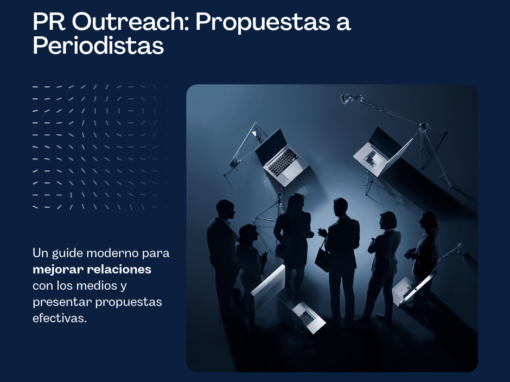































PR Outreach: How to Pitch Journalists in 2026
August 10, 2026