
Learning how to improve visibility in Google AI Overviews starts with improving the page Google can discover, understand, and use for a specific search need. AI Overview visibility is not a separate position you can secure with one tactic. It depends on sound SEO, useful original content, clear evidence, and alignment with the questions people ask.
AI Overview visibility means that Google selects content from your website—or references your brand, as a supporting source within a generated response. No publisher can guarantee inclusion, but strong SEO foundations, original and helpful content, clear structure, crawlable pages, and credible evidence can improve eligibility.
Table of Contents
What Are Google AI Overviews?
Google AI Overviews are generated summaries that help searchers understand a topic and provide supporting links for further exploration. They appear when Google’s systems determine that a generated response adds value beyond standard search results.
An overview can combine information from several sources and show different supporting pages for related questions. Google says AI Overviews and AI Mode may run searches across subtopics to find a wider and more diverse set of useful links.
The objective is not to own one permanent AI position. It is to become a relevant, trustworthy, and retrievable source across a family of related searches.
How Is Google AI Mode Different From Traditional Search?
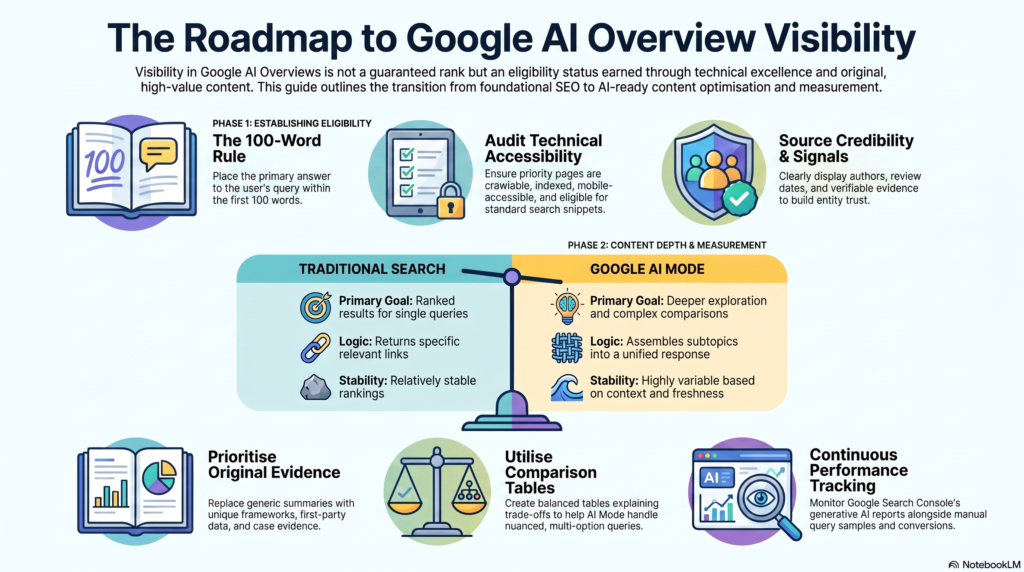
Google AI Mode is designed for deeper exploration, follow-up questions, and complex comparisons. Traditional search commonly returns ranked results for one query, while AI Mode can investigate related subtopics and assemble a response with supporting links.
AI Mode and AI Overviews may use different models and techniques, so answers and links can vary by query, user context, location, device, and freshness. A single manual search should not be treated as a permanent ranking report.
Can You Guarantee Visibility in Google AI Overviews?
No company, publisher or agency can guarantee inclusion in Google AI Overviews or AI Mode. Google controls whether an overview appears and which links support it, and meeting every published requirement still does not guarantee crawling, indexing or serving.
You can influence technical accessibility, snippet eligibility, content usefulness, originality, internal linking, source quality and freshness. You cannot control the generated answer or its exact supporting-link set.
Paid advertising is not a shortcut into organic AI features. Google states that advertising does not affect organic presence and that it does not accept payment to include or rank pages there.
Which SEO Foundations Matter Most for AI Overviews?
The essential foundations are those that make a page eligible and useful in normal Google Search. A priority page should be crawlable, indexed, snippet-eligible, internally linked, mobile-accessible, and technically consistent.
Google says there are no additional technical requirements for appearing as a supporting link in AI Overviews or AI Mode. It recommends allowing crawling, using internal links, providing a good page experience, keeping important information in text, and matching structured data to visible content.
Check canonicals, redirects, robots directives, rendering, duplicate URLs, and server access. Important claims should not exist only inside images, video or difficult-to-render scripts. Recurring indexation or rendering problems may require a Technical SEO Service rather than repeated page-level patches.
AI Overview Readiness Checklist
☐ Priority page is indexed and eligible for a normal snippet
☐ Primary answer appears in the first 100 words
☐ At least one original example, framework or first-party insight is included
☐ Important claims are supported with primary sources
☐ Comparison content is balanced and useful
☐ Important text is visible without user interaction
☐ Internal links connect the page to its topic cluster
☐ Schema matches visible content
☐ Author and review date are clear
☐ A measurement baseline is recorded before changes
Completing every item improves eligibility, but it does not guarantee inclusion in an AI Overview. Google ultimately determines when an overview appears and which supporting sources it selects.
How Can You Improve Visibility in Google AI Overviews Step by Step?
To improve visibility in Google AI Overviews, start with pages that already have demand and technical eligibility, then strengthen their answers, evidence, structure, and measurement. This sequence prevents investment in pages Google cannot access or users do not need.
- Audit queries and pages that already generate organic impressions. Prioritize relevant demand, business value, and realistic improvement opportunities.
- Identify searches that trigger AI Overviews or lead to AI Mode exploration. Use a fixed query set and record the date, country, device, and sources.
- Confirm priority pages are crawlable, indexable, and internally linked. Test canonicals, robots controls, rendering and snippet eligibility before rewriting.
- Rewrite weak introductions into direct answer paragraphs. Address the core question early, then add context, examples and implementation detail.
- Add original evidence, expert experience, examples and limitations. Replace generic summaries with frameworks, screenshots, case evidence or first-party data.
- Create balanced comparison tables and decision criteria. Explain trade-offs, best-fit use cases, exclusions and conditions that could change the recommendation.
- Improve entity clarity, author information and visible proof. Use consistent organization details, expert biographies, review dates, methodology notes and verifiable evidence.
- Implement only relevant structured data that matches visible content. Validate Article, BreadcrumbList, and FAQPage markup when the corresponding content appears on the page.
- Measure Search Console performance, source appearances, referrals and conversions, then retest monthly. Compare results with the baseline and update pages when evidence, demand, or guidance changes.
What Type of Content Is Most Useful for AI Overviews?
The most useful content offers more than a rewritten consensus. It answers the question clearly, contributes original experience or evidence, explains limitations, and helps the reader make a decision.
Google’s guidance emphasizes unique, compelling, non-commodity content rather than pages that recycle existing information. Useful formats include first-hand reviews, tested workflows, expert analysis, original visuals, case evidence, concise definitions and balanced comparisons.
Combine an immediate answer with deeper context. State what works, when it works, who it suits, and where it may fail. Review time-sensitive claims and show a visible review date.
Why Does Comparison Content Matter for Google AI Mode?
Comparison content matters because AI Mode supports nuanced questions involving options, criteria, and trade-offs. A balanced comparison can provide distinctions a generated response needs without making readers assemble them from several generic pages.
Learn how to structure effective comparison pages in our guide to Comparison Content for AI Answers.
Define the decision, use consistent criteria, and identify the best fit for different circumstances. Include disadvantages as well as advantages, avoid disguised sales claims, and explain the evidence behind each conclusion.
Link comparison pages to the relevant service and support content. GEO KPIs and ROI can define business outcomes, while Best GEO Tools and Platforms can help teams evaluate monitoring options without treating one visibility score as definitive.
How Do Structured Data and Clear Page Structure Help?
Structured data and clear page structure can help Google interpret content, but they do not guarantee AI Overview visibility. Google says no special schema is required for generative AI search and advises against overfocusing on markup as an AI tactic.
Use descriptive H2 and H3 headings, concise opening answers, readable paragraphs, lists, and tables where they help users. Add only relevant schema, keep it consistent with visible content, and validate it. Google’s guidance says markup must describe the page it appears on and should not represent hidden or absent information.
How Do You Track Brand Visibility in AI Mode?
Track brand visibility in AI Mode with complementary measures: Search Console data, a controlled query set, observed source links, analytics referrals, and conversion outcomes. No single metric captures the full picture.
Google launched dedicated Search Generative AI performance reports on June 3, 2026, initially for a subset of websites. Where available, the report shows generative AI impressions by page, country, device, and date; the data also remains part of overall Search performance.
Record a baseline before editing. Track priority URLs, topics producing impressions, visible brand mentions or links, and post-click behavior. Check a stable query set under consistent conditions, but treat manual observations as samples rather than universal results.
Measure qualified visits, engagement, lead quality, assisted conversions, and revenue contribution. Use GEO KPIs and ROI to connect visibility signals to business outcomes.
What Common Mistakes Reduce Your Chances of Appearing?
The most damaging mistakes add little value or prevent Google from accessing and understanding useful content. Thin rewrites, blocked pages, unsupported claims, and scaled low-value publishing can weaken eligibility and trust.
Common problems include:
- Rewriting ranking pages without original evidence.
- Hiding the key answer behind tabs, forms or interaction.
- Publishing unsupported statistics or vague expert claims.
- Leaving priority pages stale after facts change.
- Blocking Googlebot through robots rules, hosting or a CDN.
- Creating near-duplicate pages for minor query variations.
- Adding schema that does not match visible content.
- Pursuing inauthentic mentions instead of genuine proof.
Google permits responsible generative AI use, but producing many pages without added value may violate its scaled content abuse policy. It also says inauthentic mentions and special AI files are not shortcuts to Google visibility.
Quick Answers
What are Google AI Overviews?
They are generated summaries shown when Google believes an AI response adds value, with links that help users explore supporting sources.
Can a company pay to appear in an AI Overview?
No. Advertising does not purchase organic inclusion or a supporting-source position in Google AI Overviews.
Does schema guarantee AI Overview visibility?
No. Relevant schema can clarify visible content and support rich-result eligibility, but it cannot guarantee inclusion.
Do pages need to rank first to be cited?
No. A page must be indexed and snippet-eligible, but AI features may surface other links addressing related subtopics.
How should AI Overview visibility be measured?
Combine Search Console impressions, source appearances, referral and engagement data, conversions, and a consistent manual query sample.
How often should priority pages be updated?
Update them when facts, evidence, user needs, or platform guidance changes. Review high-value pages regularly and retest monthly.
Can AI-generated content appear in AI Overviews?
Yes, when it is useful, original, and policy-compliant. Scaled content that adds little value may violate Google’s spam policies.
What is the first page to optimize?
Start with a relevant, high-impression page that serves an important audience need and has clear business value, not automatically the homepage.
Conclusion
Improving Google AI Overview visibility begins with eligibility, not shortcuts. Fix crawlability and indexation, answer the question early, add evidence competitors cannot easily copy, clarify authorship, use relevant schema, connect the topic cluster, and measure outcomes over time.
Organizations that consistently improve technical accessibility, original evidence, and content quality are better positioned for long-term visibility than those chasing individual AI features or temporary tactics.
Shoden Global can assess priority pages, queries and conversion paths without making promises no provider can control. Request an AI Overview and AI Mode Visibility Audit from Shoden Global to identify the highest-impact technical, content, and measurement opportunities.
FAQ
How do I improve visibility in Google AI Overviews?
Strengthen technical eligibility, then add direct answers, original evidence, clear structure, credible sources, useful internal links, and repeatable measurement.
Can Google AI Overview inclusion be guaranteed?
No. You can improve eligibility and authority signals, but Google controls when an overview appears and which links it selects.
Is SEO still important for AI Overviews?
Yes. Google says its generative AI features are rooted in core Search ranking and quality systems, so foundational SEO remains relevant.
Does structured data help Google AI Overviews?
It can help Google understand content and support eligible search features, but it is not required for generative AI search and does not guarantee visibility.
What content formats work best for AI Mode?
Direct answers, expert explanations, first-party evidence, original visuals, comparisons, decision criteria, examples, and stated limitations are especially useful.
How can I track AI Overview traffic and visibility?
Use the dedicated generative AI report where available, overall Search Console performance, analytics, source observations and conversion tracking.
Why does a competitor appear when my brand does not?
The competitor may better match a related subtopic, provide clearer evidence, have stronger technical eligibility or offer a more useful passage for that response.
How long can improvement take?
There is no fixed timeline. Results depend on recrawling, indexing, demand, competition, page quality, and changing systems, so evaluate trends rather than promise a date.



































PR Outreach: How to Pitch Journalists in 2026
August 10, 2026