
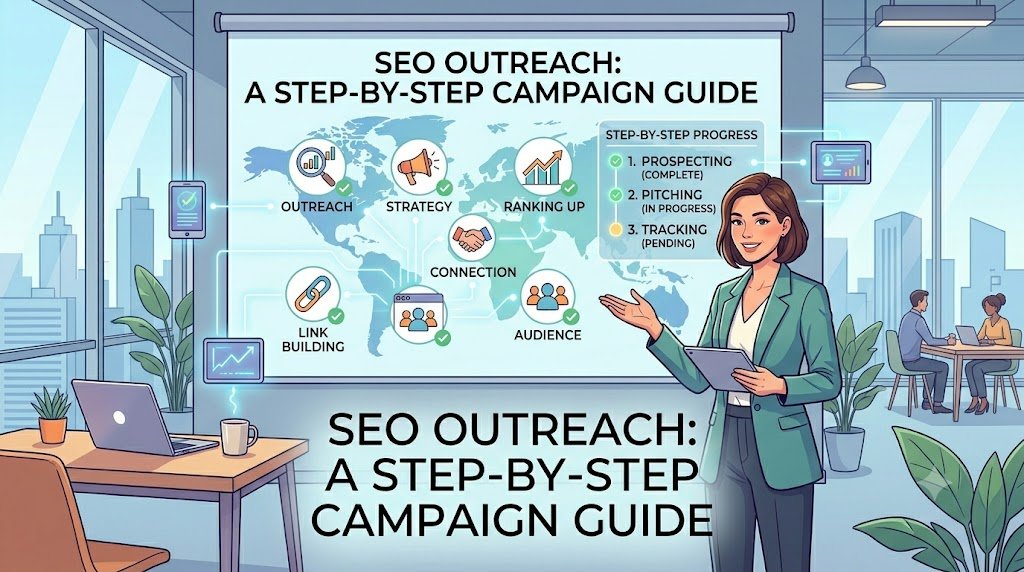
SEO outreach is one of the most misunderstood parts of search marketing.
Some people think it means sending hundreds of cold emails asking for backlinks. Others treat it like guest posting at scale. Some businesses ignore it completely because they assume good content will automatically attract links.
The truth sits somewhere in the middle.
SEO outreach is the process of building real visibility by getting your content, brand, data, expert opinions, and useful resources in front of the right publishers, editors, bloggers, journalists, website owners, and industry platforms. When done well, it supports link acquisition, editorial links, brand mentions, referral traffic, search authority, and even visibility inside AI-generated answers.
When done badly, it becomes spam.
That distinction matters. Google’s spam policies define link spam as links created mainly to manipulate search rankings, including buying links for ranking purposes, excessive link exchanges, automated link creation, and low-value content created mainly for links. Paid or sponsored links can exist, but they should be properly qualified with attributes such as rel="nofollow" or rel="sponsored".
So a smart SEO outreach campaign should not start with the question, “How can we get more backlinks?”
It should start with a better question:
How can we earn attention from relevant sources because our content genuinely helps their audience?
That is where sustainable outreach begins.
Table of Contents
What Is SEO Outreach?
SEO outreach is the process of contacting relevant websites, publishers, bloggers, journalists, partners, and industry voices to earn coverage, links, mentions, expert placements, or content opportunities that strengthen your organic visibility.
A strong SEO outreach campaign can support:
- Editorial links from relevant websites
- Guest contributions on niche publications
- Blogger outreach and product or service mentions
- Digital PR coverage
- Unlinked brand mention reclamation
- Expert quote placements
- Resource page inclusion
- Broken link replacement
- Comparison article inclusion
- Brand trust signals for SEO and AI visibility
It is not just about links anymore.
Search has changed. Buyers now discover companies through Google, AI search tools, comparison pages, list articles, expert roundups, communities, and third-party content. That means your brand needs to be visible beyond your own website.
SEO outreach helps create that wider footprint.
Why SEO Outreach Still Matters
A website can have excellent content and still struggle to rank if nobody credible links to it, cites it, quotes it, or mentions it.
Search engines use many signals to understand whether a website is useful and trustworthy. Google also recommends creating people-first content that demonstrates usefulness, expertise, trust, and a satisfying reader experience.
Outreach helps your best content travel.
For example, a B2B SaaS company might publish a strong guide on compliance automation. But if no analysts, bloggers, industry sites, or comparison pages ever mention it, the page may struggle to build authority. With SEO outreach, that same guide can be pitched to relevant writers, included in resource pages, quoted in expert articles, and used as a reference in niche content.
That creates more than a backlink.
It creates a trail of trust.
For businesses investing in Generative Engine Optimization, LLM SEO, and AI visibility, outreach is even more important. AI answer engines often rely on clear, repeated, trusted information across the web. If your brand is only visible on your own site, it is harder to become part of the broader conversation.
This is where Shoden Global can help businesses connect traditional SEO outreach with modern AI visibility. The goal is not just to build links. The goal is to make your brand easier to discover, easier to verify, and easier to recommend across search engines, answer engines, and trusted third-party sources.
Step 1: Define the Goal of the Outreach Campaign
Before building a prospect list or writing an email, define the campaign goal.
A vague goal like “get backlinks” is not enough. You need to know what kind of visibility you want and why it matters.
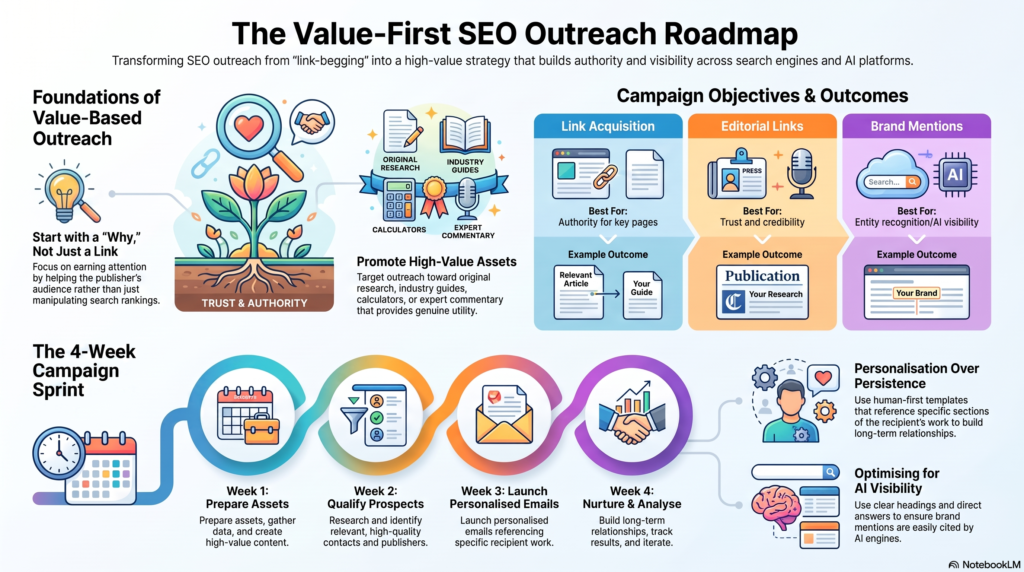
Here are common SEO outreach campaign goals:
A good outreach campaign usually has one primary goal and one secondary goal.
For example:
Primary goal: Earn editorial links to a new guide.
Secondary goal: Build relationships with niche publishers for future digital PR.
That focus helps you choose the right prospects, the right pitch, and the right measurement plan.
Step 2: Choose the Page or Asset You Want to Promote
SEO outreach works best when you have something worth promoting.
This is where many campaigns fail. Businesses send emails asking for links to ordinary service pages, thin blog posts, or generic content that does not add anything new.
Most editors will ignore that.
Before outreach begins, choose or create a strong asset.
Good outreach assets include:
- A detailed industry guide
- Original research or survey data
- A comparison page with useful criteria
- A statistics page
- A calculator, template, or checklist
- A case study with clear results
- A glossary or definition page
- A thought leadership article
- An expert commentary page
- A practical tutorial that solves a real problem
If you are targeting AI visibility, the asset should also be easy to extract and quote. Use clear headings, direct answers, short definitions, credible facts, author information, and internal links to related pages.
For Shoden Global, this is where SEO outreach connects naturally with GEO and LLM seeding. A strong outreach asset can support rankings in Google, but it can also create consistent brand signals that help your business become easier to cite in AI-generated answers.
Step 3: Build a Prospect List
The quality of your prospect list determines the quality of your campaign.
Do not scrape thousands of random websites. Start with relevance.
A strong prospect should match at least one of these criteria:
- The website covers your industry.
- The website has written about your topic before.
- The website has linked to similar resources.
- The website mentions competitors.
- The website publishes expert quotes.
- The website accepts guest contributions.
- The website has a relevant audience.
- The website has organic visibility and real traffic.
- The website is not filled with spammy outbound links.
- The website has editorial standards.
Semrush recommends strategies such as competitor backlink analysis, broken link building, unlinked brand mention reclamation, content pitching, guest posts, digital PR, and partner or community links as part of a balanced link-building strategy. It also emphasizes that good backlinks usually come from relevant, authoritative sites and are placed naturally within meaningful content.
A useful prospecting process looks like this:
- Identify your top SEO competitors.
- Review websites linking to their best pages.
- Find articles that mention your topic but not your brand.
- Search for resource pages in your niche.
- Find bloggers who write about your category.
- Look for journalists who cover your market.
- Track podcasts, newsletters, and industry blogs.
- Find unlinked mentions of your brand.
- Add prospects into a simple spreadsheet or CRM.
- Score each prospect before outreach.
Your prospect list should include:
- Website name
- URL
- Contact name
- Contact email or form link
- Relevant article URL
- Reason for outreach
- Suggested page to pitch
- Domain quality notes
- Personalization note
- Status
The goal is not a giant list.
The goal is a useful list.
Step 4: Qualify Every Prospect Before You Pitch
Not every website is worth contacting.
A link from an irrelevant or low-quality site can waste time and may create risk. A mention from a trusted niche publication can be far more valuable than ten random links from weak blogs.
Before contacting a prospect, review:
- Topic relevance
- Editorial quality
- Organic traffic potential
- Audience fit
- Outbound link patterns
- Author credibility
- Content freshness
- Spam signals
- Whether the site publishes real content
- Whether your pitch would genuinely improve the page
Avoid websites that appear to exist only to sell links. Also, be careful with sites that publish unrelated guest posts across every industry imaginable. If a site covers fintech, pets, crypto, travel, medical advice, and gambling all in the same week, that is usually not a good sign.
A simple rule works well:
If you would not want a real customer to discover your brand there, do not chase the link.
Step 5: Create a Real Outreach Angle
A good pitch needs a reason.
Do not send this:
“Hi, I found your article. Please link to my website.”
That gives the editor no reason to care.
Instead, build the pitch around a useful angle.
Examples:
- Your article mentions a problem, and your guide explains how to solve it.
- Your research adds fresh data to a section that needs support.
- Your expert can provide commentary on a timely topic.
- Your page replaces a broken or outdated resource.
- Your comparison article helps readers evaluate options.
- Your checklist gives readers a practical next step.
- Your case study adds a real world example.
- Your brand was mentioned, but the mention does not include a link.
- Your content fills a missing section in an existing article.
- Your resource is more current than the page they currently reference.
This is the heart of SEO outreach.
You are not asking for a favor. You are showing why your content makes their page better.
Step 6: Write a Personalized Outreach Email
Personalization does not mean writing a long email.
It means proving you actually read the page and understand the audience.
A strong outreach email should include:
- A clear subject line
- The recipient’s name, when available
- A specific reference to their article or publication
- A short reason for contacting them
- The value of your resource
- A simple request
- No pressure
- A polite close
Here is a simple SEO outreach template:
Subject: Quick resource suggestion for your article on [topic]
Hi [Name],
I was reading your article on [topic] and noticed the section about [specific section].
We recently published a guide on [your topic] that may be useful for readers who want to go deeper into [specific benefit].
Here is the resource:
[URL]
It covers [short reason why it helps], and I thought it might fit naturally near the part where you discuss [specific section].
Either way, I enjoyed the article and wanted to share it in case it is useful.
Best,
[Your Name]
This works because it is short, specific, and respectful.
Here is a broken link version:
Subject: Broken link on your [topic] resource page
Hi [Name],
I noticed a broken link in your article on [topic]. The link appears in the section about [specific section], and it points to [old URL or anchor text].
We have a current resource on the same topic here:
[URL]
It may be a useful replacement if you are updating the page.
Best,
[Your Name]
Here is a brand mention version:
Subject: Small note about your mention of [Brand]
Hi [Name],
Thanks for mentioning [Brand] in your article on [topic].
I noticed the mention does not currently link to our website. Would you be open to adding the link here?
[URL]
It may help readers find the source more easily.
Thanks again,
[Your Name]
The best outreach emails feel human because they are human. They are not overdesigned. They are not stuffed with keywords. They do not pretend to be personal while using a generic template.
Step 7: Send Follow-Ups Without Annoying People
Most outreach replies come after a follow-up, not the first email.
But there is a line between professional persistence and spam.
A simple follow-up schedule:
- First email: Day 1
- First follow-up: Day 4 or 5
- Final follow-up: Day 9 or 10
Do not send five or six follow-ups. Do not guilt people. Do not pretend you are “bumping this to the top of your inbox” if you are clearly running a cold campaign.
A good follow-up can be as simple as:
Hi [Name],
Just checking whether this resource might be useful for your article on [topic].
No worries if it is not a fit.
Best,
[Your Name]
That is enough.
Step 8: Track the Campaign Properly
SEO outreach needs tracking. Otherwise, you will not know what is working.
Track:
- Emails sent
- Open rate, if available
- Reply rate
- Positive replies
- Links earned
- Mentions earned
- Follow-up responses
- Referral traffic
- Ranking changes
- AI visibility changes
- Relationship opportunities
- Pages that attract the most links
- Outreach angles that perform best
For SEO, monitor rankings, organic traffic, referring domains, anchor text, and link quality.
For GEO and LLM visibility, track whether your brand appears in AI answers for target questions, whether third-party sources mention your brand accurately, and whether your key positioning becomes more consistent across the web.
A campaign that earns five strong editorial links from relevant sources can be more valuable than a campaign that earns fifty weak links from generic blogs.
Step 9: Avoid the Biggest SEO Outreach Mistakes
Bad outreach usually follows the same patterns.
Avoid these mistakes:
- Sending the same email to everyone
- Pitching irrelevant websites
- Asking for links without offering value
- Using exact match anchor text too aggressively
- Paying for links that pass ranking credit
- Ignoring sponsored or nofollow requirements
- Sending outreach to low-quality guest post farms
- Pitching thin content
- Hiding commercial intent
- Forgetting to follow up
- Measuring only the number of links
- Ignoring brand mentions
- Treating SEO outreach as a one-time task
The safest outreach strategy is built around editorial value, relevance, transparency, and useful content.
If a link is earned because your content genuinely improves a page, that is very different from forcing links into low-value content just to manipulate ranking signals.
Step 10: Connect SEO Outreach With Brand Mentions and AI Visibility
Modern outreach should not stop at backlinks.
A link is valuable, but a strong brand mention can also help build recognition, trust, and topical association. This matters for SEO, but it also matters for AI search.
When buyers ask AI tools questions such as “best B2B SEO agencies,” “top GEO agencies,” “how to choose a link acquisition partner,” or “best agencies for SaaS SEO outreach,” the systems need sources to draw from.
Your brand becomes easier to include when it appears in credible places with clear, consistent information.
That means outreach should reinforce your truth set:
- Who you help
- What you do
- What industries you serve
- What problems you solve
- What proof supports your work
- What makes your approach different
- What pages should be cited
- What expert voices represent the company
For Shoden Global, this is especially important because the agency works at the intersection of SEO, digital PR, Generative Engine Optimization, LLM SEO, and AI visibility. Outreach is not treated as a standalone link building task. It becomes part of a wider visibility system that helps B2B brands show up where buyers compare, research, and make decisions.
Step 11: Build Relationships, Not Just Links
The best outreach campaigns create future opportunities.
A journalist who quotes your expert once may come back for another story. A blogger who likes your guide may include your brand in a future comparison. A niche publication that accepts one strong contribution may invite another.
That is why outreach should be managed like relationship building, not just email sending.
Keep notes on:
- Who replied positively
- What topics they cover
- What kind of content they prefer
- Whether they accept expert quotes
- Whether they publish guest content
- Whether they need data or commentary
- Whether they prefer short pitches or full drafts
- When to contact them again
Good relationships compound.
Spam burns bridges.
A Simple 30 Day SEO Outreach Campaign Plan
Here is a practical campaign structure.
Week 1: Strategy and Asset Preparation
Choose the target page, define the campaign goal, improve the content, prepare supporting evidence, and make sure the page is worth pitching.
Week 2: Prospecting and Qualification
Build a list of relevant publishers, bloggers, resource pages, journalists, and websites. Score each prospect for relevance, quality, and fit.
Week 3: Outreach Launch
Send the first batch of personalized emails. Keep the batch small enough to monitor replies properly. Test two or three outreach angles.
Week 4: Follow-ups and Optimization
Send follow-ups, track results, update the prospect list, improve weak subject lines, and refine the pitch based on replies.
Ongoing: Relationship Building
Continue conversations, share new resources, offer expert quotes, reclaim mentions, and build a repeatable outreach system.
SEO Outreach Checklist
Before launching your campaign, review this checklist:
- The target page is useful and complete.
- The outreach goal is clear.
- The prospect list is relevant.
- Every prospect has a reason for being contacted.
- The pitch is personalized.
- The email is short and easy to understand.
- The campaign avoids paid link schemes.
- Sponsored placements are handled transparently.
- Follow-ups are respectful.
- Results are tracked.
- Brand mentions are measured.
- Links are reviewed for quality.
- Internal links are added to support the target page.
- Outreach learnings are saved for the next campaign.
How Shoden Global Can Help
Shoden Global helps businesses build SEO outreach campaigns that are strategic, relevant, and connected to the wider search landscape.
That can include:
- SEO outreach strategy
- Link acquisition planning
- Blogger outreach services
- Digital PR outreach
- Editorial link opportunities
- Brand mentions SEO
- Guest posting and content placement
- Expert quote development
- AI visibility and GEO support
- LLM seeding alignment
- Outreach copywriting
- Prospect research
- Campaign tracking and reporting
For B2B brands, SaaS companies, fintech businesses, agriculture companies, and niche service providers, outreach can be the difference between publishing content and actually being seen.
The goal is not to chase links at any cost.
The goal is to build authority in the places your buyers already trust.
FAQ
What is SEO outreach?
SEO outreach is the process of contacting relevant websites, publishers, bloggers, journalists, and industry sources to earn links, mentions, expert placements, or content opportunities that improve organic visibility.
Is SEO outreach the same as link building?
Not exactly. Link building focuses mainly on earning backlinks. SEO outreach is broader. It can include backlinks, brand mentions, digital PR, expert quotes, blogger outreach, guest posts, and relationship building.
Does SEO outreach still work?
Yes, but only when it is relevant and value-based. Mass emails, paid link schemes, and low-quality guest posting are risky. Strong outreach works when the content is useful and the target website is genuinely relevant.
How many emails should I send in an outreach campaign?
It depends on the niche and the quality of the list. A focused campaign to 50 highly relevant prospects is often better than a generic campaign to 1,000 random contacts.
What is a good SEO outreach reply rate?
Reply rates vary by industry, offer, and list quality. A highly personalized campaign will usually outperform a large generic campaign. The better metric is not just replies, but positive replies, earned links, earned mentions, and relationship opportunities.
Should I pay for backlinks?
Be careful. Paid links that pass ranking credit can violate Google’s spam policies. If a placement is sponsored or paid, it should be handled transparently and use the appropriate link attributes.
How does SEO outreach help AI visibility?
SEO outreach can help your brand appear across credible third-party sources. This can strengthen brand recognition, topical authority, and consistency, which may support visibility in AI-generated answers when buyers ask relevant questions.
What pages should I promote with SEO outreach?
The best pages are useful, specific, and worth referencing. Examples include guides, research, statistics pages, comparison pages, templates, tools, case studies, and expert commentary.