
Choosing SaaS link-building services is not simply a decision about how many backlinks a provider can secure. For most software companies, the real challenge is becoming discoverable and credible throughout a buying journey that may last weeks or months.
SaaS link building services help software companies earn relevant editorial links, mentions and third-party authority around their products, categories, integrations, research and expert knowledge. The strongest programmes combine useful assets, digital PR, partner opportunities and commercial relevance rather than buying generic links.
Table of Contents
What Are SaaS Link Building Services?
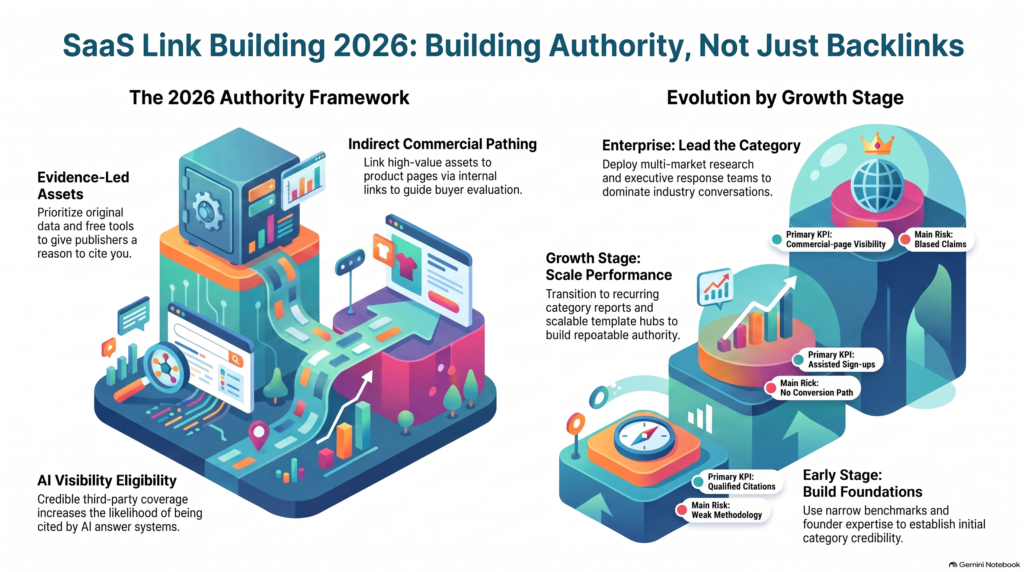
SaaS link building services plan and execute ethical ways to earn relevant links and mentions from publishers, partners, communities, associations and other credible websites. The work should strengthen product categories, integration ecosystems, buyer education and commercial pages rather than operate as an isolated backlink purchase.
Some providers market their work as SaaS backlink services, but effective link building for SaaS involves much more than placing links. A strong programme may earn coverage for an original benchmark, a useful template or an expert explanation. Relevant internal links then connect that authority to a category page, integration page, comparison page or demo journey.
This makes B2B SaaS link building part of a wider SaaS SEO Services strategy rather than a separate campaign judged only by backlink totals.
Why Is SaaS Link Building Different?
SaaS link building is different because software purchases often involve long consideration periods, technical questions, multiple stakeholders and crowded categories. A useful link therefore needs more than a strong domain metric; it should appear in a context that helps the right buyer understand a problem, solution or product choice.
Software buyers may also consult review ecosystems, integration directories, comparison pages, peer communities and technical documentation before contacting sales. This creates more potential authority paths, but it also makes relevance and message consistency essential.
Software companies have distinctive linkable assets, including integrations, product-led tools, templates, customer evidence, technical experts and usage data. Attribution is rarely immediate. A prospect may first encounter research, return through branded search, read a comparison and request a demo weeks later. Reporting must reflect that journey.
Which SaaS Link Building Tactics Work Best in 2026?
The strongest SaaS tactics in 2026 create something genuinely useful or evidential, then distribute it to audiences that already care about the category. Originality, relevance and editorial choice matter more than generic guest-post volume.
Evidence-Led Assets
Original data, transparent research, free tools, calculators, templates and permissioned customer evidence give publishers a reason to cite the company. A narrow dataset with a clear methodology can outperform a broad report with weak evidence.
For example, a customer-support platform could analyse anonymised response-time patterns by company size and support channel. The resulting benchmark could help operations leaders, journalists and industry analysts understand the market while creating a natural path to related product and category pages.
Google’s people-first content guidance encourages original information, research and substantial added value rather than content created mainly to manipulate rankings.
Relationship-Led Distribution
Integration partners, associations, specialist communities, expert commentary, selective editorial contributions and focused digital PR can place evidence in commercially relevant conversations. Honest comparison content can also earn references when it helps buyers make a real decision.
Digital PR Services and SaaS SEO outreach should prioritise editorial fit, disclosure and lasting relationships rather than automated placement volume. SaaS editorial links are most useful when the publisher independently chooses the source because it improves the page for its audience.
Which Tactics Fit Each SaaS Growth Stage?
The right tactic depends on the company’s evidence, recognition, resources and sales motion. Early-stage teams usually need focused credibility, growth-stage companies can build repeatable assets, and enterprise providers can use deeper datasets, executive expertise and partner ecosystems.
Although the tactics may remain the same, their purpose changes as the company grows. What begins as a credibility-building effort can evolve into a repeatable authority programme that supports category leadership.
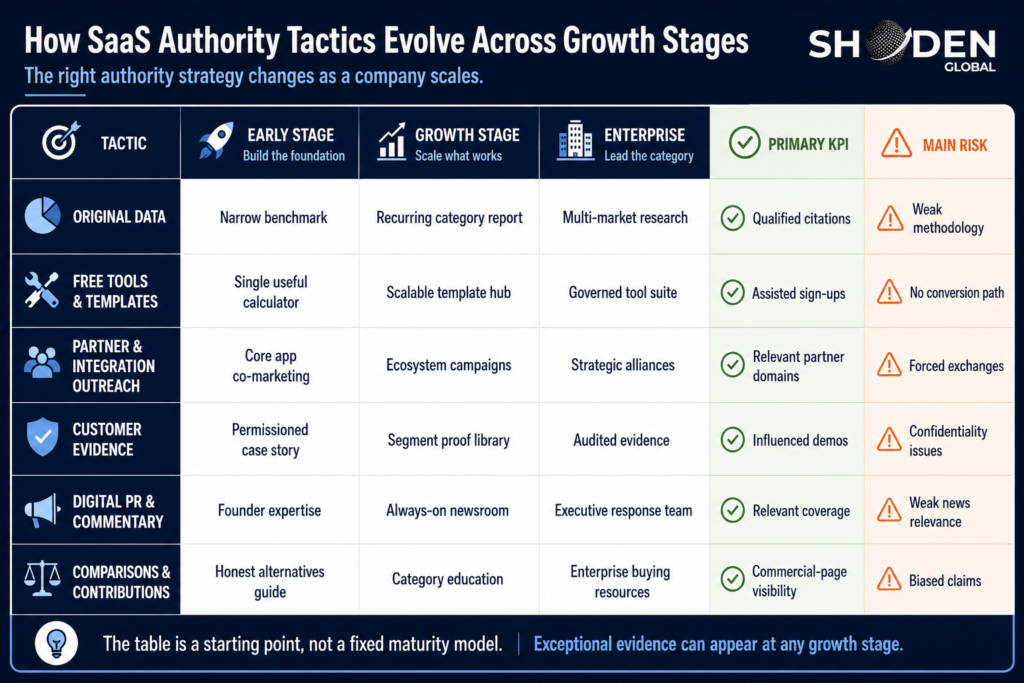
The table is a starting point, not a fixed maturity model. A technically mature early-stage company may have exceptional data, while an enterprise provider may still need to repair weak positioning before launching a major research campaign.
Regardless of company size, authority ultimately needs to support the pages that influence evaluation and revenue.
How Do You Build Links to Commercial SaaS Pages?
Commercial SaaS pages usually gain authority through an indirect path: earn links to a valuable supporting asset, then use relevant internal links to connect that asset with the product, category or integration page. Direct product-page links can still arise naturally from partner directories, customer resources, reviews and editorial product references.
For example, a subscription billing platform could publish a benchmark on failed-payment recovery, earn citations to the study, and link from the study to its dunning product page and an honest comparison resource.
The supporting asset should answer a question that publishers and buyers genuinely care about. Its internal links should then help readers move from evidence to evaluation without forcing them into an immediate sales action.
Google says links help it discover pages and understand relevance, while descriptive, concise anchor text helps users and Google understand the destination.
Link Acquisition and Editorial Links should lead to useful next steps. Sending every visitor directly to a demo page, regardless of context, can weaken the user journey and reduce the usefulness of the source asset.
Modern authority extends beyond search rankings and referral traffic. The same evidence that helps buyers evaluate a product may also become part of the public sources retrieved by AI systems.
How Can SaaS Digital PR Support AI Visibility?
SaaS digital PR can increase the likelihood that a company’s expertise is discoverable in public, crawlable sources. Credible coverage, clear expert attribution, consistent entity naming and well-documented research create source material that search and answer systems may retrieve, summarise or cite.
This does not insert content into model training data, and it does not guarantee an AI mention or citation. The objective is to improve source discovery, entity clarity, citation readiness and the amount of reliable third-party evidence associated with the company.
Brand Mentions SEO can reinforce public associations between a company, its experts and its software category. Expert Quotes for AI Citations should focus on verifiable expertise, precise claims, accessible source pages and consistent author information.
Original research should include a publication date, methodology, sample limitations and a named contact who can answer questions. Expert commentary should identify why the contributor is qualified to discuss the topic.
The goal must never be to manipulate answer systems. Google’s current spam policies apply to attempts to manipulate generative AI responses in Search as well as traditional search results.
How Do You Evaluate a SaaS Link Building Provider?
Evaluate a provider by its understanding of your SaaS category, editorial standards, research capability, reporting and connection to commercial outcomes. A polished publisher list is not enough; the provider should explain why each opportunity matters to the buyer and where authority should flow next.
Ask for permissioned or anonymised SaaS examples, sample prospect research, publisher rejection criteria, disclosure practices and a clear escalation process for questionable placements. A credible SaaS link building agency should also explain what it will not do.
Review how the provider distinguishes relevant publishers from sites created mainly to sell placements. Examine whether its research process considers the target audience, competing products, sales cycle, legal restrictions and internal conversion paths.
Ethical outreach should protect accuracy and editorial independence. The PRSA Code of Ethics centres values that include honesty, expertise, independence and fairness.
Provider Checklist
□ Provider understands the SaaS category and buyer
□ Campaign supports defined commercial topics
□ Assets offer original utility or evidence
□ Publisher relevance is reviewed manually
□ No guaranteed dofollow-link quota
□ Anchor text remains editorial
□ Product and legal claims are reviewed
□ Links connect to a useful internal conversion path
□ Reporting includes referral and lead context
□ Removed links and changing pages are monitored
What Should Happen in the First 90 Days?
The first 90 days should establish a defensible strategy, create or improve cite-worthy assets, begin focused outreach and install measurement. A credible provider will not promise a fixed link count before completing category, asset and opportunity research.
- Benchmark the SaaS category, competitors and current authority profile.
Review existing referring domains, lost links, brand mentions, commercial-page visibility and competitor evidence assets. Separate genuine opportunities from metrics that look impressive but have little category relevance.
- Map commercial pages, buyer questions and topic clusters.
Identify the product, category, integration and comparison pages that matter commercially. Map the buyer questions and supporting content that can create credible internal authority paths.
- Identify data, tools, templates, expert insights and customer evidence worth citing.
Assess what the company can publish without overstating findings or exposing confidential information. Confirm ownership, methodology and approval requirements before outreach begins.
- Build a prospect list across media, partners, associations, communities and resource pages.
Prioritise sources by topical relevance, audience fit, editorial quality and the reason each publisher might genuinely value the proposed asset.
- Launch focused digital PR and relationship-led outreach.
Use tailored pitches that explain the audience value clearly. Avoid mass emails, forced anchors and requests that make a link a condition of participation.
- Connect earned authority to priority pages through relevant internal links.
Review navigation, contextual links, anchor text and the path from the cited asset to a useful commercial next step.
- Track search, referral, AI visibility, demo and pipeline outcomes.
Establish baseline measurements so later changes can be evaluated consistently. Record both successful placements and rejected opportunities.
- Scale only the tactics that produce relevant and durable value.
Increase investment where evidence, publisher fit and commercial context align. Repair or retire assets that attract links but do not support the intended audience or topic.
By day 90, leadership should know which themes attract qualified attention, which assets need improvement and how early authority signals connect with the buying journey. The right next step may be to strengthen the evidence before increasing outreach volume.
How Should SaaS Link Building Be Measured?
SaaS link building should be measured through relevance, durability, qualified attention and commercial influence, not link totals alone. No single metric proves causation, so use a consistent framework across authority, search visibility, engagement and pipeline.
Measurement Framework
Authority quality: Track qualified referring domains, category relevance, editorial context, link durability and the proportion of opportunities rejected for poor fit.
Search visibility: Monitor priority-page rankings, non-branded clicks, crawlability and movement across the commercial topic cluster. Record major site, product and search changes that could affect comparisons.
Demand: Measure relevant referral visits, engaged sessions, demo starts, assisted conversions and branded-search movement. Segment the data where possible by source, asset and campaign theme.
Pipeline: Connect leads and opportunities with first-touch and multi-touch journeys where the available data supports it. Include sales feedback, opportunity quality and retention context instead of treating every form submission equally.
AI visibility: Monitor a defined set of priority prompts, visible brand mentions, cited source pages and topic consistency. Treat changes as directional evidence rather than guaranteed attribution.
Leadership reporting should explain why a result matters. Ten relevant citations to an original study may provide more durable commercial value than a larger group of unrelated placements, even when the unrelated sites have higher headline metrics.
Which Link Building Risks Should SaaS Companies Avoid?
SaaS companies should avoid private blog networks, irrelevant publishers, forced exact-match anchors, hacked links, mass exchanges, low-quality marketplaces and unreviewed AI-generated placements. These methods create compliance, brand and durability risks even when a report makes the link count look impressive.
Google defines link spam as links created mainly to manipulate rankings. Its examples include paid ranking links, excessive exchanges, automated link creation, low-quality directories and optimised anchors in paid articles. Properly disclosed sponsorships should be qualified appropriately.
A marketplace that sells access to a large publisher list is not automatically useful. The provider still needs to assess who owns each site, why the page exists, whether real readers can find it and whether the surrounding content is credible.
Hacked links and concealed private networks are especially dangerous because the apparent placement can disappear, redirect or expose the company to reputational damage. Mass exchanges can also create an unnatural pattern when the only purpose of partner pages is cross-linking.
Review every product claim, customer reference and data point before outreach. Confirm that publishers disclose commercial relationships where required, and remove any tactic that depends on deception, concealed ownership or inaccurate information.
What Are the Most Common SaaS Link Building Mistakes?
The most common SaaS link building mistake is optimising for visible link metrics while ignoring commercial relevance. A high-authority link can have limited value when its audience, topic and surrounding content have little connection to the software category.
Chasing DR without manually reviewing the publisher is a common example. A strong metric cannot confirm whether the site has genuine editorial standards, reaches the right buyer or offers a durable context for the link.
Other frequent mistakes include ignoring integration partners, launching weak research without a defensible method, sending identical pitches, forcing anchors and earning links to assets with no internal path to a priority page.
Teams also lose value when they report links without referral, lead or pipeline context. This prevents leadership from understanding which tactics support commercial outcomes and which campaigns are producing activity without meaningful progress.
Quick Answers
What is SaaS link building?
It is the process of earning relevant editorial links and mentions that strengthen a software company’s authority around its category, product and expertise.
Which link-building tactic works best for SaaS?
There is no universal winner. Original data, useful tools, partner opportunities and expert-led digital PR are often the strongest starting points.
Can links point directly to product pages?
Yes, when the reference is editorially useful. Supporting assets and relevant internal links are usually more natural and scalable.
How long does SaaS link building take?
Initial opportunities may appear within weeks, but durable authority and measurable commercial influence usually require sustained work across multiple buying cycles.
How should links be measured?
Measure relevance, durability, qualified referral traffic, assisted conversions, branded demand and pipeline influence alongside search visibility.
Is digital PR better than guest posting?
Digital PR often creates broader authority and evidence. Selective editorial contributions can still help when the topic, publisher and audience are genuinely relevant.
Can link building support AI visibility?
It can improve source discovery, entity clarity and public evidence, increasing eligibility for retrieval without guaranteeing mentions, citations or recommendations.
What should a SaaS provider avoid?
Avoid guaranteed dofollow quotas, irrelevant placements, paid ranking links, forced anchors, concealed networks and unreviewed low-value content.
Conclusion
Effective SaaS link building services combine evidence, editorial relevance and commercial direction. The objective is not a fixed number of links. It is a stronger authority system around the product category, integrations, buyer questions and proof that supports informed decisions.
The right programme identifies what the company genuinely knows, turns that knowledge into useful public evidence and connects earned authority with pages that help buyers evaluate the product. It also rejects placements that could create search, legal, disclosure or reputational risk.
The companies that earn durable authority are not necessarily the ones that publish the most content, but the ones that create the most useful evidence for buyers, partners and publishers.
Shoden Global can map the publications, partners, evidence assets and internal authority paths most relevant to your growth stage. Request a SaaS Link Building and Authority Opportunity Map from Shoden Global to identify practical opportunities, priority risks and the next actions most likely to build durable value.
FAQ
What do SaaS link building services include?
They may include authority audits, topic and asset planning, original research, digital PR, partner outreach, editorial prospecting, internal-link recommendations, link monitoring and commercial reporting. The exact scope should reflect the SaaS category, growth stage and buyer journey.
How much do SaaS link building services cost?
There is no reliable universal price. Cost depends on category competition, target markets, asset production, research depth, outreach scope and reporting requirements. Compare deliverables, quality controls and business alignment rather than selecting a provider by price per link.
Which links are most valuable for SaaS companies?
The most valuable links are editorially earned, topically relevant, visible to the right audience and placed in useful context. Durability, source credibility and a sensible path to priority pages matter more than a single authority score.
How can a SaaS company earn links to commercial pages?
Use integration relationships, customer resources, relevant directories, reviews and editorial product references where direct linking is natural. In other cases, earn links to supporting evidence and connect that asset internally to the commercial page.
What is the difference between SaaS digital PR and link building?
Digital PR earns attention through news, research and expert commentary. Link building is broader and can include tools, partner resources, associations, editorial contributions, resource-page outreach and the recovery of relevant unlinked mentions.
How should a SaaS link-building agency be evaluated?
Assess its SaaS category knowledge, evidence quality, manual publisher review, ethical outreach, reporting, internal-link strategy and business alignment. Ask what the agency refuses to do as well as what it offers.
Can SaaS link building generate demos and pipeline?
It can contribute through qualified referrals, stronger commercial-page visibility, branded demand and assisted buyer journeys. Results depend on audience fit, the offer, the conversion path and the company’s ability to track multi-touch behaviour.
Which tactics create the most risk?
Paid links that pass ranking credit, private networks, hacked placements, forced anchors, mass exchanges, irrelevant marketplaces and undisclosed or inaccurate content create the greatest avoidable risk.




































PR Outreach: How to Pitch Journalists in 2026
August 10, 2026