
Generative engine optimization services pricing is hard to compare because two proposals can use the same label while buying different work. One may cover a fixed audit; another may combine technical SEO, content, digital PR, prompt monitoring, reporting, and conversion tracking. The right question is not simply “What does GEO cost?” but “What scope, ownership, evidence, and measurement does this fee purchase?”
Generative engine optimization pricing is the cost of improving a brand’s discoverability, retrieval, citation readiness, and measurable visibility across AI-powered search and answer platforms. The fee depends on scope: an audit costs differently from ongoing content, technical SEO, digital PR, monitoring, and multinational execution, so credible proposals define deliverables before stating price.
Table of Contents
How Much Does Generative Engine Optimization Cost?
There is no universal GEO price because an audit, content-only project, monthly program, and multilingual enterprise engagement require different work. A credible provider prices the scope, names the deliverables, and states what the client must supply or implement.
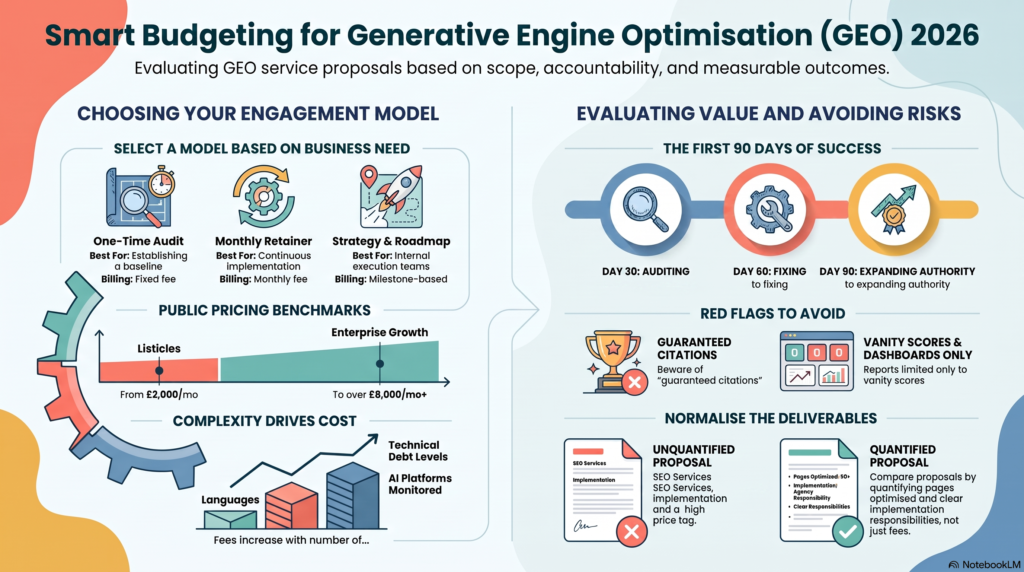
Shoden Global Public Pricing Examples
Shoden Global publicly lists these broader packages that include GEO-related work:
• Listicle inclusion services starting at $2,550 per month.
• AI Visibility and LLM SEO Growth starting at $6,500 per month.
• Enterprise SEO, AI Visibility, and Multilingual Growth starting at $10,000 per month.
These are Shoden Global starting prices, not market averages. Final scope can change with content volume, platforms, languages, technical complexity, authority work, and implementation responsibility.
Review the Shoden Global GEO agency service scope: https://shodenltd.com/generative-engine-optimization-geo/
What Is Included in GEO Services Pricing?
GEO pricing should include a baseline, prioritized implementation, and measurement tied to business outcomes. The proposal must also say whether the provider advises, executes, coordinates third parties, or combines those roles.
A complete scope may include:
• Audit, benchmarking, prompt research, and competitive analysis.
• Technical SEO, entity positioning, and messaging work.
• Content strategy, creation, optimization, and internal linking.
• Structured data recommendations and implementation guidance.
• Digital PR, outreach, and third-party authority development.
• Citation monitoring, reporting, lead tracking, and conversion measurement.
Google says existing SEO fundamentals remain relevant to AI Overviews and AI Mode, with no additional technical requirements or special schema or AI text file needed. Structured data can aid understanding and rich-result eligibility, but it does not guarantee visibility or citations.
Which GEO Pricing Models Do Agencies Use?
Agencies use fixed-fee projects, monthly retainers, campaign pricing, milestone billing, and hybrid arrangements. Choose the model according to whether the company needs diagnosis, implementation, continuous monitoring, authority building, or enterprise coordination.
GEO Engagement Model Comparison
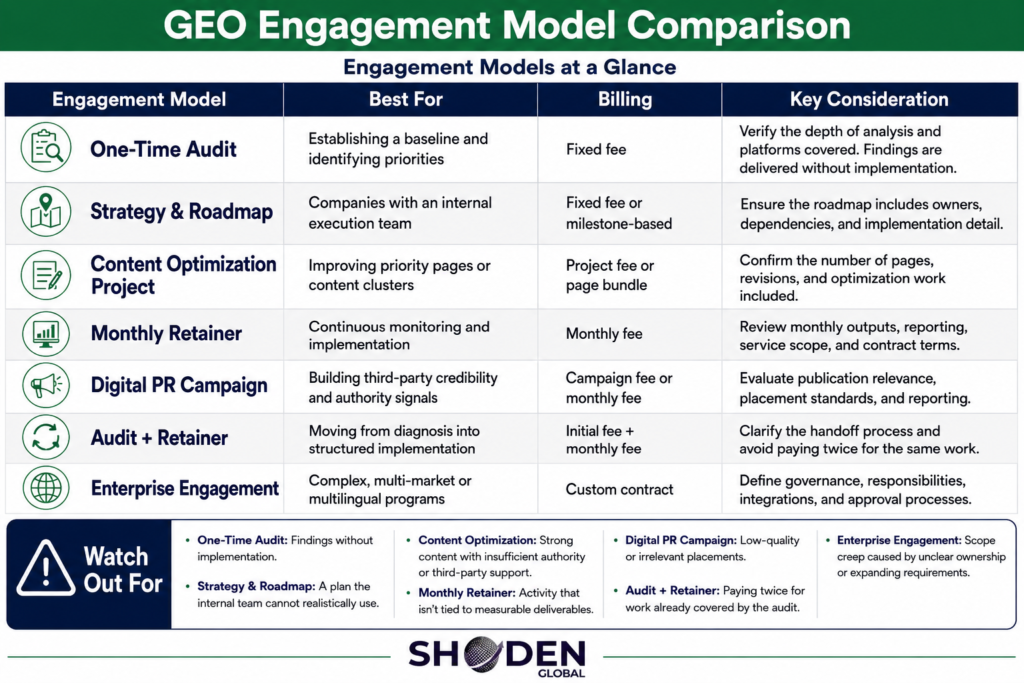
The comparison above illustrates that no single engagement model is universally better than another. The right engagement model depends on the organization's objectives, internal resources, implementation capacity, and the level of ongoing support required. Buyers should compare scope, responsibilities, and expected outcomes before comparing pricing, since two proposals with similar fees may represent very different levels of execution and accountability.
What We Learned About GEO Pricing
Comparing current GEO pricing models reveals three consistent patterns.Generative Engine Optimization Pricing Guide 2026
- Execution drives cost more than strategy alone.
- Technical complexity and authority-building are usually the largest pricing variables.
- The most expensive proposal is not necessarily the best value if implementation, measurement, and accountability are unclear.
For buyers, comparing documented scope and expected outcomes is far more useful than comparing monthly fees in isolation.
What Factors Increase the Cost of GEO Services?
GEO costs rise with execution complexity: more markets, content, platforms, technical debt, authority gaps, and stakeholders require more specialist time and coordination.
The main cost drivers are:
• Websites, products, regions, and languages.
• Prompts, competitors, and AI platforms monitored.
• Page creation, revision, and publishing volume.
• Crawl, rendering, indexation, or architecture problems.
• Entity inconsistency and weak third-party corroboration.
• Digital PR demands in competitive categories.
• Compliance review, stakeholder approvals, and integrations.
• Custom attribution, dashboards, and executive reporting.
Ask providers to separate diagnosis, production, implementation, authority, and measurement costs. This lets you reduce scope intelligently rather than remove accountability.
How Should Startups, Mid-Market Companies, and Enterprises Budget for GEO?
A generative engine optimization budget should reflect commercial priority, operational capacity, and market complexity not a universal percentage of SEO spend. Start with the smallest scope that can establish a baseline, implement changes, and measure results.
• Startups can focus on one product, one market, a limited prompt set, and high-intent pages.
• Mid-market companies often need recurring technical, content, authority, and monitoring work.
• Enterprises may require multiple domains, languages, regions, governance, security reviews, and integrations.
What Does Affordable GEO Actually Mean?
Affordable GEO does not mean buying the cheapest proposal. It means purchasing the smallest scope capable of producing measurable business value. A cheap engagement becomes expensive when it delivers a dashboard without decisions, content without implementation, or irrelevant placements.
The best affordable generative engine optimization services reduce nonessential breadth without removing accountability. A smaller company can narrow work to priority products, buyer questions, and commercial pages while preserving a baseline, named outputs, implementation ownership, repeated measurement, and conversion tracking.
For example, a one-market startup usually gains more from completing five priority pages than commissioning a global roadmap it cannot execute.
How Do You Compare Two GEO Proposals?
Compare proposals by normalizing deliverables, responsibilities, evidence, and measurement, not by monthly fee alone. Two retainers are comparable only when they cover similar platforms, pages, implementation, authority work, reporting, and terms.
A Seven-Step Proposal Comparison Process
- Normalize audit, strategy, technical, content, authority, monitoring, reporting, and conversion work.
- Verify the prompts, platforms, competitors, markets, and repeat-testing method in the baseline.
- Quantify pages audited, created, or optimized, plus campaigns, reports, and meetings.
- Assign who writes, approves, publishes, implements changes, conducts outreach, and fixes tracking.
- Require relevance, editorial standards, exclusions, and ownership for third-party placements.
- Compare citations and mentions alongside referrals, assisted conversions, leads, and revenue.
- Score minimum terms, cancellation rights, dependencies, data access, ownership, and internal workload.
Read how to choose a GEO agency: https://shodenltd.com/blog/how-to-choose-a-geo-agency/
Compare service models in best generative engine optimization agencies: https://shodenltd.com/blog/best-generative-engine-optimization-agencies/
Which Deliverables Should Be Included in the First 90 Days?
The first 90 days should establish a baseline, fix priority eligibility and content gaps, launch controlled improvements, and create a reporting rhythm. It should not be three months of discovery without implementation.
- Days 1–30: Audit priority pages, benchmark prompts, map competitors and sources, review technical access, and define conversions.
- Days 31–60: Fix critical issues, optimize priority pages, strengthen internal links and entity signals, and publish initial content.
- Days 61–90: Expand authority work, repeat prompt tests, assess mentions and citations, and connect visibility to traffic and leads.
Use this proposal checklist:
☐ Exact pages to be audited.
☐ Number of prompts and platforms monitored.
☐ Number of pages created or optimized.
☐ Technical implementation responsibility.
☐ Digital PR and outreach scope.
☐ Placement standards.
☐ Reporting frequency.
☐ Conversion tracking.
☐ Approval process.
☐ Cancellation and minimum-term conditions.
☐ Ownership of content and data.
Plan the baseline with a GEO audit: https://shodenltd.com/blog/geo-audit/
Is GEO Worth the Investment?
GEO can be worth the investment when AI-assisted discovery influences the buying journey, and the program is measured against useful outcomes. It is not valuable merely because a provider tracks more prompts or installs schema.
The foundational GEO paper introduced the framework and reported visibility gains of up to 40% in its experimental setting. A 2026 critical survey cautions that terminology, metrics, and evidence remain inconsistent; the early gains assumed a source already appeared in a fixed context and did not prove durable organic discovery or downstream traffic.
Measure prompt coverage, mentions, citations, source inclusion, share of voice, answer accuracy, referrals, assisted conversions, leads, and revenue. Because outputs can vary, use repeated tests, stable prompt sets, comparison groups, and dated baselines.
For most organizations, the question is no longer whether AI-assisted discovery will influence customer journeys, but whether the company will measure and improve its visibility before competitors do. The value of a GEO investment ultimately depends on whether it produces measurable improvements in discoverability, authority, and commercial outcomes, not simply more dashboards or tracked prompts.
Learn how to measure GEO ROI: https://shodenltd.com/blog/geo-kpis-measure-success-roi/
What Pricing Red Flags Should You Avoid?
Avoid providers that guarantee citations, permanent first-place recommendations, or results from one technical change. GEO can improve eligibility and strengthen source-selection signals, but no provider controls every retrieval system, model, query, or answer.
Other red flags include:
• Universal pricing without defined scope.
• Unsupported claims about inserting content into AI training data.
• Schema, FAQs, or llms.txt presented as guarantees.
• Baselines based on one prompt run.
• Digital PR without relevance or placement standards.
• Reports limited to vanity scores.
• No conversion hypothesis or tracking.
• Unclear ownership, minimum terms, or cancellation rules.
Google explicitly says no special optimization, schema type, or new AI text file is required for its AI search features, and valid structured data still does not guarantee a search feature.
What Common GEO Pricing Mistakes Should You Avoid?
The biggest mistake is choosing the lowest fee before checking what it excludes. Buyers also lose value when they compare retainers by hours, buy content before resolving technical barriers, divert too much from proven SEO work, or judge success from one unstable prompt result.
Every report should produce an owner, prioritized action, due date, and follow-up test. Otherwise, monitoring becomes a recurring expense rather than a decision system.
Quick Answers
Are milestone-based projects available?
Yes, when the provider ties payment to defined outputs, dates, and acceptance criteria.
How much budget should move from traditional SEO to AI visibility?
No universal percentage is responsible. Fund shared SEO foundations, run a controlled pilot, and reallocate from measured value.
Which providers offer pilot projects?
Availability varies. A credible pilot fixes the prompts, platforms, pages, baseline, implementation scope, and review date.
What should be included in a monthly retainer?
It should specify monitoring, content, technical work, authority activity, reporting, meetings, conversion tracking, and implementation ownership.
How should a company evaluate affordability?
Compare price with scope fit, internal workload, implementation likelihood, measurement quality, contract risk, and expected value.
What results can reasonably be measured?
Track mentions, citations, prompt coverage, source inclusion, share of voice, referrals, conversions, leads, and attributable revenue.
Does transparent pricing make the cheapest proposal best?
No. Transparency enables comparison; value depends on relevant scope, execution quality, and measurable outcomes.
Conclusion: What Should You Do Next?
The right GEO investment depends less on monthly cost than on the relationship between scope, execution, measurement, and expected business outcomes. Two proposals with similar pricing can represent very different levels of technical work, content production, authority building, reporting, and implementation responsibility.
Rather than comparing fees alone, compare what each provider commits to delivering, how success will be measured, who owns implementation, and whether the engagement can demonstrate meaningful commercial impact over time.
Organizations that evaluate proposals using consistent criteria are more likely to invest in programs that improve AI visibility while supporting broader marketing and revenue objectives.
FAQ
How much do GEO services cost?
There is no universal price. Cost depends on the engagement model, markets, platforms, deliverables, and implementation scope.
What is normally included in GEO pricing?
Typical work includes auditing, research, technical SEO, entity work, content, internal linking, digital PR, monitoring, and measurement.
Is a GEO audit a one-time cost?
Usually. Repeat audits may be useful after major site changes, expansion, or a completed implementation cycle.
Are monthly GEO retainers necessary?
Not always. They suit companies needing continuous content, technical work, authority building, monitoring, and adaptation.
What makes GEO services more expensive?
More languages, markets, platforms, pages, technical debt, content, approvals, authority work, integrations, and reporting increase cost.
Can a small company afford GEO?
Yes. Narrow the scope to priority prompts, commercial pages, and one market while preserving implementation and measurement.
How should GEO proposals be compared?
Normalize deliverables, quantities, responsibilities, platform coverage, evidence, measurement, ownership, terms, and internal workload.
Does a higher price guarantee better AI visibility?
No. A higher fee may fund broader work, but no price guarantees citations, recommendations, rankings, or lasting visibility.














































PR Outreach: How to Pitch Journalists in 2026
August 10, 2026