
For years, too many brands treated backlinks like a numbers game. They chased any link they could get. They bought placements, swapped links, submitted to weak directories, and published thin guest posts on sites nobody trusted. It may have looked productive on a spreadsheet, but it did not build real authority.
Today, link acquisition has changed.
The strongest links are not random backlinks. They are editorial signals. They come from relevant publishers, industry websites, niche blogs, journalists, partners, analysts, associations, and expert sources that have a real reason to mention your business.
That is the kind of link acquisition that supports SEO, strengthens brand credibility, improves referral traffic, and helps your business become easier to discover in AI search experiences.
Google’s spam policies continue to warn against links created mainly to manipulate search rankings, while Google’s link guidance also explains that links help search engines discover pages and understand relevance. In other words, links still matter, but the reason behind the link matters too.
For brands investing in SEO, digital PR, AI visibility, and organic growth, the goal is no longer to “build links” at any cost. The goal is to earn the right mentions, from the right sources, in the right context.
That is where modern link acquisition begins.
Table of Contents
What Is Link Acquisition?
Link acquisition is the process of earning backlinks from external websites to your own website.
A backlink is a clickable link from another website that points to one of your pages. When that link appears naturally inside a relevant article, guide, interview, resource page, research report, or news story, it can help search engines and readers understand that your website is useful, credible, and connected to the topic.
Good link acquisition is not about tricking search engines. It is about giving publishers a reason to reference your business.
Publishers typically link because you provide something worth referencing, such as::
- A useful expert quote
- A research-backed insight
- A strong blog post
- A case study
- A data point
- A product comparison
- A market opinion
- A practical guide
- A local or niche resource
- A helpful explanation that adds value to an existing article
When done correctly, link acquisition becomes part of a larger digital PR services strategy. It connects SEO outreach, content marketing, media relations, brand mentions, and authority building into one system.
Link Acquisition Is Not Link Spam
The difference between healthy link acquisition and spam is simple.
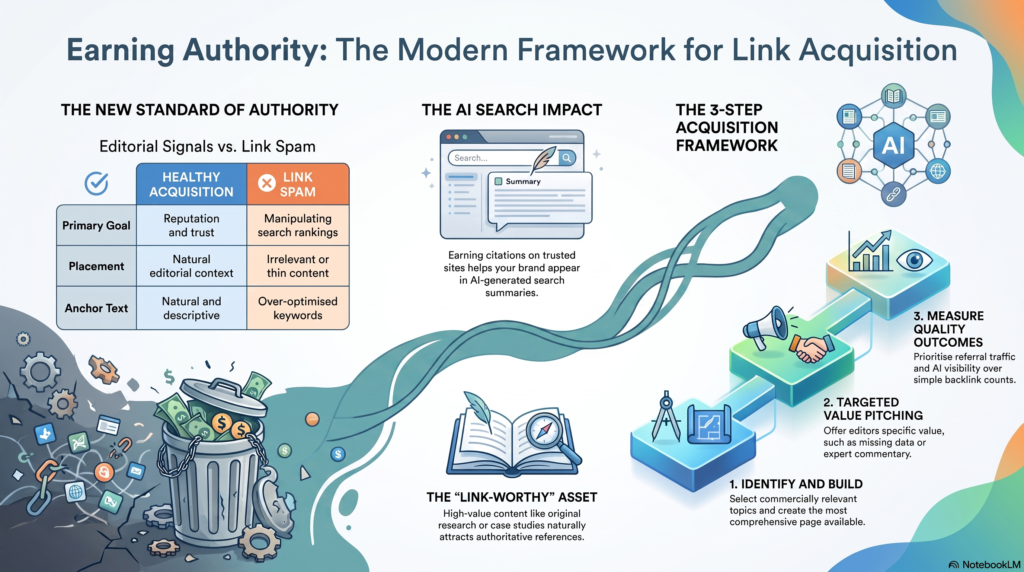
Spam starts with the question: “How can we get as many links as possible?”
Strong link acquisition starts with the question: “Why would a credible publisher want to mention us?”
That change in thinking matters.
A spam-focused approach looks for shortcuts. It may include buying links that pass ranking value, overusing exact-match anchor text, placing links on irrelevant websites, publishing weak guest posts, or creating link exchanges at scale. These tactics can create risk because they are designed mainly to influence ranking signals rather than help readers.
A quality-driven approach focuses on relevance, usefulness, credibility, and editorial value.
The link should make sense inside the article. The publisher should be relevant to your industry. The anchor text should feel natural. The page being linked to should genuinely help the reader. Google’s SEO Starter Guide explains that link text helps both users and Google understand what the linked page is about, which is why natural and descriptive anchors are better than forced keyword stuffing.
So, yes, link acquisition still supports SEO. But the best link acquisition does not look like manipulation. It looks like reputation building.
Why Link Acquisition Matters More in the AI Search Era
Search is no longer only about ten blue links.
Buyers now discover brands through Google, AI Overviews, ChatGPT, Perplexity, Gemini, industry listicles, comparison articles, expert roundups, Reddit discussions, analyst content, and niche publications.
This means your brand needs more than rankings. It needs credible signals across the web.
AI search experiences often show source links that help users explore the topic more deeply. Google’s AI features documentation explains how site owners should think about content appearing in AI experiences such as AI Overviews and AI Mode, while Google’s public AI Overview page also emphasizes that AI-generated summaries can include links for further exploration.
That is why link acquisition now has two jobs.
First, it helps improve SEO authority by earning relevant backlinks.
Second, it helps increase brand visibility across the wider information ecosystem where AI systems, journalists, buyers, and search engines look for trusted sources.
In simple terms, if your brand is never mentioned outside your own website, it becomes harder to prove authority.
If your brand appears in strong articles, expert sources, industry guides, and relevant citations, it becomes easier for people and search systems to understand what you do and why you matter.
What Makes a Link Worth Earning?
Not every backlink is valuable.
A link from an irrelevant website with thin content may not help much. A link from a trusted industry publication, a high-quality blog, a respected association, or a niche resource can be far more valuable, even if the site is smaller.
A strong link usually has these qualities:
- Relevance
The website should be connected to your industry, audience, market, or topic.
For example, a SaaS company should care more about links from SaaS blogs, software review websites, business publications, technology media, founder communities, and customer success resources than from random lifestyle sites.
Relevance is the foundation of link acquisition.
- Editorial Context
The link should appear because it adds value to the article.
A link placed inside a useful paragraph is stronger than a link dropped randomly at the bottom of a page. Editorial context tells readers why the link is there.
- Trust
The publisher should look credible.
That does not always mean a massive media outlet. A respected niche publication can be more valuable than a generic website with no clear audience.
- Natural Anchor Text
Anchor text should be clear, descriptive, and normal.
A healthy link profile includes branded anchors, page title anchors, partial match anchors, and natural language anchors. It should not repeat the same exact keyword again and again.
- A Useful Destination Page
The page receiving the link must deserve the link.
Before running outreach, ask yourself: is this page actually useful? Does it answer the question better than competing pages? Does it include examples, expert insight, original thinking, data, or practical guidance?
If the answer is no, fix the content first.
How to Build a Link Acquisition Strategy Without Spam
A good link acquisition campaign is not random. It has a structure.
Here is a practical process.
1. Start With Link-Worthy Assets
Before you ask anyone for a link, create something worth linking to.
This could be:
- A detailed guide
- A useful checklist
- An original data study
- A comparison article
- A case study
- A statistics page
- A thought leadership article
- A glossary page
- A template
- A strong opinion piece
For example, if your business wants to rank for “link acquisition,” you should not only publish a basic definition. You should create a page that explains what link acquisition is, how it works, what to avoid, how to measure results, and how it fits into digital PR and AI visibility.
That gives other websites a real reason to cite your page.
2. Map the Right Audience
The next step is to identify who would actually care about your content.
This may include:
- Journalists covering your industry
- Bloggers writing about your topic
- Editors managing niche websites
- Podcast hosts
- Newsletter writers
- Industry associations
- Partner companies
- Analysts
- SaaS review websites
- Resource page editors
The best prospects are not always the biggest websites. They are the websites that already speak to your audience.
3. Build a Relevant Prospect List
Do not scrape thousands of websites and send the same email to everyone.
That is how outreach becomes spam.
Instead, create a smaller, better list. Look for websites that have already written about your topic. Check whether they publish expert quotes, cite external resources, update old articles, or include recommended tools and agencies.
4. Create a Real Outreach Angle
Most outreach fails because the pitch is weak.
A bad pitch says: “Please link to my article.”
A better pitch says: “I noticed your guide covers this topic, but it does not include a section on recent AI search visibility. We published a practical explanation that may help your readers.”
The difference is value.
Your pitch should give the editor a reason to care. Maybe you found an outdated statistic. Maybe their article has a broken resource. Maybe you can provide a quote from an expert. Maybe your article explains something their readers are already asking about.
The more specific your angle, the better your chances.
5. Personalize Without Overdoing It
Personalization does not mean writing a fake compliment.
It means proving that you understand the website, the audience, and the article you are referencing.
A simple outreach message can include:
- The article you read
- The specific section you are referencing
- The reason your resource is relevant
- The value it adds for their readers
- A short and polite ask
Keep it simple. Editors are busy. They do not need a long biography. They need a clear reason to review your suggestion.
6. Offer Expertise, Not Just Links
One of the best ways to earn links is by becoming a useful source.
Journalists, bloggers, and editors often need expert quotes, examples, and explanations. If your business can provide clear commentary, it may earn mentions in relevant articles.
This is especially useful for brands that want visibility in AI answers and search citations. Expert quotes help connect your brand to specific topics, questions, and industry conversations.
For example, a cybersecurity company can comment on data protection trends. A fintech company can comment on payment behavior. An agritech company can comment on food security, crop inputs, or sustainable farming. A SaaS company can comment on software adoption, automation, or customer retention.
That kind of expertise can lead to links, citations, and brand mentions.
7. Use Brand Mentions as a Link Acquisition Opportunity
Sometimes your business is already mentioned online, but the mention does not include a link.
These unlinked mentions can be strong opportunities.
If a publication already mentioned your company, product, founder, research, or campaign, the editor may be open to adding a link because the reference already exists.
This is where brand mentions SEO becomes important. Brand mentions can support reputation, search visibility, and AI discoverability, especially when they appear on relevant and trusted websites.
A simple request can work well:
“Thanks for mentioning our team in your article. Would it be possible to link the mention to our relevant resource so readers can learn more?”
That is not spam. It is a helpful editorial correction.
8. Avoid Over-Optimized Anchor Text
Anchor text matters, but forcing keywords into every backlink is risky and unnatural.
If every external link to your page says “best link acquisition agency” or “link acquisition services,” that does not look organic.
A natural profile might include anchors such as:
- this guide
- link acquisition
- SEO outreach strategy
- digital PR services
- the company’s research
- read the full article
- source
The goal is not to control every anchor. The goal is to earn relevant links that make sense in context.
9. Track Quality, Not Just Quantity
A link acquisition campaign should not be judged only by the number of backlinks.
Track the quality of the outcomes.
Important metrics include:
- Number of relevant referring domains
- Number of editorial links earned
- Number of unlinked brand mentions converted into links
- Links from industry-relevant websites
- Referral traffic from earned placements
- Ranking improvements for target pages
- Organic traffic growth
- Leads generated from organic search
- Brand visibility in AI answers
- Mentions in comparison content, listicles, and industry guides
This is where many businesses make a mistake. They celebrate every backlink equally.
A single relevant editorial mention from a trusted industry website can be more valuable than twenty weak links from generic websites.
What to Avoid in Link Acquisition
To keep your strategy safe, avoid tactics that create risk without building real authority.
- Avoid Buying Links That Pass Ranking Value
Paid placements are common in some industries, but they need to be handled carefully. If a link is paid, sponsored, or part of an advertising arrangement, it should be treated properly.
The problem is not promotion itself. The problem is trying to pass paid links as organic editorial recommendations.
- Avoid Mass Guest Posting
Guest posting can be useful when it is high quality and relevant. But mass guest posting on low-quality websites is not a serious authority strategy.
If the article exists only to place a link, it is probably not worth doing.
- Avoid Irrelevant Websites
A link from a website that has nothing to do with your industry may not help your brand.
Relevance matters more than convenience.
- Avoid Excessive Link Exchanges
Some partner linking is normal. For example, a company may link to a partner, client, integration, or association when it makes sense.
But excessive reciprocal linking can become risky when the main purpose is to manipulate rankings.
- Avoid Weak AI-Generated Content
AI tools can help with research, outlines, and drafting, but low-quality mass content will not earn serious links.
Editors link to content that is useful, credible, and clear. Thin articles do not attract strong citations.
How Link Acquisition Supports AI Visibility
AI visibility depends on more than your own website.
If your brand appears across credible sources, it becomes easier for users to find you when they ask questions in search engines and AI platforms. That does not mean you can force AI systems to recommend you. You cannot. But you can improve the quality and consistency of your public footprint.
Strong link acquisition can help by:
- Getting your brand mentioned in relevant articles
- Earning citations from trusted websites
- Building topical authority around your services
- Increasing the number of pages that connect your brand with important buyer questions
- Supporting content that AI search experiences may surface as source material
- Helping your website become part of a wider trusted conversation
For example, if Shoden Global wants to be visible for AI visibility, SEO outreach, digital PR services, blogger outreach, and link acquisition, then it should not rely only on its own service pages. It should also earn mentions in articles, guides, interviews, comparison posts, and expert roundups related to those topics.
That is how brand authority compounds.
A Simple Link Acquisition Framework
A safer link acquisition campaign can follow this structure:
Step 1: Choose the Target Topic
Start with a topic that matters commercially.
For example:
- Link acquisition
- Digital PR services
- SEO outreach
- Editorial links
- Blogger outreach services
- Brand mentions SEO
- Off-page SEO services
- SaaS link building services
The topic should connect to a service, audience, and buyer problem.
Step 2: Build the Best Page You Can
Your page should be better than a basic article.
Include definitions, examples, mistakes to avoid, practical steps, expert insight, FAQs, and internal links to related resources.
Step 3: Identify Relevant Publishers
Look for websites already publishing content on the topic.
Prioritize relevance over domain metrics. A smaller niche publication with the right audience may be more valuable than a large generic website.
Step 4: Pitch a Specific Value Add
Do not send a generic link request.
Offer something useful:
- A missing explanation
- An expert quote
- Updated information
- A practical resource
- A case study
- A statistic
- A comparison
- A clearer definition
Step 5: Follow Up Respectfully
One follow-up is usually enough.
If there is no reply, move on. Link acquisition should build relationships, not annoy editors.
Step 6: Measure the Right Results
Track links, mentions, rankings, referral traffic, organic leads, and AI visibility.
The campaign should support business growth, not just SEO reports.
Where Shoden Global Fits In
Shoden Global helps businesses build link acquisition campaigns that are designed for real visibility, not artificial backlink counts.
The goal is to help your business earn stronger search visibility, more qualified organic traffic, better brand mentions, and more trusted citations across the web.
This can include:
- Link acquisition strategy
- SEO outreach campaigns
- Digital PR planning
- Publisher research
- Editorial link opportunities
- Blogger outreach
- Expert quote placement
- Brand mention tracking
- Content assets designed to attract links
- AI visibility support
- Multilingual outreach for international markets
- Campaign reporting focused on business outcomes
For B2B, SaaS, fintech, agricultural, technology, and professional service companies, this matters because buyers rarely make decisions from one search result. They compare vendors, read articles, check credibility signals, ask AI tools, look at industry mentions, and search for proof.
Shoden Global helps your business appear in more of those discovery moments.
Instead of chasing random backlinks, the focus is on building a stronger reputation around the topics your buyers already care about.
Frequently Asked Questions About Link Acquisition
Is link acquisition the same as link building?
They are related, but not exactly the same.
Traditional link building often focuses on getting backlinks. Link acquisition is a more strategic and editorial approach. It focuses on earning links through useful content, outreach, digital PR, expert commentary, and credible brand mentions.
Is link acquisition safe for SEO?
Yes, when it is done properly.
The safest approach is to earn links from relevant websites because your content, expertise, or brand mention adds value. Risk increases when links are paid, automated, irrelevant, excessive, or created mainly to manipulate rankings.
What is the best type of backlink?
The best backlink is usually a relevant editorial link from a trusted website, placed naturally inside useful content.
That kind of link can support SEO, referral traffic, brand credibility, and topical authority.
How many links do I need?
There is no universal number.
A local business in a small niche may need fewer links than a SaaS company competing nationally or globally. The better question is: how many quality mentions and links do you need to become credible in your category?
Can brand mentions help without links?
Yes, brand mentions can support visibility and credibility, especially when they appear on trusted and relevant websites. However, linked mentions are usually stronger because they give readers a direct path to your website and help search engines discover the relationship between the mention and your page.
Does link acquisition help AI visibility?
It can help indirectly.
AI visibility is influenced by many factors, and no agency can guarantee specific AI citations. But earning relevant links, mentions, expert quotes, and third-party references can strengthen your public authority and make your brand easier to discover across search and AI-driven research journeys.
Final Thoughts
Link acquisition is not about gaming the system.
It is about earning trust.
The brands that win are the ones that create useful content, build real relationships, share expertise, and appear in credible places across the web. They do not rely on spam. They build authority that lasts.
The strongest links are earned because someone believes your content genuinely improves their own. That is why successful link acquisition begins long before the outreach email is sent. It starts with creating resources, insights, and expertise that publishers, journalists, and industry experts naturally want to reference.
For businesses that want stronger SEO, more qualified traffic, better citations, and stronger AI visibility, link acquisition should be part of a larger digital PR and content strategy.
Shoden Global can help your business build that strategy with focused SEO outreach, editorial link acquisition, digital PR, brand mention campaigns, and AI visibility support.
The future of link acquisition belongs to brands that are worth citing.