

Introduction
Generative engine optimization is quickly becoming a core skill for brands that want visibility in AI-generated answers, not just “blue link” rankings. If your audience is asking questions inside AI-powered search experiences, your goal is simple: publish content that’s easy to extract, verify, and cite.
In this guide, we’ll define GEO (and yes, here it means Generative Engine Optimization, not geography), walk through how it works, and give you a practical framework you can implement today.
Table of Contents
What is generative engine optimization?
Generative engine optimization (GEO) is the practice of structuring and strengthening your content so AI-driven search experiences and “generative engines” can reliably use it as source material, often as citations, links, or brand mentions inside AI answers. GEO builds on SEO fundamentals, but focuses on being selected for summaries, comparisons, and direct answers, not just ranking as a blue link.
Generative engine optimization (GEO) is a content and visibility approach designed to increase how often your pages are used in AI-generated responses, through citations, links, or brand mentions. Research introducing GEO frames it as optimizing for “generative engines,” where the output is an answer, not a list of results.
GEO matters because AI experiences don’t just rank pages, they synthesize information. That changes what “winning” looks like: clarity, evidence, and extractable structure often beat long, vague copy.
Practical note: Semrush data can be noisy because “GEO” also means geography. In your content, always define GEO early as Generative Engine Optimization.
Why is generative engine optimization important?
GEO is important because AI-powered search experiences can answer questions directly and still include supporting links, creating new ways for users to discover your site. Google’s guidance for AI features emphasizes that SEO best practices still apply, but the opportunity is earning visibility as a supporting source inside AI responses.
In plain terms: users may not scroll ten results anymore. They may read a synthesized answer and click one or two supporting sources. GEO helps you become one of those sources.
Where GEO is most valuable:
- High-intent comparison queries (“X vs Y”)
- Complex “how-to” queries
- Industry definitions and frameworks
- Category and “best option” pages
Is generative engine optimization the same as traditional SEO?
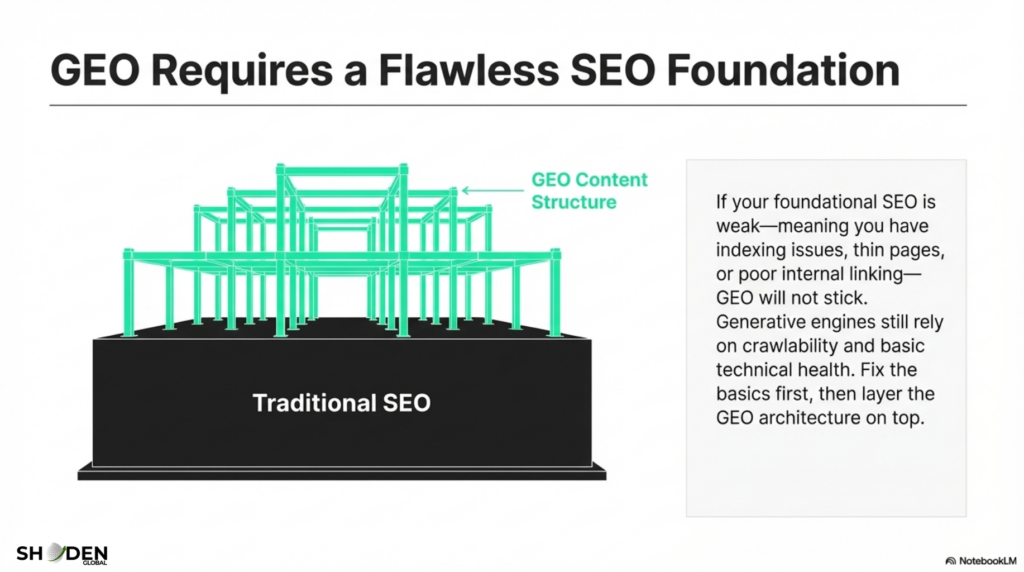
No. GEO isn’t the same as traditional SEO, but it depends on it. Traditional SEO is about ranking pages for queries; GEO is about making your content easy for AI systems to extract, trust, and cite when generating answers. Google also notes there are no special requirements for AI features beyond strong SEO fundamentals.
Here’s a simple comparison:
| Aspect | Traditional SEO | AEO (Answer Engine Optimization) | GEO (Generative Engine Optimization) |
| Primary goal | Rank pages | Win direct answers/snippets | Become cited/source in AI answers |
| Best content formats | Landing pages, long-form, category pages | Q&A, concise definitions | Answer blocks + evidence + structured sections |
| “Win condition” | Top positions | Snippet/voice answer | Mentions, citations, supporting links |
| Key skills | Technical SEO, links, relevance | Clarity, schema, brevity | Clarity + evidence + topical depth + entity signals |
Bottom line: If your SEO foundation is weak (indexing issues, thin pages, poor internal linking), GEO won’t stick. Fix the basics first, then layer the GEO structure on top.
Are answer engine optimization and generative engine optimization the same?
They overlap, but they aren’t the same. AEO focuses on earning direct answers (featured snippets, voice assistants, Q&A results). GEO focuses on being selected as source material for AI-generated responses that synthesize multiple sources. In practice, strong AEO formatting (clear Q&A blocks) often improves GEO performance too.
AEO is usually “one question → one short answer.”
GEO is often “one question → multiple sub-questions → a composed response.”
So your best play is usually hybrid content:
- A short direct answer
- Followed by deeper explanation
- Supported by lists, steps, examples, and (where appropriate) structured data
How does generative engine optimization work?
GEO works by aligning your content with how AI search experiences gather and synthesize information. Google explains that AI features may use a “query fan-out” approach, running multiple related searches across subtopics, then generating a response while surfacing supporting links. Your content wins when it cleanly answers those sub-questions.
What this means for your page structure:
- Add subheadings that match real sub-questions
- Provide tight definitions and scannable summaries
- Use consistent terminology (entity clarity)
- Include supporting evidence where claims could be disputed
One more reality: AI systems can change quickly. That’s why GEO is less about tricks and more about being the most reliably citable page on the topic.
How to do generative engine optimization?
To do GEO, start with a question-led outline, write concise answer blocks, expand with clear supporting detail, and strengthen trust signals (accuracy, sources, author expertise, internal links). Then ensure the page is technically indexable and measurable. Research introducing GEO also emphasizes optimizing for visibility metrics in generative responses.
Step-by-step GEO framework (repeatable)
- Pick one primary intent (definition, how-to, comparison, “best”).
- Map 10–14 questions (you already did—use Semrush question keywords).
- Write answer blocks first (40–60 words), then expand.
- Add “extractable assets”: tables, checklists, numbered steps, short definitions.
- Reinforce with internal links to deeper supporting pages.
- Validate technical SEO (indexable, fast, clean structure).
- Measure + iterate using KPIs (see measurement sections).
How to optimize content for generative engines?
Optimize content for generative engines by making it easy to extract and verify: lead with definitions, use question headings, keep answers concise, add supporting details in lists/steps, and avoid unsupported claims. Ensure structured data (if used) matches visible content and follows guidelines so your page remains eligible for rich features.
GEO content checklist (copy/paste)
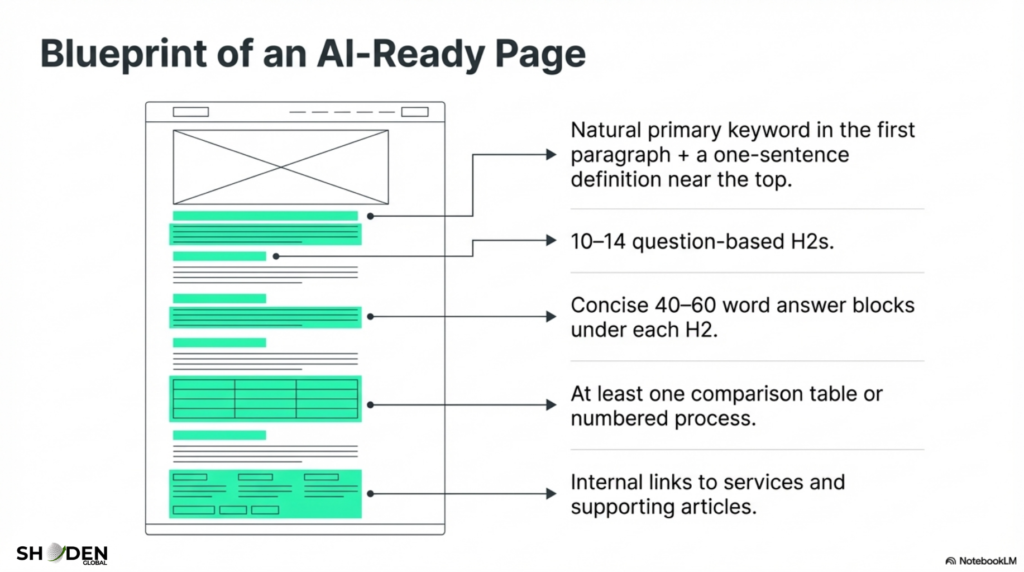
- ✅ Primary keyword in first paragraph (natural)
- ✅ One-sentence definition near the top
- ✅ 10–14 question-based H2s
- ✅ 40–60 word answer block under each H2
- ✅ At least one table (comparison or criteria)
- ✅ At least one numbered process
- ✅ Clear “who it’s for / when to use it” guidance
- ✅ Review every claim that needs proof → add a source or mark
- ✅ Internal links to services + supporting articles
How to measure the success of generative engine optimization campaigns?
Measure GEO success by tracking visibility and outcomes: appearances and clicks from AI-feature SERPs, brand mentions, assisted conversions, and engagement on GEO-optimized pages. Google notes that traffic from AI features is included in Search Console performance reporting, so combine Search Console trends with analytics and conversion data.
A practical measurement approach:
- Baseline your top GEO queries (weekly checks)
- Track page-level performance (Search Console + analytics)
- Monitor conversion quality (time on page, demo starts, lead scoring)
- Document which pages appear as supporting sources (manual sampling)
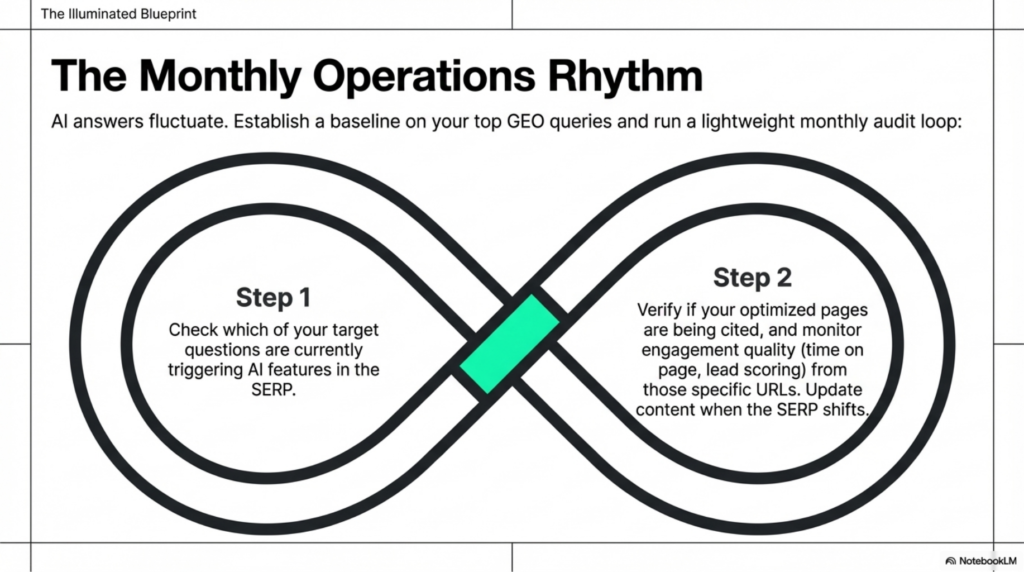
If you want a simple “ops” rhythm: run a monthly GEO audit where you check
(1) which questions trigger AI features and
(2) whether your pages are cited/visited.
What KPIs and metrics matter for generative engine optimization?
The best GEO KPIs combine visibility and business impact: inclusion as a supporting link/citation, brand mentions on target queries, engagement from those visits, and assisted conversions. Because AI features can behave differently by query type, track metrics by intent cluster (definition vs comparison vs how-to) rather than only sitewide averages.
A lightweight KPI set:
| KPI | What it tells you | How to track |
| AI-feature visibility (query set) | Are you showing up where AI answers trigger? | Manual SERP sampling + Search Console trends |
| Clicks/engagement from those pages | Are visits high-quality? | Analytics: engaged sessions, scroll depth |
| Brand mentions (target topics) | Are you becoming the “named” authority? | Tool-dependent |
| Assisted conversions | Is GEO influencing pipeline? | Analytics + CRM attribution model |
| Content freshness & accuracy checks | Are you still citable? | Content QA cadence + updates |
Are there risks to using generative engine optimization?
Yes. GEO can backfire if it encourages over-optimization, thin “answer spam,” or misleading markup. Follow structured data policies, keep content accurate, and ensure any schema matches what users can see. Also, recognize that AI answers can change frequently, so results may fluctuate even when your content is strong.
Key risk reducers:
- Don’t publish claims you can’t support
- Avoid “fake authority” tactics (invented authors, unverifiable stats)
- Keep schema honest and consistent with on-page text
- Update pages when SERPs change or when guidance evolves
What are generative engine optimization services?
Generative engine optimization services typically include AI visibility research, question-based content strategy, on-page GEO formatting (answer blocks, comparisons, schema), internal linking, and measurement/reporting. The best providers also strengthen authority signals through expert input and trusted references, so your content becomes a reliable source for AI-generated answers.
What to look for in a GEO service provider:
- A clear framework (not vague “AI hacks”)
- Content QA for accuracy + evidence
- Technical SEO competence (indexability, internal linking)
- Reporting that ties to business outcomes, not just impressions
Common Mistakes
- Treating GEO as “keywords for bots.” The win is extractability + trust, not stuffing.
- Skipping the direct answer format. If you don’t answer fast, you won’t be cited.
- Publishing unsupported claims. Add sources or label until verified.
- Confusing “GEO” with geography. Define it as Generative Engine Optimization early.
- No internal linking plan. Google explicitly calls out internal links as a best practice for AI features, too.
Conclusion
Generative engine optimization isn’t a replacement for SEO, it’s what happens when SEO meets a world where answers are synthesized, and sources are selected. If you structure your content around real questions, publish concise answer blocks, and back claims with evidence, you give generative engines a reason to cite you.If you want help implementing GEO across your site, building a topic cluster, or creating an AI visibility measurement plan, connect with Shoden Global.
FAQ
What is generative engine optimization GEO?
It’s the same concept: GEO is the common acronym for Generative Engine Optimization. In practice, always spell it out early to avoid confusion with “geo” (geography) terms in search data.
How to optimize for generative engines?
Use question-based structure, concise answer blocks, evidence-backed claims, and strong internal linking. Make sure the page is indexable and readable so it can be surfaced as a supporting source in AI features.
What are the benefits of using generative engine optimization?
Benefits include higher likelihood of being cited/linked in AI answers, stronger brand authority on high-intent queries, and content structure improvements that often help classic SEO performance too.
Are there any downsides to generative engine optimization?
Yes: volatility in AI experiences, the risk of “answer spam,” and potential issues if you add misleading schema or unsupported claims. Follow structured data policies and keep content accurate.
How to find a consultant for generative engine optimization?
Look for someone who can explain their process, show measurable outcomes (visibility + conversions), and demonstrate strong SEO fundamentals. Avoid anyone selling “guaranteed AI placement” promises.
Is generative engine optimization a part of SEO now?
It’s best viewed as an extension of modern SEO: the fundamentals still matter, but you optimize content to be extractable and attributable in AI-assisted search experiences.