
Ethical Marketing & Ethical AI
At Shoden Global, we help B2B brands become more visible, more credible, and more trusted across search engines, AI answers, LLMs, high-authority publications, and buyer research journeys.
But visibility without integrity is not real authority.
Our work in AI Visibility, LLM SEO, Generative Engine Optimization, Digital PR, listicle inclusion, guest posting, and content strategy is built on a simple belief: the brands that win in the AI era should be the brands that deserve to be cited.
That means we do not chase shortcuts, fake authority, misleading claims, manipulative campaigns, or low-quality visibility. We build defensible digital footprints that help people make better decisions and help AI systems understand accurate, useful, and trustworthy information.
This Ethical Marketing Policy explains how we work, what we will do, and what we will not do.
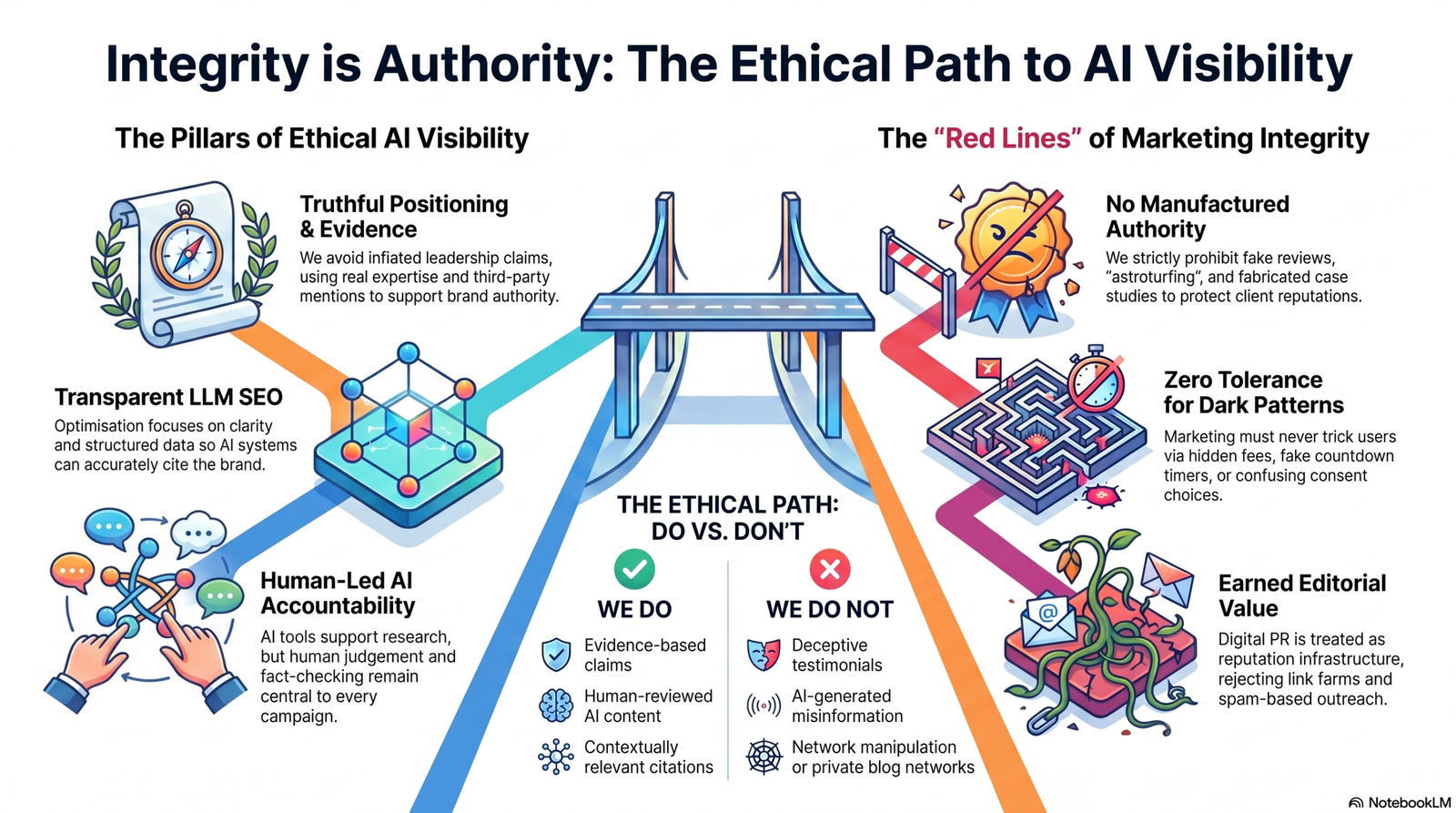
Our ethical marketing commitment
Shoden Global is committed to marketing that is honest, transparent, useful, privacy-conscious, human-led, brand-safe, and sustainable.
We do not exaggerate claims, fabricate authority, or misrepresent results.
We make content, outreach, reporting, and positioning clear and understandable.
We create content and campaigns that help real buyers, not just algorithms.
We respect user consent, data protection, and responsible data use.
We may use AI tools to support research, structure, and efficiency, but human judgment, review, and accountability remain central.
We avoid spam, link schemes, fake reviews, misleading placements, and tactics that could damage a client’s long-term reputation.
We focus on long-term authority, not short-term manipulation.
Ethical AI: Why ethics matters in AI visibility
Search has changed. Buyers no longer rely only on traditional search results. They ask ChatGPT, Gemini, Claude, Perplexity, Google AI Overviews, and other answer engines for recommendations, comparisons, and explanations.
That makes ethical marketing even more important.
When AI systems mention, summarize, or cite a brand, they rely on the signals available across the web. These signals may include website content, expert articles, listicles, PR coverage, third-party mentions, structured pages, reviews, and public claims.
Our responsibility is to make sure those signals are accurate, useful, fair, and defensible.
We do not believe in tricking AI systems. We believe in helping AI systems and human buyers find the right facts, the right context, and the right evidence.
Our core ethical marketing principles
Truthful positioning
We help clients clarify what they do, who they serve, and why they are relevant. We do not create positioning that is false, inflated, or impossible to support.
We avoid fake leadership claims, unsupported best-in-the-market statements, fabricated case studies, misleading performance claims, false urgency, artificial scarcity, and claims that cannot be verified.
When we position a brand as a strong solution, we aim to support that positioning with evidence. This may include expertise, use cases, product strengths, third-party mentions, helpful content, and credible sources.
Transparent AI Visibility and LLM SEO
LLM SEO and GEO are not about manipulating models. They are about making a brand easier to understand, evaluate, and cite.
When we optimize content for AI systems, we focus on clear brand descriptions, accurate service pages, structured FAQs, helpful comparisons, visible expertise, clean claims, reliable citations, strong topical relevance, and human-readable explanations.
We do not create misleading content purely to influence AI answers. We do not publish false facts, fake expert opinions, or content designed to confuse users or systems.
Our goal is simple. We make the truth about a brand easier to find, understand, and reuse.
Ethical LLM Seeding
LLM Seeding means placing credible and useful brand signals where buyers and AI systems can discover them.
For Shoden Global, ethical seeding means sharing accurate information about a client’s expertise, publishing content that adds real value, building visibility through relevant and reputable sources, creating assets that buyers can trust, and strengthening authority through consistency and quality.
Ethical seeding does not mean astroturfing, fake community activity, spam posting, impersonation, or flooding the web with low-value content.
We build credible digital signals based on real expertise rather than manufacturing fake authority.
Responsible Digital PR and citation engineering
Digital PR should earn attention by being useful, relevant, and credible.
Our Digital PR and citation engineering work is based on editorial value. We aim to create stories, expert contributions, list placements, and source references that help readers understand a topic or make a better decision.
We do not support link farms, private blog network schemes, hidden paid links that violate publication rules, fake journalist identities, misleading bylines, mass spam outreach, irrelevant placements created only for backlinks, or paid coverage presented dishonestly as independent editorial coverage.
When we pursue citations, backlinks, and mentions, we aim for placements that are brand-safe, contextually relevant, and useful beyond SEO value.
Comparison content
Comparison content influences both human buyers and AI-generated recommendations. Because of that, they must be handled carefully.
When we create or support comparison content, we aim to use clear, fair, and relevant criteria.
Our standards include honest descriptions of each company, tool, or service. Good comparison content should help the reader compare options, not manipulate them.
Privacy-conscious marketing
We believe performance marketing should respect people’s privacy.
Our campaigns should be built around responsible data use, consent-based practices, and clear communication. We do not support invasive tracking, hidden data collection, or unclear use of personal information.
Where data is collected, it should be collected for a clear purpose, handled responsibly, and used in ways that align with the user’s expectations and applicable privacy requirements.
We believe better data comes from trust, not surveillance.
Ethical use of AI
AI can support marketing strategy, research, content planning, optimization, reporting, and analysis. Used responsibly, it can help teams work faster and uncover useful insights.
But AI should not replace accountability.
At Shoden Global, responsible AI use means human review before publication, fact-checking important claims, avoiding fake experts, avoiding fake reviews, avoiding fake customer stories, avoiding deceptive media, avoiding AI-generated misinformation, making sure AI-supported content reflects the client’s real expertise, and prioritizing usefulness, accuracy, and clarity.
We do not use AI to deceive audiences, impersonate people, or create false trust signals.
No dark patterns or manipulative user experience
Marketing should help users make informed decisions. It should not trick them into actions they did not intend to take.
We avoid dark patterns such as hidden unsubscribe options, confusing consent choices, pre checked opt ins, misleading buttons, fake countdown timers, hidden fees, bait-and-switch offers, forms that collect more data than needed, and claims that pressure users through fear or false urgency.
A user should understand what they are agreeing to, what they are clicking, and what happens next.
Authentic content and expert integrity
Content should be useful, accurate, and connected to real expertise.
Whether we create blog posts, guest posts, opinion pieces, FAQs, guides, listicles, landing pages, or AI-optimized content, our goal is to produce assets that help buyers and strengthen trust.
We do not publish content simply to fill space.
Our content standards include clear purpose, accurate information, human editing, relevant examples, strong structure, helpful answers, appropriate sourcing, no plagiarism, no fabricated experience, and no misleading authorship.
Content should make the brand easier to trust, not just easier to find.
Inclusive and culturally aware communication
Shoden Global works with brands that may operate across different industries, countries, languages, and buyer groups. Ethical marketing must respect that diversity.
We aim to avoid messaging that stereotypes, excludes, mocks, misrepresents, or exploits cultural differences.
When creating global or multilingual content, we consider local context, cultural sensitivity, clear language, audience expectations, respectful representation, and avoidance of biased assumptions.
Visibility should never come at the cost of respect.
What we will not do
To protect our clients, their buyers, and our own standards, Shoden Global will not knowingly participate in fake reviews, fake testimonials, fake case studies, fake customer stories, fake social proof, fake community conversations, spam link building, link farms,, fabricated expert quotes, plagiarized content, AI generated misinformation, deceptive media campaigns, impersonation, scraping or misusing personal data, misleading scarcity tactics, cloaking, deceptive SEO practices, campaigns designed to exploit vulnerable audiences, unsupported claims, or outreach that misrepresents who we are or who we represent.
If a tactic may create short-term visibility but long-term reputational risk, we will challenge it.
How we apply ethics across our marketing services
AI Visibility audits
We identify where a brand appears, where it is missing, how competitors are being cited, and what opportunities exist. We aim to present findings clearly, without fear-based exaggeration or unrealistic promises.
LLM SEO and GEO
We optimize content so AI systems and human buyers can understand a brand’s value, services, expertise, and relevance. We focus on clarity, structure, accuracy, and citation-worthy information.
Digital PR
We pursue stories, placements, and mentions that are relevant to the client’s expertise and useful for readers. We do not treat PR as a link shortcut. We treat it as reputation infrastructure.
Listicle inclusion
We help brands appear in relevant comparison content while respecting fairness, accuracy, and editorial quality.
Content creation
We create content designed to answer real buyer questions, support informed decisions, and communicate expertise clearly. Every piece should serve people first and algorithms second.
Guest posting and outreach
We approach outreach with relevance, transparency, and respect. We do not spam publishers or misrepresent the value of a contribution.
Reporting
We report on meaningful indicators such as visibility, mentions, citations, placement quality, authority signals, content performance, and progress over time. We do not hide behind vanity metrics.
Our reporting standards
Clients deserve to know what is being done, why it matters, and what progress is being made.
Our reporting should be clear, honest, relevant, actionable, connected to agreed goals, transparent about limitations, and focused on long-term authority rather than only short-term activity.
We will not guarantee outcomes that no agency can fully control, such as exact AI answer placement, permanent rankings, or guaranteed citations from specific AI systems.
What we can do is build the right signals, measure progress, improve the strategy, and keep the work aligned with ethical standards.
Client responsibilities
Ethical marketing is a partnership.
To do our best work, we ask clients to provide accurate information about their company, services, product claims, customer results, certifications, partnerships, pricing, limitations, and legal requirements.
We also ask clients not to request or approve tactics that rely on deception, fake authority, misleading claims, or misuse of data.
The strongest AI visibility strategy is built on real expertise and real trust.
Our campaign ethics checklist
Before launching or publishing work, we ask whether the claim is accurate, whether the statement can be supported, whether the content is useful to the reader, whether the source or placement is relevant, whether the intent and context are transparent, whether privacy and consent are respected, whether the work could mislead a buyer, publisher, or AI system, whether it strengthens long term trust, and whether we would be comfortable explaining the tactic publicly.
If the answer creates concern, we review the work before moving forward.
Corrections and accountability
Marketing is a fast-moving field, especially in the AI search era. If we discover that content, claims, citations, or campaign materials need to be corrected, clarified, or updated, we aim to address the issue responsibly.
If you believe something connected to Shoden Global’s marketing work is inaccurate, misleading, or not aligned with this policy, please contact us so it can be reviewed.
We take trust seriously because trust is the foundation of visibility that lasts.
Shoden Global helps brands become visible where modern decisions begin: in search, in trusted publications, and inside AI-generated answers.
We believe the right way to do that is not through manipulation, spam, or shortcuts.
The right way is through clear positioning, useful content, responsible outreach, honest authority building, ethical AI use, transparent reporting, and long-term trust.
That is how brands become not only visible but also credible.
That is how brands become not only mentioned but trusted.