
Search is changing.
For years, digital visibility was simple to understand. A buyer typed a query into Google, scanned the results page, clicked a few links, and compared options. If your brand ranked well, you had a chance to win the visit, the lead, and eventually the customer.
That journey still exists, but it is no longer the whole picture.
Today, more buyers are asking AI systems for answers directly. They are using ChatGPT, Google AI Overviews, Google AI Mode, Perplexity, Gemini, Claude, Copilot, and other answer engines to shortlist vendors, compare services, explain categories, and make early buying decisions. OpenAI describes ChatGPT search as a way to get “fast, timely answers with links to relevant web sources,” while Google says AI Overviews and AI Mode help users explore complex questions with AI-powered responses and supporting links.
That creates a new question for every B2B brand:
When your ideal customer asks an AI system who they should trust, does your brand appear?
That question is at the heart of LLM visibility.
Table of Contents
What is LLM visibility?
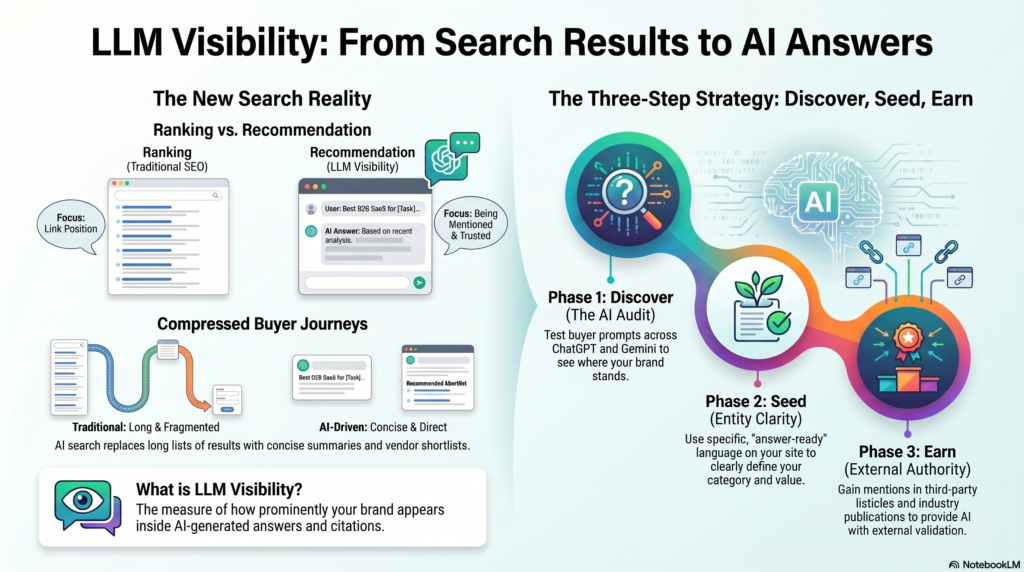
LLM visibility is the measure of how often, how accurately, and how prominently your brand appears inside AI-generated answers.
Traditional SEO asks, “Where do we rank?”
LLM visibility asks, “Are we mentioned, cited, and trusted when AI gives the answer?”
That difference matters. In a traditional search result, users can choose from ten blue links, ads, map packs, videos, forums, and product pages. In AI search, the interface often compresses that journey into a summary, a recommendation, or a shortlist. If your brand is missing from that answer, the buyer may never know you were an option.
This is why LLM visibility is not just another SEO buzzword. It is a new layer of digital presence.
For Shoden Global, the goal is clear: help B2B brands become visible, cited, and trusted inside AI-generated answers through LLM SEO, Generative Engine Optimization, digital PR, listicle inclusion, and structured content strategy.
Why LLM visibility matters now
AI search is not replacing SEO overnight. In fact, Google’s own guidance says foundational SEO still matters for generative AI features because AI Overviews and AI Mode are rooted in Google’s Search systems. Pages still need to be crawlable, indexable, useful, and eligible to appear with snippets.
But the outcome is changing.
A strong page ranking is no longer the only win. A brand also needs to be understood by AI systems, supported by reliable third-party sources, and associated with the right category, use case, and buyer intent.
For example, if someone asks:
“Best AI visibility agencies for B2B SaaS brands”
“Top LLM SEO companies in Europe”
“How do I improve brand visibility in ChatGPT?”
“Which agencies help with GEO and AI search?”
The answer engine may not simply show a standard list of search results. It may summarize the category, compare providers, cite external sources, and recommend a handful of brands.
That means the brands with the clearest positioning, strongest authority signals, and most credible online mentions are more likely to be included.
LLM visibility is built, not guessed
Many companies are still treating AI visibility as luck. They ask ChatGPT about their category, see whether their brand appears, and stop there.
That is not a strategy.
A proper LLM visibility strategy has three parts: discovery, seeding, and citation growth.
At Shoden Global, this aligns with the Discover, Seed, Earn framework already used across our AI visibility work: first understanding where a brand currently appears, then building the signals AI systems can interpret, and finally tracking whether the brand earns more mentions and citations over time.
1. Discover: find out where your brand stands today
You cannot improve what you cannot see.
The first step is an AI visibility audit. This means testing the prompts your buyers are likely to use across platforms such as ChatGPT, Perplexity, Google AI Overviews, Gemini, Claude, and other answer engines.
The audit should answer questions such as:
Does your brand appear for category-level prompts?
Is your brand cited as a source?
Do AI systems describe your company accurately?
Which competitors appear more often?
Which third-party sources are influencing the answers?
Are you missing from “best of” lists, comparison pages, or industry articles that AI tools commonly reference?
This is where LLM visibility becomes more measurable. Instead of relying on one prompt or one screenshot, brands can track mentions, citations, frequency, sentiment, and placement across AI responses over time — the same core measurement approach Shoden Global highlights on its site.
2. Seed: give AI systems clearer signals
LLMs do not “know” your brand in the same way a human buyer does. They form answers from patterns, sources, context, retrieval systems, and web content.
That means your brand needs to be easy to understand.
Your website should clearly explain:
Who you help
What problem you solve
What category you belong to
What makes you different
Which services, products, or outcomes you are known for
What proof supports your claims
How you compare with alternatives
What questions buyers ask before choosing you
This is where LLM SEO and Generative Engine Optimization overlap with strong content strategy.
A page that says “we help businesses grow” is vague.
A page that says “we help B2B SaaS companies improve AI visibility across ChatGPT, Google AI Overviews, Perplexity, and Gemini through LLM SEO, digital PR, listicle inclusion, and citation tracking” gives AI systems a much clearer signal.
That clarity matters.
Google’s guidance for generative AI search also supports this direction: create helpful, reliable, people-first content, organize pages clearly, maintain strong technical structure, and avoid relying on shortcuts or inauthentic mentions.
3. Earn: build authority beyond your own website
Your own website is important, but it is not enough.
AI systems often rely on external validation. If your brand only describes itself on its own site, the signal is weaker. If respected third-party sources, industry publications, comparison pages, listicles, partner pages, podcasts, reviews, and digital PR mentions also describe your brand consistently, the signal becomes stronger.
This is why digital PR and listicle inclusion are becoming central to AI visibility.
Not fake mentions.
Not spammy placements.
Not low-quality link building dressed up as AI strategy.
The goal is credible, relevant, category-specific authority.
For example, a B2B brand trying to improve LLM visibility may need to appear in:
“Best AI visibility agencies” lists
Industry comparison guides
Expert interviews
Thought leadership articles
Partner directories
Review platforms
Niche publications
High-quality guest posts
Relevant case studies
Data-led reports
These sources help AI systems understand not only what a brand says about itself, but how the wider web talks about that brand.
That is a major shift from old-school SEO. Backlinks still matter, but AI visibility also depends on context: the words around your brand, the categories you are associated with, the credibility of the source, and whether your brand is presented as a relevant answer to the buyer’s question.
LLM visibility is not about tricking AI
There is a temptation to treat every new search shift as a game to exploit.
That is the wrong approach.
The brands that win in AI search will not be the ones chasing hacks. They will be the ones that build durable authority.
Google’s guidance is direct on this point: for generative AI search, website owners should continue to focus on valuable content, technical clarity, crawlability, and people-first usefulness rather than special AI files, unnecessary markup, or inauthentic mentions.
In other words, the best AI visibility strategy is not “write for robots.”
It is:
Write clearly.
Structure intelligently.
Prove your claims.
Earn credible mentions.
Answer real buyer questions.
Make your brand easy to understand, easy to cite, and easy to trust.
How to improve your LLM visibility
A practical LLM visibility plan should include the following:
Audit your AI presence
Test your most important commercial, informational, and comparison prompts across major AI platforms. Track whether your brand appears, which competitors are included, and which sources are cited.
Strengthen your entity clarity
Make sure your website clearly states your brand name, category, services, audience, location, proof points, and differentiators. Avoid vague language that could apply to any company.
Create answer-ready content
Build pages that directly answer buyer questions. Use clear headings, summaries, FAQs, comparisons, examples, and specific explanations. AI systems need content they can interpret and cite.
Invest in authoritative listicles and comparisons
If AI tools are pulling from “best of” lists and third-party comparison content, your absence from those sources can become a visibility gap. Relevant listicle inclusion can help your brand appear in the research layer buyers and AI systems use.
Build digital PR signals
Earn mentions in credible publications, industry sites, partner ecosystems, and expert content. A brand that is discussed across trusted sources is easier for AI systems to validate.
Track mentions and citations over time
LLM visibility is not a one-time check. AI answers shift as models, indexes, sources, and competitors change. Track visibility regularly so you can see what is improving and where competitors are gaining ground.
The future of search is answer-led
The search journey is becoming more conversational, more compressed, and more recommendation-driven.
That does not mean websites are dead. It means websites need to work harder. They need to be technically accessible, content-rich, externally validated, and structured around the questions buyers actually ask.
For B2B brands, the opportunity is significant.
Many companies are still waiting to see what happens. Others are already building the authority signals that will shape how AI systems describe their category.
The brands that act now can create an advantage before AI visibility becomes as competitive as traditional SEO.
Become the brand AI recommends
Your buyers are already asking AI systems for help.
They are asking who to trust.
They are asking which providers to compare.
They are asking what solution fits their problem.
They are asking which brands deserve a place on the shortlist.
LLM visibility is how your brand shows up in those answers.
At Shoden Global, we help B2B brands discover where they stand, seed the right authority signals, and earn more citations inside AI-generated answers.
If you want to know whether your brand is visible in ChatGPT, Google AI Overviews, Perplexity, Gemini, Claude, and other answer engines, start with an AI visibility audit.
Because in the AI search era, ranking is no longer enough.
You need to become the answer.