
Generative Engine Optimization, often shortened to GEO, is the practice of making your content easier for AI answer systems to find, understand, trust, summarize, mention, and cite.
Traditional SEO helps pages rank in search results. GEO helps content appear inside generated answers from tools such as AI search features, answer engines, and large language model based assistants. The goal is not only to win a blue link. The goal is to become part of the answer.
Google’s own guidance says foundational SEO still matters for generative AI search because AI features in Google Search are connected to core Search ranking and quality systems. It also explains that AI search features can use retrieval augmented generation and query fan out to find relevant information from the web before generating answers.
Table of Contents
GEO definition
Generative Engine Optimization is a content and visibility strategy that improves the chance that AI systems will use your website, brand, research, product information, or expert explanations when generating answers to user questions.
A simple definition:
GEO means structuring your content around real user questions, clear answers, trusted evidence, and consistent brand facts so generative engines can reuse your information accurately.
The concept became more prominent as generative engines started answering questions by synthesizing information from multiple sources instead of only showing a list of links. A Princeton publication describes GEO as a framework for improving content visibility in generative engine responses, with visibility improvements depending on the domain and optimization method used.
Why is generative engine optimization important?
People are no longer searching only with short keywords. They now ask longer, more specific questions such as:
What is the best CRM for a small B2B agency?
How do I measure the ROI of generative engine optimization?
Is generative engine optimization the same as traditional SEO?
Which agency offers generative engine optimization services?
In these searches, the user may not click ten links and compare them manually. The AI system may summarize the answer first, then include a few supporting links. Google describes AI Overviews as AI generated snapshots with key information and links that help people dig deeper.
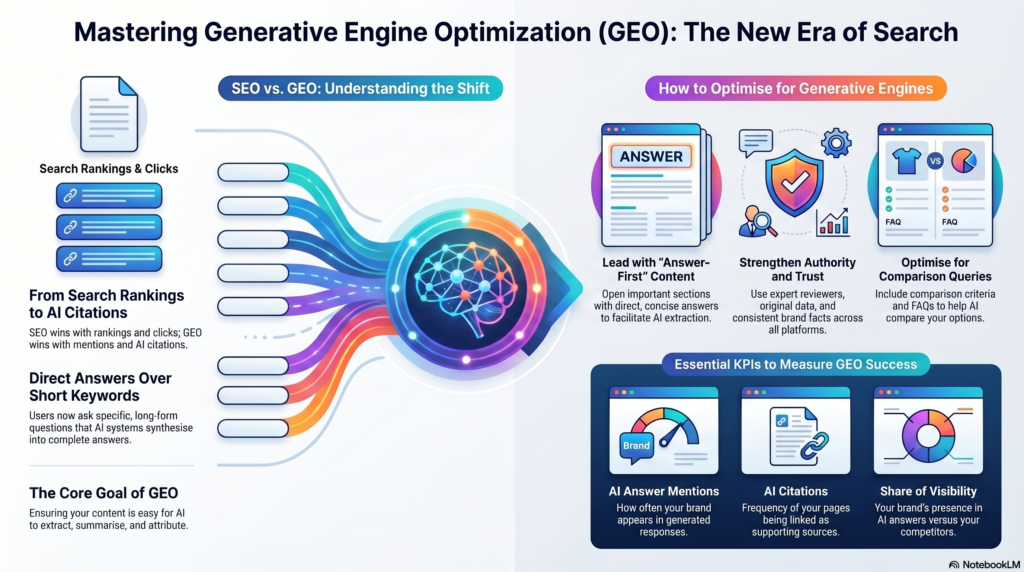
That shift changes how brands compete. You still need strong pages. You still need technical SEO. You still need authority. But your content must also be easy for AI systems to extract, summarize, and attribute.
How does generative engine optimization work?
GEO works by improving the signals that help AI systems answer three basic questions:
Can this content be found?
Can this content be understood?
Can this content be trusted enough to use in an answer?
A simple GEO flow looks like this:
User question → relevant sources discovered → AI system compares information → answer is generated → sources may be cited or linked → the user sees selected brands, facts, and recommendations
For Google’s AI features, eligibility still depends on the basics: the page must be indexed and eligible to appear in Search with a snippet. Google also states that there are no additional technical requirements for appearing as a supporting link in AI Overviews or AI Mode, although foundational SEO best practices remain important.
For GEO, this means you should not abandon SEO. You should make SEO more answer focused.
Examples of GEO in practice
Example 1: A service page
A business wants to appear when users ask:
What are generative engine optimization services?
A weak page says:
We offer innovative digital marketing services for modern brands.
A GEO friendly page says:
Generative engine optimization services help brands improve visibility inside AI generated answers. A typical service includes query research, content restructuring, technical SEO checks, citation analysis, brand fact consistency, AI answer tracking, and reporting.
The second version is easier for an AI system to understand and reuse because it gives a direct answer, explains what is included, and uses natural query language.
Example 2: A comparison article
A user asks:
Is generative engine optimization the same as traditional SEO?
A GEO focused article should answer the question directly near the top:
No. Generative engine optimization is not the same as traditional SEO, although the two overlap. SEO focuses mainly on ranking pages in search results. GEO focuses on helping content appear, be cited, or be summarized inside AI generated answers.
Then the article can explain the overlap, the differences, and when each strategy matters.
Example 3: A product or platform guide
A user asks:
Best AI tools for generative engine optimization
A strong GEO article should not only list tools. It should explain selection criteria, such as prompt tracking, citation monitoring, technical SEO checks, content optimization, analytics integration, and reporting.
That gives both humans and AI systems a clear way to compare options.
Example 4: A KPI article
A user asks:
How to measure the success of generative engine optimization campaigns?
A GEO friendly answer could include:
Measure GEO success by tracking AI answer visibility, brand mentions, citations, referral traffic from AI platforms, assisted conversions, rankings for related queries, content reuse, and changes in qualified leads.
This works because it answers the query in a complete, extractable format.
GEO vs SEO
SEO and GEO are connected, but they are not identical.
SEO focuses on search engine visibility. Its common goals include higher rankings, more organic traffic, better crawlability, stronger internal linking, and improved conversions from search.
GEO focuses on AI answer visibility. Its common goals include being mentioned in generated responses, being cited as a source, having your definitions reused correctly, and making your brand easier to verify across the web.
The overlap is important. GEO still depends on strong content, clean technical structure, crawlable pages, credible sources, and useful information. Google’s guidance is clear that SEO best practices continue to apply to generative AI search experiences.
The difference is the format of the win. In SEO, the win is often a ranking and a click. In GEO, the win can be a mention, citation, recommendation, summary, or assisted conversion that starts inside an AI answer.
AEO vs GEO
Answer Engine Optimization, or AEO, focuses on helping content appear in direct answers, featured snippets, voice search responses, and question based search results.
Generative Engine Optimization goes further. It focuses on AI systems that generate fuller responses by synthesizing information from multiple sources.
AEO asks:
Can this page answer a specific question clearly?
GEO asks:
Can this page become a trusted source inside a generated answer?
For example, an AEO page might answer:
What is GEO?
A GEO page should answer that too, but it should also include examples, comparisons, proof points, related questions, service context, measurement methods, and internal links that help an AI system understand the topic deeply.
How to do generative engine optimization
A practical GEO process starts with questions, not keywords.
1. Choose AI answer opportunity queries
Start with queries that are likely to trigger an AI answer. Good examples include:
What is generative engine optimization?
Why is generative engine optimization important?
How does generative engine optimization work?
How to do generative engine optimization?
How to optimize content for generative engines?
Generative engine optimization vs traditional SEO
Answer engine optimization vs generative engine optimization
How to measure the success of generative engine optimization campaigns?
Are there risks to using generative engine optimization?
What are generative engine optimization services?
These queries work well because they are informational, comparison based, or decision focused.
2. Build a pillar page
A pillar page should explain the full topic in one place. For this topic, the pillar should be a generative engine optimization guide that covers the definition, examples, how it works, SEO comparison, AEO comparison, best practices, risks, tools, KPIs, ROI, and services.
This page should be the main internal destination for all supporting GEO articles.
3. Create supporting articles
Supporting articles should target narrower questions. Useful supporting topics include:
GEO vs SEO
AEO vs GEO
How to do GEO
How to optimize content for generative engines
GEO best practices
GEO KPIs
How to measure GEO ROI
Risks and downsides of GEO
Best AI tools for GEO
What are GEO services?
Each support should answer one question deeply, then link back to the pillar using the consistent anchor text: generative engine optimization guide.
4. Write answer first sections
Every GEO article should include a short direct answer near the top.
For example:
Generative Engine Optimization is the process of improving content so AI answer systems can find, understand, summarize, cite, and reuse it in generated responses.
Then expand with examples, steps, and proof.
5. Add evidence and specificity
AI systems are more likely to trust content that is specific, consistent, and supported.
Use:
Named authors or expert reviewers
Clear definitions
Real examples
Original frameworks
Case studies
Statistics with sources
Comparison criteria
FAQs
Updated dates
Consistent company facts
Avoid vague claims. A sentence like “we are the best agency” is less useful than a sentence explaining what the service includes, who it is for, and how success is measured.
6. Strengthen technical SEO
GEO is harder when pages cannot be crawled, indexed, or understood. Make sure important pages are accessible, fast, internally linked, and structured with clear headings.
Use schema where it genuinely helps the page qualify for rich results, but do not rely on special markup as a shortcut. Google says there is no special schema markup required for generative AI search, although structured data can still support broader SEO goals.
How to optimize content for generative engines
Use this checklist when creating or updating content.
Start with a direct answer
Open each important section with the clearest possible answer. Do not make the reader wait through a long introduction.
Use question based headings
Questions match how users search in AI systems. Good headings include:
What is GEO?
How does GEO work?
How is GEO different from SEO?
How do you measure GEO success?
Does GEO work for every website?
Make content easy to extract
Use short paragraphs, plain explanations, and clear examples. Avoid burying the answer in long storytelling.
Include comparison language
AI systems often answer comparison queries. Add sections such as:
GEO vs SEO
AEO vs GEO
GEO services vs SEO services
GEO tools vs GEO platforms
Add internal links
Internal links help humans explore the topic and help search systems understand topic relationships.
Use descriptive anchors such as:
generative engine optimization guide
GEO vs SEO
AEO vs GEO
GEO best practices
how to measure GEO success
Keep facts consistent
Your homepage, service pages, glossary, blog posts, author bios, and third party profiles should not contradict each other.
Inconsistent facts make it harder for AI systems to identify the correct version of your brand, services, locations, pricing model, or expertise.
How to measure GEO success
GEO measurement is still evolving, but it should not be vague. Track a fixed set of prompts and monitor how visibility changes over time.
Important GEO KPIs include:
- AI answer mentions
Track whether your brand appears in AI generated answers for target prompts.
- AI citations
Track whether your pages are cited or linked as supporting sources.
- Share of AI answer visibility
Compare your brand against competitors across the same prompt set.
- Referral traffic from AI platforms
Monitor traffic from AI search and answer tools where referral data is available.
- Organic search movement
Track whether GEO content also improves rankings for related informational and commercial queries.
- Assisted conversions
Connect AI visibility to leads, demos, calls, newsletter signups, and pipeline movement.
- Content reuse quality
Check whether AI systems describe your brand, product, or service accurately.
How to measure GEO ROI
To measure GEO ROI, connect visibility to business outcomes.
A simple model:
GEO content created → AI answer visibility improves → brand mentions and citations increase → more qualified users visit or search the brand → leads and assisted conversions increase → revenue can be compared with campaign cost
For service businesses, the ROI question is not only “How many clicks did we get?” It is also “Did we become visible earlier in the buyer journey?”
That matters because AI answers often influence research before a prospect fills out a form or books a call.
Risks and downsides of GEO
GEO is useful, but it is not magic.
Risk 1: No guaranteed inclusion
A page can be well optimized and still not appear in every AI answer. Google states that meeting requirements and best practices does not guarantee crawling, indexing, or serving.
Risk 2: Inaccurate AI summaries
Risk 3: Over optimization
Risk 4: Weak evidence
Risk 5: Ignoring SEO fundamentals
Risk 4: Weak evidence
If your content makes claims without examples, data, or proof, it may be less useful for both humans and AI systems.
Risk 5: Ignoring SEO fundamentals
GEO does not replace technical SEO, content quality, internal linking, or authority building.
Does GEO work for all types of websites?
GEO can help many websites, but it works best when the site has information that people actively ask about.
Good fits include:
B2B services
SaaS platforms
Agencies
Consultants
Healthcare information providers
Finance information providers
Education websites
Legal service websites
Ecommerce brands with detailed product education
Marketplaces
Publishers
GEO may be less useful when a website has very little content, no clear expertise, limited public information, or a product category that people do not research through questions.
For best results, the site needs a clear knowledge base, accurate service pages, strong supporting content, and credible external references.
Generative engine optimization best practices
The best GEO strategy is simple: publish content that is clear enough for humans, structured enough for search systems, and trustworthy enough for AI answers.
Use these best practices:
- Answer the main question in the first few sentences.
- Add examples that make the definition concrete.
- Include comparison sections for high intent queries.
- Use internal links to connect the full topic cluster.
- Add author names, review dates, and expertise signals.
- Keep brand facts consistent across pages.
- Use original insights instead of repeating generic advice.
- Track prompts, mentions, citations, and assisted conversions.
- Update content when AI search behavior changes.
- Treat GEO as part of SEO, not a replacement for SEO.
Best AI tools for generative engine optimization
The best AI tools for GEO depend on the job you need done. Instead of choosing tools by hype, choose them by function.
Look for tools that help with:
Prompt tracking
AI answer monitoring
Citation tracking
Competitor visibility analysis
Keyword and question research
Content briefs
Technical SEO audits
Internal linking
Analytics and attribution
Content refresh workflows
A strong GEO platform should help you answer practical questions:
Where does our brand appear in AI answers?
Which competitors are mentioned more often?
Which pages are being cited?
Which questions are we missing?
Which content updates improved visibility?
Which AI visibility gains connect to leads or revenue?
What are generative engine optimization services?
Generative engine optimization services help businesses improve visibility inside AI generated answers and AI assisted search journeys.
A practical GEO service can include:
Query and prompt research
GEO content strategy
Pillar page creation
Supporting article creation
Content restructuring
Technical SEO review
Internal linking strategy
Citation and mention analysis
Brand fact consistency checks
AI answer tracking
KPI and ROI reporting
GEO services are most useful for businesses that want to be found during research heavy buying journeys, especially when prospects compare options before contacting a provider.
When should you work with a generative engine optimization agency?
You may need a GEO agency when your team knows AI visibility matters but does not have the time, tools, or process to build a full strategy.
A GEO agency can help when:
You are not appearing in AI answers for important queries.
Competitors are being mentioned more often.
Your content ranks, but does not get cited or summarized.
Your website has many pages but no clear topic structure.
Your brand facts are inconsistent across the web.
You need a measurement process for AI visibility.
You want GEO to connect to pipeline, not just content output.
Related GEO resources to build next
Use these supporting posts to create a simple, scalable internal linking structure.
- GEO vs SEO
Link this support to the pillar using the anchor: generative engine optimization guide
Also link it to: AEO vs GEO and GEO Best Practices
- How to Do GEO
Link this support to the pillar using the anchor: generative engine optimization guide
Also link it to: Optimize Content for Generative Engines and GEO KPIs
- Risks and Downsides of GEO
Link this support to the pillar using the anchor: generative engine optimization guide
Also link it to: GEO Best Practices and How to Measure GEO Success
- AEO vs GEO
Link this support to the pillar using the anchor: generative engine optimization guide
Also link it to: GEO vs SEO and GEO Examples
- GEO Best Practices
Link this support to the pillar using the anchor: generative engine optimization guide
Also link it to: How to Do GEO and How to Measure GEO ROI
- Best AI Tools for GEO
Link this support to the pillar using the anchor: generative engine optimization guide
Also link it to: GEO KPIs and GEO Platforms
FAQ
What is generative engine optimization?
Generative Engine Optimization is the practice of improving content so AI answer systems can find, understand, summarize, mention, and cite it in generated responses.
Why is generative engine optimization important?
GEO is important because users increasingly ask AI systems direct questions. Brands need content that can appear inside those answers, not only in traditional search results.
How does generative engine optimization work?
GEO works by aligning content with real user questions, improving technical accessibility, adding clear answers, strengthening trust signals, and making information easier for AI systems to verify and reuse.
Is generative engine optimization the same as traditional SEO?
No. GEO and SEO overlap, but they have different goals. SEO focuses on rankings and organic traffic. GEO focuses on visibility inside AI generated answers, citations, and brand mentions.
What is the difference between AEO and GEO?
AEO focuses on direct answers, featured snippets, and answer style search results. GEO focuses on generative AI systems that synthesize information from multiple sources to create fuller responses.
How do you optimize content for generative engines?
Start with direct answers, use question based headings, add examples, include evidence, structure pages clearly, strengthen internal links, and keep brand facts consistent across your website and trusted third party sources.
How do you measure GEO success?
Measure GEO success through AI answer mentions, citations, share of visibility, referral traffic, organic search movement, assisted conversions, and accuracy of AI generated brand descriptions.
Are there risks to using GEO?
Yes. GEO has risks such as no guaranteed inclusion, inaccurate AI summaries, over optimization, thin content, and weak measurement. The safest approach is to build useful, accurate, well structured content that also supports traditional SEO.
Does GEO work for every website?
GEO works best for websites with clear expertise, useful information, and questions that users actively ask. It is less effective for thin websites, unclear brands, or products that people rarely research through informational queries.
What are generative engine optimization services?
GEO services include query research, content strategy, technical SEO review, content restructuring, internal linking, citation analysis, AI visibility tracking, and ROI reporting.
Conclusion
Generative Engine Optimization is not a replacement for SEO. It is the next layer of search visibility.
SEO helps your pages rank. GEO helps your answers travel.
The brands that benefit most will be the ones that publish clear definitions, useful examples, strong comparison content, reliable evidence, and consistent facts across every important page.
Start with one strong generative engine optimization guide, build supporting articles around high opportunity questions, link the cluster together, and track whether your brand becomes easier for AI systems to mention, cite, and recommend.
Shoden Global helps B2B brands improve AI visibility through Generative Engine Optimization, LLM SEO, LLM seeding, digital PR, and citation engineering.
If your competitors are showing up in AI answers and your brand is missing, now is the time to act.
Get your AI Visibility Report from Shoden Global and find out where your brand stands in the new AI search era.