
Generative Engine Optimization, often called GEO, is the process of making your brand, content, and expertise easier for AI answer engines to understand, trust, summarize, mention, and cite.
Traditional SEO is still important. Your website still needs crawlable pages, useful content, strong technical foundations, and authority. But the search journey is changing. People are no longer only typing short keywords into Google. They are asking ChatGPT, Perplexity, Gemini, Claude, Google AI Overviews, and other AI systems full questions such as “what is the best solution for this problem?” or “which company should I trust for this service?”
That shift creates a new challenge for brands. Ranking is no longer the only goal. You also need to become part of the answer.
This guide gives you a practical step by step framework for how to do generative engine optimization, how to optimize content for generative engines, how to measure GEO success, and how Shoden Global Communication can help your business get seen, cited, and trusted in AI answers.
Table of Contents
What Is Generative Engine Optimization?
Generative Engine Optimization is the practice of improving your chances of being mentioned, summarized, recommended, or cited inside AI generated answers.
In simple terms, GEO helps answer engines understand who your brand is, what your business does, which topics you are credible on, which problems you solve, and why your content should be trusted.
A traditional search result gives users a list of links. A generative answer gives users a synthesized response. That means AI systems need clear, complete, and trustworthy information they can extract and explain.
Shoden Global Communication helps businesses improve AI visibility through Generative Engine Optimization, LLM SEO, digital PR, content optimization, citation building, and authority focused brand positioning.
Why Is Generative Engine Optimization Important?
GEO matters because your buyers are already asking AI tools for advice, comparisons, definitions, recommendations, and vendor shortlists.
A potential customer may ask:
“Which agency can help my B2B brand appear in AI answers?”
“Is generative engine optimization the same as traditional SEO?”
“How do I measure the ROI of generative engine optimization?”
“What are the risks of using generative engine optimization?”
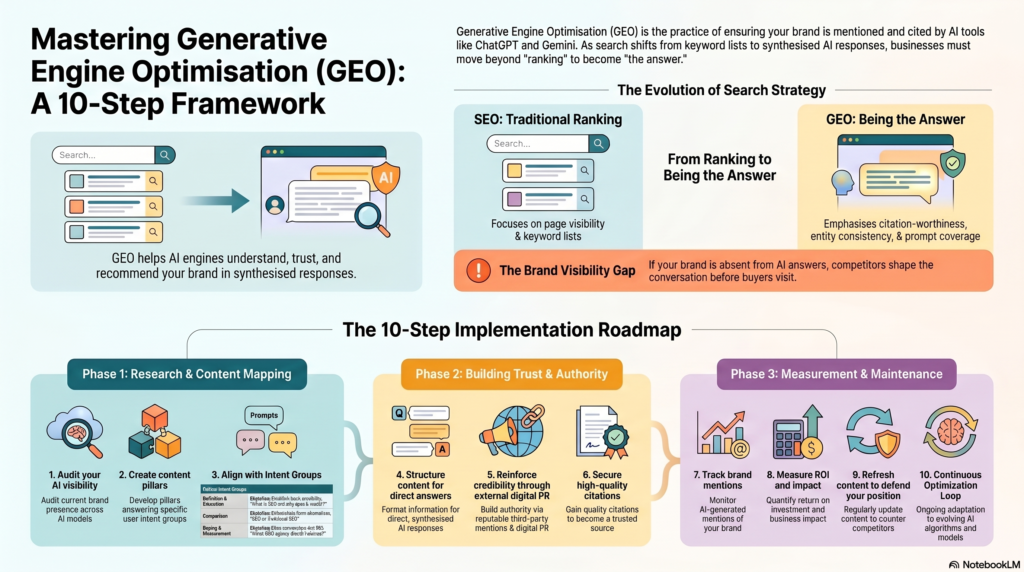
If your brand is absent from those answers, your competitors may shape the conversation before the buyer ever reaches your website.
GEO helps your business appear earlier in the buyer journey, build trust before a sales conversation, improve brand recognition in AI responses, support traditional SEO, and increase the chance of citations, mentions, and qualified visits.
GEO is not a replacement for SEO. It is an extension of SEO for the AI search era. SEO helps people find your pages. GEO helps AI systems understand, trust, and reuse your expertise.
How Does Generative Engine Optimization Work?
Generative engines do not simply match one keyword to one page. They interpret a user’s question, retrieve relevant information, compare sources, summarize the answer, and may cite supporting links.
That means your GEO strategy must go beyond one keyword and one article.
You need a connected content system that answers related questions from several angles, such as:
What is generative engine optimization?
Why is generative engine optimization important?
How does generative engine optimization work?
How to do generative engine optimization?
How to optimize content for generative engines?
Is generative engine optimization the same as traditional SEO?
Answer engine optimization vs generative engine optimization
Generative engine optimization vs traditional SEO
How to measure the success of generative engine optimization campaigns
Are there risks to using generative engine optimization?
These are not just keywords. They are answer opportunities.
Step 1: Audit Your Current AI Visibility
Before you create new content, find out where your brand stands today.
Run the same prompts your buyers are likely to ask across ChatGPT, Perplexity, Gemini, Claude, Google AI Overviews, and other answer engines.
Check whether your brand is mentioned, whether your pages are cited, which competitors appear instead of you, how AI tools describe your business, and whether those descriptions are accurate.
You should also review which third party sources influence the answer. AI generated responses may rely on your own website, competitor websites, directories, articles, listicles, reviews, and other trusted sources.
This gives you a baseline. Without a baseline, GEO becomes guesswork.
Shoden Global Communication can help your business run an AI visibility audit across major answer engines, identify where competitors are winning, and build a practical roadmap for becoming more visible in high intent AI conversations.
Step 2: Build a Prompt and Question Map
Traditional SEO starts with keywords. GEO starts with prompts, questions, and user intent.
A buyer may not ask “GEO agency” first. They may begin with:
“What is generative engine optimization?”
Then they may ask:
“How does generative engine optimization work?”
Then:
“How do I measure the ROI of generative engine optimization?”
Then:
“What are generative engine optimization services?”
Then:
“Which generative engine optimization agency should I choose?”
Your content should support that full journey.
A strong GEO question map usually includes five intent groups.
Definition intent covers questions such as “what is generative engine optimization” and “how does generative engine optimization work.”
Education intent covers questions such as “why is generative engine optimization important” and “how to do generative engine optimization.”
Comparison intent covers questions such as “generative engine optimization vs traditional SEO” and “answer engine optimization vs generative engine optimization.”
Measurement intent covers questions such as “how to measure the success of generative engine optimization campaigns” and “how do I measure the ROI of generative engine optimization.”
Buying intent covers questions such as “what are generative engine optimization services” and “generative engine optimization agency.”
This makes your content cluster stronger because every article has a clear job.
Step 3: Create a Pillar and Supporting Content Cluster
A scalable GEO content system needs a main pillar page and supporting posts.
Your pillar page should target the broad query:
“What is generative engine optimization?”
It should explain the definition, importance, process, examples, benefits, risks, measurement, and use cases.
Your supporting posts should go deeper into specific questions, such as:
How to do generative engine optimization
How to optimize content for generative engines
GEO vs SEO
AEO vs GEO
GEO best practices
How to measure GEO success
GEO risks and downsides
GEO tools and platforms
GEO services
GEO agency selection
Every supporting post should connect naturally to the main generative engine optimization guide. This helps users move through the topic and helps search systems understand the relationship between your pages.
Step 4: Structure Content for Direct Answers
AI answer engines prefer content that is easy to parse, summarize, and verify.
That does not mean writing robotic content. It means making your expertise clear.
Start important sections with a direct answer in two or three sentences. Then add supporting detail, practical examples, evidence, and related questions.
Use clear headings. Keep one main idea per section. Avoid burying important answers inside long paragraphs.
For example, instead of starting a page with a long introduction, open with a clear answer:
“Generative Engine Optimization is the process of improving your content, website, and brand authority so AI answer engines can understand, trust, mention, and cite your business.”
Then expand with examples, use cases, and proof.
This structure helps both human readers and AI systems understand the page faster.
Step 5: Make Your Pages Technically Accessible
If AI connected systems cannot access or understand your content, your chances of being cited drop.
Start with the basics. Make sure important pages are crawlable, indexable, fast, mobile friendly, and structured with clean HTML.
Use descriptive title tags, clear headings, accurate sitemaps, and helpful internal links. Avoid hiding important content behind scripts or formats that are difficult to access.
Your service pages, author details, company information, pricing details, case studies, and contact information should also be easy to find.
Technical SEO is still part of GEO. If your website is difficult to crawl or understand, AI visibility becomes harder.
Step 6: Add Evidence, Entities, and Trust Signals
Generative engines need confidence.
That confidence comes from clear information and trusted reinforcement across the web.
Improve your pages by adding author names, expert input, updated dates, clear company details, original examples, case studies, client use cases, statistics, testimonials, comparison tables, and FAQs.
Also make sure your brand entity is consistent.
Your company name, service names, founder names, location, descriptions, and core topics should be aligned across your website, social profiles, directories, guest articles, listicles, interviews, and PR placements.
If one source says one thing and another source says something different, AI systems may produce incomplete or inconsistent answers.
Shoden Global Communication can help your business clarify its brand entity, improve website content, strengthen trust signals, and create a stronger foundation for AI visibility.
Step 7: Build Authority Beyond Your Website
GEO is not only about what you publish on your own site.
AI answer engines often rely on signals from multiple sources. That means your off site reputation matters.
Useful authority sources include industry publications, expert articles, digital PR features, listicle inclusions, reviews, testimonials, partner pages, podcast appearances, data studies, and case studies.
The goal is not to spam mentions. The goal is to build a real, credible footprint around the topics you want to be known for.
If your business wants to be recommended for generative engine optimization services, AI visibility, or LLM SEO, your brand should appear in relevant trusted sources connected to those topics.
Shoden Global Communication can help your business earn stronger authority signals through digital PR, citation building, listicle inclusion, guest posting, and expert content that supports both human trust and AI visibility.
Step 8: Connect the Cluster With Internal Links
Internal linking helps readers and search systems understand which pages matter most.
A simple and scalable internal linking plan works best.
Every supporting post should link to the main pillar page using a consistent anchor such as “generative engine optimization guide.”
Each supporting post should also link to two related support articles.
For example, a “GEO vs SEO” article can link to “AEO vs GEO” and “GEO Best Practices.”
A “How to Do GEO” article can link to “Optimize Content for Generative Engines” and “GEO KPIs.”
A “Risks and Downsides” article can link to “Best Practices” and “How to Measure Success.”
This creates a connected topic cluster that is useful for readers and easier for search systems to understand.
Step 9: Measure GEO Success With the Right KPIs
You cannot measure GEO only with rankings.
AI visibility needs a broader KPI set.
Track brand mentions in AI answers, AI citations, source visibility, prompt coverage, competitor share of voice, sentiment, AI referral traffic, assisted conversions, and revenue impact.
Brand mentions show how often your company appears for target prompts.
AI citations show which pages are being used as supporting sources.
Prompt coverage shows how many priority questions produce accurate brand visibility.
Competitor share of voice shows whether other brands are appearing more often than you.
Referral traffic from AI platforms can show direct visits from tools such as ChatGPT, Perplexity, Gemini, and other AI search experiences.
Revenue impact connects GEO work to leads, sales conversations, pipeline, and closed business.
A simple GEO ROI model is:
GEO influenced revenue minus GEO cost, divided by GEO cost.
The harder part is attribution. AI answers may influence buyers before they click. That is why you should combine analytics, CRM data, lead source questions, brand search growth, and prompt tracking.
Step 10: Refresh, Expand, and Defend Your Visibility
GEO is not a one time task.
AI answers change. Competitors publish new content. Platforms change how they cite sources. Your own services, offers, and proof points also evolve.
Review your GEO program every month.
Check whether your most important prompts are improving, whether competitors are gaining visibility, whether AI answers describe your brand accurately, which pages are being cited, and which pages need better evidence.
You should also look for missing questions, weak internal links, outdated content, and new third party sources where your brand should be present.
The brands that win in GEO are not the ones that publish once. They are the ones that keep improving clarity, credibility, and coverage over time.
Generative Engine Optimization vs Traditional SEO
Traditional SEO focuses on improving visibility in search engine results pages.
GEO focuses on improving visibility inside AI generated answers.
They overlap, but they are not identical.
SEO usually asks:
“How do we rank this page for a keyword?”
GEO asks:
“How do we become a trusted source for the answer?”
SEO cares about crawlability, relevance, backlinks, content quality, and user experience.
GEO cares about those too, but also emphasizes prompt coverage, answer clarity, citation worthiness, entity consistency, off site corroboration, and AI visibility tracking.
The best strategy is not SEO or GEO. It is SEO plus GEO.
Answer Engine Optimization vs Generative Engine Optimization
Answer Engine Optimization, or AEO, focuses on making content easy to return as a direct answer.
Generative Engine Optimization focuses on making content and brand signals strong enough to be included, summarized, cited, or recommended by generative AI systems.
AEO is often closer to featured snippets, FAQ answers, and direct response formats.
GEO is broader. It includes content, technical accessibility, brand authority, digital PR, entity clarity, prompt tracking, and AI answer measurement.
In practice, they work together. A clear answer helps AEO. A credible answer supported by trusted sources helps GEO.
Common Risks and Downsides of GEO
Does GEO Work for All Types of Websites?
The main risks include overpromising results, creating low value content, chasing shortcuts, ignoring traditional SEO, measuring the wrong things, and letting AI tools define your brand incorrectly.
No agency can guarantee that every AI tool will mention your brand for every prompt.
Publishing many shallow pages can weaken trust instead of improving it.
Shortcuts such as fake mentions, manipulative content, or unnecessary technical tricks can waste time.
GEO works best when your technical SEO, content quality, authority, and brand positioning are already strong.
Good GEO is not manipulation. It is clarity, usefulness, credibility, and consistency.
Does GEO Work for All Types of Websites?
GEO can help many websites, but the best approach depends on the business model.
It works especially well for B2B service companies, SaaS brands, agencies, consultants, ecommerce brands with expert content, education companies, local service businesses, technology providers, and niche experts.
However, GEO is not equally easy for every website.
A small site with thin content, no authority, weak technical SEO, and unclear positioning will need foundational work first.
A brand with expert content, clear services, and strong third party mentions can usually move faster.
What Are Generative Engine Optimization Services?
Generative Engine Optimization services help businesses improve how they appear in AI generated answers.
A complete GEO service may include AI visibility audits, prompt research, competitive AI answer analysis, content strategy, GEO content writing, content refreshes, technical SEO checks, entity optimization, internal linking, digital PR, listicle inclusion, citation building, guest posting, AI mention tracking, and ROI reporting.
Shoden Global Communication can help your business build this system from strategy to execution.
That includes identifying the prompts your buyers ask, improving the pages AI systems can understand, strengthening your authority across trusted sources, and tracking whether your brand is gaining mentions, citations, and stronger placement over time.
Best Practices for Generative Engine Optimization
Start every important page with a clear answer to the main question.
Use natural language that matches how buyers ask questions.
Include definitions, examples, use cases, FAQs, and evidence.
Add original insight instead of repeating generic advice.
Use clear headings and simple formatting.
Link related pages together so your content cluster is easy to navigate.
Make sure important pages are crawlable, accurate, and up to date.
Keep brand and service descriptions consistent across your website and external sources.
Earn relevant third party mentions from credible websites.
Track AI visibility before and after publishing.
Refresh content as platforms, competitors, and buyer questions change.
FAQ
What is generative engine optimization?
Generative Engine Optimization is the process of improving your content, website, and brand authority so AI answer engines can understand, trust, summarize, mention, and cite your business.
Why is generative engine optimization important?
GEO is important because buyers are using AI tools to research problems, compare vendors, and make decisions. If your brand is missing from AI answers, you may lose visibility before the buyer reaches a search result or visits your website.
How does generative engine optimization work?
GEO works by making your content clear, crawlable, credible, and supported by trusted sources. AI systems are more likely to use information that is easy to extract, relevant to the question, and reinforced by authority signals.
How do I optimize content for generative engines?
Start with a direct answer, then add detail, examples, evidence, FAQs, internal links, and clear formatting. Make sure the page is crawlable, accurate, and connected to related content.
Is generative engine optimization the same as traditional SEO?
No. GEO and SEO overlap, but they are not the same. SEO focuses on search visibility. GEO focuses on AI answer visibility, citations, brand mentions, prompt coverage, and answer inclusion.
How do I measure the success of GEO campaigns?
Measure brand mentions, citations, prompt visibility, competitor share of voice, AI referral traffic, assisted conversions, sentiment, and revenue influenced by AI visibility.
How do I measure the ROI of generative engine optimization?
Compare GEO influenced revenue with the cost of strategy, content, technical work, digital PR, and tracking. Since AI answers may influence buyers before they click, combine analytics with CRM data, lead source questions, and prompt tracking.
Are there risks to using generative engine optimization?
Yes. The main risks include overpromising results, publishing shallow content, chasing shortcuts, using fake mentions, ignoring technical SEO, and failing to monitor how AI systems describe your brand.
Does generative engine optimization work for all websites?
GEO can help many websites, but results depend on content quality, authority, technical accessibility, competition, and how clearly the brand is positioned online.
What should I look for in a generative engine optimization agency?
Look for an agency that understands SEO, AI visibility, content strategy, technical optimization, digital PR, entity building, listicle inclusion, citation tracking, and ROI measurement. Shoden Global Communication can help your business build a practical GEO system designed for how people and AI tools discover brands today.
Conclusion: GEO Is How Your Brand Becomes the Answer
Generative Engine Optimization is not a trick. It is a structured way to make your business easier to understand, easier to trust, and easier to cite in AI generated answers.
The best GEO strategy starts with real buyer questions. It turns those questions into useful content. It connects content through a clear internal linking system. It strengthens credibility with trusted external signals. Then it measures what matters: mentions, citations, visibility, traffic, leads, and revenue.
If your business wants to appear where modern buyers are asking questions, Shoden Global Communication can help you build the strategy, content, authority, and tracking system needed to compete in the AI search era.