

Generative Engine Optimization is becoming an important growth channel for businesses that want to appear in AI generated answers, search overviews, chat platforms, answer engines, and research tools. As more customers use AI to compare companies, understand services, and shortlist providers, businesses need a clear way to measure whether GEO is actually working.
The challenge is that GEO success does not always look like traditional SEO success. You may not always see a simple ranking position, a direct click, or a clear referral source. Instead, your brand may appear inside an AI answer, be cited as a trusted source, influence a buyer’s research journey, or support demand before someone visits your website.
That is why GEO KPIs matter.
The right KPIs help you understand where your brand appears, how accurately it is represented, which content is being cited, and whether your GEO strategy is contributing to leads, pipeline, revenue, and ROI.
Table of Contents
What are GEO KPIs?
GEO KPIs are the metrics used to measure the performance of generative engine optimization campaigns. They show how visible your brand is across AI powered search experiences and whether that visibility is creating business value.
A strong GEO measurement framework looks at more than traffic. It tracks brand mentions, citations, answer accuracy, competitor visibility, content performance, branded search growth, assisted conversions, lead quality, and revenue influence.
For a complete foundation, read our generative engine optimization guide.
Why GEO measurement is different from SEO measurement
Traditional SEO focuses on rankings, organic impressions, clicks, backlinks, traffic, and conversions. Those metrics still matter, but GEO adds another layer.
AI platforms often answer users directly. A potential customer may ask a question, receive a summary, see your brand mentioned, and visit your website later through branded search, direct traffic, LinkedIn, email, or a sales referral.
That means the value of GEO is not always captured by last click attribution.
GEO measurement needs to answer questions such as:
- How often does our brand appear in AI generated answers?
- Are we mentioned for the right topics?
- Are we cited as a trusted source?
- Are AI tools describing our business accurately?
- Are we appearing alongside or ahead of competitors?
- Are AI influenced journeys creating leads, opportunities, and revenue?
To understand the difference more clearly, read generative engine optimization vs traditional SEO and answer engine optimization vs generative engine optimization.
The most important GEO KPIs to track
The best GEO reporting framework should include five main areas:
- AI visibility
- Brand citation quality
- Content authority
- AI influenced engagement
- Revenue and ROI
Together, these KPIs show whether your business is being discovered, trusted, and chosen through AI powered search experiences.
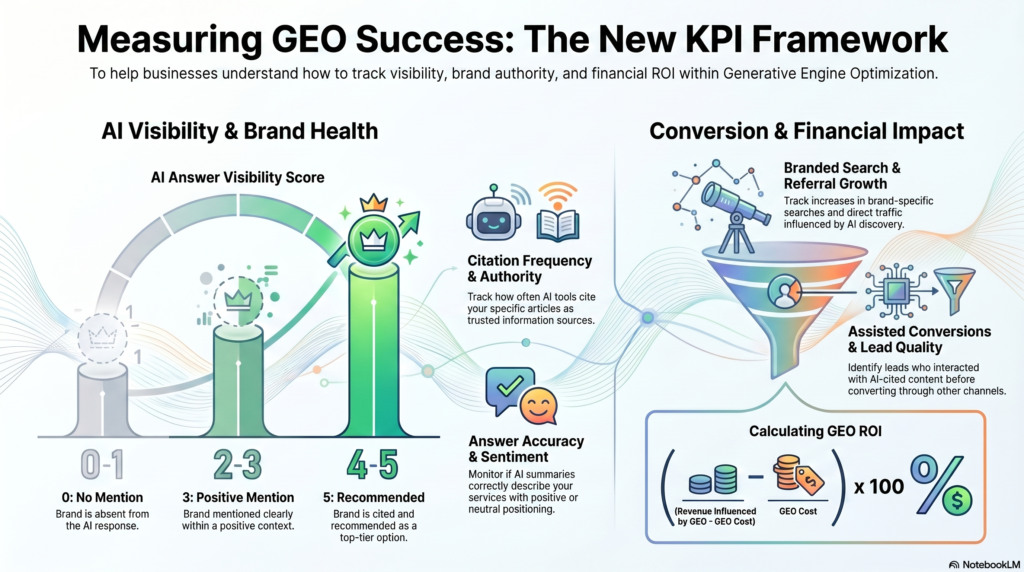
1. AI answer visibility
AI answer visibility measures how often your brand appears in AI generated responses for priority topics and questions. This is one of the most important GEO KPIs because it shows whether your business is part of the AI discovery journey.
Track visibility for queries such as:
- What is generative engine optimization?
- Why is generative engine optimization important?
- How does generative engine optimization work?
- How to do generative engine optimization?
- How to optimize content for generative engines?
- Is generative engine optimization the same as traditional SEO?
- Generative engine optimization vs traditional SEO
- Answer engine optimization vs generative engine optimization
- How to measure the success of generative engine optimization campaigns?
- How do I measure the ROI of generative engine optimization?
- What are generative engine optimization services?
- Generative engine optimization agency
For each query, review whether your brand appears, how it appears, and whether the context is useful.
A basic scoring system can help:
- 0 means no mention
- 1 means weak or indirect mention
- 2 means clear brand mention
- 3 means brand mention with positive context
- 4 means brand mention with citation or link
- 5 means brand recommended as a strong option
The goal is to increase both the number of prompts where your brand appears and the quality of those appearances.
2. Share of AI answer
Share of AI answer measures how often your brand appears compared with competitors.
For example, if you test 50 important prompts and your brand appears in 15 answers, your AI visibility rate is 30 percent. If a competitor appears in 30 answers, their visibility rate is 60 percent. This KPI helps you understand whether competitors are gaining more visibility in AI generated recommendations.
Track:
- Your brand mentions
- Competitor mentions
- Industry publication mentions
- Directory mentions
- Review platform mentions
- Influencer or expert mentions
- Citation sources used by AI platforms
This is especially useful for commercial and transactional queries such as “best AI tools for generative engine optimization,” “best generative engine optimization platforms 2025,” and “generative engine optimization agency.”
3. Citation frequency
Citation frequency measures how often AI tools cite your website, articles, service pages, case studies, research, or third party coverage.
A brand mention is useful. A citation is stronger. When your content is cited, it means your page is being treated as a source of information. It also gives users a clearer path to visit your website.
Track citations from:
- Blog posts
- Service pages
- Case studies
- Original research
- Comparison pages
- FAQ pages
- Digital PR articles
- Partner pages
- Industry publications
- Business profiles
If your website is not being cited, the problem may be content depth, structure, freshness, authority, technical accessibility, or weak external validation. For practical improvements, read how to optimize content for generative engines and generative engine optimization best practices.
4. Answer accuracy
Visibility is only valuable if the answer is accurate. AI tools may summarize your services, location, audience, pricing, process, or strengths in a way that is incomplete, outdated, or misleading. That is why answer accuracy should be part of every GEO report.
Review whether AI answers correctly describe:
- Your company name
- Your services
- Your target audience
- Your markets
- Your positioning
- Your proof points
- Your differentiators
- Your contact options
- Your current offers
- Your areas of expertise
Use a simple accuracy score:
- Accurate
- Partly accurate
- Outdated
- Misleading
- Incorrect
- No answer
If AI answers are inaccurate, your GEO strategy should focus on clearer website content, stronger entity signals, updated service pages, consistent external references, structured data, and better internal linking.
5. Sentiment and positioning
A brand mention is not always a positive result. The way your business is described matters. Sentiment and positioning measure whether AI generated answers present your brand in a positive, neutral, or negative way.
Look for phrases such as:
- Recommended for
- Known for
- Best suited to
- A strong option for
- Specializes in
- Useful for
- Trusted by
- Limited by
- Less suitable for
This KPI helps you understand whether AI platforms are placing your brand in the right competitive context. For example, if your business works with enterprise clients but AI tools describe you as a small business provider, your positioning signals may need to be improved.
6. Prompt coverage
Prompt coverage measures how many important customer questions your content can answer. A strong GEO strategy should cover the full buyer journey.
This includes definition queries such as “what is generative engine optimization,” educational queries such as “why is generative engine optimization important,” process queries such as “how does generative engine optimization work,” and action based queries such as “how to do generative engine optimization.”
It should also include comparison queries such as “generative engine optimization vs traditional SEO,” measurement queries such as “how to measure the success of generative engine optimization campaigns,” and ROI queries such as “how do I measure the ROI of generative engine optimization.”
The more complete your content ecosystem is, the easier it becomes for AI systems to understand your expertise and include your brand in relevant answers.
7. Content authority
Content authority measures whether your website has enough depth, clarity, and credibility to support AI visibility. AI platforms are more likely to use content that is clear, useful, well structured, and supported by trustworthy signals.
Track content authority through:
- Topic coverage
- Content freshness
- Clear headings
- FAQ sections
- Schema markup
- Author information
- Internal links
- External links
- Original examples
- Case studies
- Digital PR mentions
- Backlinks
- Brand consistency
- Entity clarity
Strong GEO content should be easy for humans to read and easy for machines to understand.
8. Internal linking strength
Internal linking helps search engines and AI systems understand how your content is connected. Every supporting GEO article should link back to the main generative engine optimization guide using a consistent anchor.
Supporting articles should also link to related content.
- For example, GEO vs SEO should link to AEO vs GEO and GEO best practices.
- How to do GEO should link to optimize content for generative engines and GEO KPIs.
- Risks and downsides of GEO should link to GEO best practices and how to measure GEO success.
This structure supports topical authority and helps AI systems understand the relationship between your pages.
9. Branded search growth
GEO often creates demand before it creates a click. A user may see your brand in an AI answer, remember it, and search for your business later. That makes branded search growth an important GEO KPI.
Track:
- Brand name searches
- Brand plus service searches
- Brand plus agency searches
- Brand plus reviews searches
- Brand plus pricing searches
- Brand plus case studies searches
- Direct traffic
- Homepage visits
- Service page visits
- Contact page visits
If AI visibility improves and branded search grows at the same time, GEO may be contributing to increased demand.
10. AI referral traffic
Some AI platforms send direct referral traffic to websites. Others influence journeys without showing a clear referral source. Even so, AI referral traffic should be tracked wherever possible.
Monitor visits from sources such as:
- ChatGPT
- Perplexity
- Gemini
- Copilot
- Claude
- You.com
- Google AI experiences
- Other AI search and answer platforms
In analytics, create a custom channel group for AI referrals so these visits can be measured separately from organic search, paid search, social, and direct traffic.
Track:
- Sessions
- Engaged sessions
- Average engagement time
- Page views
- Service page visits
- Contact form submissions
- Booked calls
- Assisted conversions
- Revenue where available
AI referral traffic may be smaller than traditional organic search traffic, but the users can be highly valuable because they often arrive after a research based interaction.
11. Assisted conversions
GEO is often an assisted channel. A buyer may discover your brand in an AI answer, read one of your articles, return later through branded search, visit a service page, and then submit a form. If you only measure last click conversions, you may undervalue GEO.
Track assisted impact through:
- Multi touch attribution
- CRM notes
- Self reported attribution
- First touch source
- Returning visitor behavior
- Content journey paths
- Sales call insights
- Lead form responses
A simple form question such as “How did you hear about us?” can reveal AI influenced journeys that analytics may miss.
12. Lead quality
The goal of GEO is not only more visibility. The goal is better business outcomes. Lead quality shows whether GEO is attracting the right audience.
Track:
- Company size
- Industry fit
- Budget fit
- Role or seniority
- Problem fit
- Sales accepted leads
- Sales qualified leads
- Proposal requests
- Close rate
- Deal value
- Time to close
- Customer lifetime value
If GEO brings fewer visits but stronger leads, it can still produce excellent ROI.
13. Pipeline influenced by GEO
For B2B companies, pipeline is often more useful than traffic alone. Track how many opportunities were influenced by AI visibility, AI referral traffic, GEO content, or AI cited pages.
Useful CRM fields include:
- First touch source
- Last touch source
- AI referral source
- Content viewed before conversion
- Self reported source
- Campaign influence
- Opportunity value
- Sales stage
- Closed won revenue
You can also tag contacts who viewed GEO focused content, including comparison pages, best practice articles, service explainers, and ROI content.
14. Revenue influenced by GEO
Revenue is the clearest business KPI. To measure GEO influenced revenue, combine analytics, CRM data, sales feedback, and self reported attribution.
Track:
- Closed won deals from AI referral traffic
- Closed won deals that viewed GEO content
- Closed won deals that mentioned AI tools during discovery
- Revenue from branded search journeys after AI visibility improved
- Revenue from service pages supported by GEO content
- Revenue from leads influenced by comparison or measurement articles
Because GEO attribution is still developing, use a blended measurement model instead of relying on one source of data.
15. Cost per AI influenced lead
Cost per AI influenced lead helps you measure efficiency. The formula is simple:
Cost per AI influenced lead = GEO campaign cost divided by AI influenced leads
GEO campaign costs may include strategy, content creation, technical optimization, digital PR, research, schema implementation, reporting tools, consulting, and internal team time.
AI influenced leads may include direct AI referral leads, leads from GEO landing pages, leads from branded search after AI discovery, leads that self report AI tools, and leads influenced by AI cited content.
This KPI helps compare GEO with SEO, paid search, LinkedIn ads, events, outbound sales, and other channels.
16. GEO ROI
GEO ROI measures the financial return from your investment. Use this formula:
GEO ROI = Revenue influenced by GEO minus GEO cost, divided by GEO cost, multiplied by 100
For example, if a GEO campaign costs $20,000 and influences $80,000 in revenue, the ROI is 300 percent.
You can also calculate pipeline ROI: Pipeline ROI = Pipeline influenced by GEO divided by GEO cost
Pipeline ROI is useful when sales cycles are long and closed revenue takes time to appear.
How to measure the ROI of generative engine optimization
A practical GEO ROI model should include three layers.
The first layer is direct impact. This includes traffic, leads, and sales that come directly from AI referrals or clearly tagged AI journeys.
The second layer is assisted impact. This includes users who interacted with GEO content before converting through another channel.
The third layer is strategic impact. This includes brand visibility, competitor presence, stronger topical authority, more accurate AI representation, branded search growth, and increased trust.
A strong GEO report should show all three layers because generative engine optimization is not only a traffic channel. It is also a visibility, trust, and demand creation channel.
How often should GEO KPIs be measured?
GEO performance should be reviewed regularly because AI generated answers can change.
Weekly tracking is useful for priority prompts, brand mentions, competitor mentions, and major answer changes.
Monthly reporting should cover AI visibility, citation frequency, AI referral traffic, branded search, content performance, and lead quality.
Quarterly reviews should focus on pipeline, revenue influence, ROI, content gaps, competitor visibility, and strategy priorities.
Fast moving industries may need more frequent monitoring, especially in competitive B2B, SaaS, technology, finance, healthcare, travel, legal, and professional services markets.
Common GEO measurement mistakes
One common mistake is only tracking traffic. GEO can influence buyers even when it does not produce an immediate click.
Another mistake is checking only one AI platform. Different tools can produce different answers, so your brand should be monitored across several AI search and answer experiences.
A third mistake is ignoring answer accuracy. A brand mention is not useful if the information is wrong, outdated, or poorly positioned.
Another mistake is treating GEO as separate from SEO. GEO depends on strong content, technical quality, authority, relevance, brand consistency, and trust signals.
The final mistake is expecting instant ROI. GEO builds over time. The strongest results usually come from a connected content ecosystem, not one isolated article.
Does GEO work for all types of websites?
GEO can help many types of websites, but the opportunity depends on the market, audience, and buying journey.
It is especially useful for businesses where customers research before converting. This includes B2B services, SaaS, agencies, consulting, healthcare, finance, legal, education, real estate, ecommerce, travel, and technology.
It may be less effective for websites with very low search demand, unclear positioning, thin content, limited authority, or products that people rarely research through AI tools.
Before investing heavily, businesses should check whether their audience is likely to ask AI tools about their category, services, competitors, pricing, risks, benefits, and solutions.
Are there risks to using GEO?
GEO has risks, but most can be managed with the right strategy.
Common risks include inaccurate AI summaries, weak attribution, over reliance on one platform, outdated information, generic content, and inconsistent brand signals.
The solution is to build a strong foundation with clear service pages, expert content, original insights, technical SEO, digital PR, internal links, external credibility, structured information, and regular monitoring.
For more detail, read risks and downsides of generative engine optimization and generative engine optimization best practices.
A simple GEO KPI dashboard
A useful GEO dashboard should include AI visibility rate, share of AI answer, brand mention count, competitor mention count, citation frequency, citation source quality, answer accuracy, sentiment, prompt coverage, AI referral traffic, branded search growth, engaged sessions, leads from GEO content, AI influenced leads, sales qualified leads, pipeline influenced, closed won revenue, campaign cost, cost per AI influenced lead, and GEO ROI.
This gives leadership a clear view of visibility, trust, engagement, and commercial impact.
How Shoden Global Communication can help your business
Shoden Global Communication helps businesses improve their visibility across search engines, AI answer engines, and digital discovery channels.
For businesses investing in GEO, Shoden Global Communication can help build a measurable strategy that connects content, SEO, digital PR, AI visibility, brand authority, and performance reporting.
That includes identifying the questions your buyers ask, creating content that AI platforms can understand, improving how your brand appears in AI generated answers, strengthening trust signals across the web, and tracking the KPIs that connect visibility to business growth.
The goal is not only to appear in more AI answers. The goal is to turn visibility into trust, trust into qualified traffic, and qualified traffic into leads, pipeline, and revenue.
Whether your business needs a GEO strategy, AI visibility tracking, content optimization, internal linking, service page improvements, digital PR support, or ROI reporting, Shoden Global Communication can help you build a practical system for long term growth.
Final thoughts
GEO success is not measured by one number.
A strong campaign should improve AI visibility, increase accurate brand mentions, earn more citations, support branded search growth, attract better leads, and influence revenue.
The most important question is not only whether your business appears in AI answers. The better question is whether AI generated answers are helping the right buyers understand, trust, and choose your business.
When your GEO KPIs answer that question clearly, generative engine optimization becomes a measurable growth channel.