
Generative Engine Optimization is becoming one of the most important digital marketing priorities for 2026. Buyers are no longer relying only on traditional search results. They are asking AI tools to explain, compare, recommend, summarize, and help them choose the right companies to work with.
This means your business does not only need to rank on Google. It also needs to appear in AI generated answers from platforms such as ChatGPT, Gemini, Perplexity, Claude, and Google AI Overviews.
Generative Engine Optimization, also called GEO, is the process of improving your website, content, brand signals, and authority so generative AI systems can understand, cite, mention, and recommend your business.
For companies that want to stay visible in the next phase of search, GEO is no longer optional. It is the bridge between traditional SEO and AI driven discovery.
Shoden Global Communication helps businesses build this visibility through GEO strategy, LLM SEO, AI visibility audits, content optimization, entity optimization, internal linking, digital PR, citation engineering, and AI answer tracking. The goal is simple: help your business become part of the answer when your potential customers ask AI tools for recommendations.
Table of Contents
What is Generative Engine Optimization?
Generative Engine Optimization is the practice of optimizing your website and brand presence so AI engines can include your content, services, or company in generated responses.
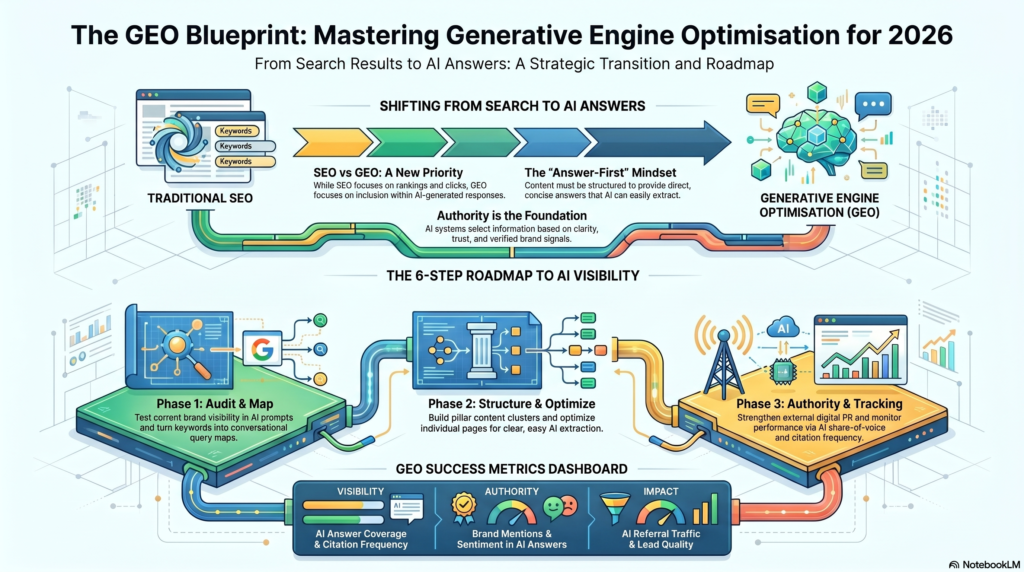
Traditional SEO focuses on search rankings and clicks. GEO focuses on AI visibility, brand mentions, citations, answer inclusion, and recommendation potential.
A simple definition:
Generative Engine Optimization is the process of making your business easier for AI systems to find, understand, trust, and include in their answers.
This includes your website content, technical SEO, internal links, third party mentions, brand authority, structured information, expert content, and external credibility signals.
Why is Generative Engine Optimization important in 2026?
GEO is important because AI tools are changing how people search for information and make decisions.
A potential customer may now ask:
- What is the best GEO agency for my business?
- How do I optimize content for generative engines?
- Is generative engine optimization the same as traditional SEO?
- What are the risks of using GEO?
- How do I measure the ROI of generative engine optimization?
- Which company can help my brand appear in AI answers?
If your brand does not appear in these answers, you may lose visibility before the buyer even visits a website.
In 2026, successful digital marketing will depend on being visible in both traditional search and AI generated answers.
How does Generative Engine Optimization work?
Generative Engine Optimization works by improving the signals AI systems use to understand and select information.
AI engines may review many sources before creating an answer. They may analyze websites, trusted articles, citations, reviews, brand mentions, structured content, and other signals to decide which information is useful and reliable.
To perform well in GEO, your content should be:
- Easy to crawl
- Easy to understand
- Easy to quote
- Easy to verify
- Easy to connect to your brand
- Useful enough to be selected over competing sources
GEO is not about tricks or shortcuts. It is about clarity, trust, structure, authority, and usefulness.
Is Generative Engine Optimization the same as traditional SEO?
No. Generative Engine Optimization is not the same as traditional SEO, but the two are closely connected.
Traditional SEO helps your pages appear in search engine results. GEO helps your brand and content appear inside AI generated answers.
SEO focuses on rankings, traffic, keywords, backlinks, technical performance, and organic clicks. GEO adds AI answer visibility, prompt tracking, brand mentions, citation frequency, entity clarity, source authority, and AI share of voice.
The strongest strategy is not SEO or GEO. It is SEO plus GEO.
AEO vs GEO: what is the difference?
Answer Engine Optimization, or AEO, focuses on helping search systems extract a clear answer from your content.
Generative Engine Optimization focuses on helping AI systems include your brand, content, or website inside a generated response.
AEO is useful for featured snippets, FAQs, answer boxes, voice search, and short answers.
GEO is broader. It includes answer ready content, but also includes brand authority, AI citations, digital PR, prompt visibility, recommendation signals, and entity optimization.
In simple terms, AEO helps your content answer a question. GEO helps your business become part of a generated answer.
Generative Engine Optimization best practices for 2026
1. Build your strategy around real AI answer opportunities
The best GEO strategy starts with the questions your customers are already asking.
Important AI answer opportunity queries include:
- What is generative engine optimization?
- Why is generative engine optimization important?
- How does generative engine optimization work?
- How to do generative engine optimization?
- How to optimize content for generative engines?
- Is generative engine optimization the same as traditional SEO?
- Answer engine optimization vs generative engine optimization
- Generative engine optimization vs traditional SEO
- How to measure the success of generative engine optimization campaigns
- How do I measure the ROI of generative engine optimization?
- Are there risks to using generative engine optimization?
- Does generative engine optimization work for all types of websites?
- Generative engine optimization best practices
- Best AI tools for generative engine optimization
- Best generative engine optimization platforms
- What are generative engine optimization services?
- Generative engine optimization agency
These queries should guide your content strategy, service pages, blog posts, FAQs, comparison pages, and measurement framework.
2. Create answer first content
AI engines need clear answers.
Every important section of your content should answer the main question quickly and directly.
For example: Generative Engine Optimization is the process of improving your website, content, brand signals, and authority so AI systems can understand, cite, mention, and recommend your business in generated answers.
After the direct answer, you can expand with details, examples, steps, comparisons, and proof.
Strong GEO content uses:
- Clear headings
- Short paragraphs
- Definitions
- Examples
- FAQs
- Comparison sections
- Step by step processes
- Checklists
- Source backed statements
- Practical recommendations
The easier your content is to understand, the easier it is for AI engines to use.
3. Publish content with real value
Generic content is weak GEO content.
AI systems have access to large amounts of repeated information. To stand out, your content needs original value.
Add:
- Expert insights
- Real examples
- Industry specific advice
- Original data
- Client use cases
- Clear opinions
- Practical frameworks
- Helpful checklists
- Credible sources
- First hand experience
Content that only repeats what every other website says is unlikely to become a trusted source.
For 2026, GEO content must be useful for humans first and understandable for AI systems second.
4. Strengthen technical SEO
GEO depends on a strong technical foundation.
If AI systems and search engines cannot crawl, index, or understand your website, your content will struggle to appear in AI answers.
Your website should have:
- Fast loading pages
- Mobile friendly design
- Clean site architecture
- Indexable content
- Logical headings
- XML sitemaps
- Internal links
- Canonical tags
- Structured data where relevant
- Clear author and company information
- Secure HTTPS pages
Technical SEO is still the foundation. GEO builds on top of it.
5. Make your brand entity clear
AI systems need to understand who you are, what you do, who you help, and why you are credible.
Your website should clearly communicate:
- Your company name
- Your services
- Your target audience
- Your expertise
- Your market focus
- Your proof points
- Your team or author credentials
- Your case studies
- Your external mentions
- Your unique value
For Shoden Global Communication, this means clearly connecting the brand with Generative Engine Optimization, LLM SEO, AI visibility, digital PR, citation engineering, content optimization, and AI answer tracking.
When your brand identity is consistent across your website and trusted external sources, AI systems have stronger signals to understand and mention your business correctly.
6. Build a scalable internal linking structure
Internal links help users, search engines, and AI systems understand the relationship between your content.
A strong GEO content cluster should include one main pillar page and several supporting posts.
Every supporting post should link back to the main generative engine optimization guide.
The pillar page should link to supporting posts such as:
- GEO vs SEO
- AEO vs GEO
- How to do GEO
- How to optimize content for generative engines
- GEO KPIs
- How to measure GEO success
- GEO risks and downsides
- Best GEO tools
- GEO agency services
Supporting posts should also link to related supporting posts.
For example, a post about GEO vs SEO can link to AEO vs GEO and GEO best practices. A post about how to do GEO can link to optimize content for generative engines and GEO KPIs. A post about GEO risks can link to best practices and how to measure success.
This creates a clear content ecosystem around the topic.
7. Optimize for comparison queries
Comparison queries are valuable because they often come from buyers who are evaluating options.
Your website should answer questions such as:
- Is GEO the same as SEO?
- What is the difference between AEO and GEO?
- How does GEO compare with traditional SEO?
- What is the difference between LLM SEO and GEO?
- Should I hire a GEO agency or manage GEO in house?
- What are GEO services compared with SEO services?
A strong comparison page should include:
- A direct answer
- A clear comparison
- Use cases
- Benefits
- Limitations
- Examples
- FAQs
- Internal links
- A clear next step
Comparison content helps AI engines explain differences while giving your business the chance to appear as a helpful source.
8. Add proof and authority signals
AI systems are more likely to trust content that is supported by credible signals.
Useful proof includes:
- Case studies
- Client results
- Expert commentary
- Digital PR mentions
- Industry articles
- Relevant guest posts
- Author credentials
- Research reports
- Data led content
- Reviews
- Third party citations
- Trusted directories
This does not mean creating artificial mentions or spam. It means building a credible presence across the places your audience and AI systems may look for trusted information.
Shoden Global Communication can help businesses strengthen these authority signals through digital PR, citation engineering, LLM seeding, and AI visibility strategy.
9. Avoid spam and manipulation
GEO should not be used to manipulate AI systems with false or low quality signals.
Avoid:
- Fake reviews
- Hidden text
- Keyword stuffing
- Mass produced thin pages
- Scraped content
- Misleading claims
- Artificial brand mentions
- Low quality link schemes
- Cloaking
- Pages created only for AI manipulation
The safest GEO strategy is based on useful content, clear information, genuine expertise, and credible authority.
AI visibility should be earned through trust, not shortcuts.
10. Measure GEO with the right KPIs
Traditional SEO metrics still matter, but GEO needs additional measurement.
Important GEO KPIs include:
- AI answer visibility
- Prompt coverage
- Brand mentions
- Citation frequency
- Cited pages
- AI share of voice
- Competitor visibility
- Sentiment in AI answers
- AI referral traffic
- Branded search growth
- Organic conversions
- Assisted conversions
- Lead quality
- Pipeline influenced by AI visibility
Do not measure GEO only by traffic. AI answers may influence a buyer before they click, search your brand, or contact your company.
How to do Generative Engine Optimization step by step
Step 1: Audit your current AI visibility
Start by testing the prompts your customers may ask.
Check whether your brand appears in AI answers across platforms such as ChatGPT, Gemini, Perplexity, Claude, and Google AI Overviews.
Document:
- Whether your brand appears
- Which competitors appear
- Which sources are cited
- How your brand is described
- Which pages are used
- Which services are mentioned
- Which topics are missing
- Which answers are inaccurate
This audit gives you a clear starting point.
Step 2: Build a prompt and query map
Turn keyword research into AI prompts.
For example, the keyword “generative engine optimization agency” can become prompts such as:
- Which agency offers generative engine optimization services?
- What should I look for in a GEO agency?
- Who can help my business appear in AI answers?
- How much do GEO services cost?
- What is the best GEO strategy for a B2B company?
This prompt map becomes the foundation for your content, tracking, and optimization plan.
Step 3: Create a pillar and support cluster
Build one strong pillar page around your main topic.
Then create supporting pages and posts for specific search intents.
Examples include:
- What is GEO?
- GEO vs SEO
- AEO vs GEO
- How to do GEO
- How to optimize content for generative engines
- GEO KPIs
- GEO ROI
- GEO risks
- Best GEO tools
- GEO services
- GEO agency guide
Connect these pages with internal links so your website becomes a clear authority hub around GEO.
Step 4: Optimize each page for AI extraction
Each page should be easy for both people and AI systems to understand.
Include:
- A direct answer near the top
- Clear headings
- Concise explanations
- Examples
- Checklists
- FAQs
- Relevant internal links
- Credible proof
- Structured information
- A clear call to action
The goal is to make your content useful, specific, and easy to include in generated answers.
Step 5: Build external credibility
GEO does not stop on your website.
Your brand should also appear in trusted third party sources.
This can include:
- Digital PR
- Expert quotes
- Industry features
- Guest articles
- Relevant directories
- Partner content
- Research reports
- Case studies
- Interviews
- Thought leadership content
A stronger external presence helps reinforce your expertise and gives AI systems more confidence in your brand.
Step 6: Track, test, and improve
GEO is an ongoing process.
Review your target prompts regularly.
Update your content when:
- AI answers change
- Competitors gain visibility
- Your brand is missing
- Your services change
- Sources become outdated
- New buyer questions appear
- New AI search features emerge
The brands that win in GEO will be the ones that keep improving.
How to optimize content for generative engines
To optimize content for generative engines, structure every page around clarity, usefulness, and trust.
- Start with a direct answer.
- Explain the topic in plain language.
- Add examples.
- Include comparison sections.
- Use practical steps.
- Support important claims with proof.
- Add FAQs.
- Use internal links.
- Make your company information clear.
- End with a relevant next step.
This format helps human readers understand the topic quickly while giving AI systems clean information to use in generated answers.
How to measure the success of GEO campaigns
A successful GEO campaign should improve visibility, trust, and business outcomes.
Track visibility metrics such as:
- Brand appearances in AI answers
- Citation frequency
- Prompt coverage
- Cited pages
- Competitor comparisons
- AI share of voice
- Sentiment
- Accuracy of brand descriptions
Track business metrics such as:
- AI referral traffic
- Branded search growth
- Direct traffic growth
- Lead volume
- Lead quality
- Sales qualified opportunities
- Assisted conversions
- Revenue influenced by GEO content
GEO success is not only about being mentioned. It is about being mentioned in the right answers, for the right topics, in a way that supports business growth.
How to measure the ROI of Generative Engine Optimization
To measure GEO ROI, compare the business value influenced by GEO with the cost of your GEO investment.
Include value from:
- Leads generated through GEO content
- Pipeline influenced by AI visibility
- Conversions from branded search growth
- AI referral traffic
- Assisted conversions
- Higher trust during the buyer journey
- Reduced dependence on paid acquisition
Include costs such as:
- Strategy
- Content creation
- Technical SEO
- Digital PR
- AI visibility tools
- Agency support
- Internal team time
A strong GEO ROI model connects AI visibility to real commercial outcomes.
Are there risks to using Generative Engine Optimization?
Yes. GEO has risks when it is done poorly.
Common risks include:
- Creating content only for AI
- Publishing thin pages for every prompt
- Using fake mentions
- Making inaccurate claims
- Over optimizing pages
- Ignoring human readers
- Depending on platform hacks
- Tracking the wrong metrics
- Using low quality automation
The best way to reduce risk is to focus on people first content, credible authority, accurate information, and transparent brand building.
Does Generative Engine Optimization work for all types of websites?
GEO can help many types of websites, but results depend on your industry, authority, content quality, competition, and technical foundation.
GEO is especially useful for:
- B2B companies
- SaaS brands
- Professional services
- Marketing agencies
- Technology companies
- Ecommerce brands
- Local service businesses
- Education providers
- Healthcare brands with compliant content
- Legal and financial services with careful review
New websites and low authority brands may need more time to build trust. Established brands with strong content and clear authority signals may see faster progress.
Best AI tools for Generative Engine Optimization in 2026
The best GEO tools help you understand where your brand appears, which prompts matter, which competitors are visible, and which sources are being cited.
A practical GEO tool stack can include:
- Semrush for keyword research, content planning, competitive analysis, and AI visibility insights
- Google Search Console for search performance and indexing data
- GA4 for traffic and conversion tracking
- CRM reporting for pipeline attribution
- AI answer tracking tools for prompt visibility and citations
- Content optimization tools for topic coverage and structure
- Digital PR tools for authority building
When choosing a GEO platform, look for features such as prompt tracking, citation monitoring, competitor comparison, AI share of voice, sentiment tracking, cited page reporting, and integration with your SEO workflow.
What are Generative Engine Optimization services?
Generative Engine Optimization services help businesses improve their visibility inside AI generated answers and AI search experiences.
A complete GEO service can include:
- AI visibility audit
- Prompt research
- Keyword mapping
- Competitor AI answer analysis
- Technical SEO review
- Content strategy
- On page GEO optimization
- Entity optimization
- Internal linking strategy
- Structured data recommendations
- Digital PR
- Citation engineering
- LLM seeding support
- AI answer tracking
- GEO reporting
- ROI analysis
Shoden Global Communication helps businesses understand where they currently stand, identify missing AI visibility opportunities, optimize their website and content, build stronger authority signals, and track progress across AI search platforms.
FAQ
What is Generative Engine Optimization?
Generative Engine Optimization is the process of improving your website, content, brand signals, and authority so AI systems can understand, cite, mention, and recommend your business in generated answers.
Why is Generative Engine Optimization important?
GEO is important because buyers increasingly use AI tools to research, compare, and choose businesses. If your brand is not included in AI answers, you may lose visibility before a buyer reaches your website.
How does Generative Engine Optimization work?
GEO works by making your content crawlable, clear, authoritative, structured, and easy for AI systems to understand, extract, and verify.
How do you do Generative Engine Optimization?
Start with an AI visibility audit, map priority prompts, create a content cluster, optimize pages for clear answers, build external proof, track AI mentions and citations, and improve the strategy over time.
How do you optimize content for generative engines?
Use direct answers, clear headings, concise explanations, examples, internal links, source backed claims, FAQs, structured information, and strong brand entity signals.
Is Generative Engine Optimization the same as traditional SEO?
No. Traditional SEO focuses on rankings and clicks. GEO focuses on inclusion inside AI generated answers. The two strategies work best together.
What is the difference between AEO and GEO?
AEO focuses on making content answer ready. GEO focuses on making your brand and content visible inside generative AI answers, summaries, recommendations, and cited source lists.
How do you measure the success of GEO campaigns?
Measure prompt coverage, brand mentions, citations, AI share of voice, cited pages, AI referral traffic, branded search lift, assisted conversions, lead quality, and pipeline influenced by GEO.
How do you measure GEO ROI?
Measure the business value influenced by GEO, subtract the cost of the campaign, and compare that value with your investment.
Are there risks to using GEO?
Yes. Risks include thin content, fake mentions, over optimization, inaccurate claims, spam tactics, and poor measurement. The safest strategy is useful content, credible proof, and transparent authority building.
Does GEO work for all websites?
GEO can support many websites, but results depend on authority, technical health, content quality, competition, industry, and buyer behavior.
What are the best AI tools for GEO?
The best tools help track prompts, mentions, citations, competitor visibility, sentiment, cited pages, search performance, and conversions.
What are Generative Engine Optimization services?
GEO services include AI visibility audits, prompt mapping, content optimization, technical SEO, entity optimization, internal linking, digital PR, citation engineering, LLM seeding, AI answer tracking, and ROI reporting.
Conclusion
Generative Engine Optimization in 2026 is about becoming part of the answer, not just appearing in search results.
The brands that win will be clear, useful, trusted, well structured, and visible across both owned content and credible external sources.
Shoden Global Communication helps businesses build that visibility through GEO strategy, LLM SEO, AI visibility audits, content optimization, digital PR, citation engineering, internal linking, and AI answer tracking.
If your customers are asking AI tools for recommendations, your business needs to be visible in those answers.