
If you want to show up in AI answers, you need more than “good SEO.” You need ai strategic visibility: a deliberate system that makes your brand easier to understand, safer to recommend, and simpler to summarize when answer engines compare options.
AI recommendations don’t happen because you publish more content. They happen when your content is clear enough to reuse, your claims are easy to validate, and your brand signals are consistent across the places AI systems and people trust.
Table of Contents
What is ai strategic visibility?
ai strategic visibility is your ability to be repeatedly understood and recommended by AI answer engines for the questions that lead to revenue.
It’s not just about “ranking” anymore It’s also:
• Being named as an option
• Being summarized accurately
• Being cited or linked (when citations are provided)
• Being compared favorably when the answer includes multiple choices
A simple way to think about it:
SEO helps you get found.
AI strategic visibility helps you get chosen.
Why does ai strategic visibility matter now?
Because discovery is shifting from “which page ranks first?” to “which brand gets suggested inside the answer?”
That shift creates two new realities:
• You can have strong rankings and still lose attention if users get what they need from the AI answer panel.
• You can earn real influence without a click if your brand becomes a frequent “recommended next step.”
This is why teams that treat AI visibility like a measurable channel (instead of a vague trend) tend to move faster and waste less time.
How is ai strategic visibility different from AEO, GEO, LLM Seeding, and LLM SEO?
This post is meant to support your Answer Engine Optimization pillar (not replace it). Here’s the clean positioning so you avoid cannibalization:
AEO (Answer Engine Optimization)
Focus: Becoming the recommended answer in AI experiences.
Best for: How content becomes the answer or the shortlist.
GEO (Generative Engine Optimization)
Focus: Ranking in generative search experiences and being used as the source for answers.
Best for: Structuring and covering topics so your pages are “answer eligible.”
LLM Seeding
Focus: Reinforcing your brand facts and definitions across trusted sources.
Best for: Consistency and credibility beyond your website.
LLM SEO
Focus: Winning visibility in LLM-driven discovery, including LLM traffic and answer inclusion.
Best for: A measurable approach that blends classic SEO foundations with AI-era extractability.
AI strategic visibility (this post)
Focus: The operating system that connects strategy, content formats, authority, and measurement into one framework.
Best for: Making your AI visibility repeatable across multiple answer engines and query types.
If you want the deepest “what it is” definitions, keep those in your pillars. This post is about execution: how to set up a framework your team can run every month.
How do AI systems decide who to recommend?
Most recommendation-style answers are built on a few predictable needs. The system is trying to reduce risk while helping the user decide faster.
Recommendations tend to favor brands and pages that provide:
• Clear definitions (no vague marketing language)
• Fast answers (the first lines do the work)
• Decision criteria (why one option fits vs another)
• Consistent signals (same story across key pages and profiles)
• Proof and constraints (specificity that prevents misunderstandings)
If you want to write for AI recommendations, assume the answer engine wants four elements:
- The direct answer
- The criteria (what matters to choose)
- The trade-offs (what to watch out for)
- The fit (who this is for, and who it’s not for)
What is the AI Strategic Visibility framework?
Here’s the framework we use at Shoden Global to keep AI visibility practical, measurable, and scalable.
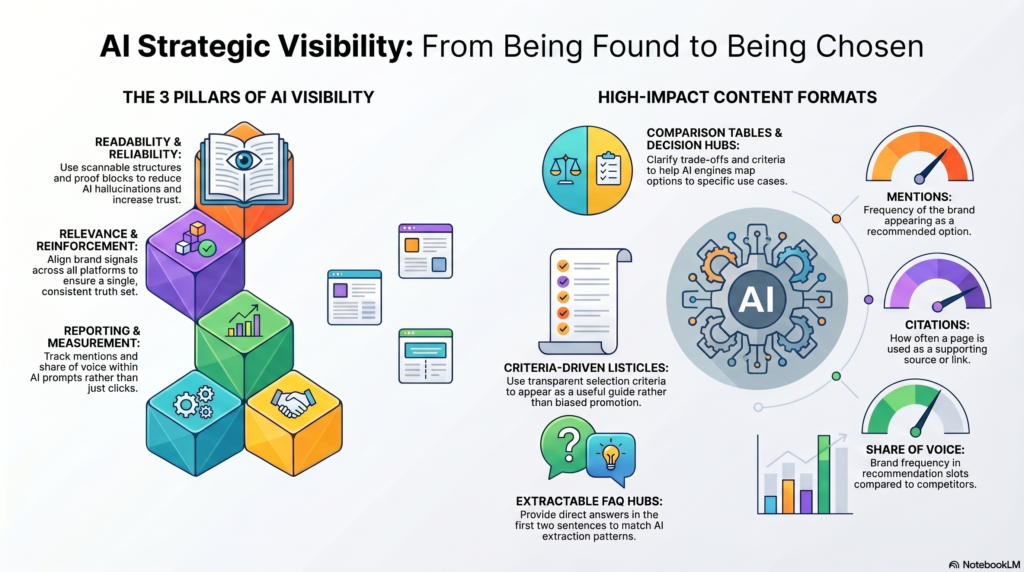
The AI Strategic Visibility framework has five pillars:
• Relevance
• Readability
• Reliability
• Reinforcement
• Reporting
Framework at a glance (use this as your internal checklist)
- Relevance
Goal:
Show up for the questions that actually drive decisions.
What you do:
Map questions to the buying journey and pick “recommendation moments.”
What to publish:
Pillars, supporting pages, and decision guides tied to real intent.
What to measure:
Share of voice on target prompts, and coverage gaps.
- Readability
Goal:
Make your content easy to extract and summarize accurately.
What you do:
Use question headings, short answers first, and scannable structure.
What to publish:
FAQs, comparisons, checklists, how-to sections, and clear definitions.
What to measure:
Which pages get mentioned, quoted, or cited most often.
- Reliability
Goal:
Increase trust by reducing exaggeration and ambiguity.
What you do:
Add proof blocks, constraints, and transparent claims.
What to publish:
Method pages, process explanations, case studies, and “how we evaluate” criteria.
What to measure:
Reduction in misrepresentation, better match quality in recommendations.
- Reinforcement
Goal:
Make your brand story consistent across trusted environments.
What you do:
Align About pages, bios, profiles, partners, and citations with one truth set.
What to publish:
Consistent descriptions, verified profiles, and selective third-party reinforcement.
What to measure:
Consistency checks and corroboration signals.
- Reporting
Goal:
Turn visibility into a channel you can manage.
What you do:
Track mentions, citations, LLM traffic, and assisted conversions.
What to publish:
Measurement dashboards and an ongoing improvement backlog.
What to measure:
Trends over time, not one-off wins.
How do you apply the framework step by step?
This is the simplest way to operationalize ai strategic visibility without turning it into a never-ending project.
Step 1: Pick your “recommendation questions”
Choose 10–20 questions where being recommended would create real business value:
• Best X for Y
• Top agencies/tools/providers for Z
• X vs Y for a specific use case
• How to choose X
• Common mistakes with X
Step 2: Create a brand truth set (one internal doc)
This is the wording you want repeated consistently across your site and key mentions:
• What you do (one sentence)
• Who you serve
• Your differentiators (only what you can support)
• Your process (high level)
• Your definitions (how you use key terms)
Step 3: Build a “decision hub” page for each core topic
This is where many brands fall short: they publish content, but not decision-making structure.
Your decision hub should include:
• A short definition
• Criteria to choose an approach
• A comparison table
• A short “best for” section
• Links to deeper supporting pages
Step 4: Create 3 supporting assets that make extraction easy
Pick three from this list:
• FAQ page
• Comparison page (X vs Y)
• Checklist page
• Listicle-style “best options” page with criteria
• Step-by-step implementation guide
Step 5: Add proof and constraints (the reliability layer)
This is where you reduce risk and increase trust.
Examples:
• “Best for” and “not ideal for” lines
• Clear scope boundaries
• Real examples of outcomes (no inflated stats)
• Transparent selection criteria (especially in listicles)
Step 6: Reinforce consistency across your footprint
Update:
• About page and service pages
• Author bios and team pages
• Key profiles and partner listings
• Definitions and naming consistency
Step 7: Measure, improve, and expand
Once your initial set is live:
• Track mentions and citations monthly
• Improve the pages that are closest to winning
• Expand into adjacent questions once you win the first set
Which content formats increase ai strategic visibility fastest?
If you want faster traction, focus on formats that compress decision-making and are easy to summarize.
High-impact formats (in order of usefulness for recommendations)
• Comparison pages (because they clarify trade-offs)
• Criteria checklists (because they explain how to choose)
• FAQ hubs (because they match question intent)
• “Best for” decision guides (because they map options to use cases)
• Listicles with transparent criteria (because they fit recommendation intent)
A simple content format rule:
If a human can skim it and confidently decide, an answer engine can usually summarize it more safely.
How can listicles help you get recommended in AI answers?
Listicles can support ai strategic visibility because recommendation answers often come out in list form. When a user asks “best,” “top,” or “recommended,” a structured list is the natural response shape.
But listicles only help if they are editorial and criteria-driven.
A listicle that improves recommendation likelihood usually includes:
• A clear promise (who the list is for)
• Transparent selection criteria (how items were chosen)
• Consistent formatting for each item
• A one-line “best for” statement per item
• A comparison table (so trade-offs are obvious)
• A neutral tone (so it reads like guidance, not hype)
Listicle mini-template (copy/paste)
For each item:
• Name
• One-sentence description
• Best for (one line)
• Why it’s a fit (2–4 bullets)
• Watch-outs (1–2 bullets)
Subtle but important point:
A “best of” page without criteria reads biased. A “best of” page with criteria reads useful. AI systems tend to prefer useful.
If you want a done-for-you approach, Shoden Global’s listicle service is built around this format discipline (criteria, consistency, comparisons) so the output is decision-helpful and extractable without feeling promotional.
Where should you publish to improve ai strategic visibility?
Think in three layers: owned, earned, and community. Start with what you control, then reinforce selectively.
Owned (start here)
Best for:
Canonical truth and extractable answers.
Examples:
• Pillar pages and supporting posts
• Glossary and definitions
• Service pages and process pages
• FAQs and comparison pages
Earned/partner (reinforcement)
Best for:
Credibility and corroboration.
Examples:
• Partner ecosystem pages
• Interviews and reputable directories
• Co-marketing pages with aligned brands
Community (selective)
Best for:
Demonstrating expertise with real substance.
Examples:
• Professional communities where buyers ask questions
• Niche forums and Q&A threads
A practical rule:
If your audience trusts the platform, it’s worth reinforcing there.
If your audience doesn’t trust the platform, it’s usually not worth seeding there just for visibility.
How do you measure ai strategic visibility?
Measurement is where most brands are thin. If you want strategic visibility, you need proof that visibility is improving and that it connects to outcomes.
Track two layers:
• Visibility signals (mentions, citations, share of voice)
• Business signals (LLM traffic, assisted conversions, lead quality)
AI Strategic Visibility scorecard (simple, measurable)
Metric: Mentions
What it means:
Your brand appears as an option in AI answers.
How to track:
A fixed prompt set (25–50 prompts), checked monthly.
What “good” looks like:
More mentions for high-intent questions over time.
Metric: Citations/links (when provided)
What it means:
Your page is used as a supporting source.
How to track:
Log which pages get cited and what question triggered it.
What “good” looks like:
Citations concentrate on your best decision hubs and comparisons.
Metric: Share of voice
What it means:
How often competitors are recommended instead of you.
How to track:
Record the top recommended brands for each prompt.
What “good” looks like:
Your brand appears consistently in the same “slots.”
Metric: LLM traffic
What it means:
Clicks from AI experiences into your site.
How to track:
Analytics referral patterns and landing page behavior.
What “good” looks like:
Higher engagement and conversion quality than average.
Metric: Assisted conversions
What it means:
AI influenced the journey, even if the final click came later.
How to track:
Channel paths, branded search lift, and pipeline attribution.
What “good” looks like:
AI-origin visitors return and convert through other channels.
A simple measurement routine
• Monthly: run the prompt set and log mention/citation changes
• Monthly: review top landing pages from AI-related traffic sources
• Quarterly: update truth set and consistency checks
• Quarterly: refresh top decision hubs with new comparisons and clearer criteria
How long does ai strategic visibility take to improve?
You can see early signals in weeks if you improve structure and publish clear decision assets. More durable “recommended” visibility typically compounds over months as your footprint becomes more consistent and reinforced.
What moves faster
• Tightening answers (first 1–2 sentences)
• Adding comparison tables and criteria
• Publishing a strong FAQ hub for repeated questions
• Creating one criteria-driven listicle
What moves slower
• Becoming a default recommendation in competitive categories
• Building consistent reinforcement across multiple trusted sources
• Developing enough topical depth that AI systems regularly pull from your cluster
Common Mistakes
• Treating ai strategic visibility like a one-time content project instead of a system
• Writing long introductions that delay the answer
• Publishing listicles with no selection criteria (they look biased and unhelpful)
• Avoiding trade-offs (users and AI both need constraints)
• Being inconsistent across About page, service pages, and bios
• Measuring only clicks, ignoring mentions and share of voice
• Rebuilding definitions in every post instead of linking back to your pillars
Quick Answers
What is ai strategic visibility?
It’s your ability to be repeatedly understood and recommended by AI answer engines for high-intent questions.
How is ai strategic visibility different from AEO?
AEO focuses on optimizing for answer inclusion. AI strategic visibility is the operating system that connects content, authority, and measurement to make inclusion repeatable.
What’s the fastest way to improve AI recommendation likelihood?
Publish one decision hub with criteria, a comparison table, and clear “best for” guidance.
Do listicles help?
Yes, when they are criteria-driven, consistently formatted, and include a comparison table.
How do you measure it?
Track mentions, citations, and share of voice with a fixed prompt set, then connect it to LLM traffic and assisted conversions.
How long does it take?
Weeks for early wins, months for durable recommendation patterns.
Conclusion
AI strategic visibility is how brands shift from being “findable” to being “recommendable.” The playbook is consistent: target high-intent questions, publish decision assets that are easy to extract, reinforce your truth set across trusted environments, and measure progress with a repeatable system.
If you want to operationalize this without turning it into an endless project, start with one decision hub, one FAQ, one comparison page, and one criteria-driven listicle. Then measure, refine, and expand.
FAQ
What does ai strategic visibility mean in plain language?
It means your brand shows up more often when people ask AI tools for recommendations, and the recommendations describe you accurately.
Is ai strategic visibility just SEO?
No. It builds on SEO fundamentals but adds extractability, decision criteria, consistency, and measurement for AI answers.
How do I start if I only have a few pages?
Start with: one clear service page, one FAQ hub, one decision guide with a comparison table, and one criteria-driven listicle.
What content formats work best?
Comparisons, checklists, FAQs, decision guides, and listicles with transparent selection criteria.
What should I avoid?
Vague claims, unsupported “best” statements, inconsistent brand descriptions, and content that hides the answer.
How can Shoden Global help?
Shoden Global can help you build the operating system: mapping questions, structuring decision assets, reinforcing credibility, and measuring visibility over time.