

If you’re looking for generative engine optimization services, you’re probably trying to solve a very specific problem: your brand may be doing “fine” in traditional search, but you want to appear in AI-generated answers where buyers now ask for recommendations, comparisons, and best options.
Generative Engine Optimization (GEO) services are the practical work of making your brand and content easier for AI systems to understand, trust, retrieve, and reference. This usually combines content strategy, on-site clarity, authority signals, and measurement—delivered as a repeatable process, not a one-time trick.
Table of Contents
Generative engine optimization services help you earn visibility inside AI answers by improving how your expertise is expressed, validated, and reinforced across your website and other credible sources, so AI systems can confidently include you in responses.
What are generative engine optimization services?
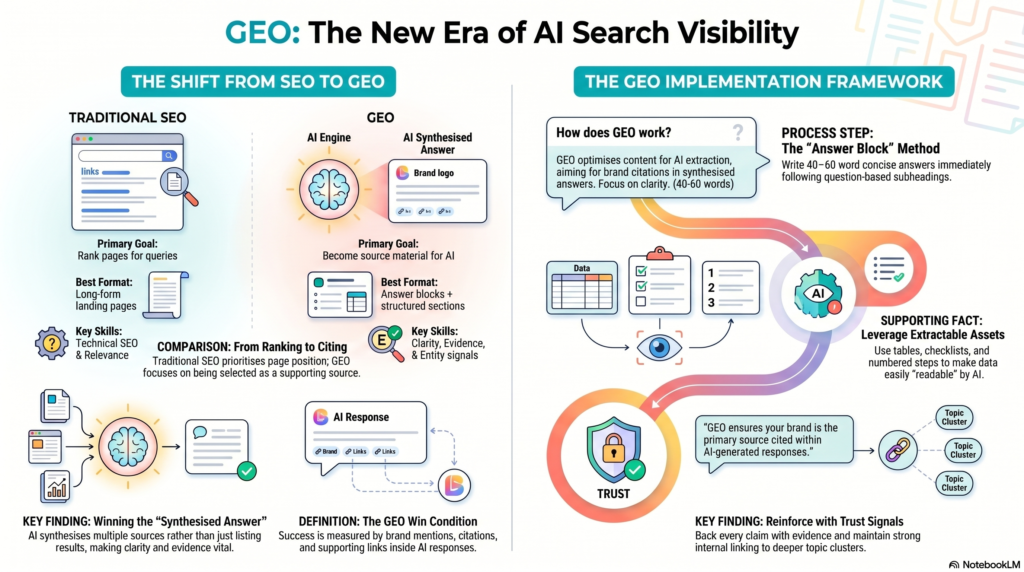
Generative engine optimization services are professional services that help a brand become discoverable, understandable, and recommendable in AI-generated answers, not just in traditional search results.
In practice, GEO services focus on two outcomes:
- Make your site and content “easy to cite” by being structured, specific, and proof-oriented.
- Build external confirmation signals (mentions, citations, expert references, and relevant links) that reinforce credibility.
A simple way to think about it:
- SEO helps you rank in search results pages.
- GEO helps you show up inside the answer itself (or the sources the answer relies on).
At Shoden Global, our team treats GEO as a system: clear entities, high-utility content formats, strong internal linking, and measurable visibility improvements across the AI-driven discovery journey.
What’s included in a GEO services engagement?
A strong GEO services engagement usually includes a mix of strategy, execution, and reporting—because AI visibility is rarely “one change” that fixes everything.
Here are the deliverables most buyers should expect.
1) GEO discovery and audit
A GEO audit is not just another SEO audit. It typically covers:
- Brand and entity clarity (who you are, what you do, who you serve, what you’re best at)
- Content gaps for AI-answer queries (definitions, comparisons, “best for,” “how to,” troubleshooting)
- Evidence and trust signals (proof blocks, expert quotes, author credibility, references)
- Internal linking and topical cluster structure
- Baseline visibility measurement (what you’re already being cited for and where you’re absent)
2) Content roadmap built for AI answers
Most GEO services include a roadmap that prioritizes:
- Low-difficulty, high-intent queries
- “Extractable” content formats (FAQs, lists, comparisons, glossaries, checklists, step-by-steps)
- Supporting clusters that strengthen your existing pillar pages (instead of creating keyword cannibalization)
3) High-utility content production (or optimization)
Depending on your team, this can look like:
- Creating new cluster posts that target specific AI-answer questions
- Rewriting key pages to include clearer definitions, better structure, and proof
- Building comparison pages that buyers (and AI systems) can summarize
- Adding “buyer decision” sections: who this is for, when it’s a fit, when it’s not
4) On-site clarity improvements (technical + editorial)
This is where GEO overlaps with great modern SEO:
- Strong information architecture (pillar + spokes)
- Clean internal linking that helps both humans and machines understand your site
- Structured data where it makes sense (Organization, Article, FAQPage, Author)
- Better “About,” “Contact,” and author credibility pages (often overlooked)
5) Distribution and reinforcement
Many brands stop after publishing. GEO services typically include a reinforcement layer such as:
- Repurposing key answers into formats that travel well (short posts, definitions, Q&A)
- Ethical citation-building: earning mentions and references on relevant, credible sites
- Collaboration with subject matter experts to increase trust and specificity
This is also where LLM seeding often becomes a companion process. If you want the deeper version, you can connect this work to your existing LLM seeding pillar at /how-llm-seeding-works/.
6) Measurement and reporting
Good GEO reporting doesn’t pretend AI visibility is a single metric. You’ll usually track:
- Coverage: which priority topics now have strong pages
- Visibility: presence in AI answers for defined prompt sets
- Citations: whether your pages are being referenced as sources
- Conversions: assisted impact on leads, demos, or sales conversations
How are GEO services different from traditional SEO services?
GEO services differ from traditional SEO services mainly in what they optimize for: being selected and summarized by AI systems, not only ranking positions.
Traditional SEO services often prioritize:
- Technical SEO health
- Keyword-to-page mapping
- Backlinks and authority building
- SERP rankings and organic traffic growth
GEO services prioritize those fundamentals too, but add additional requirements:
- Answer-ready structure (clear definitions, direct responses, structured sections)
- Entity clarity (who/what you are in a way machines can consistently interpret)
- Proof orientation (sources, quotes, process details, constraints, experience)
- Topic reinforcement across multiple credible surfaces (not just your blog)
A useful buyer mindset:
If your current SEO already brings traffic but your brand isn’t getting “picked” in AI answers, GEO services are the missing layer.
Do GEO services include Answer Engine Optimization and LLM seeding?
Often, yes—because in real life these disciplines overlap. But you should still expect a clear scope so you’re not paying for vague buzzwords.
Most modern engagements include three layers:
- GEO (generative engine optimization): become a credible, retrievable source for AI answers
- AEO (answer engine optimization): structure content to win “best answer” behaviors and recommendation patterns
- LLM seeding: distribute and reinforce your key answers across places where AI systems commonly retrieve or validate information
The best providers won’t treat these as separate silos. They’ll use them as a coordinated system:
- Your site becomes the canonical source of truth.
- Supporting surfaces reinforce credibility and consistency.
- Measurement closes the loop so content decisions stay data-driven.
Which GEO service option is right for you: DIY, in-house, or agency?
The right GEO services option depends on your speed requirements, internal expertise, and how much “proof-heavy” content you can produce consistently.
Here’s a compact comparison table you can use to decide.
| Option | Best for | Strengths | Risks / Limitations |
| DIY (founder-led) | Early-stage brands with time and strong domain expertise | Lowest costFastest learning loop | Slow executionInconsistent output |
| In-house team | Brands that can hire writers/SEOs and manage quality | Long-term compoundingInternal knowledge retention | Hiring takes timeStrategy can drift without a strong framework |
| Agency (GEO services provider) | Brands that want speed and clear deliverables | Faster productionProven processes | Quality variesRisk of generic work if not SME-led |
| Hybrid (agency + in-house) | Teams that want speed plus internal ownership | Best of both worlds when managed well | Requires strong coordinationNeeds clear editorial standards |
A common winning path:
Start with an agency-led audit + roadmap, then build in-house publishing muscle while keeping strategic oversight and measurement tight.
How do you choose the right generative engine optimization agency?
You choose the right provider by evaluating whether they can produce specific, proof-oriented content, build reinforcement ethically, and measure results without hiding behind vanity metrics.
Use this step-by-step process to reduce risk.
Step-by-step: How to evaluate a GEO services provider
- Ask for their definition of GEO (in one paragraph)
If they can’t explain it without buzzwords, the engagement will be messy. - Ask what they optimize for (rankings, citations, mentions, conversions)
A good answer includes multiple outcomes, not only “rank higher.” - Request a sample content outline for one of your money topics
Look for: direct answers, comparison sections, buyer criteria, and proof blocks. - Ask how they handle subject matter expertise
If your niche needs accuracy, you need a plan for SME input, review, or interviews. - Ask how distribution and reinforcement is done
You want ethical, relevant reinforcement—not spam, not fake accounts, not low-quality placements. - Ask what reporting looks like in month 1, month 2, and month 3
Early wins are often coverage and improved clarity; later wins can include citations and assisted conversions. - Check whether they can integrate with your existing pillars
They should build clusters that strengthen pages like /generative-engine-optimization-geo-guide/ rather than creating overlapping duplicates.
Buying tip:
If the agency’s pitch is “we’ll make you show up in every AI answer,” treat that as a red flag. You want process, not promises.
How much do generative engine optimization services cost?
Generative engine optimization services cost depends on scope, depth of expertise, and how much execution you need (strategy-only vs full content production vs authority reinforcement).
Instead of focusing on a single “price,” evaluate pricing models and what they include.
Common GEO services pricing models
- One-time audit and roadmap
Best when you have an internal team ready to execute. - Monthly retainer
Best when you need steady production, optimization, distribution, and reporting. - Project-based packages
Best when you want a defined set of deliverables (for example, a cluster of supporting posts plus updates to your pillar pages). - Hybrid model (audit + retainer)
Often the most practical: get clarity first, then execute consistently.
What typically increases cost (and also increases outcomes)
- Heavy SME involvement or interviews
- High-stakes topics requiring careful review
- Competitive categories where proof and authority matter
- Strong distribution and reinforcement (done ethically and selectively)
- Measurement across multiple AI answer surfaces
If you want a “sanity check” when reviewing a proposal, the easiest question is:
“What specifically will be published, updated, and reinforced in the first 30 days?”
How long does GEO take to show results?
GEO timelines vary, but most brands see meaningful movement after consistent publication, reinforcement, and iteration—not after a single update.
A realistic timeline often looks like this:
- Weeks 1–2: audit, roadmap, and priority fixes (clarity, structure, internal links)
- Weeks 3–6: first supporting cluster goes live (spokes that strengthen your pillars)
- Weeks 6–12: reinforcement + optimization + early visibility signals
- Ongoing: compounding effects as coverage, credibility, and corroboration improve
Leading indicators you can watch early
- Your key pages become clearer, more structured, and more “answer-ready”
- More impressions on long-tail informational queries
- Mentions and references begin to show up in third-party surfaces
- Stronger conversion behavior from visitors landing on decision-support content
How do you measure success for GEO services?
You measure GEO success by tracking coverage, visibility, citations, and business outcomes together—because no single metric tells the whole story.
A practical GEO measurement dashboard includes:
- Topic coverage: how many priority questions have strong, dedicated pages
- AI-answer presence: do you appear for your prompt set (consistent prompts, consistent checking)
- Citation quality: where you’re cited and whether those citations drive qualified clicks
- Assisted conversion impact: do these pages support sales conversations and shorten evaluation cycles
Measurement tip:
Create a fixed “prompt set” (20–50 prompts) aligned to your buyer journey, and track it on a schedule. If you change prompts constantly, your reporting becomes noise.
What should you prepare before hiring GEO services?
Before you hire GEO services, you’ll get better outcomes if you prepare your inputs, decision points, and review workflow.
Use this checklist before you sign a contract.
Pre-hire GEO checklist (copy/paste)
- Clear positioning: what you sell, who you sell to, and what you’re best at
- Your top 5–10 revenue-driving use cases (the “money topics”)
- Competitive context: who buyers compare you against
- Access to subject matter experts (even 30 minutes per month helps)
- Existing assets: case studies, documentation, methodology, examples
- Approval process: who reviews content and how fast
- Internal linking targets: pillar pages you want strengthened (including /generative-engine-optimization-geo-guide/ and /how-llm-seeding-works/)
- Measurement agreement: what gets tracked and how often
If you do nothing else, make sure your provider gets clarity on:
What do you want to be known for, and what proof do you have that it’s true?
Common Mistakes
Here are the mistakes that most often waste budget in GEO services engagements:
- Buying “AI visibility” with no deliverables
If a proposal doesn’t specify exactly what will be published or updated, you can’t manage outcomes. - Publishing content that answers questions but has no proof
AI systems (and buyers) prefer information that’s specific, constrained, and supported by credible reasoning, process detail, or references. - Creating multiple “pillar” posts that overlap
This leads to cannibalization. One pillar should be the canonical guide; supporting posts should go deep on a single angle (services, tools, tracking, tactics). - Treating GEO as only content
Without internal linking, entity clarity, and reinforcement, content alone is often too weak to become a cited source. - Measuring with random prompts
If measurement isn’t consistent, you’ll either panic too early or celebrate noise. - Overdoing distribution in a spammy way
Low-quality “seeding” can harm trust. Reinforcement should be selective, relevant, and human-sensible.
Quick Answers
Q: Are GEO services worth it if my SEO is already strong?
A: Often yes—GEO adds “answer-ready structure” and reinforcement so your content can be selected inside AI responses, not only ranked in search.
Q: Do GEO services replace SEO?
A: No. GEO usually builds on SEO fundamentals and adds new requirements for extractable answers, entity clarity, and credibility signals.
Q: What deliverable should I expect first?
A: A GEO audit plus a prioritized roadmap tied to specific pages and specific AI-answer queries.
Q: Can GEO services help a new site with low authority?
A: Yes, if you start with narrow, high-utility topics and build credibility with proof-heavy content and ethical reinforcement over time.
Q: What’s the biggest red flag when hiring a GEO agency?
A: Vague promises with no publishing plan, no measurement plan, and no clear definition of success.
Q: What’s the fastest “first win” in GEO?
A: Improving a key pillar page with clearer definitions, better internal linking, and a few high-intent supporting posts that answer buyer questions directly.
Conclusion
If you’re serious about being discovered through AI answers, the right generative engine optimization services engagement should feel practical: clear deliverables, proof-driven content, ethical reinforcement, and reporting that ties visibility improvements to business outcomes.
At Shoden Global, we help teams turn GEO from a buzzword into an operating system—so your best content becomes easy to understand, easy to trust, and easy to include in AI recommendations. If you want a GEO audit and a prioritized roadmap that strengthens your existing pillars, our team can help.
FAQS
What are generative engine optimization services?
They’re services that help your brand and content become understandable, trustworthy, and selectable inside AI-generated answers through content structure, credibility signals, and measurement.
What should be included in GEO services?
A mix of audit, content roadmap, content creation/optimization, on-site clarity improvements, reinforcement, and reporting tied to a consistent prompt set.
Is GEO the same as Answer Engine Optimization (AEO)?
They overlap. AEO focuses on being the best direct answer; GEO focuses on being selected and cited across generative answer systems. Most brands benefit from doing both together.
How does LLM seeding fit into GEO services?
LLM seeding is typically part of the reinforcement layer—publishing and distributing clear, consistent answers in credible places that support your on-site source of truth.
How do I know if a GEO services provider is any good?
They can explain GEO clearly, show a plan for proof-heavy content, demonstrate ethical reinforcement, and report progress with consistent measurement—not just vague “visibility” claims.
Do I need a big budget to start GEO?
Not necessarily. Start with a narrow cluster, strengthen one pillar page, publish a few high-utility supporting posts, then expand as you see traction.
Can GEO services help with AI Overviews or similar AI features in search?
GEO principles often help because they improve clarity, structure, and credibility. The exact impact depends on your niche, competition, and how well your content answers the query.