
Generative Engine Optimization, or GEO, is becoming a major part of digital visibility.
As more buyers use ChatGPT, Gemini, Perplexity, Claude, Google AI Overviews and other AI answer engines to research products, services, and vendors, businesses want to know how to appear inside those answers.
That makes sense. Being mentioned, cited, or recommended by AI systems can influence trust before a buyer ever reaches your website.
But GEO also comes with risks.
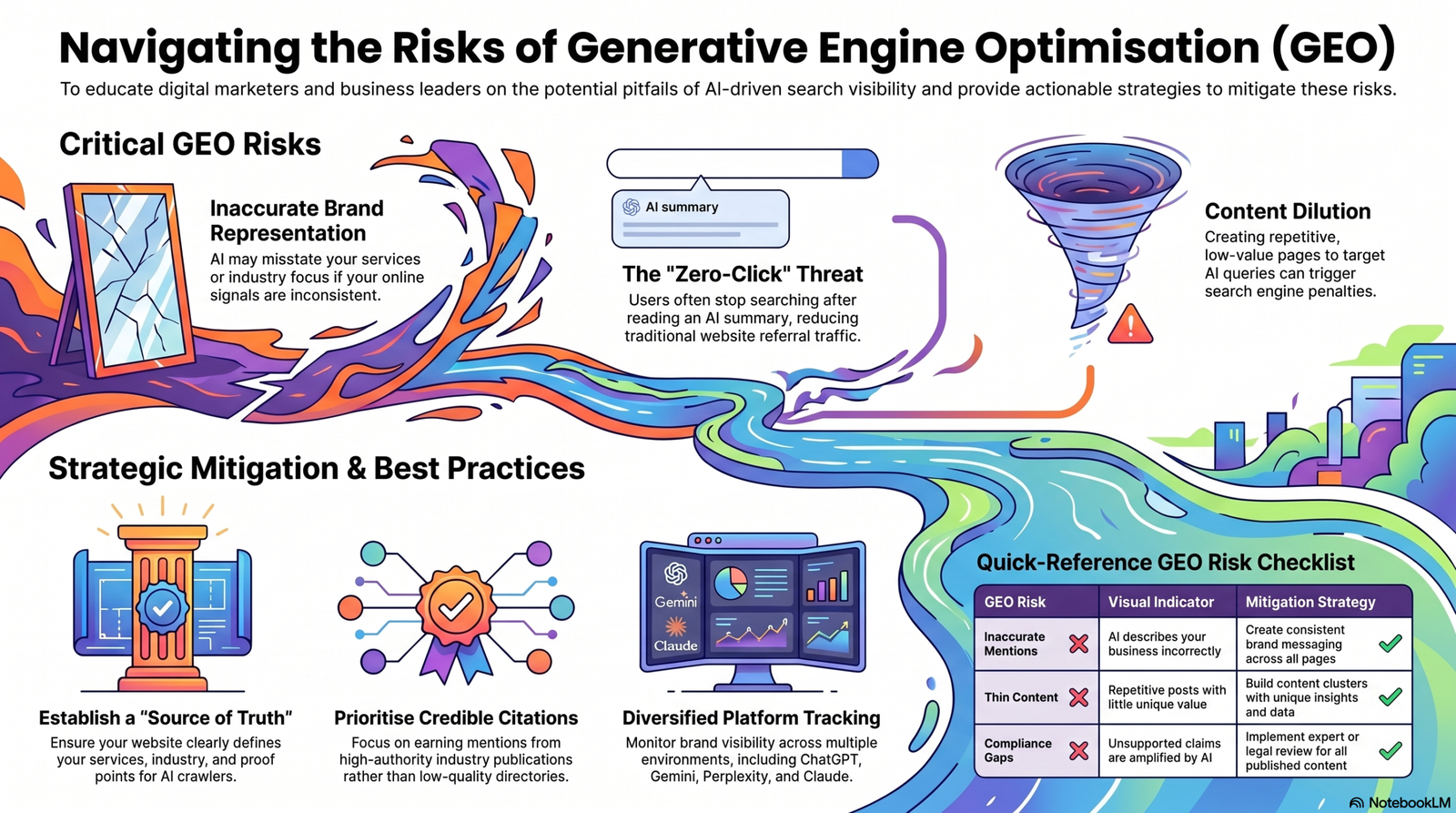
If it is handled badly, GEO can lead to thin content, inaccurate brand positioning, wasted budget, misleading performance reports, and even lower website traffic. The goal is not to chase AI mentions at any cost. The goal is to build a clear, credible, measurable visibility system that helps both humans and AI understand why your business deserves to be trusted.
For the full foundation, start with our generative engine optimization guide.
Table of Contents
What Is Generative Engine Optimization?
Generative Engine Optimization is the process of improving how your brand, website, and expertise appear inside AI generated answers.
Traditional SEO focuses on visibility in search results. GEO focuses on visibility inside AI responses, summaries, recommendations, comparisons, and sourced answers.
A strong GEO strategy usually includes:
- Clear content that answers real customer questions
- Structured pages that AI systems can understand
- Expert led information that goes beyond generic summaries
- Strong internal linking across related topics
- External mentions from credible sources
- Technical SEO that helps crawlers access and interpret your content
- Measurement across AI mentions, citations, referral traffic, branded search, leads, and revenue influence
GEO is not a replacement for SEO. Google’s own guidance says generative AI search visibility is still rooted in core search ranking and quality systems, with AI features using retrieval and grounding from indexed web pages.
That is why the safest approach is not “GEO instead of SEO.” It is SEO, content strategy, digital PR, and AI visibility tracking working together.
Why GEO Risk Matters
AI answer engines change how people discover information.
Instead of clicking through ten blue links, users may get a summarized answer that compares options, explains a concept, or recommends a provider. Google says AI Overviews are designed to help users understand a topic faster and explore supporting links.
That creates opportunity, but it also creates pressure.
If your business is missing from AI answers, competitors may shape the conversation before you enter it. If your business is included but described incorrectly, the damage can be even worse. Research from Columbia’s Tow Center has highlighted publisher concerns around AI search misattribution and misrepresentation.
There is also a traffic risk. Pew Research found that Google users who encountered an AI summary clicked traditional search results less often than users who did not encounter one.
This does not mean GEO is bad. It means GEO must be managed carefully.
Risk 1: Chasing AI Mentions Instead of Accuracy
The first downside of GEO is that businesses can become obsessed with being mentioned, even when the mention is incomplete, outdated, or wrong.
An AI answer that says your company offers the wrong service, serves the wrong industry, or lacks a key capability can confuse buyers. In some cases, a bad mention may be worse than no mention.
How to Avoid It
Build a source of truth for your brand.
Your website should clearly explain:
- Who you help
- What problems you solve
- What services you provide
- What makes your approach different
- Which industries or customer types you serve
- What proof supports your claims
- How buyers can take the next step
Review your core service pages, homepage, about page, case studies, FAQs, comparison pages, and third-party mentions. AI systems need consistent signals. If your message is different across every source, the answer engines may summarize your business incorrectly.
Risk 2: Publishing Thin AI Content
One of the biggest GEO mistakes is creating dozens of low value articles just to target AI answer queries.
For example, a company may publish separate posts for every variation of the same query:
- What is generative engine optimization?
- Why is generative engine optimization important?
- How does generative engine optimization work?
- How to do generative engine optimization?
- How to optimize content for generative engines?
These are useful topics, but they should not become repetitive filler pages.
Google’s guidance for generative AI search emphasizes unique, valuable, people first content and warns against overdoing content variations mainly to manipulate rankings or AI responses.
How to Avoid It
Create content clusters with a purpose.
A strong GEO content system should include:
- A pillar page that explains the main topic
- Supporting posts that answer specific questions
- Comparison content for buyer research
- Measurement content for decision makers
- Best practice content for implementation
- Risk content, like this article, for balanced evaluation
Each page should have a unique job. Do not publish content unless it adds new insight, examples, data, process, or decision support.
For implementation guidance, read our GEO best practices.
Risk 3: Treating GEO as Separate From SEO
Some businesses treat GEO as a completely new discipline and ignore the SEO foundations that still matter.
That creates problems.
If your pages are slow, blocked, poorly structured, duplicated, vague, or not indexed, AI visibility becomes harder. GEO depends on content that can be found, understood, trusted, and reused.
How to Avoid It
Keep the SEO foundation strong.
Before investing heavily in GEO, check:
- Can search engines crawl your important pages?
- Are your service pages indexed?
- Do pages have clear titles, headings, summaries, and FAQs?
- Is your internal linking logical?
- Are important claims supported with evidence?
- Are author, company, and contact details easy to find?
- Are pages updated when services, pricing, or positioning change?
Google’s generative AI search guidance says technical clarity remains important because AI systems access website data through the same discovery and indexing foundations used by Search.
For a deeper comparison, read our GEO vs SEO guide.
Risk 4: Building Low Quality or Inauthentic Mentions
Because AI systems may use third-party information to understand brands, some businesses try to manufacture mentions across weak websites, fake reviews, spammy directories, or irrelevant forums.
This is risky.
Low quality mentions can damage trust. They can also create inconsistent information about your brand. If one weak profile says you are a SaaS company, another says you are a consultancy, and another lists outdated services, AI systems may struggle to understand what your business actually does.
Google’s guidance specifically warns that seeking inauthentic mentions is not as helpful as it may seem.
How to Avoid It
Prioritize credible citation building.
Better sources include:
- Relevant industry publications
- Expert roundups
- High quality partner pages
- Case studies
- Thought leadership articles
- Useful comparison pages
- Trusted directories
- Podcasts, interviews, and webinars
- Real customer stories
- Digital PR coverage with clear brand context
The goal is not to scatter your name everywhere. The goal is to create consistent, trustworthy signals around your expertise.
Risk 5: Losing Clicks to AI Answers
GEO can increase visibility, but AI summaries may reduce the need for users to click.
If a buyer gets the basic answer directly from an AI result, they may not visit your website. This is especially important for informational content, definitions, simple how-to topics, and list based queries.
How to Avoid It
Give people a reason to click.
Do not only publish content that can be fully summarized in two sentences. Add assets that create deeper value, such as:
- Original frameworks
- Templates
- Checklists
- Calculators
- Benchmarks
- Examples
- Case studies
- Comparison tables
- Downloadable resources
- Interactive audits
- Strong calls to action
For example, an article about how to measure the success of generative engine optimization campaigns should not stop at listing KPIs. It should explain how to track them, how often to review them, how to connect them to pipeline, and how to make decisions from the data.
That is why every GEO campaign should include both visibility content and conversion content.
Risk 6: Over Optimizing for One AI Platform
Another common GEO downside is platform tunnel vision.
A brand may optimize only for Google AI Overviews, only for ChatGPT, or only for Perplexity. But buyers use different tools at different stages of research.
A B2B buyer may ask ChatGPT for a shortlist, use Google to validate options, check Reddit for opinions, visit comparison articles, and then ask Perplexity for sourced evidence.
How to Avoid It
Track visibility across multiple AI environments.
Monitor how your brand appears across:
- ChatGPT
- Google AI Overviews
- Gemini
- Perplexity
- Claude
- Bing Copilot
- Industry specific AI tools
- Search results
- High authority third-party pages
The safest GEO strategy is diversified. Your website, external citations, expert content, and brand mentions should work together across multiple discovery paths.
Risk 7: Measuring the Wrong Things
GEO measurement is not as simple as checking a search ranking.
Your brand may appear in an AI answer without generating an immediate click. A prospect may see your company mentioned in ChatGPT, search your brand later, read a comparison post, and convert days or weeks after the first AI interaction.
If you only measure last click traffic, you may underestimate GEO. If you only measure AI mentions, you may overestimate it.
How to Avoid It
Measure both visibility and business impact.
Useful GEO KPIs include:
- AI answer visibility
- Brand mention frequency
- Citation frequency
- Accuracy of AI answers
- Sentiment and positioning
- Competitor visibility
- Prompt coverage
- AI referral traffic
- Branded search growth
- Assisted conversions
- Lead quality
- Pipeline influenced by GEO
- Revenue influenced by GEO
- GEO ROI
A strong measurement framework connects AI visibility to real business outcomes. For the full framework, read our guide on how to measure GEO success.
Risk 8: Assuming GEO Works for Every Website in the Same Way
GEO does not work equally for every website.
A B2B SaaS company, law firm, ecommerce store, local service provider, health brand, financial services firm, and media publisher all need different approaches. Some websites need more technical cleanup. Others need stronger authority. Others need clearer service pages, better comparison content, or more third-party validation.
How to Avoid It
Match GEO strategy to business type.
Ask these questions before starting:
- Do buyers already ask AI tools questions about your category?
- Are competitors appearing in AI answers?
- Does your website explain your services clearly?
- Do you have proof, expertise, reviews, case studies, or original insight?
- Are your pages crawlable and indexable?
- Do you have a content cluster that covers the buyer journey?
- Can you measure visibility, leads, and revenue influence?
If the answer to most of these questions is no, the first step may not be aggressive GEO. It may be brand clarity, technical SEO, content improvement, and authority building.
Risk 9: Weak Compliance and Brand Safety
AI visibility can amplify mistakes.
If your website makes unsupported claims, uses vague guarantees, publishes outdated advice, or gives information in regulated categories without review, GEO can increase the reach of those problems.
This is especially important for industries such as finance, healthcare, legal services, insurance, cybersecurity, and B2B technology.
How to Avoid It
Add a review process.
Before publishing GEO content, check:
- Are claims accurate?
- Are statistics sourced?
- Are service descriptions current?
- Are comparisons fair?
- Are legal or compliance teams needed?
- Are customer examples approved?
- Are pricing and product details up to date?
- Is the content clear about limitations?
- Is there an expert reviewer where needed?
Good GEO is not just about visibility. It is about being visible with information you can stand behind.
Risk 10: Expecting Instant Results
GEO is not a magic switch.
AI systems need repeated, consistent, credible signals. A single blog post may help, but it is rarely enough on its own. You usually need a connected system of content, technical optimization, internal links, third-party validation, and measurement.
How to Avoid It
Build GEO as a long term system.
A practical GEO roadmap could include:
- Audit current AI visibility
- Identify priority buyer questions
- Map queries to content types
- Improve core service and pillar pages
- Build supporting content
- Strengthen internal links
- Improve technical accessibility
- Earn credible mentions and citations
- Track AI answer visibility and accuracy
- Connect results to leads, pipeline, and revenue
The businesses that win in GEO will not be the ones chasing shortcuts. They will be the ones building the clearest, most credible answer ecosystem around their market.
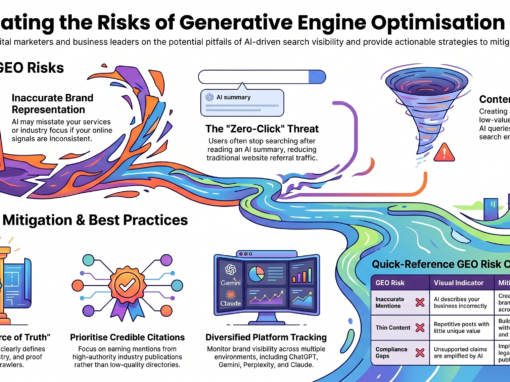
GEO Risk Checklist
| GEO Risk | What It Looks Like | How to Avoid It |
|---|---|---|
| Inaccurate AI mentions | AI tools describe your business incorrectly | Create consistent brand and service messaging |
| Thin content | Many similar posts with little unique value | Build useful content clusters with clear search intent |
| Ignoring SEO | Pages are hard to crawl, index, or understand | Maintain technical SEO and strong site structure |
| Weak citations | Brand appears on low quality or irrelevant sites | Focus on credible digital PR and authority signals |
| Traffic loss | Users get answers without clicking | Add templates, tools, examples, and conversion assets |
| Poor tracking | Reports show mentions but no business impact | Measure visibility, citations, leads, pipeline, and ROI |
| Platform dependence | Strategy focuses on only one AI tool | Track multiple AI and search environments |
| Compliance gaps | Unsupported claims get amplified | Use expert, legal, or compliance review where needed |
| Unrealistic expectations | GEO is treated as a quick win | Build a long term content and authority system |
How Shoden Global Communication Can Help Your Business
Shoden Global Communication helps businesses turn GEO from a risky experiment into a structured visibility system.
That means helping your business understand where it appears in AI answers today, where competitors are being recommended, which prompts matter most, and what content or citation gaps are holding you back.
Shoden Global Communication can support your business with:
- AI visibility audits
- GEO strategy
- LLM SEO
- Content planning and optimization
- Service page improvements
- GEO content clusters
- Internal linking strategy
- Digital PR and citation building
- AI answer tracking
- Competitor visibility analysis
- GEO KPI and ROI measurement
The goal is simple: make your brand easier to understand, easier to trust, and easier to recommend across search engines and AI answer platforms.
If your business wants to appear in more AI answers without relying on risky shortcuts, Shoden Global Communication can help you build the right foundation, improve the right pages, earn the right citations, and measure the results properly.
Frequently Asked Questions
Are there risks to using generative engine optimization?
Yes. The main risks of generative engine optimization include inaccurate AI mentions, thin content, poor measurement, low quality citations, reduced website clicks, and over reliance on one AI platform. These risks can be reduced with strong SEO foundations, credible content, clear brand messaging, and consistent tracking.
What are the downsides of GEO?
The biggest downside of GEO is that visibility does not always equal control. AI systems may summarize your brand incorrectly, cite outdated sources, or answer user questions without sending traffic to your site. A safe GEO strategy focuses on accuracy, authority, measurement, and content that gives users a reason to click.
Is generative engine optimization the same as traditional SEO?
No. Generative engine optimization and traditional SEO are closely related, but they are not identical. SEO focuses on search rankings, organic traffic, and technical visibility. GEO focuses on how your brand appears inside AI generated answers, citations, summaries, and recommendations. The best strategy combines both.
Answer engine optimization vs generative engine optimization: what is the difference?
Answer Engine Optimization, or AEO, focuses on getting content selected for direct answers, featured snippets, voice search, and answer based search experiences. Generative Engine Optimization, or GEO, focuses on visibility inside AI generated responses from platforms such as ChatGPT, Gemini, Perplexity, Claude, and Google AI Overviews. In practice, AEO and GEO overlap because both require clear, trusted, answer ready content.
Does generative engine optimization work for all types of websites?
GEO can help many types of websites, but the strategy should change based on the business model. B2B brands may need comparison content and thought leadership. Ecommerce sites may need product data and reviews. Local businesses may need location signals and service clarity. Regulated industries may need expert review and stronger compliance controls.
How do you measure the success of generative engine optimization campaigns?
How do you measure the ROI of generative engine optimization?
How do you measure the ROI of generative engine optimization?
To measure GEO ROI, compare the cost of GEO activity with the value of leads, pipeline, and revenue influenced by AI visibility. Since GEO may influence buyers before the final click, it is important to track assisted conversions, branded search growth, lead source notes, CRM data, and changes in sales conversations.
What are generative engine optimization best practices?
The best GEO practices include creating expert led content, answering real buyer questions, using clear page structure, improving technical SEO, building strong internal links, earning credible third-party mentions, updating content regularly, and tracking AI visibility over time.
How do you do GEO safely?
To do GEO safely, avoid shortcuts. Start with an AI visibility audit, identify important buyer prompts, improve core pages, build useful supporting content, strengthen internal links, earn credible citations, review claims for accuracy, and measure both visibility and business impact.
What are generative engine optimization services?
Generative engine optimization services help businesses improve visibility across AI answer engines and AI powered search experiences. These services may include AI visibility audits, GEO strategy, content optimization, technical SEO, digital PR, citation building, competitor analysis, and KPI reporting.
Final Thoughts
GEO can help your business become more visible in the places where buyers now research, compare, and make decisions.
But GEO is not risk free.
The wrong approach can create thin content, weak citations, inaccurate AI mentions, poor reporting, and wasted budget. The right approach builds clarity, authority, technical strength, useful content, and measurable business impact.
If you want GEO to work, do not chase hacks. Build a brand that AI systems can understand, cite, and trust.
Start with the generative engine optimization guide, apply proven GEO best practices, and track progress with a clear system for how to measure GEO success.


























PR Outreach: How to Pitch Journalists in 2026
August 10, 2026